Job-ready digital marketing skills are the specific, provable abilities that get a candidate shortlisted and hired, not just the general topics a course covers. The gap between the two explains why some graduates land a role in weeks while others with the same certificate wait months. This guide separates the two and shows what actually moves a hiring decision.
Key Takeaways
- HubSpot’s State of Marketing report, surveying 1,500-plus marketers, found hiring managers name finding candidates with the right skill set as their top challenge, even as 86.4% of teams already use AI.
- Indeed Hiring Lab found 49% of applications from workers with 10-plus years of experience went to entry-level roles, making up 30% of all entry-level applicants in its most recent monthly data.
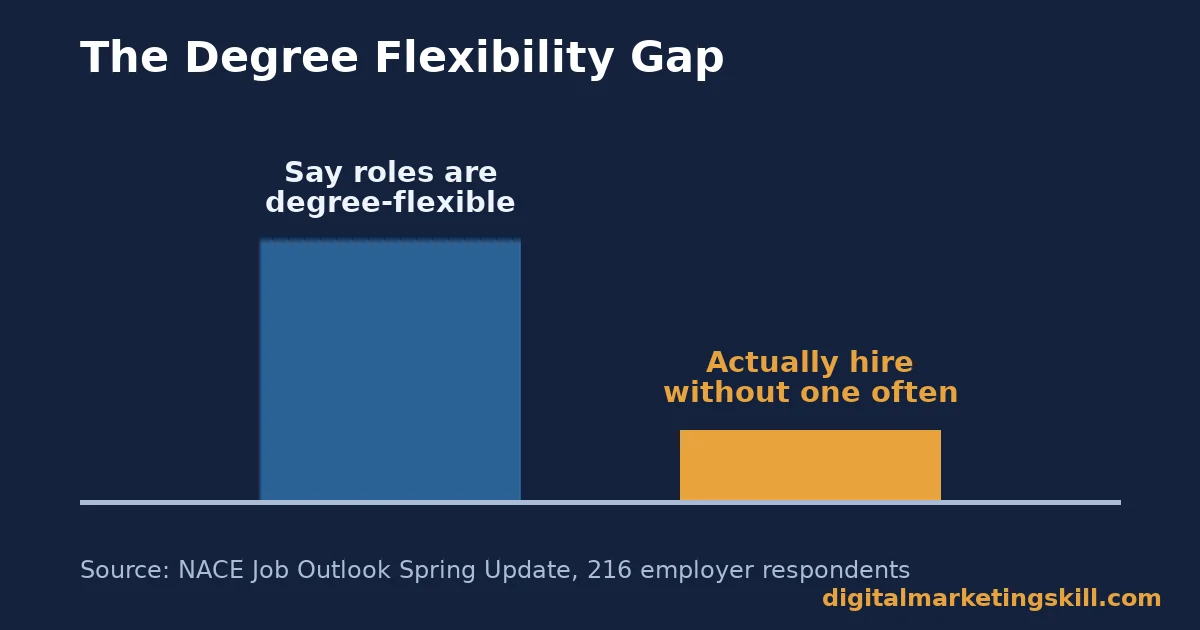
- NACE’s Job Outlook survey found about half of employers have roles flexible on degree requirements. Few actually hire a candidate without one, even then.
- Coursera reports 75% of Google Career Certificate graduates show a positive career outcome within six months. That figure includes promotions and raises, not only new jobs.
- Job-ready digital marketing skills are not one list. Technical skills, proof of work, communication and AI fluency each get judged differently. Treating them as one checklist is why strong candidates still get passed over.
In this guide
- The Gap Most Skills Lists Miss
- How Job-Ready Digital Marketing Skills Actually Work
- What Differs by Skill Type
- Job-Ready Digital Marketing Skills by Career Stage
- Build Each Skill Type This Way
- Mistakes That Undo Job-Ready Digital Marketing Skills
- How to Know Your Job-Ready Digital Marketing Skills Are Working
- Why This Matters More Right Now
- The One Decision Rule
- Tools Change. Fundamentals Do Not.
- What Doing This Right Looks Like
- Frequently Asked Questions About Job-Ready Digital Marketing Skills
- Put This Into Practice
The Gap Most Skills Lists Miss
Most “skills you need” lists name the same ten topics. SEO, social media, email, content, analytics. The list is accurate, but it treats every skill as equally visible to a hiring manager. It is not.
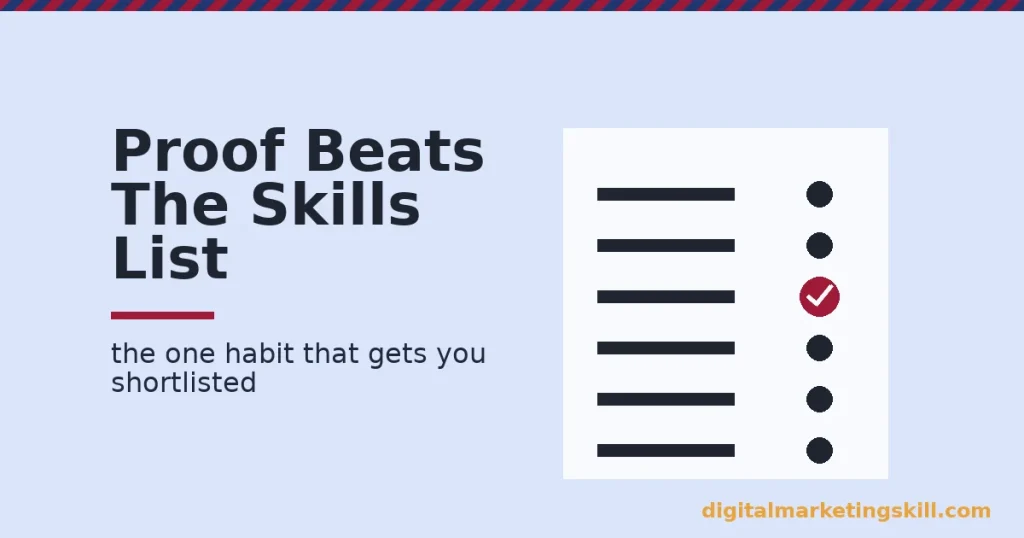
This guide narrows the focus to what a hiring manager actually checks: whether you can prove a skill, not just name it. Naming SEO on a resume costs nothing. Showing a page you optimized, and the traffic change it produced, is what gets a callback.
Our guide to the digital marketing career path covers the broader route. This guide stays narrow on the skills themselves and how to prove each one.
Two ground rules apply. First, the hiring data below comes from broad surveys, not a guarantee for any one application. Treat it as direction, not a promise. Second, this guide makes no income or job promises. Outcomes vary by market, effort and timing. Nothing here replaces real, demonstrated work.
This guide is for anyone entering digital marketing, whether straight from school, switching careers, or upskilling in a current role. The proof-of-work principle applies the same way in each case.
It also applies at every stage of a career, not just the first job. The skills that get you hired at twenty-two are the same skills that get you promoted at thirty-two, proven at a larger scale each time. The proof just gets bigger as the role does.
How Job-Ready Digital Marketing Skills Actually Work
HubSpot’s State of Marketing report ranks three skills as the highest priority: AI and automation fluency, cross-organizational communication, and data and analytics. The same report states plainly that “finding candidates with the right skill set” is hiring managers’ top challenge.
That gap between what employers want and what they can find is the entire mechanism. A skill only counts as job-ready once an employer can verify it exists, quickly, without taking your word for it. Listing “SEO” on a CV does not verify anything. A before-and-after ranking screenshot does.
LinkedIn’s Skills on the Rise research ranks performance analysis, AI literacy and social media branding as the fastest-growing marketing skills. The ranking is based on the hiring outcomes of people who already landed roles in the past year, not on what people merely claim to know.
Why a Degree or Certificate Alone Falls Short
NACE’s Job Outlook Spring Update, surveying 216 employer respondents, found about half of employers have roles flexible on degree requirements. Most trade one year of experience for one year of education. Even so, the same survey notes few employers actually hire a candidate without a degree more than a quarter of the time, even where the policy exists.
The lesson is not that credentials are worthless. A credential opens a conversation. Proof of work is what closes it. Job-ready digital marketing skills combine both, with proof carrying the heavier weight.
A certificate without a project behind it reads as potential, not performance. Employers have seen enough certificates that the paper alone rarely moves a decision on its own anymore.
What Differs by Skill Type
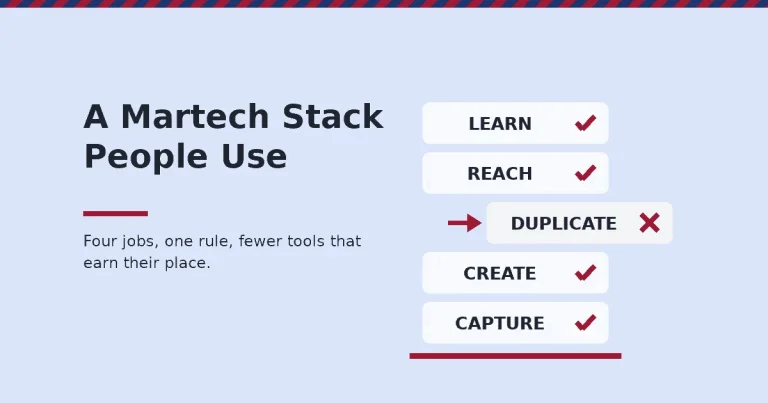
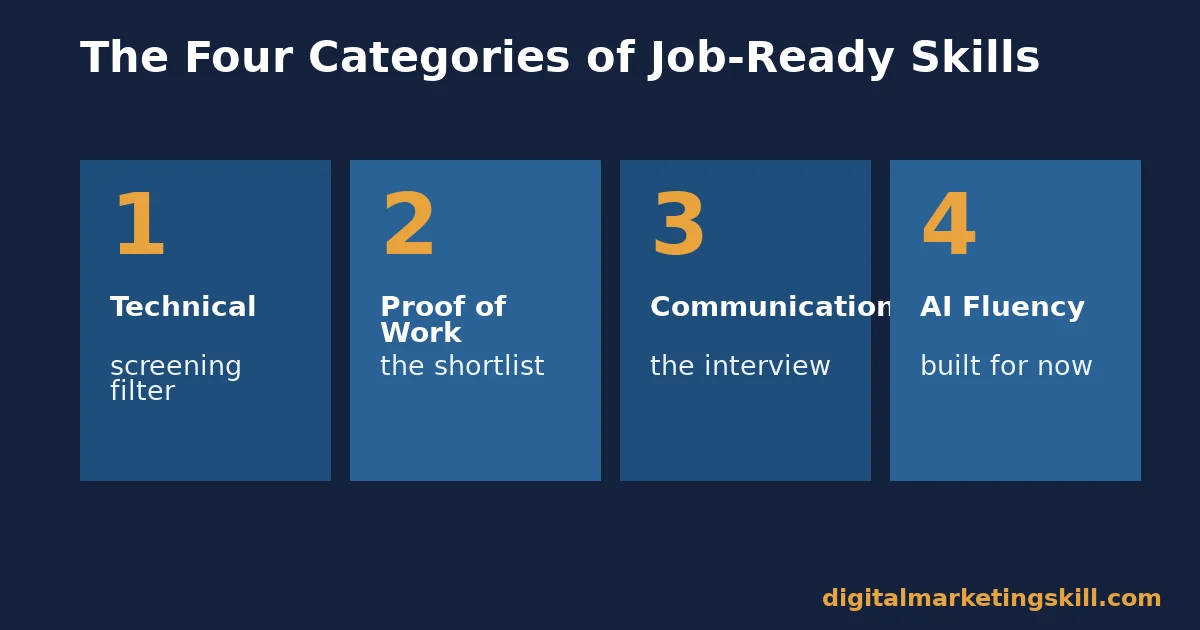
Four categories make up job-ready digital marketing skills. Each one gets evaluated differently by whoever is hiring.
Technical Skills: Built for the Screening Filter
SEO, paid ads, email platforms and analytics tools are what gets a resume past an automated or junior-level screen. They are necessary, but they are the baseline every applicant claims. They rarely decide a close call on their own.
Proof of Work: Built for the Shortlist
A real campaign, a case study, or a before-and-after metric is what moves a candidate from “plausible” to “shortlisted.” Proof of work is the one category a hiring manager cannot fake-check in thirty seconds, which is exactly why it carries so much weight.
Communication: Built for the Interview
Explaining why a campaign worked, in plain language, is what separates a candidate who executed a task from one who understood it. Technical skill gets you into the room. Clear explanation is what keeps you there. This matters just as much once hired, since explaining results to a manager is close to the habit covered in our guide to customer relationship management.
AI Fluency: Built for Right Now
HubSpot’s report found 86.4% of marketing teams already use AI in at least some areas, and only 1.7% have no plans to. A candidate who can show how they used an AI tool to do real work, not just that they have “used ChatGPT,” reads as current rather than generic.
Job-Ready Digital Marketing Skills by Career Stage
The four categories stay the same at every stage. What changes is which one needs the most attention right now.
A student or new graduate usually has technical knowledge but almost no proof of work. So the first project matters more than a sixth certificate, because it is the first thing a hiring manager can actually check.
A career switcher often has strong communication skills from a different field, but no marketing-specific proof yet. Because of that, the fastest path is usually one focused project, not a long course list. That one project, done well, can carry more weight than years of unrelated experience.
Someone already working in marketing, looking to move up, typically has proof of work already. For them, AI fluency and the ability to explain impact to leadership are usually the weakest link, so that is where to invest next. In other words, the next skill to build is rarely the one that feels most comfortable to practice, which is exactly why it gets skipped so often.
Build Each Skill Type This Way
Understanding the four categories only matters if it changes what you build first. Here is the specific move for each one.
Technical Skills: Lead With One Deep Area, Not Ten Shallow Ones
Pick one lane, such as SEO or paid social, and go deep enough to explain the mechanism, not just the steps. A hiring manager testing depth will ask “why,” not “what.” Shallow knowledge shows immediately under that question. Our SEO expert guide covers what real depth looks like in one lane, if that is the one you choose.
Proof of Work: Lead With a Real or Volunteer Project
Run a real campaign for a small business, a nonprofit, or even your own project. Document the before-and-after numbers honestly. One documented project with real, modest results outperforms five vague bullet points claiming expertise.
Communication: Lead With a Plain-Language Case Study
Write up your project in three parts: the problem, what you changed, and what happened. Keep it short enough that a busy hiring manager reads the whole thing. This single document does more work than most resumes.
AI Fluency: Lead With a Specific Workflow
Describe one real workflow where AI tools sped up research, drafting or data analysis, and what you double-checked before shipping it. A specific workflow reads as current skill. A vague mention of AI tools reads as keyword-stuffing.
Mistakes That Undo Job-Ready Digital Marketing Skills
Four mistakes quietly cancel out otherwise strong job-ready digital marketing skills. Each one is easy to fix once you see it.
Listing Every Tool You Have Ever Touched
A resume claiming twenty tools and platforms reads as unfocused, not capable. Hiring managers trust depth in three or four areas more than a shallow pass through twenty. A long tool list also invites questions you cannot answer in depth, which hurts more than a shorter, honest list ever would.
Describing Work Without a Single Number
“Managed social media accounts” says nothing. “Grew engagement 40% over three months on two accounts” says everything. Numbers are what make a claim checkable, and checkable claims are what get believed.
Treating AI Skill as a One-Time Box to Check
Mentioning AI once, in passing, does not demonstrate fluency. With 86.4% of teams already using AI tools, a single vague mention reads as behind the curve, not ahead of it.
Relying on the Credential to Speak for Itself
NACE’s research shows even employers with degree-flexible roles rarely hire without one. Betting entirely on a certificate, with no project behind it, ignores how cautiously most employers actually use that flexibility. Treat the certificate as the entry ticket, not the proof itself.
How to Know Your Job-Ready Digital Marketing Skills Are Working
Four signals tell you whether your skills have crossed from “listed” to job-ready. None require a hiring manager’s feedback to check.
- Can you show it in under a minute. If a skill takes more than a minute to demonstrate with a real artifact, it is not yet proof of work. It is still a claim.
- Interview callback rate. If applications go out but interviews rarely follow, the resume is not translating skills into proof a screener can verify quickly.
- Depth under follow-up questions. Practice explaining “why” behind any skill on your resume. If you run out of explanation fast, the skill needs more real practice before it is interview-ready.
- Recency of your AI workflow example. If your best AI example is more than a few months old, refresh it. This space moves fast enough that stale examples read as out of date.
The One-Row Habit
After each application or interview, write one row. Note what was asked, what you could prove, and what you could not.
After a handful of rows, the gaps become obvious. They tell you exactly what to build next, instead of guessing at a fifth skill to add to the list. So the habit replaces guesswork with a short, specific list of real gaps, which is far easier to act on than a vague feeling that something is missing.
Why This Matters More Right Now
HubSpot’s report found 73% of marketers face higher budget scrutiny than before, and most companies do not plan to add significant marketing headcount. So every open role gets more applicants, and each hire has to justify their cost more clearly.
That pressure flows straight into what counts as job-ready digital marketing skills. A hiring manager under budget scrutiny cannot afford to guess. They need proof, fast, because a wrong hire costs more when headcount is already tight.
This is not a reason to panic. It is a reason to invest in proof of work before you need it, rather than scrambling to build it during a job search. The candidates who already have it move through a tighter market faster than those still building their first example.
The One Decision Rule
If you can only build one thing before your next application, build one documented project with real, verifiable numbers. It beats adding a fourth or fifth skill to a list nobody can check.
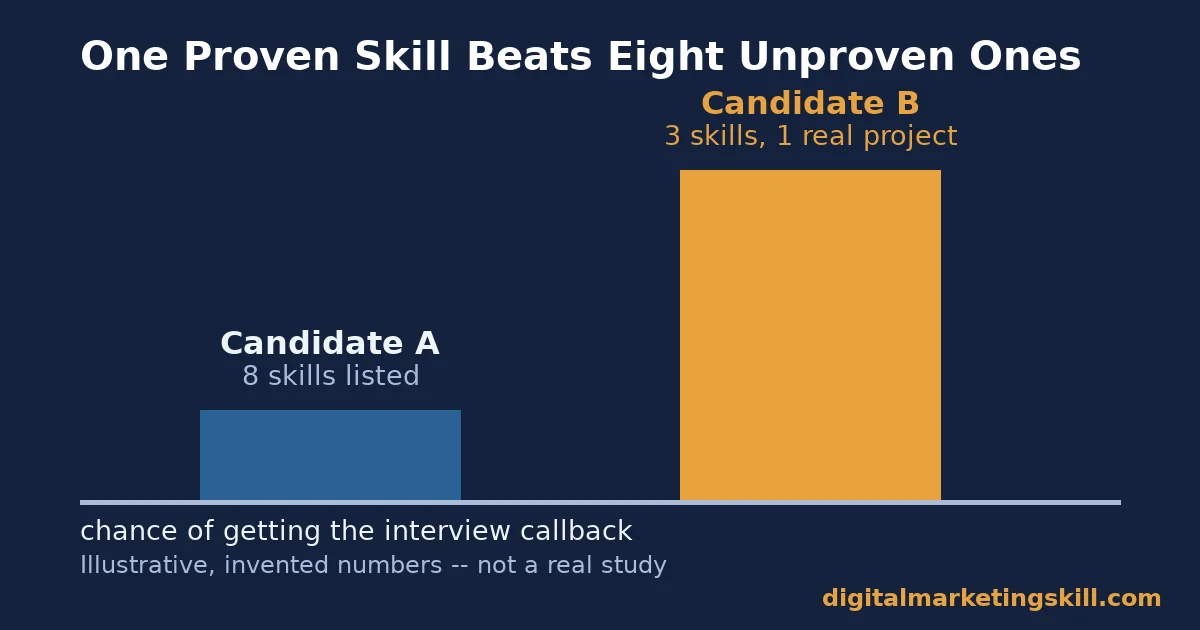
Here is an illustrative, invented example to show the logic, not a real case. Two candidates apply for the same entry-level role.
Candidate A lists eight skills with no evidence. Candidate B lists three skills and attaches one real project with a before-and-after result. Despite the shorter list, Candidate B gets the callback. The hiring manager can verify one claim in seconds instead of guessing at eight.
Tools Change. Fundamentals Do Not.
The specific AI tool, ad platform or analytics dashboard you learn today will change within a few years. That is normal, and it is not a reason to avoid learning tools now.
What makes job-ready digital marketing skills durable is the fundamental underneath the tool. Understanding why an audience responds to one message over another outlasts any specific platform. Knowing how to read a conversion funnel outlasts any specific dashboard. These fundamentals are also what transfer cleanly from one employer to the next, which is why interviewers probe for them specifically.
When you learn a new tool, ask what fundamental it is teaching you, not just which buttons to click. That habit is what keeps job-ready digital marketing skills current years after the tool itself has been replaced.
What Doing This Right Looks Like
Digital Marketing Skill Institute publishes student outcomes directly from graduates. One, Kofi B., writes: “What won me the remote role in Canada was my AI marketing knowledge. I could do the work of a 3-person team. My location became irrelevant.”
The honest limit: this is a self-reported testimonial, not an independently audited outcome. It does not name the employer or give a timeframe. No outside source confirmed the details, so read it as one graduate’s account, not a typical guarantee.
What it still shows clearly is the mechanism this guide describes. A specific, demonstrable skill, not a generic list, is what the graduate credits with winning the role. Location became irrelevant because the skill itself did the convincing, not a resume line claiming it.
Frequently Asked Questions About Job-Ready Digital Marketing Skills
Which digital marketing skill should I learn first?
Pick one with clear, measurable output, such as SEO or paid social, so you can build a documented project quickly. A skill you can prove within weeks beats a broader list you cannot yet demonstrate. Our guide on how to become a social media expert covers what deep, provable skill looks like in that lane specifically.
Do I need a degree to get hired in digital marketing?
Not always. NACE’s research found about half of employers have some roles flexible on degree requirements, though few hire without one often. A strong portfolio improves your odds regardless of your education path.
Does AI replace the need to learn core marketing skills?
No. HubSpot’s data shows 86.4% of teams already use AI, which raises the bar rather than lowering it. Employers now expect both the core skill and the ability to use AI to do that skill faster.
How do I build proof of work with no job yet?
Run a real campaign for a small business, a nonprofit, or a project of your own. Document the result honestly, including modest ones. A real, small result beats a hypothetical big one every time.
Why does entry-level hiring feel so competitive?
Indeed Hiring Lab found experienced workers made up 30% of all entry-level applicants in its latest data, with almost half of their applications going to entry-level roles. You are often competing with people who have years of experience, which is exactly why proof of work matters more than a skills list.
How many skills should I list on a resume?
Fewer, proven skills beat a long, unverifiable list. Three to five skills, each backed by a real example, read as more credible than ten skills with no evidence behind them.
Does this apply to someone switching careers into marketing?
Yes, and proof of work matters even more for a career switcher, because there is no marketing job history to lean on. One real project, built from scratch, does more to close that gap than any certificate alone. Job-ready digital marketing skills do not require a marketing background to start building; they require one honest project.
What actually counts as proof of a digital marketing skill?
Anything a hiring manager can check in under a minute: a live page, a before-and-after metric, a short case study, or a real campaign report. A claim they have to take on trust does not count, no matter how accurate it is.
Put This Into Practice
Start with the one decision rule above. This week, pick one skill and build one real, documented project around it, even a small one. Write it up in three plain sentences: the problem, the change, the result.
Keep the project honest, even if the result is modest. A small, real result you can defend under questioning will always beat a bigger claim you cannot explain. That single habit, repeated once a month, is what quietly turns a skills list into job-ready digital marketing skills over a year.
If you want a structured path that builds job-ready digital marketing skills with real project work, not just theory, the Master Diploma in Digital & AI Marketing at Digital Marketing Skill Institute covers it inside a wider curriculum. It runs ten practical courses across four tracks, with unlimited one-on-one coaching and real project work inside a U.S. partner company.
The diploma carries dual US and UK accreditation, known in more than 100 countries. It runs 100% online, so you can build these skills from anywhere in your country.
See the full Master Diploma programme, browse more guides on the digital marketing blog, or read more outcomes on the student reviews page. Every guide referenced here lives on the Digital Marketing Skill Institute site. Apply to the programme when ready, or start this week by building the one project above.
Every figure in this guide was checked against its original source before publication. Figures marked as illustrative are invented examples, not real results.
![9 Amazing Digital Marketing Skills to Make Money Online [With Proof]](https://digitalmarketingskill.com/wp-content/uploads/2019/07/9-Amazing-Digital-Marketing-Skills-to-Make-Money-Online-With-Proof-17.png)