
The best digital marketing courses are not the ones with the longest syllabus. They are not the cheapest ones either. The best digital marketing courses are structured so you actually finish them. They leave you with proof you can show an employer or a client. Cohort-based, mentored courses finish at roughly double the rate of self-paced ones. That one difference matters more than curriculum length.
Key Takeaways
- Scheduled, cohort-based courses finish at 53.4%. That is nearly double the 41.9% rate for self-paced courses. The figures come from a Ruzuku study of 26,632 courses and 1.3 million enrollments.
- Learners who complete one lesson in their first week finish the whole course 78.3% of the time. Learners who stall early finish only 17.2% of the time (Ruzuku).
- Employers posted 64,900 digital marketing job openings in a single recent year in the US alone. Marketing managers earn a median $166,790 a year, well above the national average wage (Robert Half; U.S. Bureau of Labor Statistics).
- 52% of marketing and creative leaders say skill shortages have already delayed real projects in the past year. 45% say finding skilled people has gotten harder (Robert Half).
- Performance analysis has overtaken AI literacy as the single fastest-growing marketing skill. The ability to measure a campaign now outranks simply knowing AI tools exist (LinkedIn Skills on the Rise, via Social Media Today).
In this guide
- Why Most “Best Digital Marketing Courses” Lists Mislead You
- Why Course Structure Decides The Outcome, Not Content
- What Actually Differs Between Course Types
- How To Get The Most Out Of Whichever Format You Pick
- How To Measure A Course Before You Pay For It
- Red Flags To Watch For When Comparing The Best Digital Marketing Courses
- The One Decision Rule For Choosing Between Courses
- A Real Case: Turning One Course Skill Into Paid Client Work
- Frequently Asked Questions About The Best Digital Marketing Courses
- Choosing Your Next Step
Why Most “Best Digital Marketing Courses” Lists Mislead You
Most roundups of the best digital marketing courses rank by price. Others rank by how many modules a syllabus lists. Both approaches make the wrong comparison. After all, a syllabus only tells you what a course covers. It tells you nothing about whether you will finish it. It tells you even less about whether finishing it gives an employer anything real to evaluate.
This guide compares course types using published completion and hiring data, not brand names. Treat the figures below as a snapshot, not a permanent scoreboard, since course platforms change their formats often.
The Ground Rule For Any “Best Courses” List
A course only earns the label “good” if it does two things. First, it has a structure that gets a realistic share of enrollees to the end. Second, it ends with something concrete, a campaign, a page, a portfolio piece, that a hiring manager can actually look at. Therefore, price is secondary to both of those, not the deciding factor most lists treat it as.
Why Course Structure Decides The Outcome, Not Content
Digital marketing content is not scarce. The mechanics behind the four skill families employers actually hire for, SEO, paid ads, email flows and social campaigns, are documented for free across thousands of blog posts and videos. What is scarce is a structure that turns watching into doing. Demand for people who can actually do the work keeps climbing. U.S. employers posted 64,900 digital marketing roles in a single year, Robert Half reports. Marketing managers earn a median $166,790 a year. That figure comes from the U.S. Bureau of Labor Statistics. For that reason, a course that only teaches theory is solving the wrong half of the problem.
The Completion-Rate Evidence
A Ruzuku study of 26,632 online courses and 1.3 million enrollments found that scheduled, cohort-based courses complete at 53.4%. Open-access, self-paced courses on comparable material complete at only 41.9%. The same research found an even sharper early signal. Learners who finish a single lesson within their first week go on to complete the full course 78.3% of the time. Learners who do not engage in week one finish only 17.2% of the time.
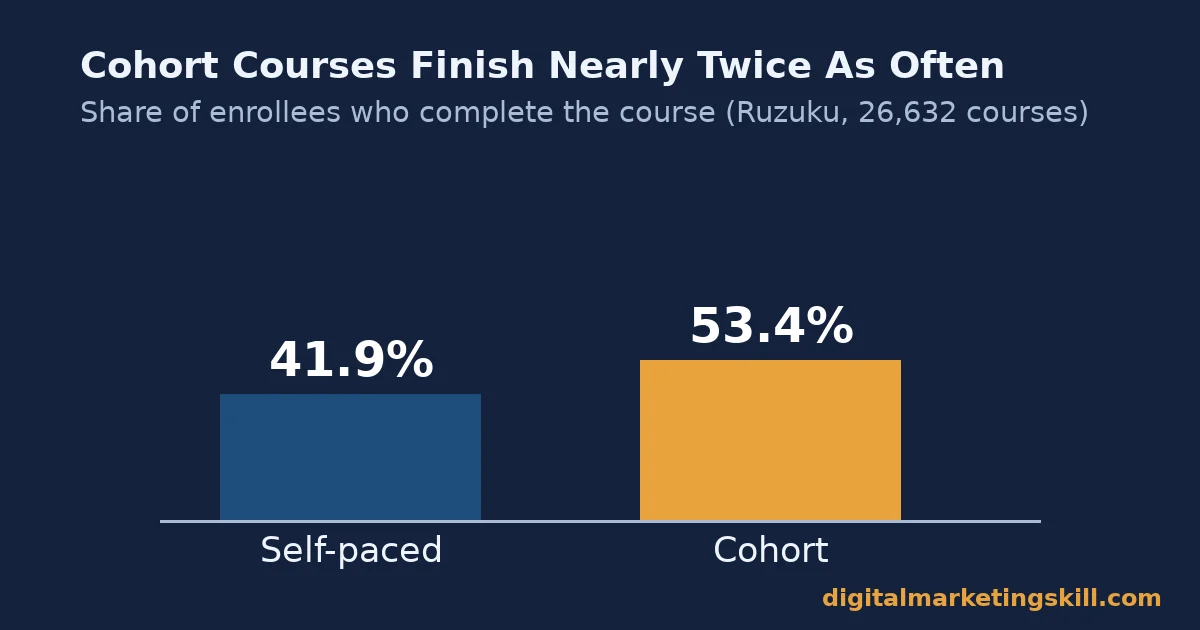
That gap exists for a simple reason. A cohort adds three things a self-paced library cannot: a visible peer group, a scheduled deadline, and an instructor who responds inside the course itself. None of those three things require more content. They require a different structure wrapped around the same content. That is why “more modules” is a weak filter when you compare the best digital marketing courses, and “does it have a start date, a cohort, and a mentor who actually replies” is a strong one.
What Actually Differs Between Course Types
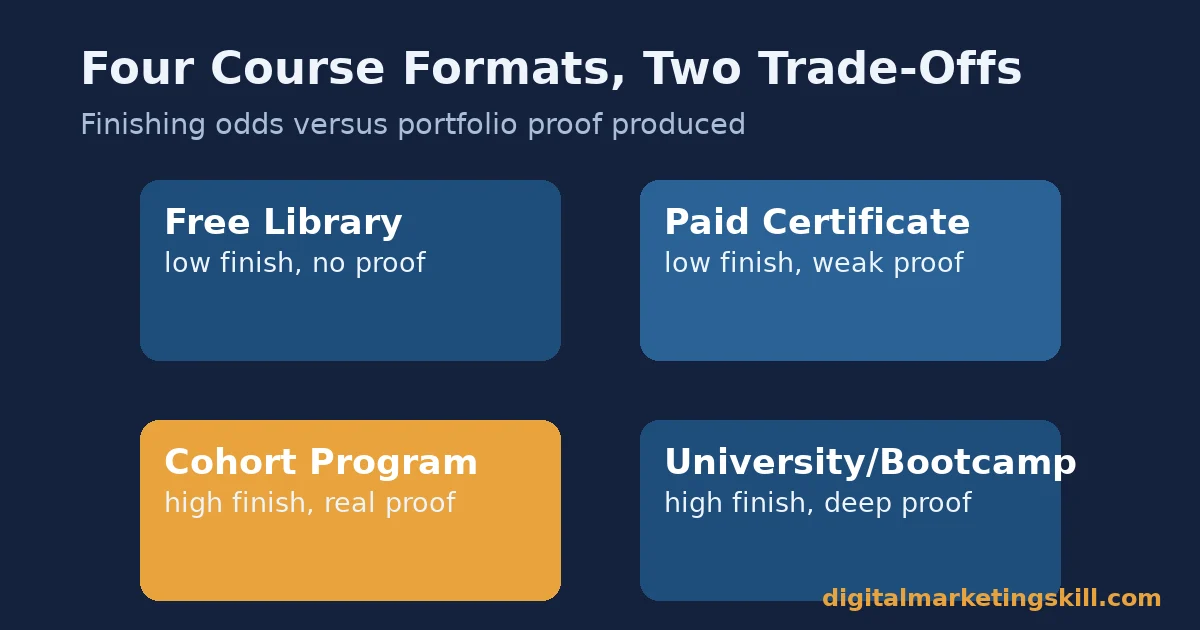
Four formats cover almost every digital marketing course on the market today. Each one trades completion odds and portfolio evidence differently. Knowing which trade-off you are making is the real skill in choosing among the best digital marketing courses.
Free Self-Paced Libraries: Built For Browsing, Not Finishing
Free, self-paced video libraries are the easiest entry point. However, they are also the easiest to abandon, since there is no cohort, usually no deadline, and rarely any project review. For that reason, the 41.9% self-paced completion average above is likely an optimistic ceiling for free content specifically. Paid self-paced courses at least carry a small sunk-cost nudge that free ones do not.
Free libraries are genuinely useful for one thing: testing whether a topic, say, paid search or email automation, actually holds your interest before you spend money or months on it. They are a poor primary path if your goal is a finished portfolio piece or a job within a set timeframe.
Paid Self-Paced Certificates: Built For Credentialing, Not Proof
Paid self-paced certificates add structured lessons and a certificate on completion. That certificate helps a resume pass an automated filter. But these courses still lack the cohort and live-feedback loop that drives the completion gap above, so paying money does not make that finishing-rate problem disappear on its own.
The deeper issue is simple. A certificate alone answers “did you watch the material,” but it does not answer “can you do the work.” Instead, hiring managers increasingly weight demonstrated, job-ready skills over credential count when the two are compared side by side during screening.
Cohort-Based Mentored Programs: Built For Finishing And Proof
Cohort-based programs schedule fixed start dates. They also group learners together, and they pair each learner with a mentor who reviews real work inside the course. As a result, this structure is behind both the 53.4% completion figure and the 78.3% early-momentum figure cited above.
The stronger version of this format also builds in a real or client-style project. That means completion produces a specific, reviewable artifact, a live campaign, a published page, a managed ad account, rather than only a certificate. This is usually the closest match to what people actually mean when they ask for the best digital marketing courses for getting hired.
University Programs And Bootcamps: Built For Depth, Not Speed
Traditional marketing degrees and longer bootcamps go deeper into theory, and they often carry more external recognition too. However, they run for a year or more, and they cost substantially more than an online certificate or a cohort program.
These formats suit someone planning a long academic or agency-leadership track. They suit that person more than someone following a faster digital marketing career path built on a working portfolio within a few months.
How To Get The Most Out Of Whichever Format You Pick
Picking well from a list of the best digital marketing courses is only half the job. Using the format correctly is the other half. Here is how to lead with each one.
Free Libraries: Lead With A One-Week Trial, Then Commit Elsewhere
Use a free library for exactly one to two weeks on a single topic. Confirm genuine interest before motivation fades, then move to a structured format. Specialized freelance digital marketing rates GoLance puts at roughly $15 to $75 an hour on Upwork, depending on the specific skill, so it is worth confirming which skill you actually enjoy before you commit further. Treat the free trial as a filter, never as a finishing line.
Paid Self-Paced: Lead With A Self-Imposed Project And Deadline
If a paid self-paced certificate is your only option, manufacture the structure it lacks. First, pick a real or practice business, and set your own weekly deadline. Then publish each module’s output somewhere visible: a campaign brief, a draft page, or a short report. Even a personal portfolio page works well for this. That turns a certificate course into evidence, not just a credential.
Cohort Programs: Lead With The Schedule, Not The Curriculum List
When you compare cohort-based programs, ask three structural questions first. Ask them before you ask about topics covered. How often does a mentor respond to submitted work? Is there a fixed cohort start date? Does the program end in a specific project you keep? A program that answers all three well will usually beat a rival that instead offers a longer module list but a vague mentoring process.
University And Bootcamp: Lead With The Specific Outcome You Need
These programs are the largest time and money commitment on this list. Confirm that your specific goal, a license, an academic credential, a leadership track, actually requires that depth. Otherwise, do not default to the longest option. Price and length alone do not make a course one of the best digital marketing courses for your actual goal.
How To Measure A Course Before You Pay For It
Four numbers separate a genuinely good course from one that only looks good on its sales page. Each is defined in one plain sentence below.
- Completion rate: the share of enrolled learners who finish the course. Ask the provider directly, since most will not publish this number on their own.
- Project turnaround time: how many days pass between submitting work and getting specific, individual feedback on it, not a generic “great job.”
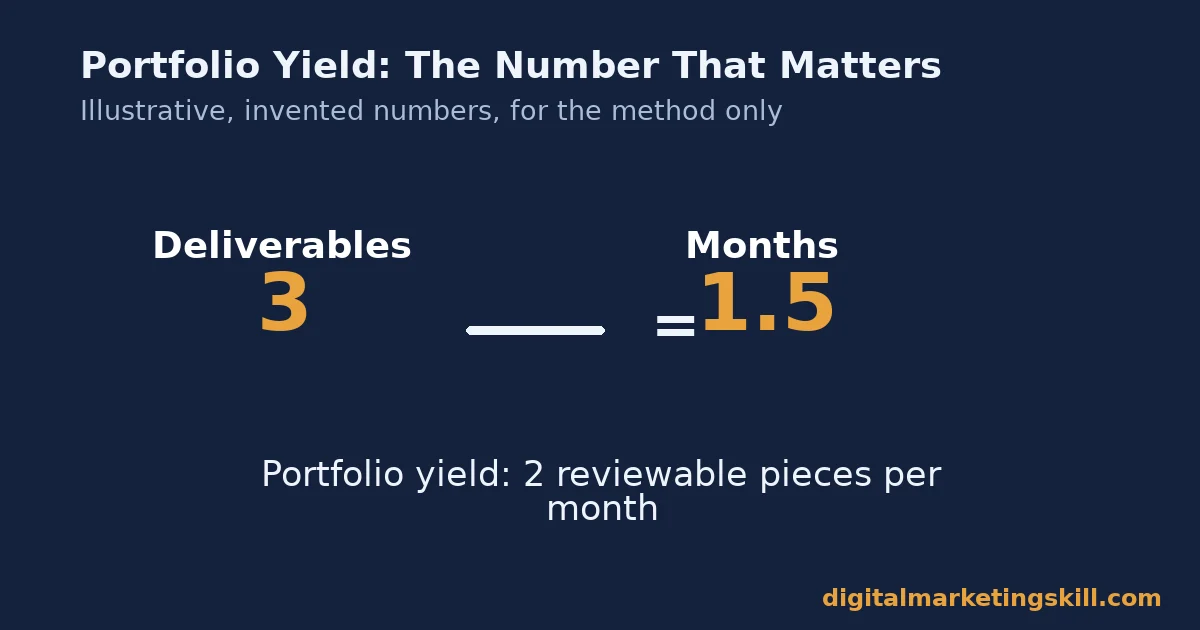
- Portfolio yield: the number of reviewable, named deliverables you walk away with, separate from the certificate itself. See how to build a marketing portfolio with no experience for what a strong deliverable actually looks like.
- Placement or outcome rate: the share of finishers who land a role, a client, or a measurable income result within a defined window, and whether that figure is self-reported or independently tracked.
Read all four numbers the same way: higher is better. A provider that will not answer the completion-rate question directly is answering it anyway, just not in words.
Red Flags To Watch For When Comparing The Best Digital Marketing Courses
Some warning signs show up again and again across weaker programs. Watch for these before you pay anything.
- No fixed start date. If you can “start anytime,” there is usually no cohort and no shared deadline, so the completion odds above tend to apply.
- Feedback that is generic. If sample feedback on submitted work reads like a template, for example “Great job, keep going,” rather than specific notes, assume the mentoring is thin.
- No named deliverable. If the sales page cannot describe one specific thing you will have built by the end, there is likely no real portfolio yield to measure.
- Outcome numbers with no source. A placement rate or income claim with no sample size, no time window, and no way to verify it is a marketing claim, not evidence. Compare it against a provider that publishes an honest earnings disclaimer instead, the way this guide’s real case does further down.
- Pressure to decide immediately. Scarcity countdowns and “last spot” messaging are sales tactics, not information about course quality, so treat them as noise when you are comparing the best digital marketing courses.
None of these red flags are fatal on their own. However, two or more together are a reasonably strong signal to keep looking.
The One Decision Rule For Choosing Between Courses
Decision rule: pick the course with the highest portfolio yield per month of your time, not the lowest price per module. A free course that produces zero reviewable deliverables after two months costs you more, in time, than a paid cohort that produces three deliverables in six weeks.
Illustrative, invented numbers, for the method only: Course A costs nothing and produces 0 portfolio pieces over 8 weeks. Its portfolio yield is 0 per month. Course B costs $400 and produces 3 portfolio pieces over 6 weeks. Its portfolio yield is 2 per month. Measured by time-to-proof rather than sticker price, Course B is actually the cheaper option. It converts your time into evidence an employer can check, and that evidence is the entire point of taking a course.
A Real Case: Turning One Course Skill Into Paid Client Work
Olajire Jacob, a graduate of the Digital Marketing Skill Institute’s program, described the transition this way in a published review: “Fresh from the course, I was charging an average of $500 to set up email marketing flows for clients in the US, UK & Ca. With the library of resources, templates and support at DMSI, I was able to expand my digital marketing services and scale to $5K/mo.”
This case shows the pattern described above, in practice. One specific, demonstrable skill, setting up email flows, turned into paid work almost immediately after the course. It then expanded with ongoing support. Individual results vary and are not typical or guaranteed. See the earnings disclaimer for context on how to read any student income result, including this one.
Frequently Asked Questions About The Best Digital Marketing Courses
What is the single best indicator that a digital marketing course is worth paying for?
Ask for its completion rate and its portfolio yield, meaning how many reviewable deliverables a finisher walks away with. If a course cannot or will not answer either question, it is a weaker bet than its sales page suggests.
Are free digital marketing courses worth starting with?
Yes, for a short trial of one to two weeks. Use that trial to confirm genuine interest in a specific skill, such as paid search or email marketing. Free courses are a poor primary path to a portfolio or a job, since they lack the cohort structure linked to higher completion.
Do certificates alone get you hired in digital marketing?
Rarely on their own. Certificates help a resume pass an initial filter, but hiring decisions increasingly come down to demonstrated project work instead. Because of this, a course that also produces reviewable deliverables alongside its certificate is always the stronger choice overall.
How long should a good digital marketing course take?
Long enough to produce at least one real deliverable. Short enough that you stay inside the high-completion early-momentum window described above. The clearest early signal is simple: finish a lesson in week one, and you are statistically likely to finish the whole course.
Is a cohort-based course always better than a self-paced one?
For completion odds, generally yes. Scheduled cohort courses finish at 53.4% against 41.9% for self-paced courses on similar material. That said, self-paced still suits someone who genuinely cannot commit to a fixed schedule, provided they build in their own deadlines and public outputs.
What digital marketing skill is most in demand right now?
Performance analysis, the ability to measure what a campaign actually did, has overtaken AI literacy as the fastest-growing marketing skill. Even so, AI literacy is now treated as a baseline expectation rather than a differentiator.
Can I complete a digital marketing course while working remotely from anywhere?
Yes. Most structured digital marketing programs today run fully online. More than 70 countries now offer a digital nomad visa, so a portable, verifiable skill from a course, like the ones taught at Digital Marketing Skill Institute, can support working from many places, once you can show real proof of the work and not just a certificate.
Why do so many “best digital marketing courses” rankings disagree with each other?
Most rankings weigh different things: price, brand recognition, or raw content volume. Very few publish completion rates or portfolio yield, which this guide treats as the real test instead. So two rankings can disagree simply because they are measuring different, unstated criteria.
Should I compare the best digital marketing courses by price per module?
No. Price per module measures content volume, not outcome. Measure portfolio yield per month instead, since that tracks how much usable proof the course actually produces for the time and money you put in.
What should I ask a course provider before enrolling?
Ask three direct questions: what is your completion rate, how many days does feedback on submitted work typically take, and what specific deliverable will I have by the end. A provider with a strong program answers all three without hesitation. That is exactly what separates the best digital marketing courses from the rest of the list.
Does the best digital marketing course for a beginner differ from one for someone changing careers?
Somewhat. A beginner usually benefits most from the trial-then-cohort path described above, since they still need to confirm which skill they enjoy. Someone changing careers already knows the target skill, so they can often skip the free trial and move straight into a cohort-based program with a named deliverable.
Choosing Your Next Step
If you want the structure described throughout this guide, cohort scheduling, mentor feedback on real work, and a finished project rather than only a certificate, the Master Diploma in Digital & AI Marketing at Digital Marketing Skill Institute is built around four AI-powered tracks. Those tracks are Social Media Management and Advertising, Lead Generation and Email Automation, Google Specialist, and WordPress and SEO Specialist. Together they total ten courses, with a Full Stack option for completing all four.
Every track includes unlimited one-on-one coaching and mentoring. Every track includes a U.S. Project Internship with a verified U.S. Work Reference Letter. Every track carries dual US and UK accreditation, recognised in more than 100 countries, 100% online, so you can study from anywhere in your country, or move to work from anywhere else, once you have the proof to show for it.
See the program tracks and structure, browse more student outcomes, or go straight to the application page to see current tracks. Whichever course you ultimately choose, wherever you live, measure it by what it makes you finish and what it lets you prove. Do not measure it by its module count alone.
Every figure in this guide was checked against its original source before publication. Figures marked as illustrative are invented examples, not real results.
![9 Amazing Digital Marketing Skills to Make Money Online [With Proof]](https://digitalmarketingskill.com/wp-content/uploads/2019/07/9-Amazing-Digital-Marketing-Skills-to-Make-Money-Online-With-Proof-17.png)






