A digital marketing career path usually runs through practical experience, not a job title search. Employers report real skills gaps. Interns convert to full-time hires at high rates, and job postings increasingly skip degree requirements, even though hiring itself has been slower to change. This guide covers the paths that actually work and how to measure your progress along them.
Key Takeaways
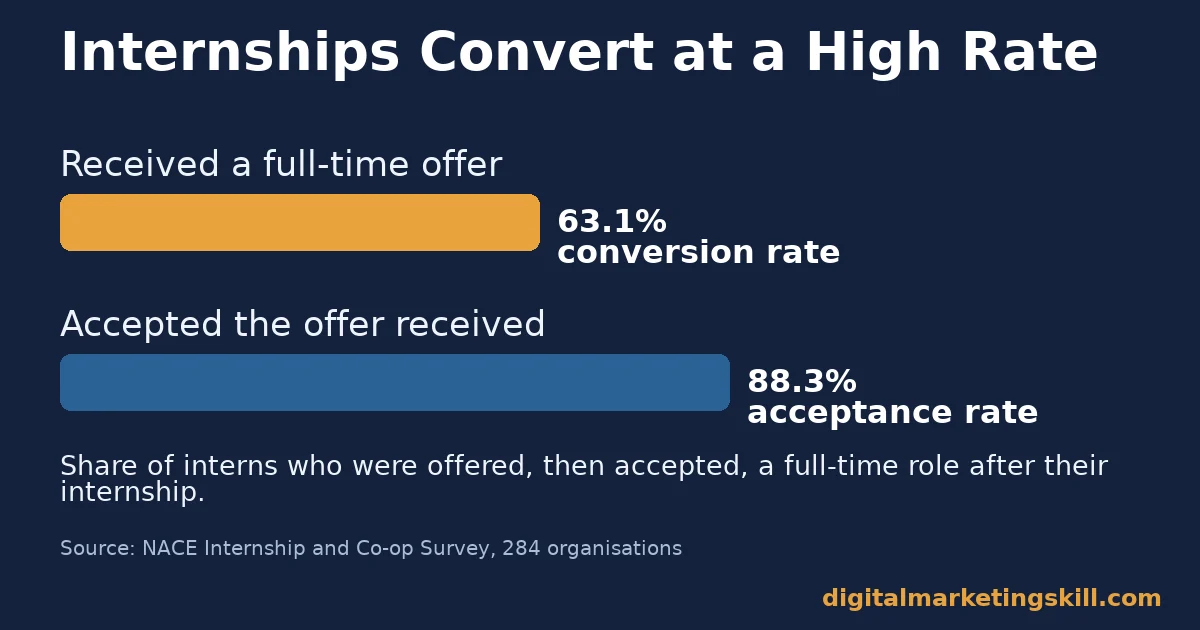
- Internships convert at a high rate. NACE’s most recent Internship and Co-op Survey of 284 organisations found 63.1% of interns received and accepted a full-time offer, the highest conversion rate in five years.
- Skills gaps are specific, not vague. Robert Half’s research found skills shortages delayed marketing analytics projects at 44% of organisations, customer experience work at 38%, and marketing automation at 37%.
- Degree requirements are easing, slowly. LinkedIn’s analysis found the share of paid job posts without a degree requirement grew from about 20% to almost 30% over a recent multi-year period, but actual hires grew far more slowly than postings.
- Demand keeps growing. The US Bureau of Labor Statistics projects 6% employment growth for advertising, promotions and marketing managers through the decade, with about 36,300 openings a year.
- A portfolio closes the gap a resume cannot. Where postings no longer require a degree, hiring managers still lean on demonstrated skills. That is exactly what a portfolio of real campaigns shows.
In this guide
- Why Most “How to Become a Digital Marketer” Advice Misses the Real Barrier
- What Actually Gets You Hired
- Three Proven Paths Into Digital Marketing Differ by What They Prove
- How to Build Each Path
- Five Mistakes That Undo a Digital Marketing Career Path
- How to Measure Progress on a Digital Marketing Career Path
- The Most Useful Rule: Finish One Real Project Before Chasing a Second Certificate
- A Four-Week Plan to Start Your Digital Marketing Career Path
- A Real Case: An Internship Placement That Turned Into a Fast Job Offer
- Frequently Asked Questions About a Digital Marketing Career Path
- Start With One Real Project, Then Apply
Why Most “How to Become a Digital Marketer” Advice Misses the Real Barrier
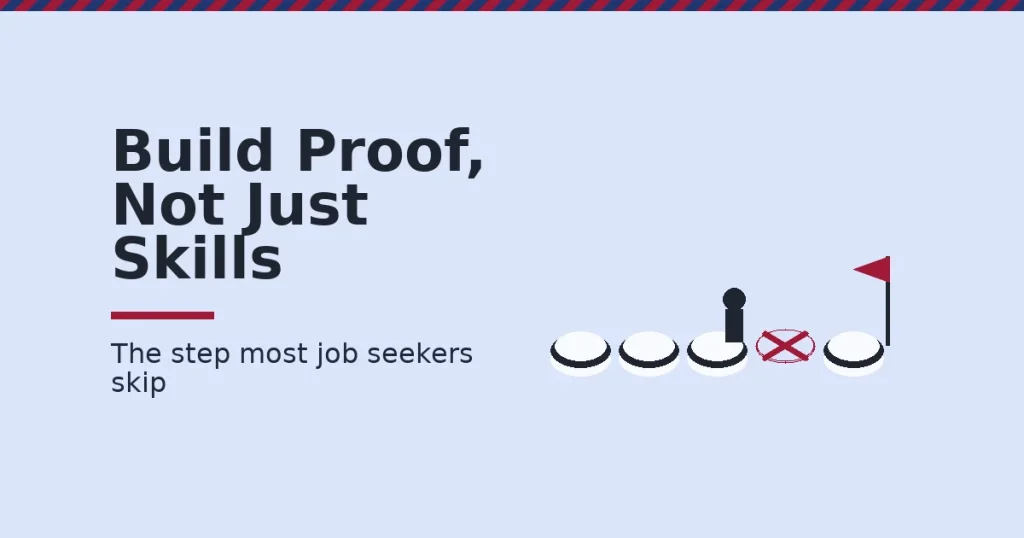
Most advice on starting a digital marketing career path lists channels to learn: SEO, paid ads, email, social. Learning the channels matters, but it is not what stalls most beginners. The real barrier is proof. Employers cannot tell a prepared candidate from an unprepared one without evidence.
That is why internships, portfolios and certifications matter more than another course on fundamentals. Each one gives an employer something to check instead of something to take on faith.
This distinction matters most for people switching careers or starting without a marketing degree. A related field, such as sales, customer support or writing, already teaches transferable skills. It rarely comes with marketing-specific proof, though. Building that proof on purpose, rather than hoping a resume line implies it, is what actually moves a digital marketing career path forward.
Here are the ground rules. The hiring figures below mostly come from US surveys, so treat them as directional evidence rather than a global guarantee, and local job markets vary. The three-path framework in this guide is our own way to organise the options, an informed inference from the evidence, not a settled fact.
What Actually Gets You Hired
Hiring managers are not choosing between candidates who know digital marketing and candidates who do not. Most applicants have read the same guides. They are choosing between candidates who can show results and candidates who can only describe theory.
Two forces make this proof even more important right now. One is specific skills gaps inside marketing teams. The other is a slow shift toward judging skills over credentials. Neither force is unique to one country or industry. That is part of why a digital marketing career path travels reasonably well across borders, once you have real evidence to show.
Skills Are Starting to Matter More Than Degrees, on Paper
LinkedIn’s analysis of its own paid job postings found the share without a professional degree requirement grew from about 20% to almost 30% over a recent multi-year period. That sounds like an open door for self-taught candidates.
Read the next figure before celebrating. In tech, degree-less postings grew fastest. But actual hires without a degree grew only a few percentage points faster than hires with one. Postings changed faster than hiring managers did. The honest takeaway is that skills-based hiring is real but still catching up to its own marketing.
The Skills Gaps Are Specific, Not General
Robert Half’s research into skills shortages found they delayed real work: marketing analytics projects at 44% of organisations, customer experience and personalisation work at 38%, marketing automation at 37%, and AI integration at 37%. These are not entry-level mysteries. They are learnable, demonstrable skills.
You do not need to claim these skills. Show that you can build a simple automation flow or read a results dashboard, and you are solving a gap a hiring manager already has a name for. SHRM’s research, based on 1,688 HR professionals, found 79% say skills assessment scores matter as much as or more than traditional hiring criteria, which is exactly what a documented project demonstrates.
Demand for these roles is not shrinking either. The US Bureau of Labor Statistics projects 6% employment growth for advertising, promotions and marketing managers over the decade, with about 36,300 openings a year, US-specific but a useful directional signal. Combined with the skills gaps above, the opportunity is real even where competition for any single posting is tough.
Three Proven Paths Into Digital Marketing Differ by What They Prove
There is no single correct route in. The three paths below are the ones that consistently produce hires, and each proves something different to an employer.
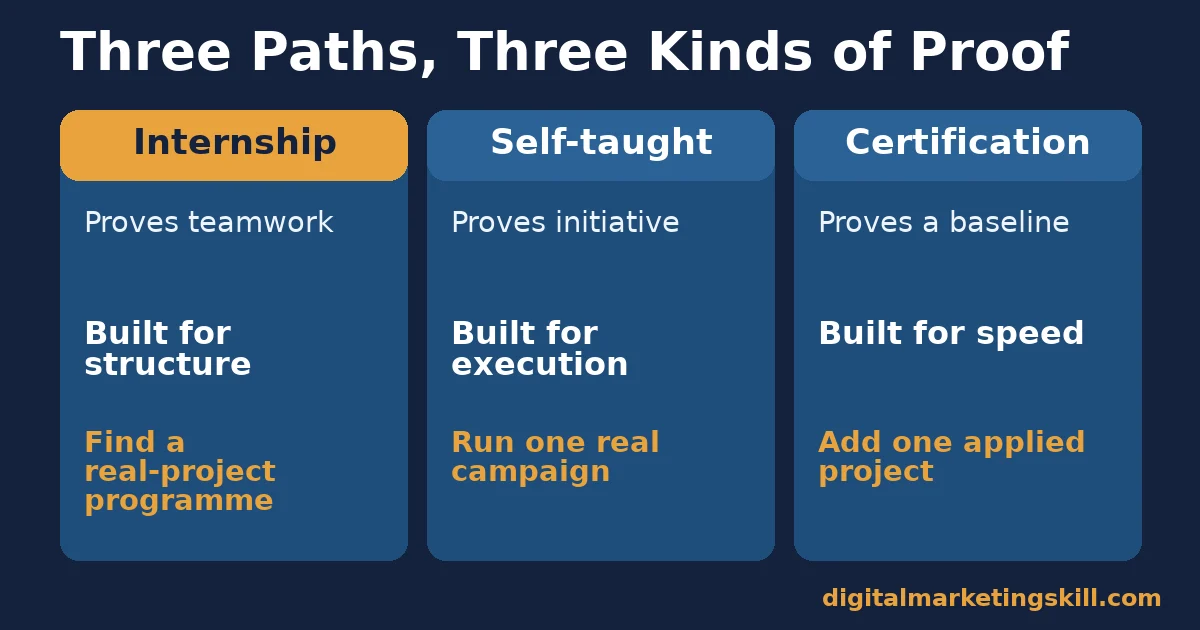
Internships: Built to Prove You Can Work on a Real Team
An internship proves you can take direction, hit a deadline and produce something inside someone else’s process. That is different from proving you know a channel. NACE’s data shows this path converts: 63.1% of interns in its most recent survey received and accepted a full-time offer, and acceptance itself reached 88.3%.
The catch is competition for placements. A structured programme with a defined curriculum and a real client project, rather than vague “exposure,” gives you something specific to describe afterward. Our guide to landing a digital marketing internship covers where to look and how to stand out.
Self-Taught With a Portfolio: Built to Prove You Can Execute Alone
A self-directed path proves initiative and hands-on ability without waiting for anyone’s permission. It works when the portfolio shows real campaigns, even small ones, with results, not just completed course certificates.
The catch is credibility. Anyone can claim they “learned SEO.” Few can show a page they optimised and the ranking or traffic change that followed. That specific evidence is exactly what hiring managers are short on.
Structured Certification: Built to Prove a Baseline, Fast
A certification proves you cleared a defined bar: a syllabus, an assessment, a pass mark. It is the fastest way to signal baseline competence to a stranger reading a resume for thirty seconds.
The catch is that a certificate alone rarely closes a specific skills gap like marketing automation or analytics. It works best paired with a project that proves you can apply what the certificate says you learned.
How to Build Each Path
Knowing the three paths is not the same as working one. Pick the path most available to you right now, and use the steps below to get more out of it.
Internships: Lead With a Programme That Has a Real Client Project
Apply to programmes that name a real internship placement and a specific assessment, not just “training.” Ask directly what you will have produced by the end, such as a live campaign or a documented project, before you enrol.
Once placed, document everything: the brief, your decisions, and the measurable outcome. That becomes your first portfolio piece and your first interview story.
Ask your supervisor, early on, whether you can keep a redacted version of the work after the placement ends, since some companies restrict what interns can take with them. If they cannot share exact figures, ask whether you can describe the result in relative terms instead, such as a percentage change rather than a raw number.
Self-Taught: Lead With One Small, Real Campaign
Pick one channel and run one small, real campaign, even for a friend’s business or a volunteer project, rather than a simulated exercise. A real audience and a real budget, however small, force real decisions. If you are still deciding how to begin, our guide to becoming a digital marketer covers the broader basics this path builds on.
Write up what happened: what you tried, what the numbers showed, and what you changed. That write-up is worth more in an interview than a list of tools you have used.
Certification: Lead With One Applied Project Alongside It
Choose a certification with a practical assessment component, not a multiple-choice quiz alone. While studying, apply each module to a real or sample business as you go, instead of finishing the course first and practising later.
By the time you finish, you should have both the certificate and a worked example to show for it. That answers the “can you actually do this” question before it is even asked.
Five Mistakes That Undo a Digital Marketing Career Path
Even motivated beginners on a digital marketing career path stall for avoidable reasons. Check your own search against this list, because most of them are easy to fix once you notice them.
- Collecting certificates instead of proof. A long list of course completions with no applied project answers a question nobody asked. Pick one and build something with it.
- Applying with a generic resume to every role. A resume that could belong to any candidate reads like one. Name the specific skills gap you can fill for each role. Our digital marketing resume guide covers how to lead with a specific project rather than a list of tools.
- Treating the portfolio as optional. Without evidence, a hiring manager has to take your word for it, and most will not. Build the portfolio before you need it.
- Ignoring the measurement side of the work. Marketers who cannot read their own results rarely get trusted with a budget. Learn to explain a dashboard, not just produce content.
- Giving up after one rejected path. One unsuccessful internship application does not rule out the self-taught or certification path. Most people who land a role tried more than one door.
Fix whichever mistake is slowing you down most before adding a new skill to learn. One completed, documented project usually does more for a job search than a fourth online course.
How to Measure Progress on a Digital Marketing Career Path
A job search along a digital marketing career path can feel like it produces no evidence until the offer arrives. However, tracking a few numbers shows you whether the search itself is working, well before that point.
Five Numbers Worth Tracking
- Applications sent. This is the raw volume of roles you have applied to in a period. Low volume alone can explain a quiet search.
- Response rate. This is the share of applications that get any reply. A very low rate usually points to the resume or targeting, not the interview skills.
- Interview rate. This is the share of applications that reach an interview. If response is fine but interviews are rare, the portfolio or resume content needs work.
- Offer rate. This is the share of interviews that produce an offer. A low rate here usually points to interview preparation or the strength of your project stories.
- Portfolio pieces completed. This is simply how many real, documented projects you can show right now. It is the number most within your direct control.
How to Read These Numbers Together
Read the numbers in order, from applications to offer, to find where your search is actually stalling. A high response rate but few interviews often means the portfolio is not convincing once someone looks. Many interviews but no offers usually means the story around your projects, not the projects themselves, needs work.
Do not judge the search after a handful of applications. Give each stage enough volume to be meaningful before changing your approach.
A weekly check works better than a daily one for a digital marketing career path search. Checking daily invites you to overreact to normal noise, such as one quiet week after a holiday or a role closing early. A weekly review, on a fixed day, shows the real trend instead.
Keep a simple log rather than relying on memory. A spreadsheet with one row per application works well: the date, the role, and which stage it reached. It takes a few minutes to update, and it turns a vague feeling about the search into numbers you can actually read.
The Most Useful Rule: Finish One Real Project Before Chasing a Second Certificate
If you remember one decision rule from this guide, make it this one. Before enrolling in another course, finish and document one real project on your current path, whether that is an internship task, a self-run campaign, or a certification’s applied assignment.
Here is an illustrative example, with invented numbers. A career changer applies to 40 roles over two months with no completed portfolio project and gets two interviews and no offers. They pause new applications, spend three weeks finishing one documented email campaign for a local business, then resume applying. Over the next month, with a similar number of applications, interview rate roughly doubles and they receive an offer.
The lesson is about evidence, not effort. The same number of applications performed differently once there was something real behind them to discuss.
A Four-Week Plan to Start Your Digital Marketing Career Path
You do not need to wait for a formal programme to start proving yourself. This plan takes about an hour a day.
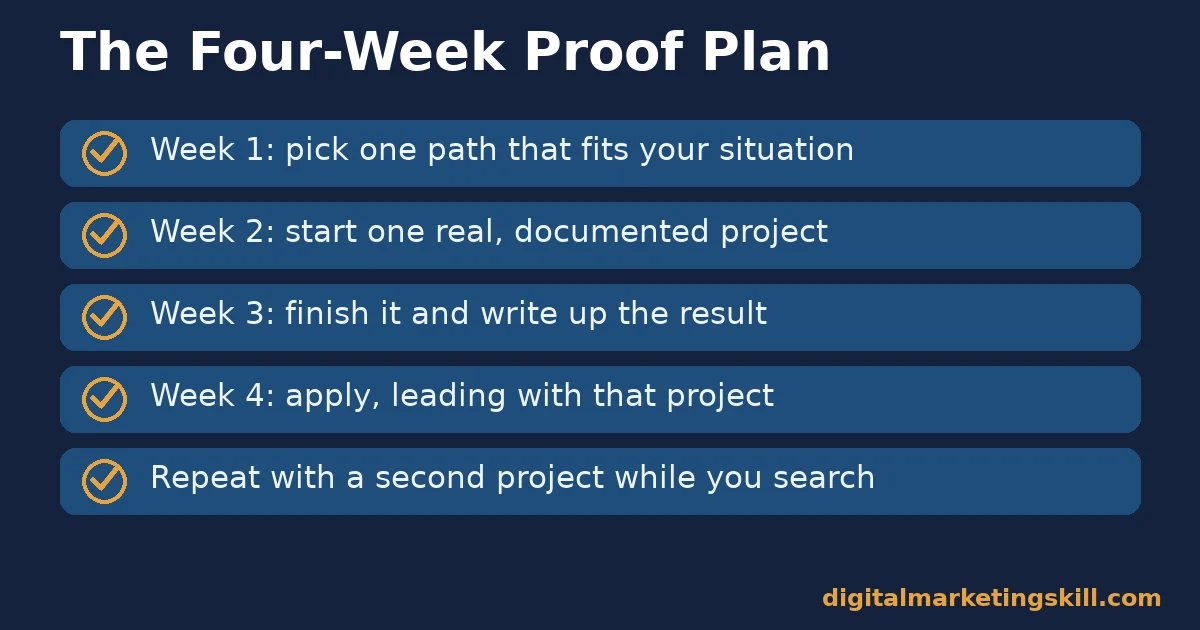
- Week one: pick one path. Choose internship, self-taught, or certification based on what is realistically available to you right now.
- Week two: start one real project. Begin a real campaign, internship task, or applied assignment, not a simulated exercise.
- Week three: finish and document it. Write up the brief, your decisions, and the measurable result, even a small one.
- Week four: apply with the evidence. Update your resume and outreach messages to lead with that specific project. Our guide to using LinkedIn for a job search covers how to message hiring managers and alumni directly.
At the end of the month, check your response and interview rate against before you had the project. Then start the next one.
A Real Case: An Internship Placement That Turned Into a Fast Job Offer
Harrison Acha, a Digital Marketing Skill Institute graduate, is one published example of a digital marketing career path working quickly. According to the Institute’s student success stories, Acha was recruited by a company to work on Facebook’s advertising business within weeks of starting training, after completing a structured programme rather than studying alone.
Keep the limits in mind. This is one published account, not an audited case study, and a fast outcome like this is not typical or guaranteed. Most people on a digital marketing career path will take longer, and that is normal. Read it as evidence that a structured, real-project path can move quickly for the right fit, not as a timeline to expect for yourself.
Frequently Asked Questions About a Digital Marketing Career Path
Do I need a degree to start a digital marketing career?
Not necessarily. A growing share of job postings do not require one, though hiring itself has moved more slowly than postings. A strong portfolio reduces how much the degree question matters either way.
Is an internship worth it if it is unpaid or low-paid?
Weigh it against what it proves for your digital marketing career path. A programme with a real client project and a documented outcome can be worth more to your search than a paid role with no portfolio-worthy work.
That said, it is a personal financial decision too, and nobody else can make it for you. If you do take an unpaid role, set a time limit for yourself in advance, so it stays a deliberate step rather than an open-ended wait.
How long does it take to start a digital marketing career from scratch?
It depends on your starting point and the path you choose, and timelines vary too much to promise a number. Focus on finishing one real, documented project rather than a calendar date.
Which digital marketing skill should I learn first?
Pick one with a specific, named gap, such as marketing automation or analytics, rather than the broadest possible topic. A narrow, demonstrable skill is easier to prove than a wide, shallow one.
Do certifications actually help you get hired?
They help establish a baseline, especially alongside an applied project. A certificate with no accompanying project proves less than a smaller, real campaign on its own.
What should go in a digital marketing portfolio with no job experience yet?
Real, even small, projects: a campaign for a friend’s business, a volunteer organisation, or your own test site, with the brief, your decisions and the measurable result documented.
Can a mentor speed up a digital marketing career path?
Often, yes, because a mentor can point out which gaps actually matter to employers and review your project write-ups before a hiring manager sees them. Our guide to finding a digital marketing mentor covers how to find one and what to ask them.
How many portfolio projects are enough to start applying?
One finished, well-documented project beats three unfinished ones. Start applying once you have at least one project you can explain clearly, and keep adding more while you search rather than waiting for a round number.
Start With One Real Project, Then Apply
A digital marketing career path moves fastest when you have proof, not just knowledge. Pick one path, finish one real project this month, and lead with it in every application.
If you want a structured path with real projects built in, Digital Marketing Skill Institute teaches these skills hands-on.
The Master Diploma in Digital & AI Marketing covers ten courses across four AI-powered tracks, including social media management and advertising, and Google specialist skills. Every track comes with unlimited 1-on-1 coaching and mentoring and real project-based work experience with a US partner company. The diploma is dual US and UK accredited and recognised in more than 100 countries.
The programme is 100% online, so you can study from anywhere in your country. You can find more guides on the Digital Marketing Skill Institute blog. When you are ready, apply for the Master Diploma or start from the Digital Marketing Skill Institute homepage.
Every figure in this guide was checked against its original source before publication. Figures marked as illustrative are invented examples, not real results.
![9 Amazing Digital Marketing Skills to Make Money Online [With Proof]](https://digitalmarketingskill.com/wp-content/uploads/2019/07/9-Amazing-Digital-Marketing-Skills-to-Make-Money-Online-With-Proof-17.png)