You break into digital marketing by pairing one practical skill with proof you can use it, not by collecting certificates alone. The field keeps growing. The U.S. Bureau of Labor Statistics counts 454,800 marketing management jobs and projects 6% growth, faster than average, with about 36,300 openings a year. Most of those openings go to people who can show real, finished work.
Key Takeaways
- The job market keeps growing. BLS counts 454,800 marketing management jobs, projecting 6% growth and about 36,300 openings a year.
- A degree helps, but is not the only path. Government data on search marketing roles shows 48% held a bachelor’s degree, 22% an associate’s, and 17% some college.
- Entry-level pay reflects a wide specialist category. The broader market research analyst and marketing specialist group had a median wage of $78,760 a year, in a category projected to grow 7%.
- Practical work beats theory. Employers consistently rank hands-on proof, such as a real campaign, ahead of course completion alone.
- The field changes constantly. New tools appear often, so the skill that matters most is the ability to keep learning one tool at a time.
In this guide
- What Most Advice to Break Into Digital Marketing Misses
- How Hiring in Digital Marketing Actually Works
- Three Kinds of Proof That Actually Get You Hired
- How to Build Each Kind of Proof, Starting From Zero
- A Thirty-Day Plan to Break Into Digital Marketing
- Choosing a Discipline Without Guessing
- How to Know If Your Preparation Is Actually Working
- The Most Useful Rule: One Finished Project Beats Five Certificates
- Common Mistakes That Slow Down Breaking Into Digital Marketing
- A Real Case: Turning a Small Budget Into Proof of Skill
- Frequently Asked Questions About How to Break Into Digital Marketing
- Start With One Project This Week
What Most Advice to Break Into Digital Marketing Misses
Most advice says the same three things. Learn the basics. Get certified. Apply everywhere. None of that is wrong. But it skips the one thing hiring managers actually screen for first: proof.
A certificate shows you studied a topic. It does not show you can run a campaign, write copy that converts, or read a results dashboard. Employers in a fast-changing field want evidence you can do the job today, not evidence you studied it once.
This guide treats the two separately, because they solve different problems. Studying teaches you a concept. Only a finished project proves you can apply it. The BLS and government labour data below are solid, verified counts, so treat the specific figures as one data point, not a guarantee for any single applicant or country.
How Hiring in Digital Marketing Actually Works
Digital marketing hiring runs on a short filter. Most hiring managers skim a resume in seconds. They look for one thing: has this person actually touched the tools and channels the job needs? A list of courses rarely answers that question by itself.
That is why practical work carries more weight than certificates alone. A small campaign you ran, a page you optimised, or a dashboard you built answers the question directly. For a fuller walkthrough of the process, see this step-by-step hiring guide.
Why a Degree or Certificate Alone Rarely Gets You Hired
Government data on search marketing strategist roles shows the field does not require one fixed path. Among people in these roles, 48% held a bachelor’s degree, 22% an associate’s degree, and 17% had some college without finishing a degree. The job, in other words, is open to more than one route in.
What a degree does not replace is demonstrated skill. A hiring manager comparing two similar resumes will usually pick the one with a visible project over the one with only a certificate listed.
Three Kinds of Proof That Actually Get You Hired
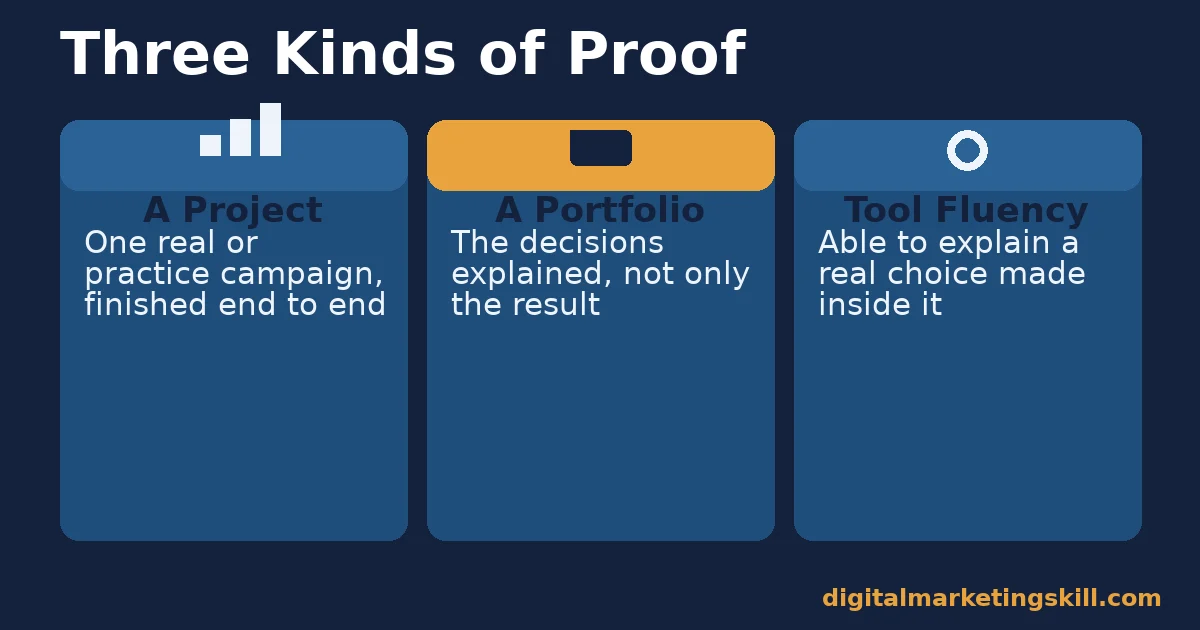
Almost every successful attempt to break into digital marketing rests on one of three kinds of proof. Each one answers the hiring manager’s real question in a different way.
A Real or Practice Project
A real campaign, even a small unpaid one, shows you can plan, execute and measure. A practice project, built for a fictional business, is the next best option if a real one is not yet available.
A Portfolio That Shows the Work, Not Just the Result
A portfolio that explains your thinking, not only the final number, lets a hiring manager see how you solved a problem. That reasoning is often more persuasive than the result alone, especially for a first job.
Fluency in the Tools the Job Actually Uses
Naming a tool on a resume is weak proof. Being able to open it, and explain a real decision you made inside it, is strong proof. Fluency beats familiarity every time.
How to Build Each Kind of Proof, Starting From Zero
Knowing the three kinds of proof matters less than knowing how to build them without a job yet. Each one has a realistic starting point, even with no network and no budget.
Build a Project: Start With One Real or Fictional Business
Pick one business, real or invented, and run one full project end to end: a landing page, a small ad test, or a short content calendar. A single finished project beats five half-started ones. For step-by-step practice, this beginner’s path through the fundamentals is a useful starting structure.
Build a Portfolio: Document the Decision, Not Just the Output
For every project, write two or three sentences on what you decided and why. That short explanation is what turns a finished task into a portfolio piece a hiring manager can actually evaluate. So treat the write-up as part of the work, not an afterthought.
Build Fluency: Pick One Tool and Go Deep Before Moving On
Choose one tool connected to the discipline you want most. It could be an ads platform, an analytics dashboard, or an email platform. Use it on a real task until you can explain three decisions you made inside it.
A Thirty-Day Plan to Break Into Digital Marketing
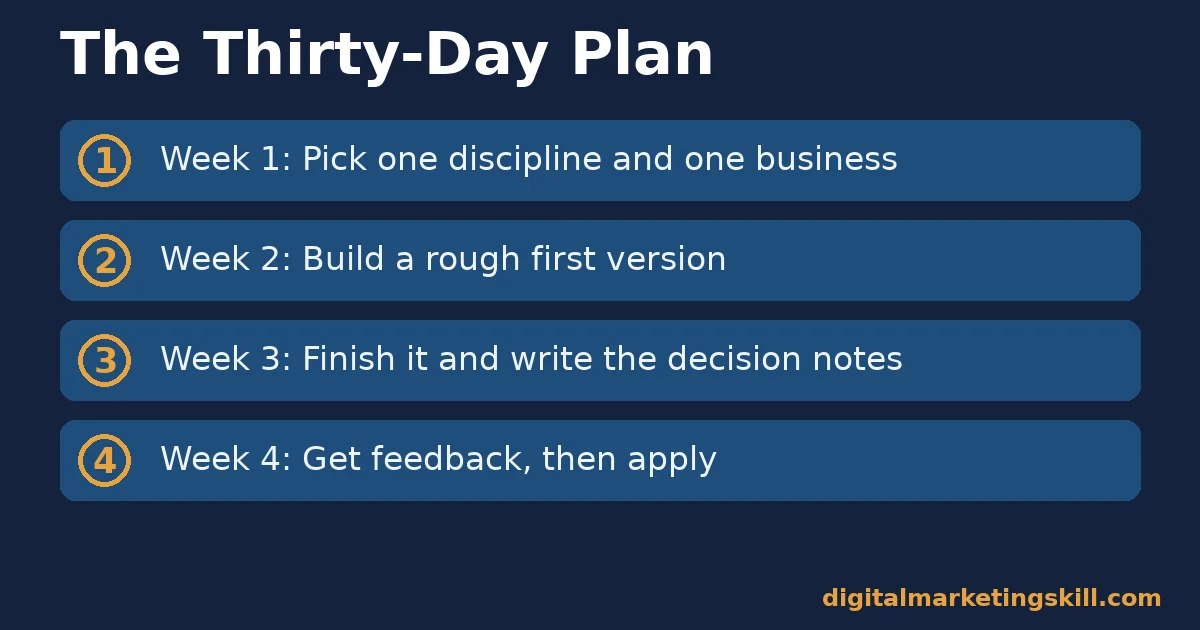
Reading about proof is easier than building it. Splitting the work into four short stages keeps the plan realistic, even around a full-time job or studies. None of the four stages requires a budget, a network, or an existing job in the field to start.
Week One: Pick One Discipline and One Business
Choose a single discipline, such as SEO, paid ads, email or content. Then pick one business, real or fictional, to build around. Write down the one result you will try to achieve.
Week Two: Build the First Version of Your Project
Create a first, rough version: a landing page draft, a sample ad set, or a short content plan. It does not need to be polished yet. It only needs to exist.
Week Three: Finish It and Write the Decision Notes
Finish the project to a presentable standard. Add two or three sentences explaining each major decision, since that is what turns the task into a portfolio piece.
Week Four: Get Feedback and Apply
Share the finished project with one experienced person for feedback, then make one round of changes. After that, start applying, and lead with the project in every application and interview.
Choosing a Discipline Without Guessing
Digital marketing covers many disciplines: content, SEO, paid ads, email, social media, and analytics, among others. New disciplines keep emerging as platforms change. Trying to learn all of them at once usually means finishing none.
A better approach is to pick the discipline closest to work you already enjoy, even informally, and build your first project there. You can always add a second discipline once the first one has a finished project behind it.
- Like writing? Start with content or email.
- Like numbers? Start with analytics or paid ads.
- Like design? Start with social media or landing pages.
- Like research? Start with SEO.
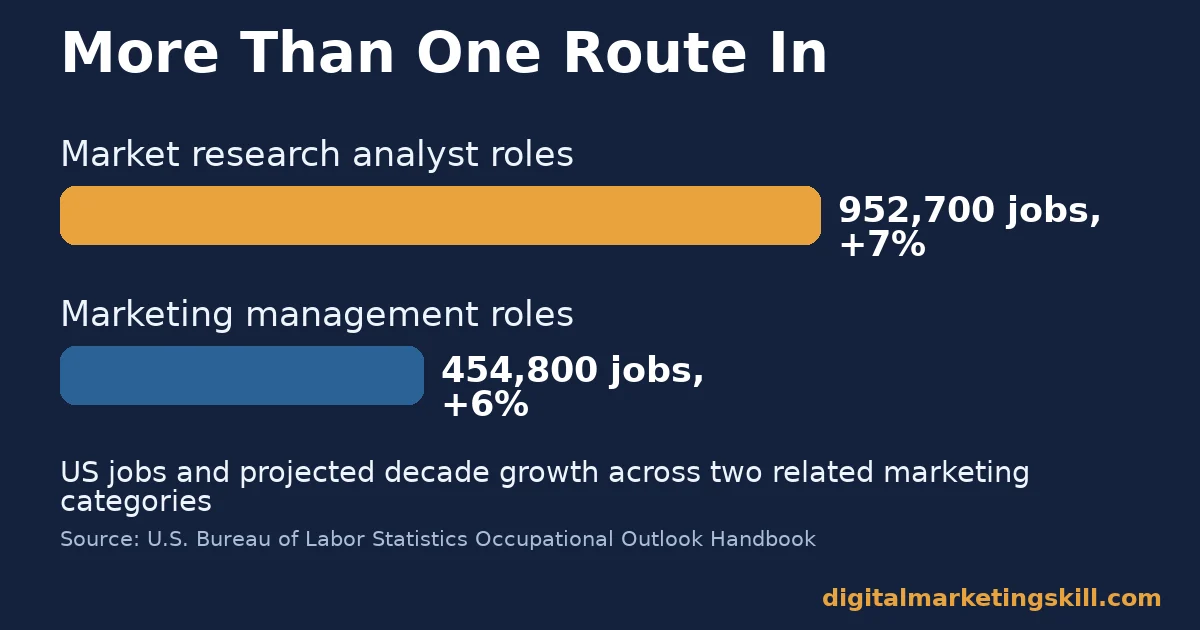
Government data backs up this broad range of entry points. The market research analyst category alone covers 952,700 jobs in the United States, with about 82,000 openings projected each year. That spread across one related category suggests room for more than one specialism, not a single narrow ladder.
Where to Find a Real Project When You Have No Network Yet
The hardest part of trying to break into digital marketing is often finding a first real project, not learning the skill itself. A few starting points work for almost anyone, even with zero connections.
Offer One Small, Scoped Task to a Local Nonprofit
Many small nonprofits and community groups have no marketing help at all. Offer one small, clearly scoped task, such as a single social post series or one email, rather than an open-ended favour. A narrow scope is easier to finish and easier to explain later.
Market Something You Already Run
If you already sell something small, write, or run a hobby page, that counts as a real business. Apply one discipline to it directly, and the results are genuinely yours to show.
Build for a Fictional Business If Nothing Real Is Available
A fictional business is a legitimate fallback, not a weak option, as long as you say so clearly in the portfolio. Hiring managers care more about the thinking shown than whether the business was real.
Use a Short Internship as a Structured First Project
A short, even unpaid, internship can supply both a real task and feedback from someone experienced. Treat it the same way as any other project: finish one piece of it fully, and write up the decisions behind it.
How to Know If Your Preparation Is Actually Working
Preparation to break into digital marketing is hard to measure by feeling alone. A few concrete signals show whether the work is paying off.
Four Signals Worth Tracking
- Interview requests per ten applications. A low rate after real effort usually points to the resume or the proof behind it, not the number of applications sent.
- Questions you can answer with a specific example. Count how many common interview questions you can answer using one of your own projects, not a general statement.
- Time to explain a project, start to finish. If you can walk through what you did in under two minutes, the project is ready to show. If it takes longer, it needs a clearer explanation, not more work.
- Feedback you actually act on. Collecting feedback without changing anything in the portfolio afterward is a sign the preparation has stalled.
Track these four signals together, not in isolation. A high interview rate with weak answers in the room usually means the resume oversells the project. A low interview rate with strong in-person answers usually means the resume undersells it. Either way, the fix is different, so knowing which one is happening matters more than the raw numbers alone.
Revisit the Choice Once, Not Repeatedly
It is fine to question your first discipline once, after the first project is finished, since you will know far more by then than you do today. However, switching disciplines before finishing a single project usually just restarts the same uncertainty in a new area.
The Most Useful Rule: One Finished Project Beats Five Certificates
If you remember one rule from this guide, make it this one. One finished, explainable project outweighs a list of completed courses, because it answers the hiring manager’s real question directly: can you do this.
Illustrative, invented example: two candidates apply for the same entry-level role. One lists four certificates and no projects. The other lists one certificate and one small finished campaign with a short write-up of the decisions made. Hiring managers consistently describe the second candidate as easier to evaluate, because there is something concrete to discuss.
Common Mistakes That Slow Down Your Attempt to Break Into Digital Marketing
Collecting Certificates Instead of Finishing Projects
Each new course feels like progress. However, a sixth certificate rarely changes a hiring manager’s mind the way a first finished project does.
Trying to Learn Every Discipline at Once
Spreading effort across content, ads, SEO and email at the same time usually means none of them reach a finishable project. One discipline, finished, beats five left half-done.
Finishing Work Without Explaining It
A project with no written explanation forces a hiring manager to guess at your reasoning. Because the decision notes are quick to write, skipping them is one of the easiest mistakes to fix.
Waiting for a Job Before Starting the First Project
Some people wait to practise a skill until a job gives them the chance. That order is backwards for anyone trying to break into digital marketing with no track record yet. The project has to come first, since it is what earns the chance in the first place.
A Real Case: Turning a Small Budget Into Proof of Skill
Ayooluwa Osemi, a student on the Digital Marketing Skill Institute reviews page, described spending $14 on Facebook and Instagram ads and generating $878 in results from that campaign. The exact return will vary by product, audience and market, and is not a guarantee for anyone else.
What the case shows clearly is the pattern this guide describes. A small, real, finished campaign becomes concrete proof of skill in a way that a certificate alone cannot. Because the campaign was finished, measured and explainable, it worked as proof regardless of the exact dollar figure attached to it. Results like this are not typical and are not promised; see the Institute’s earnings disclaimer for the full context behind any student outcome mentioned here.
Frequently Asked Questions About How to Break Into Digital Marketing
Do I need a degree to break into digital marketing?
No single path is required. Government data on search marketing roles shows people entering through a bachelor’s degree, an associate’s degree, and some college without a degree at all.
What is the fastest way to break into digital marketing with no experience?
Build one small, finished project, even for a fictional business, and be ready to explain the decisions behind it. That single piece of proof usually matters more than additional courses.
Which digital marketing discipline is easiest to break into first?
There is no single easiest discipline. The most practical starting point is whichever one connects to work you already enjoy, since that project will be easier to finish.
How many projects do I need in a portfolio to get hired?
There is no fixed number. One well-explained, finished project usually demonstrates more than several unfinished ones, since it gives a hiring manager something concrete to discuss.
Do certificates help at all when trying to break into digital marketing?
Yes, as a supporting signal. A certificate shows you studied a topic, but it works best paired with a finished project that proves you can apply it.
What do hiring managers look for first on an entry-level application?
Most look first for visible proof of hands-on work, such as a project or a specific tool result, rather than a list of completed courses alone.
Is digital marketing too competitive for someone starting from zero?
It is competitive, but government projections still show faster-than-average job growth and tens of thousands of openings a year, with more than one route into the field.
What should go first on a resume when trying to break into digital marketing?
Lead with the finished project and its measurable result, placed above education and certificates. That order matches what hiring managers scan for first, rather than burying the strongest evidence near the bottom.
How long does it realistically take to break into digital marketing?
There is no fixed timeline. A focused thirty-day plan can produce one finished, explainable project, though building fluency in a tool often takes longer than finishing the first project.
Can I break into digital marketing while working a full-time job?
Yes. The thirty-day plan in this guide is designed around small, weekly steps so a first project can be finished evenings and weekends, without needing to quit a current job first.
Does it matter which country I am trying to break into digital marketing from?
The core approach does not change by location. Because hiring managers everywhere look for the same proof of skill, a finished project travels across borders better than a list of local courses.
Start With One Project This Week
Breaking into digital marketing comes down to one repeatable habit: build a small, real project, explain the decisions behind it, and go deep on one tool before adding another. Pick a single discipline this week and commit to finishing one project in it, however small.
The Master Diploma in Digital & AI Marketing at Digital Marketing Skill Institute is built around exactly this kind of proof: nine practical courses, unlimited 1-on-1 coaching and mentoring, and real project work inside a U.S. company instead of theory alone. The diploma is dual US and UK accredited and recognised in more than 100 countries, and the whole program runs 100% online, so you can build real proof of skill from anywhere in your country.
Browse digitalmarketingskill.com for the full programme, explore more practical guides on the digital marketing blog, read outcomes on the reviews page, or apply directly whenever you are ready, wherever you live. For the practical pieces this guide covers in more depth, see this guide to building a marketing portfolio with no experience and this guide to writing a digital marketing resume, and see the Institute’s homepage for current programme details.
Every figure in this guide was checked against its original source before publication. Figures marked as illustrative are invented examples, not real results.
![9 Amazing Digital Marketing Skills to Make Money Online [With Proof]](https://digitalmarketingskill.com/wp-content/uploads/2019/07/9-Amazing-Digital-Marketing-Skills-to-Make-Money-Online-With-Proof-17.png)