
Content syndication means republishing an article you already wrote on other sites. It reaches readers who would never find your own blog. Done well, it earns new traffic and backlinks from a single piece of writing. A vendor study tracking real client sites found organic traffic rose 23% after syndication partnerships began. This guide shows how syndication works, when to use it, and how to avoid the SEO risks.
Key Takeaways
- Syndication can lift organic traffic measurably. A study of 71 client sites found median organic traffic rose 23%, and traffic value rose 65%, after syndication partnerships began.
- Top rankings moved too. The same study found keywords ranking in positions one to three rose 62%. Positions four to ten rose 72%. Both changes were statistically significant.
- Syndication carries a real duplicate-content risk. Without a canonical tag pointing back to your original, search engines can rank the syndicating site’s copy above yours.
- Longer, fuller articles earn more from syndication. Detailed, well-researched pieces attract more syndication interest and more backlinks than short, thin posts.
- Syndication works alongside other channels, not instead of them. It adds reach to an article that already performs on your own site. It rarely rescues a weak one.
In this guide
- What Most Traffic Advice Misses About Syndication
- Why Content Syndication Drives Traffic
- What Differs by Syndication Method
- How to Run Each Syndication Method
- How to Measure a Syndication Program
- The One Decision Rule: Syndicate Your Best, Not Your Newest
- A Real Case: What Syndication Moved for 71 Sites
- Frequently Asked Questions About Content Syndication
- Put Content Syndication to Work
What Most Traffic Advice Misses About Syndication
Most traffic advice covers social posting, SEO and paid ads. Syndication rarely gets mentioned, even though it reuses work you already did. That is the gap this guide fills.
This guide explains how content syndication actually drives traffic. It covers the technical step that protects your own SEO, and the one rule for deciding which articles to syndicate. Treat the research here as named evidence, not a guarantee. The vendor study below tracked its own clients, so read the figures as a realistic range, not a promise for every site.
For a baseline definition, HubSpot’s overview of content syndication is a useful starting reference if any of the terms here are new to you.
Why Content Syndication Drives Traffic
Syndication puts your article in front of readers who were never going to visit your blog directly. For example, a partner site republishes your piece, often with a link back to the original. Readers who like it click through. Meanwhile, search engines see a new, relevant link pointing at your page too.
That combination, new readers plus new links, is why the effect shows up in both traffic and rankings. A study tracking 71 client sites found median organic traffic rose from roughly 78,600 to 97,000 visits. That is a 23% increase, judged statistically significant.
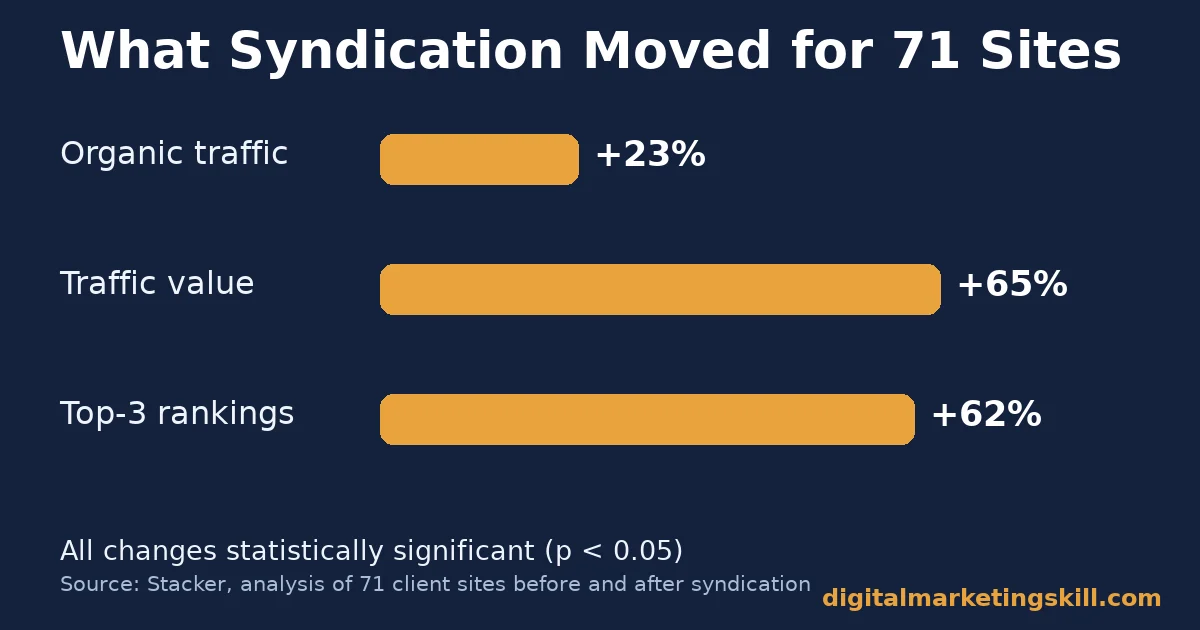
The same study found an even larger jump in traffic value, up 65%. Top-three keyword rankings grew 62%. The limit is worth stating plainly. This is one vendor’s analysis of its own client base, not an independent, controlled experiment. It has no comparison group of similar sites that did not syndicate. Treat it as a strong signal, not proof for your specific site.
What Differs by Syndication Method
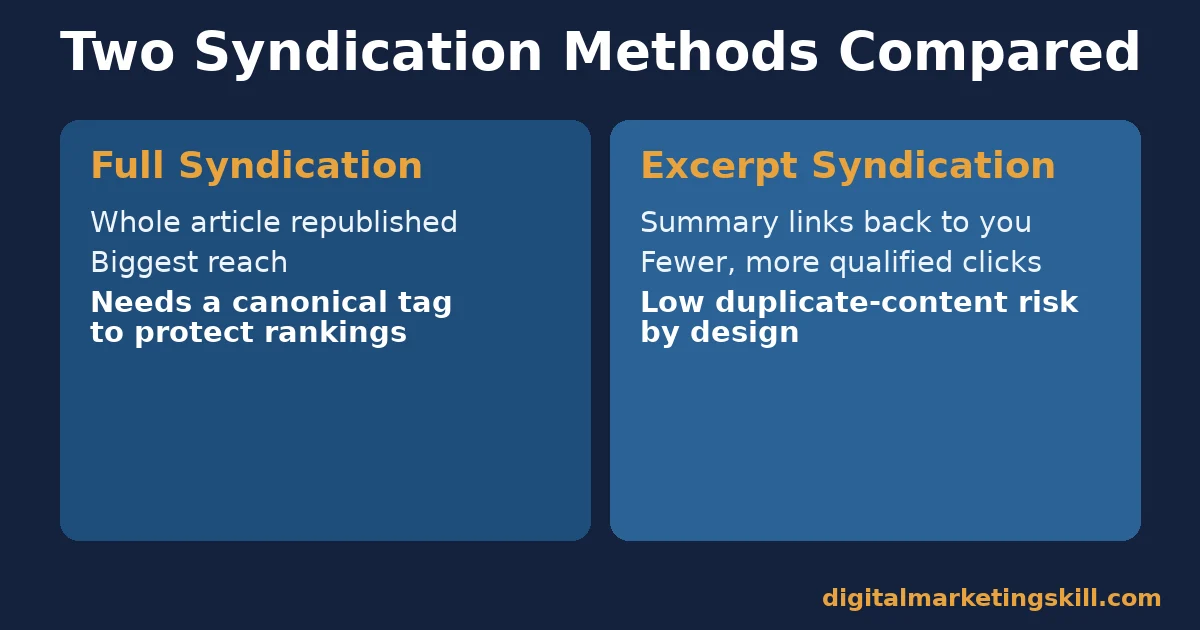
Not all syndication works the same way. Two approaches cover most of what businesses actually do. Full syndication republishes the whole article. Excerpt syndication publishes a summary that links back for the rest.
Full Syndication: Built for Reach
Full syndication republishes your entire article on a partner’s site, usually word for word. This reaches the most readers, because nobody has to click away for the full value. However, it also carries the biggest SEO risk. Two identical pages now compete for the same search rankings, unless one explicitly defers to the other.
So full syndication works best with larger, well-known partner sites. Pick ones that use a canonical tag pointing back to your original, and that readers already trust.
Excerpt Syndication: Built for Qualified Clicks
Excerpt syndication publishes only an introduction or summary on the partner site, with a clear link to read the rest on your own site. Fewer readers see the full piece this way. But everyone who clicks through is already interested. So that tends to produce a more engaged visitor on your own page.
Excerpt syndication avoids most duplicate-content risk by design, since the partner site never hosts your full text. It usually also preserves more of your own site’s traffic numbers, since the full read happens on your domain.
How to Run Each Syndication Method
These two sections mirror the methods above. Pick the one that fits your goal. Use full syndication for maximum reach, and excerpt syndication for more qualified visits back to your own site.
Full Syndication: Lead With a Canonical Tag
Before you send an article to a syndication partner, confirm they will add a canonical tag on their copy. It should point to your original URL. This tells search engines which version is the source, so your page keeps the ranking credit instead of losing it to the copy.
If a partner will not add a canonical tag, ask for a prominent, dofollow link back near the top of the piece instead. Without either protection, skip the partnership. The traffic is not worth the ranking risk. Google’s own guidance on consolidating duplicate URLs explains why the canonical signal matters here.
Excerpt Syndication: Lead With a Clear Reason to Click
Write the excerpt to end on an open question, not a full summary of the conclusion. A reader who already has the answer has no reason to click through to your site.
Pick your strongest, most complete articles for excerpt syndication. A thin article will not convert the click into a satisfied reader. So a disappointed visitor rarely returns. Backlinko’s own ranking factors research has found that longer, more comprehensive content tends to attract more backlinks than short posts, which is exactly the kind of article worth syndicating.
How to Measure a Syndication Program
Syndication results take time to show up. Track these four measures over months, not days.
- Referral traffic from syndication partners. The visits your analytics attributes to each partner’s domain. A rising number confirms the partnership is sending readers.
- Organic traffic to the syndicated article’s original URL. This isolates whether the backlinks and exposure are improving your own page’s search performance, separate from referral clicks.
- Keyword position for the article’s main terms. Track this before and after each syndication placement. A rising position links new links to a real ranking gain.
- New backlinks pointing to the original URL. Count links from the syndication partner and from any site that picked up the story afterward. Syndication often triggers secondary pickups you did not directly arrange.
Read these together. Strong referral traffic with flat organic traffic suggests the partnership is working as a traffic source but not yet lifting your own rankings. So give it more time, or more canonical-tagged placements, before judging it a failure.
The One Decision Rule: Syndicate Your Best, Not Your Newest
If you take one rule from this guide, make it this one. Syndicate your proven, highest-performing articles, not whatever you published most recently. A syndication partner’s audience judges your brand by the one piece they see. So a weak article undersells everything else you have written.

Here is an illustrative example, with invented numbers. A company syndicates its newest post every week, regardless of how that post performed on its own site. Average referral traffic per placement sits at around 40 visits, with few backlinks earned. It switches to syndicating only its top five performing articles, on a slower schedule. Average referral traffic per placement rises to around 310 visits. Three unplanned backlinks appear from sites that picked up the republished piece on their own.
The lesson is about selection, not volume. A smaller number of syndicated placements, built on genuinely strong articles, usually outperforms syndicating everything you publish.
A Real Case: What Syndication Moved for 71 Sites
The clearest available evidence on content syndication’s traffic effect comes from a published analysis by Stacker, a content syndication company. It covers 71 of its own client sites, with partnerships running 100 to 700-plus days. The company compared each client’s performance before and after its syndication partnership began, using t-tests to check statistical significance.
The results were specific. Median organic traffic rose 23%. Median traffic value rose 65%. Keywords ranking in positions one to three rose 62%, and positions four to ten rose 72%. All changes were reported as statistically significant.
The limit is worth stating twice, because this is a vendor measuring its own product. There is no control group of similar sites that skipped syndication during the same period. The study also does not separate syndication’s effect from other SEO work those sites may have done at the same time. Treat the direction as credible, and the exact percentages as one company’s experience, not a universal guarantee.
Frequently Asked Questions About Content Syndication
What is content syndication in marketing?
It is the practice of republishing an article, in full or as an excerpt, on other websites to reach a new audience and earn backlinks. Done with a canonical tag or clear link back, it adds exposure without costing you SEO credit.
Does content syndication hurt SEO with duplicate content?
It can, if the syndicating site has no canonical tag pointing back to your original. Without one, search engines may rank the copy instead of your source. With a canonical tag or clear attribution, the risk is largely avoided.
How much traffic can content syndication actually bring?
A study of 71 client sites found median organic traffic rose 23% after syndication partnerships began, with traffic value up 65%. Results vary by partner audience size and article quality, and that study has no control group.
Should I syndicate the full article or just an excerpt?
Full syndication reaches more readers but carries a larger duplicate-content risk without a canonical tag. Excerpt syndication sends fewer but more qualified readers back to your own site, with less SEO risk by design.
Which articles should I choose for syndication?
Choose your best-performing, most complete articles, not your newest ones. A syndication partner’s audience judges your brand by that one piece, so a strong article represents you better and earns more backlinks.
How do I measure whether syndication is working?
Track referral traffic from each partner, organic traffic to the original URL, keyword position for its main terms, and new backlinks earned. Strong referral traffic with flat rankings means give it more time before judging the result.
Is content syndication worth it for a small business?
Yes, if you already have a few strong, proven articles. Start with excerpt syndication on one or two relevant partner sites, confirm the link or canonical tag is in place, then track the four measures above before expanding.
Put Content Syndication to Work
Content syndication turns an article you already wrote into a new traffic and backlink source, without new writing. Pick your best-performing piece. Confirm the partner uses a canonical tag or a clear link back. Then track referral traffic alongside your original URL’s own rankings before you scale the program further.
If you want to build these skills with guided practice, Digital Marketing Skill Institute teaches them hands-on inside the Master Diploma in Digital & AI Marketing. The programme runs four AI-powered tracks, including AI-Powered WordPress and SEO Specialist and AI-Powered Lead Generation and Email Automation. All four total ten courses, with a Full Stack option for completing them together. It includes unlimited 1-on-1 coaching and mentoring, plus a U.S. Project Internship with a verified U.S. Work Reference Letter. It is dual US and UK accredited, and recognised in more than 100 countries.
See our related guides to website traffic strategies for the wider channel mix syndication fits into, and link building strategies for earning backlinks beyond syndication partnerships. The programme is fully online, so you can study from anywhere in your country. Browse more guides on the Digital Marketing Skill Institute blog, and when you are ready, apply for the Master Diploma or start from the Digital Marketing Skill Institute homepage.
Every figure in this guide was checked against its original source before publication. Figures marked as illustrative are invented examples, not real results.
![9 Amazing Digital Marketing Skills to Make Money Online [With Proof]](https://digitalmarketingskill.com/wp-content/uploads/2019/07/9-Amazing-Digital-Marketing-Skills-to-Make-Money-Online-With-Proof-17.png)






