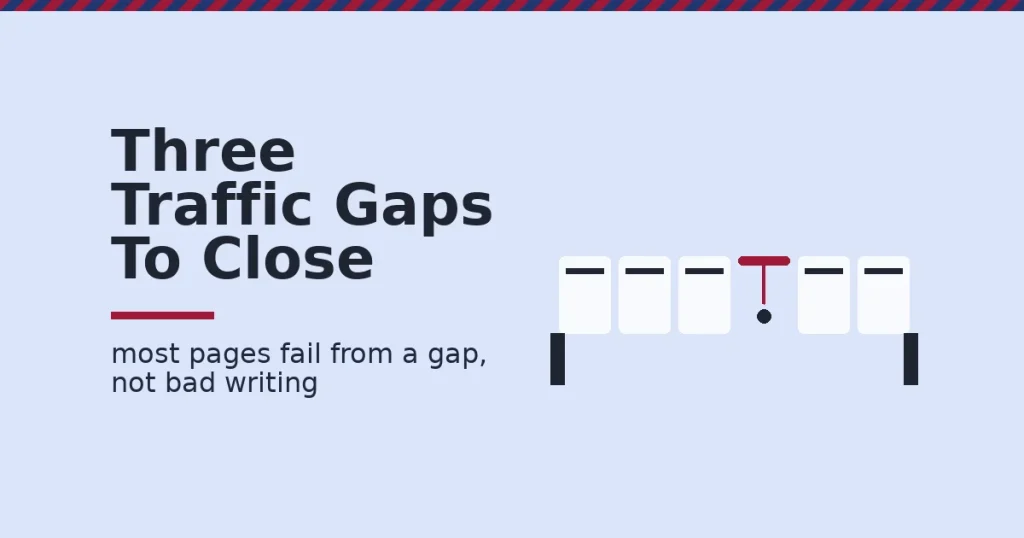
Website traffic strategies fail for one of three reasons. Nobody can find the page. Nobody trusts the page. Or nobody hears about the page. Most advice treats traffic as one problem with one fix, but it is really three separate gaps. This guide names each gap, with the evidence behind it, and a direct fix for each one.
Key Takeaways
- Most pages get nothing. Ahrefs analysed about 14 billion pages and found that 96.55% get zero organic traffic from Google. Being published is not the same as being found.
- Backlinks still separate winners from the rest. Backlinko’s study of 11.8 million Google results found the number 1 result averages 3.8 times more backlinks than positions 2 through 10. It also averages 3 times more referring domains.
- Consistency beats sporadic bursts. In HubSpot’s survey of 500+ marketers, half said blogging delivered a higher ROI than the year before. Most blogging businesses post weekly or more often.
- Distribution is not optional. The same HubSpot survey found 83% of blogging businesses distribute content through social media, and 47% through email.
- Zero backlinks is normal, not a failure. Backlinko’s study found about 95% of pages have no backlinks at all. So earning even a handful puts a page ahead of most competitors.
In this guide
- What Most Website Traffic Strategies Advice Misses
- How Pages Actually Earn Organic Traffic
- What This Means For Your Next Page
- Website Traffic Strategies That Differ By Gap
- How To Fix Each Website Traffic Strategies Gap
- How To Measure Whether You Are Closing These Gaps
- The One Rule: Fix the Nearest Gap First
- A Worked Example: Diagnosing a Page Stuck at Zero
- Frequently Asked Questions About Website Traffic Strategies
- Where To Go From Here
What Most Website Traffic Strategies Advice Misses
Most lists of website traffic strategies read the same way. Post more. Use keywords. Get backlinks. Be on social media. None of that is wrong. But it treats traffic as one lever, when it is really three separate gaps that need three separate fixes.
This guide names each gap directly: a visibility gap, an authority gap, and a distribution gap. The data below comes from Ahrefs, Backlinko and HubSpot’s own published research. Read every figure as a snapshot from the source named, not a settled rule.
One more ground rule: backlink and ranking correlations show what tends to go together. They are not proof that one single change will move one specific page. Treat every website traffic strategies tactic in this guide as a lever to pull, not a guarantee.
This also means a single traffic report rarely tells the whole story. A page can gain impressions while losing clicks, or gain backlinks while losing social reach, and each of those movements points at a different gap closing or opening. Reading the gaps separately, rather than watching one combined traffic number, is what makes a diagnosis useful instead of just descriptive.
It also means website traffic strategies deserve a regular review, not a one-time setup. A page that already closed its visibility gap can still develop a distribution gap later, if the channel that once sent it readers quietly stops working or changes its own rules.
How Pages Actually Earn Organic Traffic
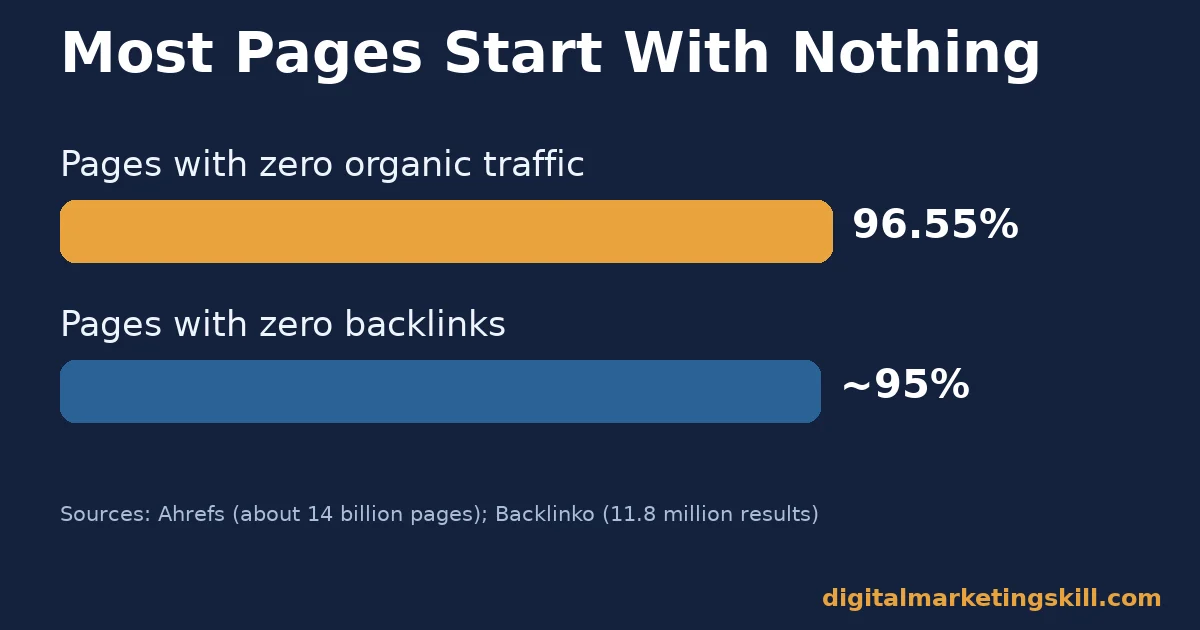
Most published pages never earn meaningful traffic at all. Ahrefs looked at roughly 14 billion pages in its own index. It found that 96.55% get zero organic traffic from Google. That number alone should change how you read any website traffic strategies advice. Publishing is the easy part, and most pages stop there.
Among pages that do rank, link signals still separate the top result from the rest. Backlinko’s study of 11.8 million Google search results found the number 1 result averages 3.8 times more backlinks than positions 2 through 10. It also averages 3 times more referring domains.
Yet the same study found about 95% of all pages have zero backlinks. So earning even a small number already puts a page ahead of most competing pages.
This is easy to misread as “backlinks are everything.” A more accurate read is narrower: among pages that already satisfy real search intent, link signals explain much of why one outranks another. A page with no search demand behind it will not out-rank anyone, no matter how many links it earns.
What This Means For Your Next Page
Two things follow directly. First, a page with no inbound links and no distribution plan is statistically likely to join the 96.55% that gets nothing. This is true no matter how well it is written.
Second, so few pages have any backlinks at all that a small, deliberate link-earning effort can move a page further than most competitors ever bother to go.
Website Traffic Strategies That Differ By Gap
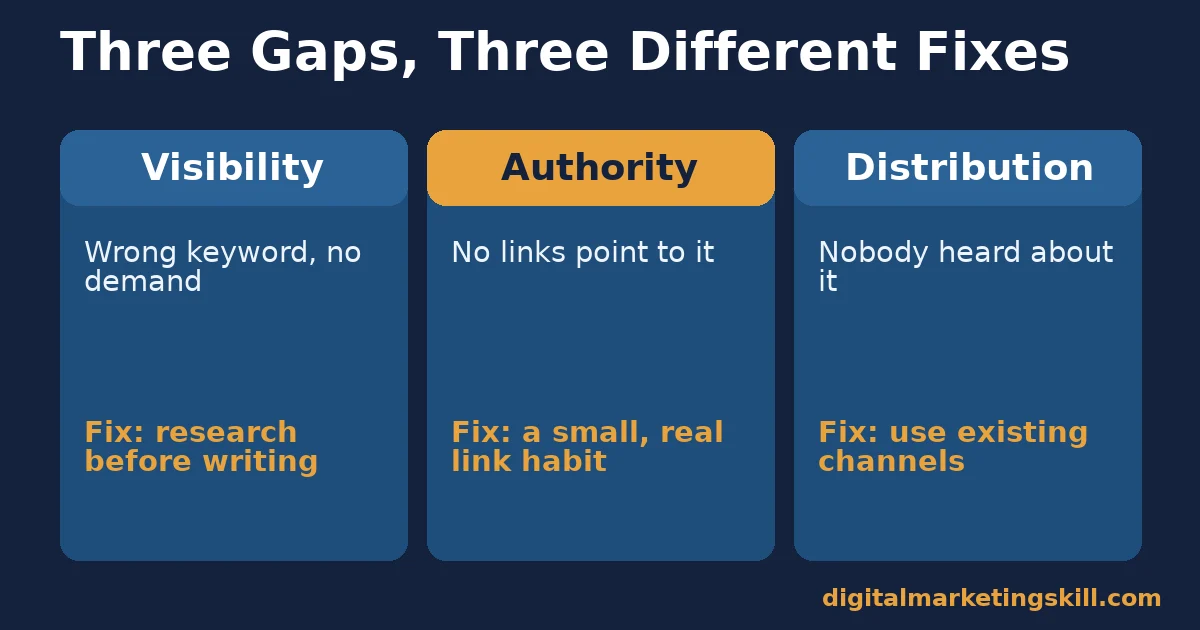
Low traffic rarely has one single cause. It is usually one of three gaps, and each one needs a different fix. Reading the wrong gap as the problem is why so many website traffic strategies efforts stall even after real work goes in.
The Visibility Gap: Built On Guessed Keywords
A page with a visibility gap targets a topic nobody is searching for. Or it competes directly against pages with far more authority. The content might be well written, but it is aimed at the wrong target. It never gets the chance to rank in the first place, no matter how much time went into writing it.
This is the most common starting mistake. Teams pick topics based on what feels important to the business. A keyword research process or a competitor analysis would show what people are actually searching for instead.
Google’s own guidance on helpful, people-first content asks whether a page genuinely serves a search someone is already making, not a topic the business simply wants to talk about. Without that check, even great content can sit at position 40 indefinitely, which is exactly the trap most website traffic strategies advice fails to name.
The Authority Gap: Built On Content Alone
A page with an authority gap targets the right keyword, but nothing else on the web points to it. Backlinko’s data shows link signals correlate strongly with top rankings. A page sitting with zero referring domains is competing with one hand behind its back, even when the content itself is genuinely the best answer available.
Teams fall into this gap when they treat publishing as the finish line. Good content is necessary, but on its own it rarely earns the links that move a page from page two to page one. A page with a strong website SEO optimization foundation still needs this outside signal to close the gap fully.
The Distribution Gap: Built On Search Alone
A page with a distribution gap might rank reasonably well, but it still gets little traffic. That’s because search was never the only channel that mattered. HubSpot’s survey of 500+ marketers found 83% of blogging businesses distribute content through social media, and 47% through email.
A new page with no distribution plan has to wait for search rankings to slowly build. A single relevant social post or newsletter mention could have sent real readers immediately instead. This gap is easy to miss because the page can look fine on every on-page checklist while still sitting unseen by the audience it was written for.
How To Fix Each Website Traffic Strategies Gap
The fix for each gap mirrors its cause directly. None of these require a bigger budget, only a different sequence of work. The order matters more than most website traffic strategies checklists suggest, because fixing a later gap before an earlier one often wastes the effort entirely.
For example, earning backlinks to a page that targets the wrong keyword does not fix the visibility gap underneath it. The links may arrive, but the page still competes for a search nobody is making. Diagnose the gap first, then apply the matching fix below.
The same logic runs in reverse. Publishing more content to fill a distribution gap just adds more unseen pages to the pile, since the problem was never a shortage of content in the first place. Matching the fix to the correctly diagnosed gap is what separates website traffic strategies that compound from ones that simply add more work without adding more readers.
The Visibility Gap: Lead With Competitor Keyword Research
Before writing, check what already ranks for the topic. A simple method: list your top three competitors, and check which keywords send them the most traffic. Then build content around the ones with real search demand and a realistic chance to rank. Skip the ones chosen on instinct alone.
This process is never finished. New competitors enter, search demand shifts, and a keyword that worked two years ago can quietly stop converting. Revisit the list on a fixed schedule, not only when traffic drops.
The Authority Gap: Lead With a Small, Real Link-Earning Habit
Since about 95% of pages have zero backlinks, a page does not need hundreds of links to stand out. It needs a handful of genuine ones. Research the articles already covering a similar topic. Then reach out to the people most likely to find your page genuinely useful to their own readers.
Treat this as a habit, not a one-time campaign. A page that earns two or three new referring domains a month will out-pace most competitors. The typical page earns none at all.
The Distribution Gap: Lead With the Channels Your Audience Already Uses
Match the distribution channel to the business, not the other way around. HubSpot’s survey found social media and email are the two most common channels blogging businesses use, at 83% and 47%. The same principles covered in this guide to social media marketing principles apply directly here. Pick the one or two channels where your specific audience already spends time, and commit to using them for every new page.
A consistent publishing habit matters here too, and a documented blog content strategy makes that habit easier to sustain. In the same HubSpot survey, half of blogging businesses reported a higher ROI than the year before. Most of those businesses published weekly or more often. Sporadic bursts of content rarely build the same compounding effect.
How To Measure Whether You Are Closing These Gaps
Five numbers show whether a page’s traffic problem is visibility, authority or distribution.
- Impressions without clicks (visible in Google Search Console’s own definitions) flags a visibility gap. High impressions with a low click-through rate usually means the page shows up, but the title or snippet fails to earn the click.
- Average position for the target keyword shows how close a page sits to the top results that earn most of the clicks. A page stuck below position 10 is still fighting the visibility gap.
- Referring domains (not just total backlinks) tracks the authority gap directly. A rising number of distinct referring domains matters more than a handful of links from the same site.
- Traffic by channel (search, social, email, direct) shows whether a page depends entirely on search. That dependence is the clearest sign of an unaddressed distribution gap.
- Time to first meaningful traffic (days from publish to a real, sustained visit count) shows whether the distribution habit is working. Search rankings alone can take months to build.
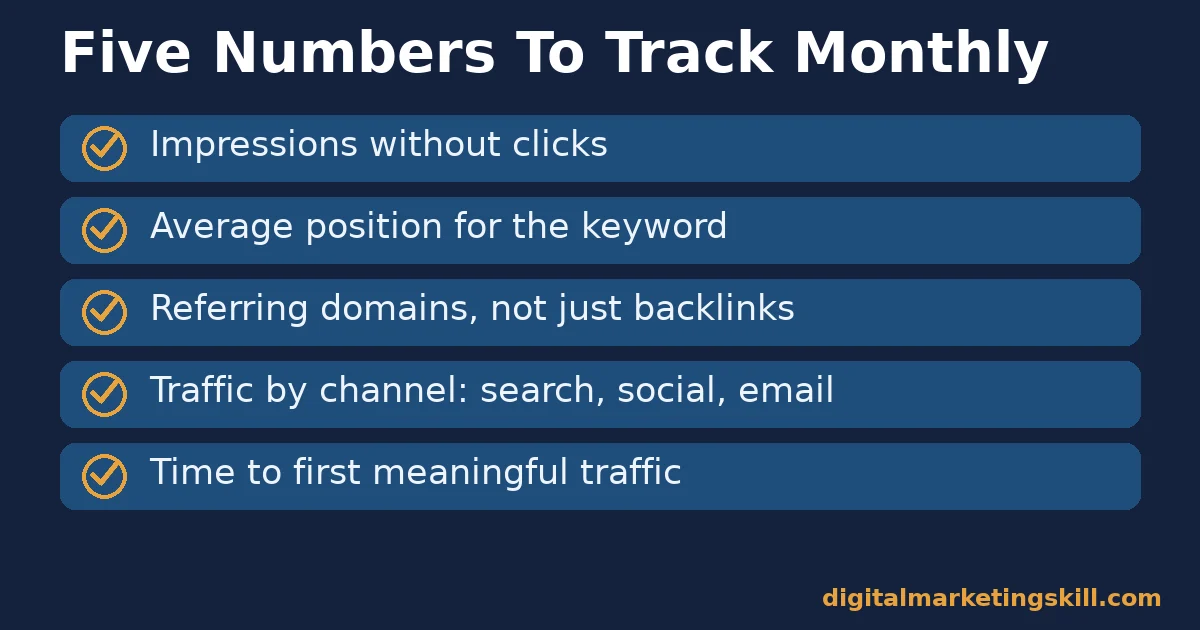
Read these five together. A page with strong impressions, weak referring domains and no social traffic tells a very different story than one with none of the three, even if both show the same total visits today.
A monthly review works well for most small teams: pull the five numbers for your top pages, and assign the matching fix.
The One Rule: Fix the Nearest Gap First
Diagnose which gap is actually limiting a page before adding more work to it. Writing more content will not fix an authority gap. Chasing backlinks will not fix a page nobody is searching for. Match the fix to the gap, or the extra effort is likely to be wasted.
Illustrative, invented numbers: imagine two new pages, each published on the same day. Page A targets a well-researched keyword. It earns three referring domains in its first month, and gets shared twice on social media, reaching 500 monthly visits by month three.
Page B targets a guessed keyword. It earns no links and is never shared anywhere, so it sits near zero visits at the same point. The difference is not writing quality. It is which gaps got closed.
A Worked Example: Diagnosing a Page Stuck at Zero
Illustrative, invented numbers: a page has been live for six months with almost no traffic. A quick audit finds it ranks around position 35 for its target keyword. It has zero referring domains and was never shared outside the company’s own social accounts.
All three gaps are open at once, so the team picks one order. First, they swap the target keyword for one with real, checkable search demand from a competitor gap analysis. Next, they reach out to three sites already covering related topics. Finally, they share the updated page through the one social channel their audience actually uses.
Over the following months, impressions, referring domains and social referrals each move independently. That is itself the proof: the three gaps were genuinely separate problems, not one problem with three names.
The limit on this example is that it is illustrative, not a documented case. Real pages rarely close all three gaps on the same timeline, and the order that works for one page may not work for another with a different starting point. Treat the sequence here as a starting framework for your own website traffic strategies, not a fixed formula.
Frequently Asked Questions About Website Traffic Strategies
Why does a well-written page still get no traffic?
It is usually a visibility, authority or distribution gap, not the writing. Ahrefs found that 96.55% of pages get zero organic traffic. Most of those pages are not badly written. They are either targeting the wrong keyword, missing backlinks, or missing a real distribution channel.
Do website traffic strategies work the same way for every industry?
The three gaps apply broadly, but the weighting differs. A niche B2B topic may have very little search demand, so the visibility gap matters more than backlinks ever will. A competitive consumer topic usually has real demand already, so the authority and distribution gaps tend to decide the outcome instead.
How many backlinks does a page actually need?
More than zero is already ahead of most pages. Backlinko’s study found about 95% of pages have no backlinks at all. The number 1 result averages 3 times more referring domains than positions 2 through 10. So even a small, genuine link-earning habit can make a real difference.
How often should a business publish new content?
Weekly or more often correlates with stronger self-reported results. In HubSpot’s survey, most blogging businesses that posted weekly or more often were also the ones reporting higher ROI year over year. Frequency alone is not the only factor at play, though.
Is social media or search a better source of website traffic?
Most businesses need both, not one instead of the other. HubSpot’s survey found 83% of blogging businesses distribute through social media and 47% through email. Both sit alongside search, rather than replacing it.
What is a referring domain, and why does it matter more than total backlinks?
A referring domain is a distinct website linking to your page, rather than a raw count of links. Ten links from the same site count as one referring domain. Google’s own guidance on search performance treats diverse, genuine signals as more durable than any single tactic. Backlinko’s research found referring domains correlate more strongly with rankings than total backlink count.
How do I know if my keyword targeting is the actual problem?
Check impressions and average position in Search Console. High impressions with a low click-through rate suggests a snippet problem. Very low impressions for a page that should be relevant usually means the keyword has little real search demand, or stronger pages already dominate it.
Can a new website compete for website traffic strategies against older, established sites?
Yes, on specific, well-chosen keywords. Most established pages still have few or no backlinks. A new site that closes the authority gap deliberately on a narrow topic can out-rank a larger site that never bothered to build any links for that specific page.
Should content ever be updated instead of replaced?
Often, yes. A page that already has some backlinks and impressions, but is stuck in a visibility or distribution gap, usually keeps more of its existing authority if it is updated rather than replaced with a brand-new URL. Replacing it resets the referring-domain count to zero on the new address, which reopens the authority gap this guide is trying to close.
What is the fastest website traffic strategies fix to try first?
Distribution, in most cases. Checking a keyword’s demand or earning a new backlink both take real time, but sharing an existing, relevant page through a channel your audience already uses can send a measurable batch of readers within days. It will not fix a visibility or authority gap on its own, but it is the fastest way to confirm whether a page is actually worth the deeper fix.
Where To Go From Here
Closing website traffic strategies gaps is rarely about writing more. It is about diagnosing which gap is actually open, and closing that one first. Digital Marketing Skill Institute’s Master Diploma in Digital & AI Marketing builds this skill alongside SEO, content, paid search and analytics.
It covers nine practical courses, unlimited one-on-one coaching and mentoring, and real project work inside a U.S. company. The program is dual US and UK accredited, recognised in more than 100 countries, and delivered 100% online. You can study anywhere in your country.
Browse more guides like this one on the digital marketing blog, or read outcomes from past students on the reviews page. Go straight to the application page to start. Wherever you live, the program runs entirely online. Digital Marketing Skill Institute is built for marketers who want proof, not just a certificate. Explore more free resources at digitalmarketingskill.com while you decide.
Every figure in this guide was checked against its original source before publication. Figures marked as illustrative are invented examples, not real results.
![9 Amazing Digital Marketing Skills to Make Money Online [With Proof]](https://digitalmarketingskill.com/wp-content/uploads/2019/07/9-Amazing-Digital-Marketing-Skills-to-Make-Money-Online-With-Proof-17.png)