
Copywriting books teach the psychology behind words that sell. But a stack of classics will not improve your writing on its own. This copywriting books guide groups 15 titles by the skill gap each one closes. Then it shows you how to turn the reading into copy you can actually test.
Key Takeaways
- Reading alone rarely changes your output. Rewriting your own copy with one technique from a book, then testing it, is what builds skill.
- Direct-response copywriting books (Ogilvy, Schwartz, Hopkins, Whitman) teach measurable, sales-focused writing. Story and brand books (Handley, Godin, Cron) teach long-form engagement instead.
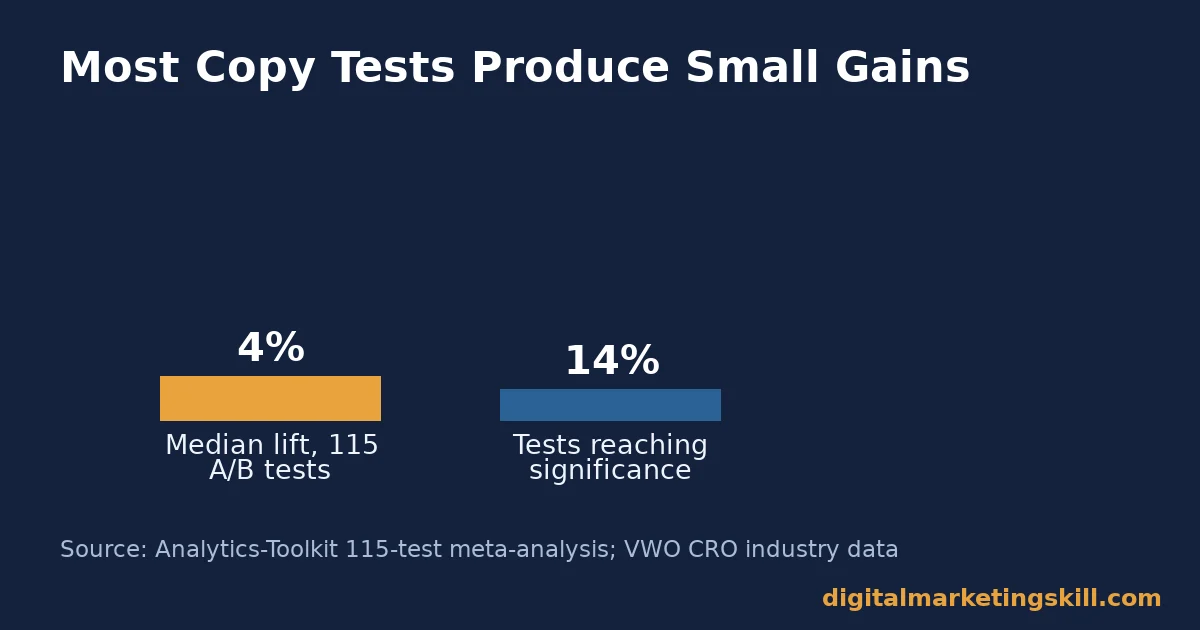
- Most copy tests produce small gains. An analysis of 115 A/B tests found a median lift under 4%, so one book is rarely a silver bullet.
- Few tests “win” outright. CRO platform VWO reports that only around 14% of A/B tests reach statistical significance. So a decision rule matters more than a favorite author.
- Copywriting sits inside a stable field. U.S. Bureau of Labor Statistics data puts median pay for writers and authors above $70,000 a year.
In this guide
- The Gap Most Copywriting Books Lists Miss
- How Reading Turns Into Better Copy
- What Differs By Your Goal
- How To Use Each Group Of Copywriting Books
- How To Measure Whether A Copywriting Book Worked
- The One Decision Rule
- A Real Case: Why The Underlying Skill Still Matters
- Frequently Asked Questions About Copywriting Books
- Turn These Copywriting Books Into A Skill You Can Sell
The Gap Most Copywriting Books Lists Miss
Most roundups rank copywriting books by fame, not by the skill gap each one closes. That leaves you with a long list and no way to pick where to start. Worse, it gives no way to check afterward whether the book actually worked.
This is an informed grouping, not a settled ranking. Copywriting has many working styles. For instance, a book that transforms one person’s sales pages may do little for someone writing brand storytelling instead. So treat the order inside each group as a starting point, not a verdict. Also treat every dollar or percentage figure below as a snapshot from the source named, not a permanent industry standard.
It also helps to know what a copywriting book cannot do. A book cannot hand you your audience’s exact objections, because only your own data can do that. Therefore, pair every technique below with a real reply, comment, or support ticket from your own readers. In short, the books supply the framework; your own audience supplies the proof.
It also helps to separate two things people often blend together: reading speed and reading depth. You can finish a 250-page copywriting book in a weekend and still absorb almost nothing, if you read it the way you would read a novel. Slower, active reading, where you stop after each chapter and ask “what would I change in my own copy because of this,” produces far more transfer than fast reading does. None of the figures in this guide measure reading speed for that reason; they measure what happens after you apply a technique, not how quickly you turned the pages.
How Reading Turns Into Better Copy
A copywriting book works like a coaching manual for a sport. It gives you a model to copy, not a shortcut around practice. The mechanism has three steps.
First, read one chapter and pull out a single named technique: a headline formula, an objection-handling structure, a story beat. Second, rewrite one real piece of your own copy using only that technique. Change nothing else. Third, test the rewrite against the original with a real reader action, such as a click, a reply, or a purchase.
That third step matters most, and most reading lists skip it. Nielsen Norman Group’s eye-tracking research found that most web readers scan a new page instead of reading every word. The same research found that people typically absorb only around a fifth to a quarter of the words on a page. So a book can teach persuasion theory. But if your rewritten copy is not built for scanning, readers never reach the persuasion. This is also why a book written for print ads and a book written for landing pages teach different mechanics, even when the psychology underneath overlaps.
This is the main reason to read more than one copywriting book instead of settling on a single favorite. A print-era book assumes a captive reader who already picked up the page. A web-era book assumes a distracted reader who is one click from leaving. Combine a print-era book for persuasion theory with a web-era book for structure, and you cover both halves of the job.
What Differs By Your Goal
The 15 copywriting books split into two working groups. Pick the group that matches what you are writing this month. Do not pick by the most famous name on the cover.
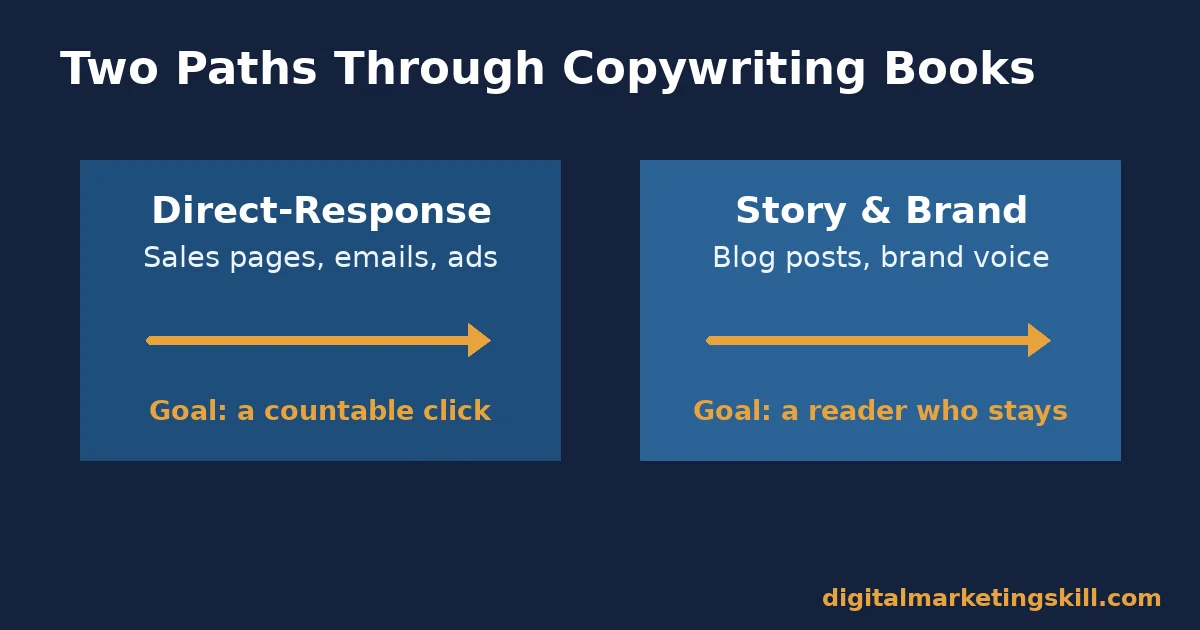
Direct-Response Copywriting Books: Built For Measurable Sales Copy
This group fits anyone writing landing pages, sales emails, ads, or checkout copy. The goal here is a click or a purchase you can count.
- Ogilvy on Advertising by David Ogilvy teaches positioning and research-led headlines. It also teaches the habit of testing claims before you publish them, which makes it a solid foundation book.
- The Adweek Copywriting Handbook by Joseph Sugarman walks through the psychological triggers behind classic mail-order ads, step by step, so it works well as a first direct-response read.
- Scientific Advertising by Claude Hopkins makes the original case that advertising should be measured like an experiment, not judged by taste. It is short, old, and still worth the hour.
- Cashvertising by Drew Eric Whitman catalogues psychological triggers and maps each one to a specific copy technique, making it useful as a quick-reference checklist.
- Breakthrough Advertising by Eugene M. Schwartz explains how to match your copy to a reader’s existing awareness of their own problem. It is denser than the others, so read it last in this group.
- The Boron Letters by Gary Halbert shares informal, example-heavy lessons on persuasion from real mail-order campaigns, in a tone closer to advice from a mentor than a textbook.
- Copy Logic by Michael Masterson and Mike Palmer explains the strategic reasoning behind why a structure converts, not just the structure itself, which helps once you already know the basic formulas.
Story And Brand Books: Built For Long-Form Content
This group fits anyone writing blog posts, brand voice, or social captions. Here, the reader is not expected to buy in the next 30 seconds.
- Everybody Writes by Ann Handley covers grammar, structure, and voice for everyday digital writing, aimed at marketers rather than novelists. It is a good first pick if your writing still feels stiff.
- This Is Marketing by Seth Godin argues for writing to a specific, smaller audience instead of chasing the widest possible reach. Use it when you are tempted to write for everyone at once.
- How to Write Seductive Web Copy by Henneke Duistermaat bridges both groups. It is written specifically for on-page web content, so it suits blog posts that still need to sell softly.
- Hey, Whipple, Squeeze This by Luke Sullivan shows how advertising ideas get made and defended inside an agency, with a focus on originality over formula.
- The Copywriter’s Handbook by Robert W. Bly is a reference-style manual that covers both print and digital copy formats. Keep it nearby as a lookup guide, not a cover-to-cover read.
- Wired for Story by Lisa Cron explains the cognitive science behind why human brains respond to narrative structure. It is the deepest explanation of “why” in this entire list.
- The Idea Writers by Teressa Iezzi shows how creative teams generate and pressure-test big advertising ideas, which helps if you write copy inside a team rather than alone.
Notice the pattern across this group: each book trades a little formula for a little more voice. That trade-off is fine, as long as the voice still serves a reader who is deciding whether to keep reading at all.
One book sits outside both groups. The Copywriter’s Guide to Getting Paid by Ray Edwards is not about writing at all. Instead, it covers pricing, contracts, and running copywriting as a business, which matters once your copywriting books start producing paid work. For context, freelance writing marketplace data gathered by Mediabistro’s freelance copywriter rate research puts typical hourly rates between $50 and $150, with beginners charging far less per word than writers with five or more years of experience. That is a self-reported survey, not a guaranteed rate card, but it is a useful anchor when you move from reading to billing. None of the 15 copywriting books above will set your rate for you. What they will do is shorten how long it takes to produce copy a client is willing to pay for in the first place.
How To Use Each Group Of Copywriting Books
Direct-Response Books: Lead With A Rewrite, Not A Re-Read
After each chapter in this group, rewrite one live piece of your own sales copy. Use only the single technique you just read about. For example, change a headline using Schwartz’s awareness levels. Or rebuild one email using Whitman’s trigger list. Leave the rest of the piece untouched, so you can isolate what the technique did. Then track a plain outcome, such as clicks, replies, or purchases, before and after.
Headlines are a good place to start, because they carry an outsized share of the result. Analysis of more than 800 tested page variants by conversion agency Apexure found that headline and clarity-focused changes were consistently among the highest-lift test categories. That is agency case-study data, drawn from its own client projects, not an independent academic sample, so treat the size of the lift as a best case rather than a typical one. Even so, it supports starting your rewrite with the headline, not the body copy.
Story And Brand Books: Lead With One Story Swap Per Week
After each chapter in this group, replace one abstract claim in your content with a concrete example. Cron’s research argues that brains process narrative more easily than plain assertions. Make one swap per week, not a whole piece at once. That way, you can tell whether the swap changed how far readers actually read, not just how the piece reads to you.
How To Measure Whether A Copywriting Book Worked
Three numbers show whether a technique from a book is paying off. Each is defined in one sentence, so you can track it without new tools.
- Conversion rate change: the share of readers who take the target action after your rewrite, compared with the share before it, on the same traffic source.
- Scroll or completion rate: how far down the page readers get. This tells you whether a structural change, such as shorter paragraphs or a clearer opening, keeps scanners reading.
- Statistical significance of the test: whether the difference you see is a real effect, or just noise. An analysis of 115 published A/B tests found a median lift under 4%. And VWO’s CRO industry data puts the share of tests reaching significance at around 14%. So expect most single changes to produce a small or inconclusive result. Plan to test more than once before crediting, or blaming, a book.
The One Decision Rule
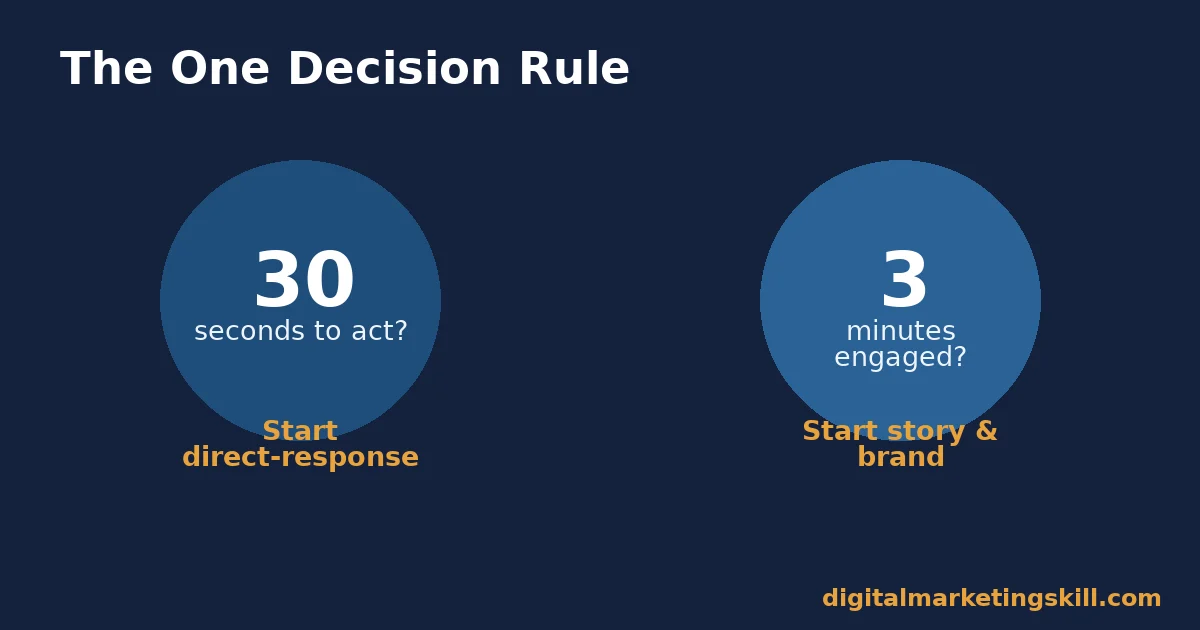
If you need a reader to act within the next 30 seconds, start with the direct-response group. If you need a reader to stay engaged for the next 3 minutes, start with the story and brand group. Everything else is sequencing.
Illustrative, invented numbers: picture two writers who each read three books from their matching group. Both rewrite one asset per chapter over six weeks. Writer A, in the direct-response group, rewrites a checkout email sequence. Their conversion rate might move from 2.1% to 2.6% after four tested rewrites. Writer B, in the story group, rewrites blog introductions. Their average scroll depth might move from 38% to 51% of the page. Neither number is guaranteed. They simply illustrate that the right group produces a trackable number, which is the real goal. Notice also that each writer tracked only one number. That is deliberate. Tracking five metrics at once makes it hard to tell which rewrite caused which change, so pick the single number tied to your actual goal and watch that one first.
A Real Case: Why The Underlying Skill Still Matters
Digital Marketing Skill Institute student Olajire Jacob has described charging an average of $500 to set up email marketing flows for clients. He later scaled that side of his business to around $5,000 a month. This case is about building and selling email marketing services broadly. It is not a controlled test of any single copywriting book, and the result reflects one person’s reported experience, not a typical outcome.
Still, it shows something useful. The words inside an email flow, such as subject lines, body copy, and calls to action, are part of a service clients pay for. That is the same skill this reading list tries to sharpen. As with any income example, results are not guaranteed and will vary by effort, market, and offer. See the Institute’s earnings disclaimer for the full context.
The lesson generalises beyond one case. A service built on email flows is really a service built on words that trigger an open, a click, and a reply, in that order. Clients rarely separate “the automation” from “the copy inside it,” because to them it is one deliverable. So the reading habit behind this guide is not academic. It is closer to stocking a toolbox before a job, one technique at a time, so you have an answer ready the next time a client asks for a better-performing sequence.
Frequently Asked Questions About Copywriting Books
What are the 3 Cs of copywriting?
The 3 Cs are shorthand for clear, concise, and compelling copy. The message should be easy to understand, free of unnecessary words, and persuasive enough to move the reader to act. Some writers add a fourth C, “credible,” since a compelling claim that is not believable will not convert.
Can you really learn copywriting from books alone?
Books teach the principles: psychology, structure, and formulas. But the skill itself is built by rewriting your own copy and testing it against real readers. Treat each book as a source of techniques to try, not a finished course.
Which copywriting book should a complete beginner start with?
A beginner writing sales pages or ads benefits most from a structured, example-heavy book like The Adweek Copywriting Handbook. A beginner writing blog content or brand voice benefits more from Everybody Writes, since it assumes no advertising background. Either way, resist the urge to buy all 15 copywriting books before you have finished rewriting anything from the first one; one applied chapter beats five unread books on a shelf.
How long does it take to see results from a copywriting book?
Most single copy changes produce small measurable gains. So expect to run several tested rewrites, not one, before drawing a conclusion. A few weeks of consistent testing is a more realistic window than a single edit.
Are older copywriting books like Scientific Advertising still relevant?
The channels have changed, but the core argument has not. Advertising claims should be tested and measured, not judged by taste. That same argument underpins how modern A/B testing works today. It is also worth knowing that copywriting books can disagree with each other on purpose: Ogilvy favored research-heavy, formal copy, while Halbert favored a conversational, almost reckless voice, and both approaches sold real products, so test conflicting advice on your own audience rather than picking a side by reputation alone.
Do I need a different book for email copy versus website copy?
Not strictly, but the groups do map differently. The direct-response group maps more directly onto email and landing pages. The story and brand group maps more directly onto blog posts and longer web content. Match the group to the format you write most.
Is copywriting a stable skill to build?
U.S. Bureau of Labor Statistics data classifies copywriting under the broader writers-and-authors occupation group. That group reports median pay above $70,000 a year, roughly 135,000 jobs, and steady projected growth of about 4% over the next decade. That makes copywriting a stable skill to build, even as one service alongside other marketing work.
What is the fastest way to practice what a copywriting book teaches?
Pick one live piece of your own copy today. Rewrite only its headline or opening line using one technique from the book you just read. Publish or send the new version, then compare the result against the old one on the same audience. Reading order matters far less than matching the book to the format in front of you: if you are drafting a sales email today, open a direct-response book today, even if a story-focused title is next on your list.
Turn These Copywriting Books Into A Skill You Can Sell
Reading these 15 copywriting books gives you the theory. Turning that theory into copy that converts is a different, trainable skill, and Digital Marketing Skill Institute builds that practice directly into its curriculum. Our guide on 8 must-have copywriting skills for beginners breaks that practice down further, and our explainer on what copywriting actually is is a good starting point if you are new to the field. If your copywriting leans toward search content, our step-by-step guide to SEO copywriting pairs well with the story and brand group above.
This is one piece of a wider AI-powered marketing skill set you can build anywhere in your country. Digital Marketing Skill Institute’s Master Diploma in Digital & AI Marketing includes the AI-Powered Lead Generation and Email Automation track, where you practice the kind of email and sales copy covered in the direct-response group above. It also includes the AI-Powered WordPress and SEO Specialist track, where long-form content and on-page writing from the story and brand group come into play. Every track includes unlimited 1-on-1 coaching and mentoring, plus a U.S. Project Internship with a verified U.S. Work Reference Letter. The program is dual US and UK accredited, and it is recognised in more than 100 countries, 100% online.
You can specialize in one track, or complete the Full Stack option across all four. Start wherever you live by visiting digitalmarketingskill.com. Review the Master Diploma program, read more on the blog or in student reviews, and apply directly at digitalmarketingskill.com/apply/, wherever you live.
Every figure in this guide was checked against its original source before publication. Figures marked as illustrative are invented examples, not real results.
![9 Amazing Digital Marketing Skills to Make Money Online [With Proof]](https://digitalmarketingskill.com/wp-content/uploads/2019/07/9-Amazing-Digital-Marketing-Skills-to-Make-Money-Online-With-Proof-17.png)






