
Strong digital marketing interview answers follow a structure, not a script. Interviewers remember a specific example more than a textbook definition. Pick one real project per skill area, then use a simple structure to tell it. This guide shows the three question types you will face, how to structure an answer for each, a five-step way to prepare, and how to tell if your answers are actually landing.
Key Takeaways
- Structure beats memorised scripts. The U.S. Office of Personnel Management reports that interviews with a higher degree of structure show higher validity at predicting job performance than unstructured ones.
- Proof outperforms knowledge alone. Almost two-thirds of employers in a NACE survey of 216 US employers now use some form of skills-based hiring, so a real example beats a textbook answer.
- The right hire shows up in satisfaction too. In a TestGorilla survey of 2,736 employers and employees, people hired through a skills assessment reported 72.1% job satisfaction, against 62.9% for conventionally hired candidates.
- Three question types need three different answers. Knowledge questions, behavioural questions, and scenario questions each reward a different structure, so one script cannot answer all three well.
- Preparation is specific, not general. The strongest digital marketing interview answers name a real tool, a real number, or a real campaign, not a general description of “best practices.”
In this guide
- What Most Digital Marketing Interview Answers Guides Get Wrong
- How Hiring Managers Actually Judge Digital Marketing Interview Answers
- Three Kinds of Digital Marketing Interview Questions
- How to Lead With Each Question Type
- A Five-Step Process to Prepare Your Digital Marketing Interview Answers
- How to Know Your Digital Marketing Interview Answers Are Working
- The One Decision Rule: Lead With Proof, Not Just Knowledge
- Three Weak Digital Marketing Interview Answers, Fixed
- A Real Case: What Confidence Built on Proof Looks Like
- What Changes in Digital Marketing Interview Answers for Senior Roles
- Frequently Asked Questions About Digital Marketing Interview Answers
- Prepare Your Digital Marketing Interview Answers With Real Proof
What Most Digital Marketing Interview Answers Guides Get Wrong
Most guides are long lists of questions with short sample answers attached. The questions are useful. But the sample answers teach you to memorise a script, not to build one of your own.
The real skill is not memorising seventy answers. It is knowing which structure fits which question, then filling that structure with your own real experience. That is the gap this guide closes. The strongest digital marketing interview answers always use your own examples, never a copied script, and that single habit matters more than any individual question on any list. For a fuller bank of sample questions to practise against, see our digital marketing interview questions list.
How Hiring Managers Actually Judge Digital Marketing Interview Answers
Interviewers are not grading you against a textbook, even on knowledge questions. They are testing whether your answer predicts how you will actually perform on the job once you are hired. The Office of Personnel Management notes that interviews with a higher degree of structure, meaning the same core questions asked the same way to every candidate, show higher validity at predicting job performance.
That structure works in your favour once you understand it. A structured question wants a structured answer. A vague, rambling response is hard to compare against other candidates, so it tends to score lower even when the content is decent.
This is also why proof now matters more than polish. Almost two-thirds of employers in the NACE survey of 216 US employers use some form of skills-based hiring. A real example, with a real result, carries more weight than a confident but generic answer. A clean digital marketing resume and a finished marketing portfolio give you those real examples before you ever sit down for the interview.
Three Kinds of Digital Marketing Interview Questions
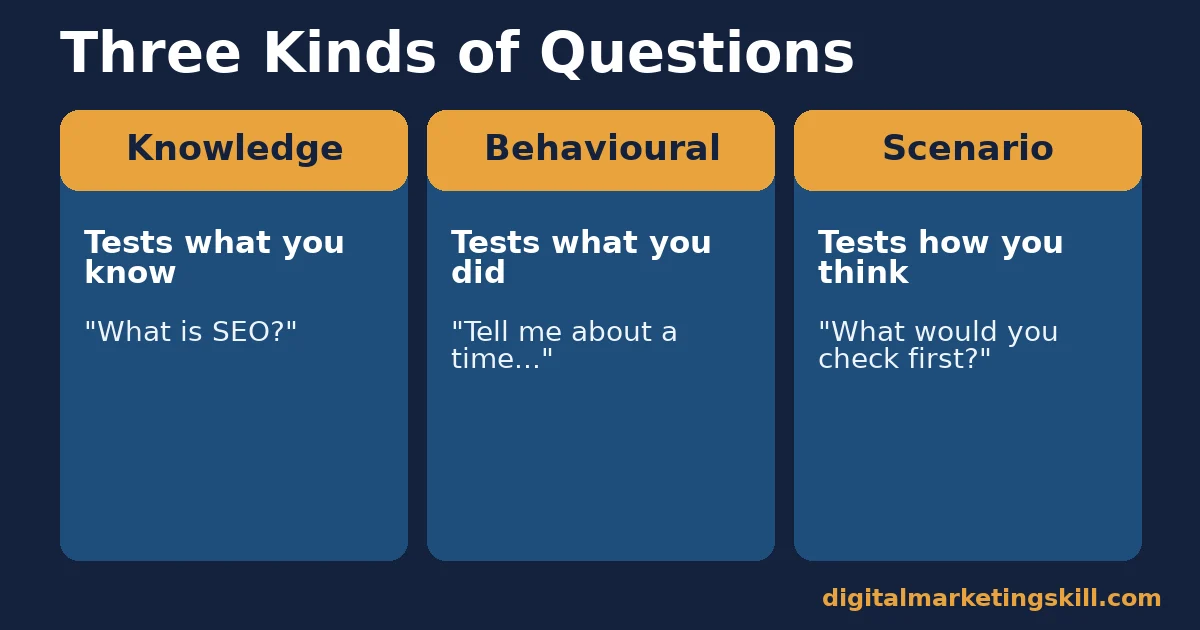
Most digital marketing interviews mix three question types. Each one is built to test something different, so treat them differently.
Knowledge Questions: Built to Test What You Know
These ask you to define a term or explain how something works. “What is SEO?” “How does a Google Ads auction work?” They test baseline competence, not your personal experience.
Behavioural Questions: Built to Test What You Have Done
These start with “Tell me about a time…” or “Describe a situation when…” They test real past behaviour, because past behaviour is the best signal interviewers have for how you will act on the job.
Scenario Questions: Built to Test How You Think
These describe a hypothetical situation and ask what you would do. “A campaign’s cost per lead doubled overnight. What do you check first?” They test your reasoning process, not a memorised fact.
How to Lead With Each Question Type
Knowing the type is step one. Structuring your answer for that type is step two.
Knowledge Questions: Lead With a Plain Definition, Then an Example
Give a short, plain-word definition first. Then immediately attach it to a real project where you used that concept. A definition alone sounds like a textbook. A definition plus one real example sounds like practice.
Take “What is SEO?” as an example. A weak answer recites a dictionary definition and stops there. A strong digital marketing interview answer defines it in one sentence, then adds: “On my last project, I used keyword research and on-page fixes to move a client’s blog post from page three to page one for its main term.” The second version proves the first.
Behavioural Questions: Lead With the Situation, Task, Action, Result Structure
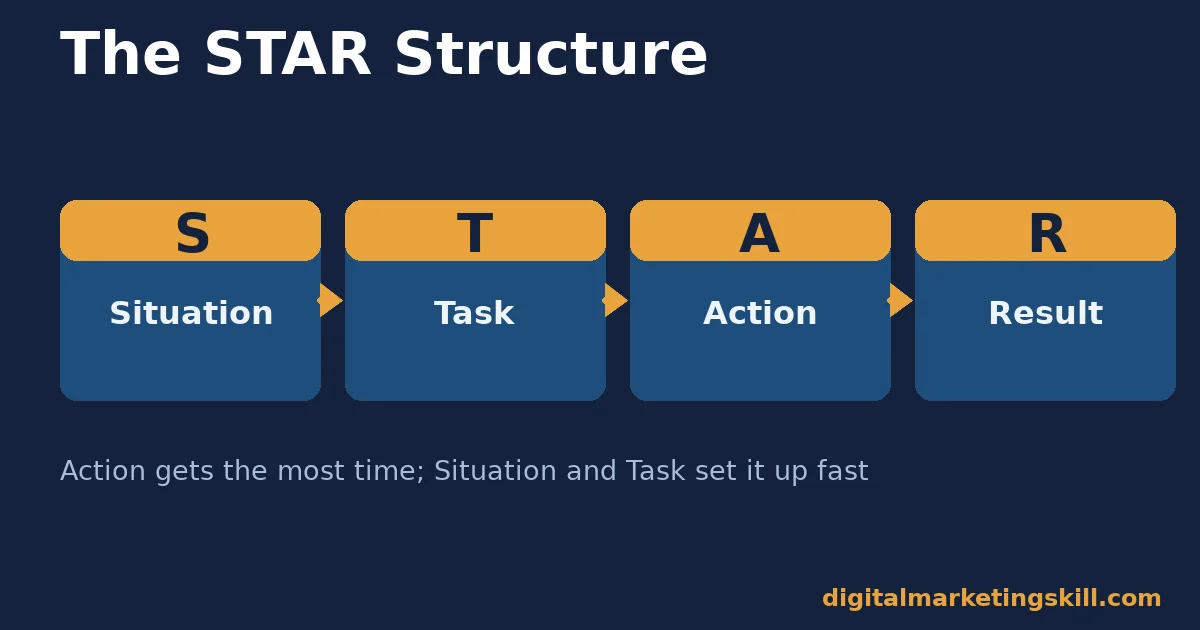
Set the Situation in one or two sentences. State the Task you were responsible for. Spend most of your answer on the Action, the specific steps you took. Close with the Result, a number or outcome wherever you can give one. This order keeps a behavioural answer from turning into a rambling story.
A question like “Tell me about a time a campaign underperformed” fits this structure well. Situation: the campaign’s cost per lead was rising. Task: you were asked to find out why within a week. Action: you audited targeting, creative, and landing pages, then paused the weakest ad set. Result: cost per lead fell back to target within ten days. Four short parts, one clear story, no rambling.
Scenario Questions: Lead With Your First Diagnostic Step
Do not jump straight to a fix. Name the first thing you would check, and why. Interviewers want to see your reasoning process, so walking through your diagnosis matters more than guessing the “correct” answer on the first try. Take the cost-per-lead example from the key takeaways: name the first three things you would check, in order, before naming a fix. That order is the real answer the interviewer is listening for. For the behaviours and body language that undercut even a good answer, see our guide to digital marketing interview mistakes to avoid.
A Five-Step Process to Prepare Your Digital Marketing Interview Answers
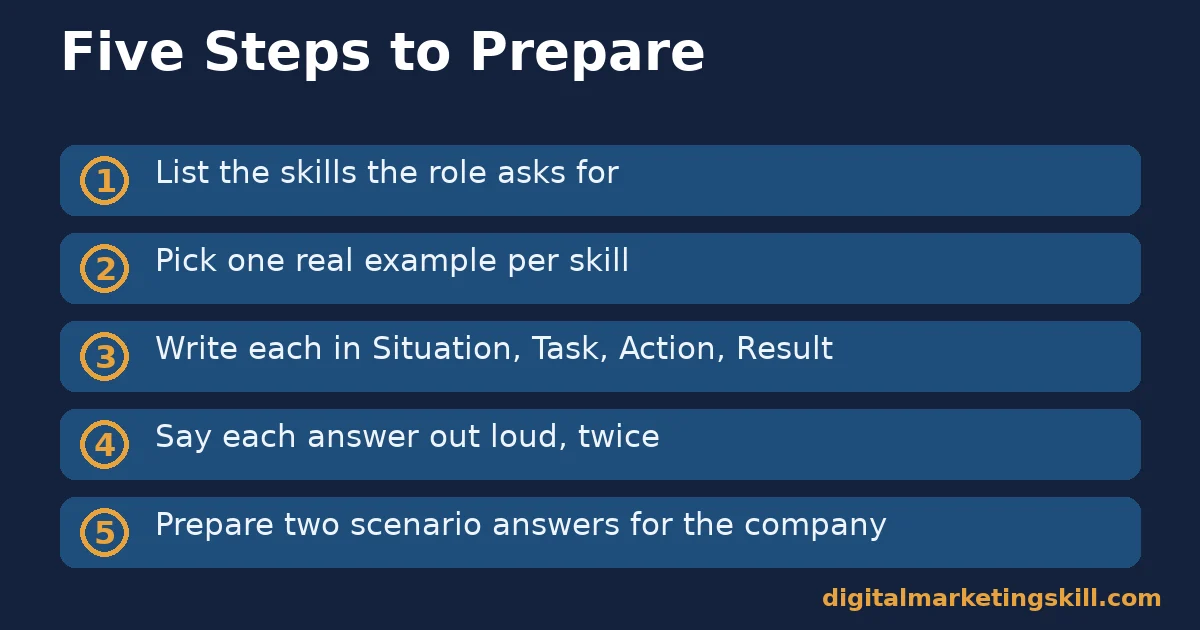
Preparation beats improvisation. Run through these five steps before any digital marketing interview, specialist or generalist role alike.
Step 1: List the Skills the Role Actually Asks For
Read the job description line by line and list every skill it names: SEO, paid social, email automation, analytics, whatever applies. This list becomes your map for which real examples you need to prepare.
Step 2: Pick One Real Example Per Skill
For each skill on your list, pick one real project, even a small one. A three-week social calendar counts. A single SEO audit counts. You need breadth across skills more than depth in any one story at this stage, since depth comes later once you know which skill the interview actually probes hardest.
Step 3: Write Each Example in the Situation, Task, Action, Result Structure
Write two or three sentences for each part. Keep the Action section the longest, since that is where interviewers learn how you actually work. Keep the Result section short but numeric wherever you can make it numeric.
Step 4: Say Each Answer Out Loud, Not Just in Your Head
An answer that sounds clear in your head often comes out tangled when spoken. Say each prepared story out loud at least twice before the interview, timing yourself so you learn roughly how long each one takes to tell.
Step 5: Prepare Two Scenario Answers for the Company’s Own Situation
Look at the company’s own marketing: their website, their social accounts, their recent campaigns. Prepare one honest observation and one scenario answer tied to something specific you noticed. This step alone usually separates a prepared candidate from an unprepared one, because it is the one piece of preparation most candidates skip entirely.
How to Know Your Digital Marketing Interview Answers Are Working
You cannot read a hiring manager’s mind in the room. But a few signals tell you whether your answers are landing.
Four Signals Worth Tracking
- Follow-up questions are a good sign. An interviewer who asks “what happened next” is engaged with your example, not just waiting for you to finish.
- Answer length balance matters. If every answer runs over three minutes, you are likely under-structuring; if every answer is under thirty seconds, you are likely under-explaining.
- Second-round rate is the share of first interviews that lead to a second round. A low rate across several interviews usually points to a structure problem, not a knowledge problem.
- Specific-example rate is how many of your answers actually named a real project, tool, or number. Count it honestly after each interview; it is the easiest one to improve fast.
How to Read These Signals Together
A high specific-example rate with a low second-round rate often means your examples are real but your structure is still loose. A low specific-example rate, on its own, is usually the first thing to fix. It is also the fastest, because it just needs you to prepare two or three real stories before your next interview, not a new skill.
A Note on Video Interviews
Many digital marketing interviews now happen over video, often across time zones. Video calls add a real strain on top of the content of your answer: Stanford researcher Jeremy Bailenson’s analysis of video-call fatigue found that maintaining eye contact and reading nonverbal cues on camera takes more effort than doing the same in person. So on video, be more deliberate than usual. Look at the camera, not the screen, while you deliver your answer, and leave a short pause before you start speaking so the connection has caught up.
The One Decision Rule: Lead With Proof, Not Just Knowledge
Here is the single most useful rule: for every question, reach for a specific proof point before you reach for a general explanation. Proof beats polish, almost every time. A rough but specific answer beats a smooth but generic one.
Here is an illustrative, invented example of the rule in action. Two candidates are asked how they would improve a client’s email open rate. The first gives a textbook answer: subject lines, send times, list segmentation. The second says the same three things, then adds one sentence: “In a past campaign, changing the subject line format alone moved open rate from around 18% to around 27%.” Those numbers are invented for illustration. The second answer is not smarter. It is just specific, and specific is what interviewers remember.
Three Weak Digital Marketing Interview Answers, Fixed
Seeing the fix next to the problem makes the structure easier to apply under pressure.
Weak: “I’m a hard worker who is passionate about marketing”
This is a weak digital marketing interview answer because it is true of almost every candidate and proves nothing. Fixed: name one project where that work ethic produced a specific, checkable result. Finishing a client’s SEO audit two days early, and finding three quick wins the client implemented immediately, works well.
Weak: “I would look at the data and optimise the campaign”
This sounds reasonable but is too vague to count as a strong digital marketing interview answer. Fixed: name the first metric you would check, the second thing you would check if that metric looked fine, and roughly how long each check would take.
Weak: “The campaign failed because the client wouldn’t approve my recommendations”
Blaming the client, even if partly true, reads poorly in any digital marketing interview answer. Fixed: describe what you did try, what you learned from the constraint, and how you adjusted your approach within it. That answer shows judgement under a real limit, which is closer to what the job actually involves.
A Real Case: What Confidence Built on Proof Looks Like
A Digital Marketing Skill Institute graduate, Anselem Orisakwe, is described in a published review this way: “Got a job in Canada… using his globally recognised certificate.” Behind a result like that sits an interview process the candidate had to get through, almost certainly across a time zone and without an in-person meeting.
Treat this as one real, published outcome, not a guarantee; results vary by person, market, and timing, and are not typical for every graduate. See the Institute’s earnings disclaimer for the limits on any student outcome example.
What Changes in Digital Marketing Interview Answers for Senior Roles
The structure stays the same at every level. What changes is the scale of the example and who it involves.
At junior level, a strong digital marketing interview answer usually centres on an individual project: one campaign, one audit, one email sequence you ran yourself. At senior level, interviewers expect more. The Action section of your answer should include other people: who you briefed, who you had to convince, and how you managed disagreement over strategy.
A senior digital marketing interview answer that still only talks about individual tasks often reads as a level below the role being interviewed for. The fix is simple: for each prepared story, add one sentence about who else was involved and what you asked of them.
Frequently Asked Questions About Digital Marketing Interview Answers
How do I answer “tell me about yourself” in a digital marketing interview?
Keep it work-focused, not a full life story. One of the strongest digital marketing interview answers to this question covers your current or most recent role, one or two specific wins, and why this particular role interests you, in under ninety seconds.
What is the best way to answer “what are your weaknesses”?
Name a real, specific weakness, then describe the concrete step you are taking to address it. A vague, rehearsed weakness like “I work too hard” usually reads as evasive rather than honest.
Should I memorise answers word for word?
No. The most reliable digital marketing interview answers come from a memorised structure, not memorised sentences. A word-for-word script breaks the moment the interviewer asks a follow-up question that was not in your script.
How do I answer a question about a tool or platform I have not used?
Say so directly, then bridge to a similar tool you have used and how fast you picked it up. Pretending familiarity you do not have is usually easy to spot and hard to recover from.
What if I do not have a real example for a behavioural question?
Use the closest real example you have, even from a course project, freelance work, or a volunteer role, and say clearly where it came from. A smaller real example still beats an invented big one, and honest digital marketing interview answers always beat invented ones. A digital marketing internship is one reliable way to build a fresh supply of these examples before your next interview round.
How many examples should I prepare before an interview?
Prepare three to five real stories that each cover a different skill, such as one for SEO, one for a campaign you ran, and one for solving a problem under pressure. Most behavioural questions can be answered by adapting one of those three to five stories.
How should I answer “Why do you want to work here?”
Name one specific thing you noticed about the company’s own marketing, not a generic compliment. A specific observation shows you actually researched them before the interview, which is a strong digital marketing interview answer in its own right.
What should I ask the interviewer at the end?
Ask one question that shows you were listening, tied to something they mentioned earlier, and one question about how success is measured in the role. Both signal genuine interest more than a list of generic questions copied from a template. Save at least one question for this moment, even if earlier answers already covered most of what you planned to ask, because arriving with nothing left to ask can read as a lack of real curiosity about the role.
Prepare Your Digital Marketing Interview Answers With Real Proof
Strong digital marketing interview answers come from real, specific experience, structured clearly, not from a memorised script. Prepare three to five real stories, learn the structure that fits each question type, and lead with proof every time. Come back to this guide before your next interview and re-read the question type that matches what you are about to face.
What a Structured Program Adds
If you want a structured way to build the skills and real projects your interview answers can draw on, the Digital Marketing Skill Institute’s Master Diploma in Digital & AI Marketing covers all four AI-powered tracks: AI-Powered Social Media Management and Advertising, AI-Powered Lead Generation and Email Automation, AI-Powered Google Specialist, and AI-Powered WordPress and SEO Specialist, totalling ten courses, with a Full Stack option for completing all four.
It includes unlimited one-on-one coaching and mentoring and a U.S. Project Internship with a verified U.S. Work Reference Letter, the kind of real, specific experience that makes a strong interview answer. The program is dual US and UK accredited and recognised in more than 100 countries, delivered 100% online, so you can study and apply it anywhere in your country.
Explore the Master Diploma program for the full curriculum, read real outcomes on the reviews page, browse more guides on the blog, and when you are ready to commit, apply here. Wherever you live, you can prepare real proof and walk into your next interview ready. Learn more at Digital Marketing Skill Institute, or begin directly at digitalmarketingskill.com.
Every figure in this guide was checked against its original source before publication. Figures marked as illustrative are invented examples, not real results.
![9 Amazing Digital Marketing Skills to Make Money Online [With Proof]](https://digitalmarketingskill.com/wp-content/uploads/2019/07/9-Amazing-Digital-Marketing-Skills-to-Make-Money-Online-With-Proof-17.png)






