
Digital marketing recruitment is the process employers use to source, screen and hire marketing talent. Most candidates lose at a screen they never see. A resume filter removes some applicants before a human reads them. A skills or portfolio check removes more. Only a handful reach an interview. Understanding each screen, and what it actually checks for, is how a candidate gets through all three.
Key Takeaways
- Hiring managers are genuinely struggling to find skilled candidates. Robert Half surveyed 245 marketing and creative hiring managers. It found 45% say finding skilled professionals is harder than a year earlier. The gap is worst in analytics, automation and AI integration.
- Skills shortages are not just an inconvenience. The same Robert Half survey found 52% of leaders reported project delays from skills shortages. 40% reported a project cancelled outright.
- A marketing vacancy takes weeks, not days, to fill. Public Insight’s analysis of 108,000 US marketing job postings found an average time to fill of 38.7 days. A slow candidate still has a real window to apply.
- Soft skills top the advertised list. The same Public Insight analysis found communication, project management and cross-functional collaboration advertised more often than any single marketing tool or platform.
- Marketing and advertising roles already pay above the typical worker. The US Department of Labor’s O*NET data for market research analysts and marketing specialists lists a median wage of $78,760 a year, and growth is described as much faster than average.
In this guide
- What Most Advice on Digital Marketing Recruitment Misses
- How Digital Marketing Recruitment Actually Works
- Digital Marketing Recruitment Runs Through Three Filtering Screens
- How to Pass Each Screen in Digital Marketing Recruitment
- How to Measure Progress in a Digital Marketing Recruitment Search
- The Most Useful Rule: Fix the Earliest Failing Screen First
- A Real Case: Why One Institute Built Recruitment Help Into Training
- A Four-Week Plan to Work Through Digital Marketing Recruitment
- Frequently Asked Questions About Digital Marketing Recruitment
- Start With Your Weakest Screen, Then Move to the Next
What Most Advice on Digital Marketing Recruitment Misses
Most advice on digital marketing recruitment tells job seekers to build a strong resume and “network more.” That advice is not wrong. But it skips the actual mechanism: a filtering process with distinct stages, each checking for something different.
This guide explains how digital marketing recruitment actually works, stage by stage, for both the employer running it and the candidate going through it. It names what each stage filters for and gives one way to pass it.
A few ground rules first. The figures below are named, scoped studies, not a universal guarantee. Several are US-focused staffing and job-board data, not a worldwide census, and are marked as such. Hiring practices vary by company size, industry and country, so treat every number here as an informed pattern, not a rule.
How Digital Marketing Recruitment Actually Works
A typical digital marketing recruitment process runs through four stages: sourcing, screening, interviewing and the offer. Sourcing is how the employer finds candidates, through job boards, referrals, agencies or direct outreach.
Screening narrows that pool. It often starts with an applicant tracking system reading resumes for keywords before a person ever opens one. This is not a small-company quirk. Jobscan’s ATS Usage Report detected an applicant tracking system at 97.4% of Fortune 500 companies. The researchers built that figure by reverse-engineering each company’s own career page.
Robert Half’s Demand for Skilled Talent survey of 245 marketing and creative hiring managers found that 65% plan to expand permanent headcount. A further 55% expect to increase contract or temporary hiring. That demand is real, but it sits alongside a stated skills gap.
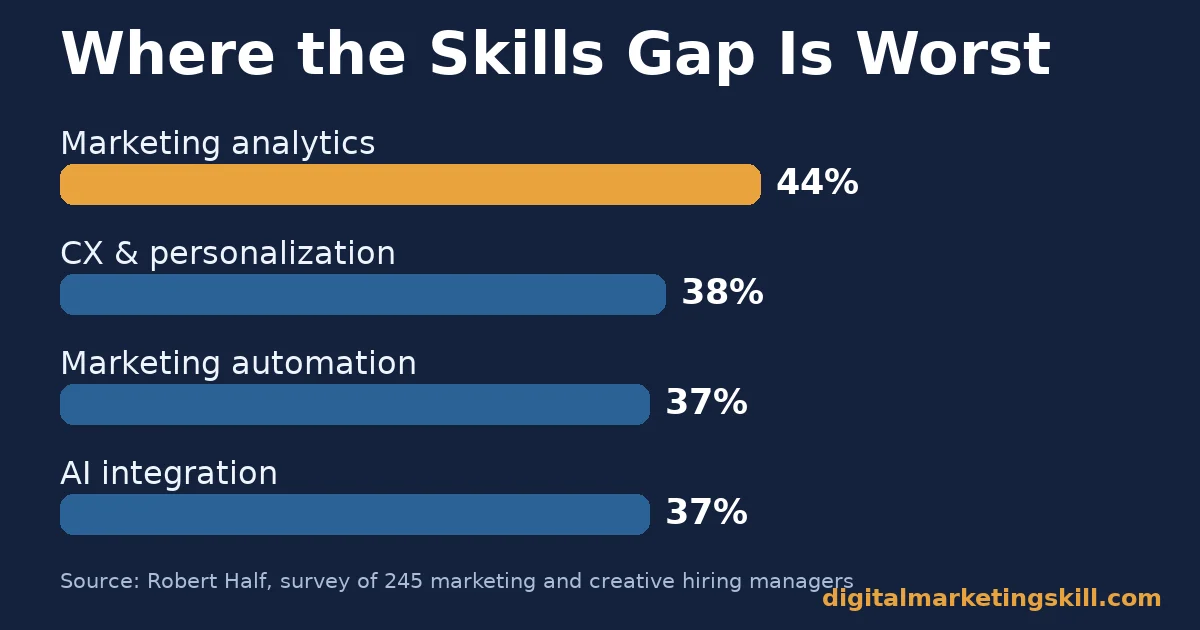
The same survey found skills gaps concentrated in marketing analytics and performance (44%), customer experience and personalization (38%), marketing automation (37%) and AI integration into workflows (37%).
Scale backs up the demand. Public Insight’s TalentView analysis tracked 108,000 US marketing job postings. It found an average time to fill of 38.7 days. A role that stays open for weeks is not a role with too many strong candidates. It is usually a role where the employer cannot find the specific mix of skills it is filtering for.
For a candidate, that gap is an opportunity. A role still open after the typical window is often still genuinely searching, not quietly filled behind the scenes.
Digital Marketing Recruitment Runs Through Three Filtering Screens
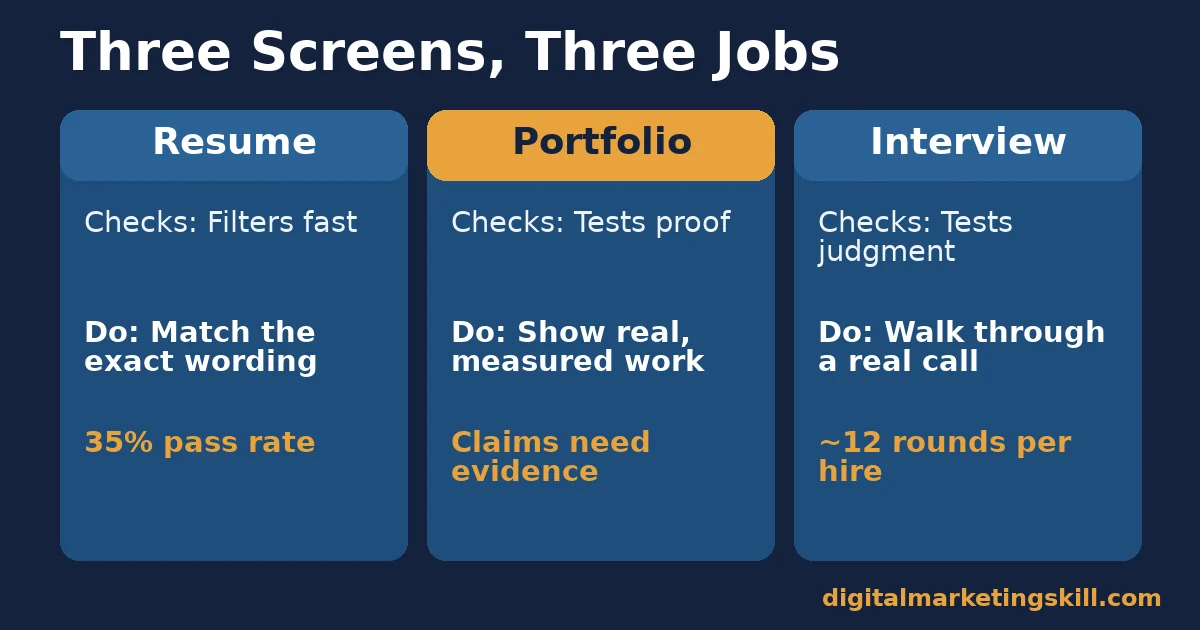
Almost every hiring process funnels candidates through the same three screens, whether the employer calls them that or not. Each screen checks for something different. Failing one ends the process, regardless of how strong a candidate is at the next stage.
The Resume Screen: Built to Filter Fast, Not Fairly
The resume screen exists to cut a large applicant pool down to a manageable one, quickly. An applicant tracking system often scans for keywords that match the job posting before a recruiter reads anything.
Public Insight’s top ten advertised skills for marketing postings included project management, cross-functional collaboration and marketing analytics, alongside the expected channel skills. A resume listing only channel names (social, email, SEO) without these connecting skills can get filtered out early.
This screen is genuinely the hardest to pass cold. Ashby’s Recruiting Operations Benchmarks report analysed more than 54 million applications across 93,000 jobs. It found only a 35% passthrough rate at the initial screen, the lowest of any hiring stage it measured. A referral changes the odds: referred candidates passed that same screen 52% of the time.
The Skills or Portfolio Screen: Built to Separate Claims From Proof
Candidates who pass the resume screen usually face a skills check next. That might be a portfolio review, a case study, a short task, or a certification check. This screen exists because resumes are self-reported and easy to inflate. So employers want evidence a candidate actually did the work they claim, not just a description of it.
The Interview Screen: Built to Test Judgment, Not Just Knowledge
The interview screen is where employers test judgment. They want to see how a candidate reasons through a real scenario, not just whether they know a definition. This is usually the most expensive screen to run, so employers protect the time by only inviting candidates who already cleared the first two.
It is also getting longer. Ashby’s same benchmarks report found business interviews per hire rose to an average of 11.7, up over a third from a few years earlier. A single conversation rarely decides a digital marketing recruitment outcome anymore. Expect several rounds, often with different people testing different judgment calls.
How to Pass Each Screen in Digital Marketing Recruitment
Passing each screen means matching what it actually checks for, not generic advice to “stand out.”
The Resume Screen: Lead With the Exact Language of the Posting
Mirror the job posting’s own language for skills and tools. An applicant tracking system usually matches text, not meaning. A synonym you consider obvious may simply not register.
Then pair every channel skill (social, email, SEO, paid media) with a connecting skill the posting also lists. Project management, analytics and cross-functional collaboration are good examples. Public Insight’s data shows those among the most advertised competencies, one more reason to name them explicitly rather than assume they are implied.
Keep the resume to real, specific outcomes. “Grew organic traffic” is a claim. “Grew organic traffic 40% over six months by restructuring site navigation” is evidence the next screen can verify.
Illustrative, invented example of the difference: a weak line reads “Managed social media accounts.” A line built to pass the screen reads “Managed four social accounts, grew combined engagement 22% over a quarter, and cut content production time by reusing a repeatable template.” The second line repeats a connecting skill (process, measurement) alongside the channel skill, which is exactly what the resume screen is built to catch.
The Skills or Portfolio Screen: Lead With Verifiable Work
Build a small portfolio before you need one. Two or three pieces of real or illustrative work are enough, each showing the goal, the action taken and the measurable result. If the work is illustrative because you have not had a paid role yet, say so plainly. Do not imply it was a client project.
Walk through your reasoning, not just the output. A portfolio piece that explains why you chose a channel or a metric shows the judgment the next screen will test anyway. That can shorten the whole process.
Expect More Rounds Than You Did a Few Years Ago
Plan for a longer interview process than you may expect. With business interviews per hire averaging close to 12 across Ashby’s dataset, a single strong conversation is rarely the whole story. Each round often tests a different thing: one for strategic thinking, one for collaboration style, one for a hiring manager’s direct fit check.
Ask early in the process how many rounds to expect and who you will meet at each one. That single question lets you prepare differently for a technical skills round than for a culture or stakeholder-fit round, instead of repeating the same generic answers at every stage.
The Interview Screen: Lead With a Real Decision You Made
Prepare two or three real situations where you made a marketing decision under some uncertainty: a budget cut, a channel underperforming, a conflicting stakeholder request. Walk through what you chose, why, and what you would do differently now.
Ask the interviewer what the role’s first real deliverable will be in the opening weeks. The answer tells you what the team actually values, which is often different from what the job posting emphasizes.
Use a Referral to Skip the Hardest Screen
Ashby’s data showed referred candidates passing the initial screen at 52%, against 35% overall. Before applying cold, spend fifteen minutes checking whether anyone in your network already works at the company, even in a different department. Ask for an introduction rather than sending a blind application.
How to Measure Progress in a Digital Marketing Recruitment Search
Whether you are hiring or job hunting, a recruitment search is only as good as what you track. These are the numbers that show whether your approach to digital marketing recruitment is actually working, rather than just busy.
Five Metrics That Show Real Progress
- Response rate is replies divided by applications sent. A very low response rate across many applications usually points to a resume-screen problem, not an interview problem.
- Screen-to-interview rate is interview invitations divided by completed skills or portfolio screens. A low rate here suggests the portfolio is not providing convincing evidence.
- Interview-to-offer rate is offers divided by completed interviews. This is the clearest signal of how your interview answers are landing, separate from resume or portfolio quality.
- Time to fill, for employers, is the days between posting a role and an accepted offer. Public Insight’s 38.7-day average is a useful benchmark to compare your own process against.
- Quality of hire, for employers, is typically a 90-day or 6-month performance check against the goals set at hiring. A fast time to fill with poor quality of hire usually means the screens were not checking for the right thing.
Reading These Numbers Together
No single metric diagnoses the problem. A strong response rate with a weak screen-to-interview rate points to the portfolio, not the resume. A strong interview-to-offer rate with few interviews overall points to the earlier screens, not your interview performance. Track all three together before changing your strategy.
SHRM’s own recruiting benchmarking research found screening and interviewing each averaging 8 to 9 days, together making up over two weeks of a roughly five-week hiring cycle. If your search is stretching past that, the delay is probably sitting inside one of those two stages, not the offer stage at the end.
The Most Useful Rule: Fix the Earliest Failing Screen First
Work on the screen where you are losing the most candidates, not the screen you find most uncomfortable. A candidate who struggles with interviews but rarely gets invited to one has a resume or portfolio problem to fix first. Polishing interview skills will not matter until more interviews happen.
Illustrative, invented numbers to show the logic: a candidate sending 40 applications and getting 2 replies has a resume-screen problem, worth fixing before anything else. A candidate getting 10 replies and 1 interview has a portfolio-screen problem.
A candidate getting 5 interviews and no offers has an interview-screen problem. Each case points to a different fix, and working on the wrong one wastes the most limited resource in a job search: time.
A Real Case: Why One Institute Built Recruitment Help Into Training
Digital Marketing Skill Institute built hiring support directly into its training. The decision followed a pattern: graduates kept passing skills checks but stalling at the resume screen, the earliest and most invisible filter in digital marketing recruitment.
Ayooluwa Osemi, a published result on the Institute’s reviews page, described spending a small amount on a Facebook and Instagram ad test and generating measurable sales from it. That is exactly the kind of specific, verifiable outcome a resume screen and a portfolio screen both respond to.
The limit on this case: it is one published, self-reported result from the Institute’s own reviews page, not an independent audit, and results vary by effort, market and starting point. It illustrates the mechanism, not a guarantee.
A Four-Week Plan to Work Through Digital Marketing Recruitment
A staged plan beats applying to everything at once, because it gives you real numbers to diagnose before you have burned through your best opportunities.
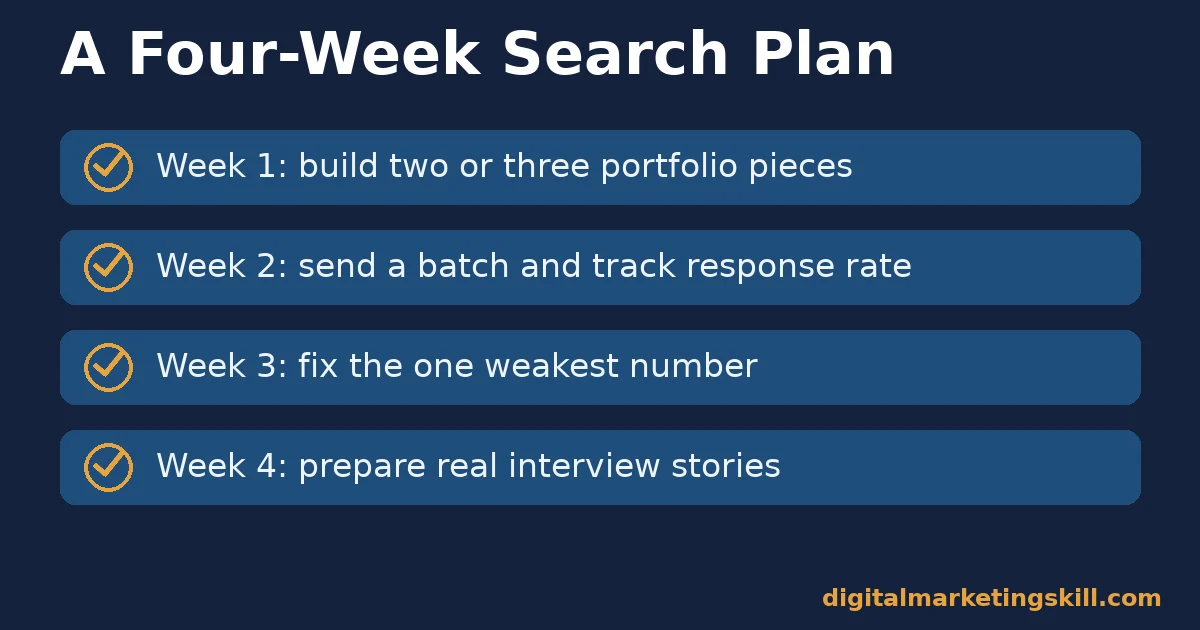
- Week one: build the portfolio first. Assemble two or three pieces of verifiable work before sending a single application. Applying without proof ready wastes the reply you worked to earn.
- Week two: send a batch and track the response rate. Apply to ten to fifteen roles that closely match your actual skills, using the posting’s own language on each resume. Log replies against applications sent.
- Week three: fix the weakest number. If replies are low, rework the resume keywords. If replies come but interviews do not, rework the portfolio. Do not change both at once, or you will not know which fix worked.
- Week four: prepare real interview stories. Once interviews start, prepare the two or three real decisions mentioned above, and rehearse them out loud, not just in your head.
Repeat the cycle every few weeks rather than applying continuously without checking the numbers. Because each cycle produces real data, you are never guessing at week five the way you were at week one. A search that is not working after a full cycle needs a changed approach, not just more applications sent the same way.
Frequently Asked Questions About Digital Marketing Recruitment
What do digital marketing recruiters look for first?
Most recruitment processes filter on an applicant tracking system before a person ever reads a resume closely. Matching the job posting’s own language for skills and tools is the first practical filter to pass, before polish or formatting matters.
Do I need a certification to pass a digital marketing recruitment screen?
A certification can support a resume screen by matching keywords the posting lists. It rarely passes a skills or portfolio screen on its own. Employers in Robert Half’s survey pointed to analytics, automation and AI integration as the biggest gaps, which are demonstrated through work, not a certificate alone.
How long does digital marketing recruitment usually take?
Public Insight’s analysis of 108,000 US marketing postings found an average time to fill of 38.7 days. That is an aggregate US figure. Individual roles vary by seniority, company size and how specific the skills requirement is.
Is a portfolio more important than a resume in digital marketing recruitment?
They check different things. The resume gets you past the first filter; the portfolio proves the claims on it. A strong portfolio cannot fix a resume that never reaches a human reader, and a strong resume cannot survive a portfolio with no real evidence behind it.
What is the biggest skills gap employers report in digital marketing recruitment?
Robert Half’s survey of 245 marketing and creative hiring managers found the largest gaps in marketing analytics and performance, AI and automation, and email-campaign strategy and execution. Candidates who can show real, specific work in these areas stand out against a shortage employers are actively reporting.
Should I apply even if I do not match every requirement?
Yes, within reason. A job posting is a wish list, not a pass/fail test, and the resume screen filters on overlap, not a perfect match. So prioritize the skills the posting repeats most, plus the connecting skills (project management, analytics, collaboration) that Public Insight’s data shows employers advertise most often. A missing nice-to-have rarely sinks an otherwise strong match.
What does the O*NET data say about pay and growth in marketing careers?
The US Department of Labor’s O*NET profile for market research analysts and marketing specialists lists a median wage of $78,760 a year, with growth described as much faster than average. That is a US government estimate for a broad occupational group, not a guarantee for any single role or country.
Start With Your Weakest Screen, Then Move to the Next
Whether you are hiring for a role or applying to one, digital marketing recruitment rewards the person who diagnoses which screen is actually failing and fixes that one first. Track your numbers for a month before changing your whole approach, wherever in your country you happen to be searching.
If you want structured help getting through every screen in digital marketing recruitment, from portfolio work to interview practice, the Institute’s Master Diploma in Digital & AI Marketing combines nine practical courses with unlimited one-on-one coaching and mentoring and real project work inside a U.S. company.
It is dual US and UK accredited, recognised in more than 100 countries, and delivered 100% online, so you can build a portfolio wherever you live.
Related reading on the skills a social media manager needs and digital marketing tools can help you prepare answers for the skills screen above. Browse more guides on the digital marketing blog, read real outcomes on the reviews page, or see the full program and apply at digitalmarketingskill.com. Wherever you live, those free guides at digitalmarketingskill.com are a reasonable place to start before your next application.
Every figure in this guide was checked against its original source before publication. Figures marked as illustrative are invented examples, not real results.
![9 Amazing Digital Marketing Skills to Make Money Online [With Proof]](https://digitalmarketingskill.com/wp-content/uploads/2019/07/9-Amazing-Digital-Marketing-Skills-to-Make-Money-Online-With-Proof-17.png)