
A digital marketing strategy is a written plan. It prioritizes channels by evidence, sets a budget tied to revenue, and defines how you measure success before you spend. Companies plan around an average marketing budget of 7.7% of revenue, yet most SMEs still choose channels by guesswork. This guide gives you a five-step framework to fix that.
Key Takeaways
- Budgets are shrinking and need discipline. Gartner’s CMO Spend Survey of roughly 400 marketing leaders found average marketing budgets at 7.7% of company revenue, down from 11% in prior years (reported via Marketing Brew). Every channel in your plan has to earn its share.
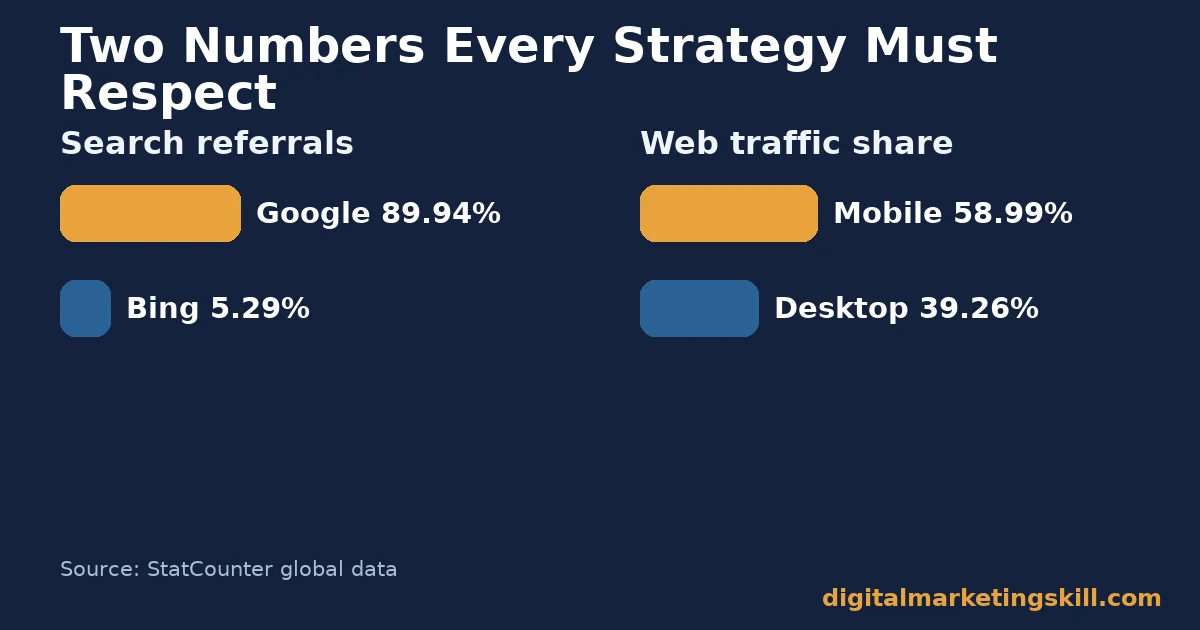
- Google is not the whole search market. StatCounter puts Google at 89.94% of global search referrals, with Bing at 5.29% and Yandex and others splitting the rest. A strategy built only around Google ignores a real, if smaller, audience.
- Mobile now leads, but desktop still matters. StatCounter’s global traffic data shows mobile devices at 58.99% of page views against 39.26% for desktop. A strategy that is not mobile-first is already behind most visitors.
- Blogging compounds leads over months. HubSpot’s internal review of 2,300 customers found blogging businesses grew monthly leads by 165% over six months, against 73% for non-blogging businesses.
- Most pages never get found at all. Ahrefs studied about 14 billion pages and found 96.55% get no traffic from Google, so picking the right topics matters more than publishing volume.
In this guide
In this guide
- What Most Digital Marketing Strategy Advice Misses
- How a Digital Marketing Strategy Actually Works
- The Five-Step Digital Marketing Strategy Framework
- How to Apply Each Step of the Framework
- Why Relying on One Channel Is the Most Common Mistake
- How to Measure a Digital Marketing Strategy
- The Most Useful Rule: Fund What Is Proven Before Funding What Is Promising
- A Real Case: One Channel, Focused and Scaled
- Frequently Asked Questions About Digital Marketing Strategy
- Your Next Step
What Most Digital Marketing Strategy Advice Misses
Most advice on digital marketing strategy is a channel checklist: do SEO, run ads, post on social, send emails. None of that is wrong. But a checklist is not a strategy. A strategy decides which channels deserve your limited budget first, and which can wait.
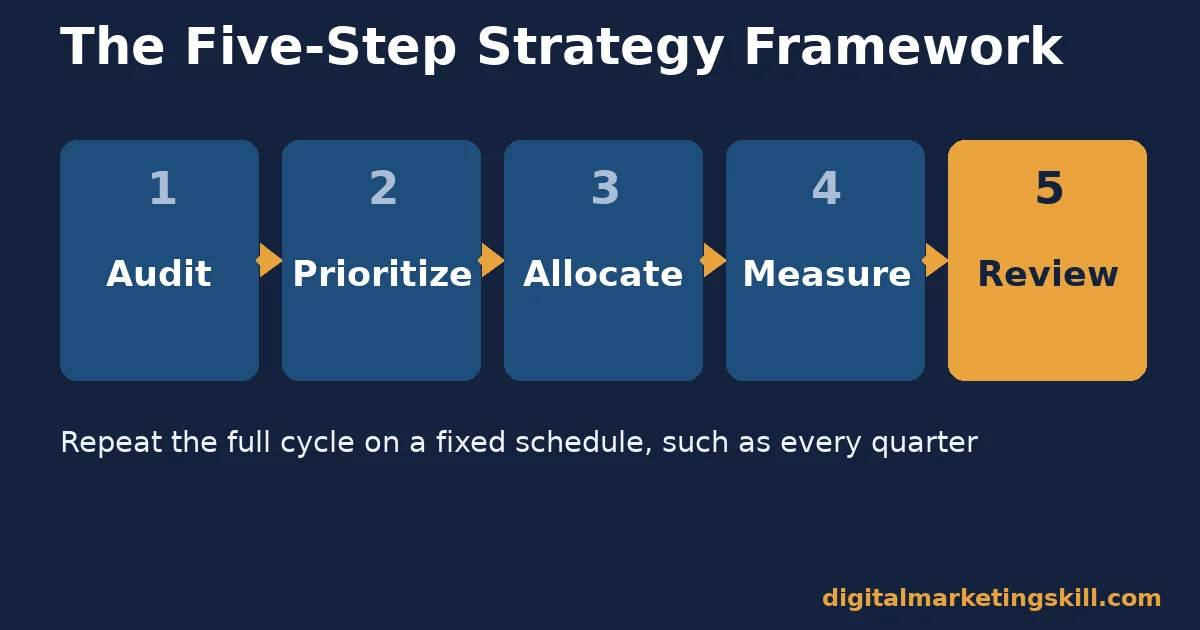
This guide treats a digital marketing strategy as a five-step framework. Audit what already works. Prioritize channels by evidence, not habit. Allocate a budget that matches your goals. Measure the right numbers. Then revisit the plan on a fixed schedule. Skip a step, and the ones after it rest on guesswork.
A few ground rules first. The budget figures below come from Gartner’s survey of roughly 400 CMOs, mostly at larger companies across North America, the UK and Europe. Read them as a benchmark from bigger budgets, not a rule for every business size. Every other figure names its source and scope, so you can judge it the same way. Treat every number as a snapshot, not a permanent ranking.
How a Digital Marketing Strategy Actually Works
A strategy only works if it answers three questions in order. Where are customers already looking? Where does your business have a real chance to be seen there? How much budget does each channel deserve? Most businesses answer these backwards. They pick a channel first and hope customers show up.
Audience behavior sets the ceiling on every channel choice. If most buyers search before they purchase, your strategy needs search visibility. If they discover brands through short video, your strategy needs that format too. Budget then decides how much of each channel you can run well. A thin effort across six channels usually loses to a focused effort on two.
Measurement closes the loop. Without agreed metrics, a failing channel can look fine for months. A channel that is quietly working gets cut for looking slow. The framework below forces audit, prioritization, budget and measurement into one repeatable cycle, not four separate decisions made at different times.
The Five-Step Digital Marketing Strategy Framework
Each step below builds on the one before it. Do them in order the first time you build a strategy. Then repeat the whole cycle on a fixed schedule, such as every quarter.
Step One: Audit What Is Already Working
Before adding a new channel, list every channel you already use. Note how much traffic, leads or sales each one produced over the last three months. Most businesses skip this step. They chase new tactics while an existing channel is already quietly proving itself.
This is also where you check channel concentration risk. StatCounter’s search engine data shows Google carries 89.94% of global search referrals, with Bing at 5.29% and smaller engines splitting the remainder. If all your organic traffic depends on one platform’s algorithm, flag that as a risk in your audit, not a strength.
Step Two: Prioritize Channels by Evidence
Rank each channel by two factors: how many of your actual customers use it, and how much competition you face for their attention there. A channel with real demand and light competition deserves priority over a crowded channel with uncertain demand.
Device behavior belongs in this ranking too. StatCounter’s global traffic data puts mobile devices at 58.99% of page views against 39.26% for desktop. So any channel you prioritize needs a mobile experience that actually works, not a desktop page that merely resizes.
How to Apply Each Step of the Framework
Knowing the five steps is only useful once you apply them. The sections below mirror the framework above, in the same order, with one concrete move for each step.
Audit: Pull Three Months of Real Numbers
Open Google Analytics and Search Console. List sessions, leads and sales by channel for the last three months. Do the same for email and social platforms, using their own reporting. This single spreadsheet becomes the baseline every later decision gets compared against.
Prioritize: Pick Two Channels to Own This Quarter
From your ranked list, commit real budget and time to no more than two channels this quarter. A focused channel usually beats a thin presence spread across six. Depth earns search rankings, algorithm favor and audience trust that a shallow effort never reaches. Our guide to driving traffic from social platforms and search covers the mechanics once you have picked your two.
Step Three: Allocate a Budget Tied to Revenue
Set your total marketing budget as a percentage of revenue. Then split it across your prioritized channels, rather than splitting it evenly by habit. Gartner’s CMO survey found average marketing budgets at 7.7% of company revenue among larger companies. Use that as a useful anchor, even if your own percentage differs by size and goals.
Inside that budget, weight content and email higher than most businesses expect. Litmus’s State of Email survey of nearly 500 marketing professionals found most companies report returns between $10 and $36, and some over $50, for every $1 spent on email. Few channels post that range of return. That is why abandoning an email list in favor of paid ads alone is usually a mistake.
Step Four: Measure the Numbers That Predict Revenue
Choose metrics that predict revenue, not just activity. Page views and follower counts feel productive, but they rarely predict sales on their own. Pair each channel with one leading metric, like qualified leads or email click rate, and one lagging metric, like closed revenue. That way you see a problem before the quarter ends, not after. Our guide to online marketing metrics worth tracking covers more of these in detail.
Content strategy needs this discipline most, because publishing feels like progress even when it is not working. Ahrefs’ study of about 14 billion pages found that 96.55% get no traffic from Google. So track whether your specific posts are ranking and earning clicks, not just whether you published on schedule.
Step Five: Review and Rebuild on a Fixed Schedule
Put a date on the calendar, every quarter, to repeat the audit and reprioritize. Markets, algorithms and competitors change faster than most strategies get revisited. A plan that was right two years ago can be quietly wrong today, and nobody notices.
Treat the review as a real decision point, not a formality. If a prioritized channel underperformed for two straight quarters, drop it. Promote whichever channel is already showing signs of working.
Why Relying on One Channel Is the Most Common Mistake
The single most common strategy failure is not picking the wrong channel. It is depending on one channel so heavily that a single algorithm update, platform policy change or competitor move can cut off most of your traffic overnight.
Search concentration is the clearest example. Google carries close to 90% of global search referrals. A business that ranks well there can feel secure, right up until an algorithm update changes rankings industry-wide. A digital marketing strategy that also builds an email list and a direct audience is not duplicating effort. It is insurance against that single point of failure.
Diversify Without Diluting Your Effort
Diversifying does not mean being active everywhere at once. It means owning two or three channels well, while keeping a baseline presence, like a claimed profile and basic content, on a few others. That way you are not starting from zero if you need to shift focus.
Email is the easiest second channel to build alongside search. You already own the list, and you do not depend on any platform’s algorithm to reach it. Building a consistent brand presence across whichever channels you choose makes each one perform better, because visitors recognize you faster when they move between them.
How to Measure a Digital Marketing Strategy
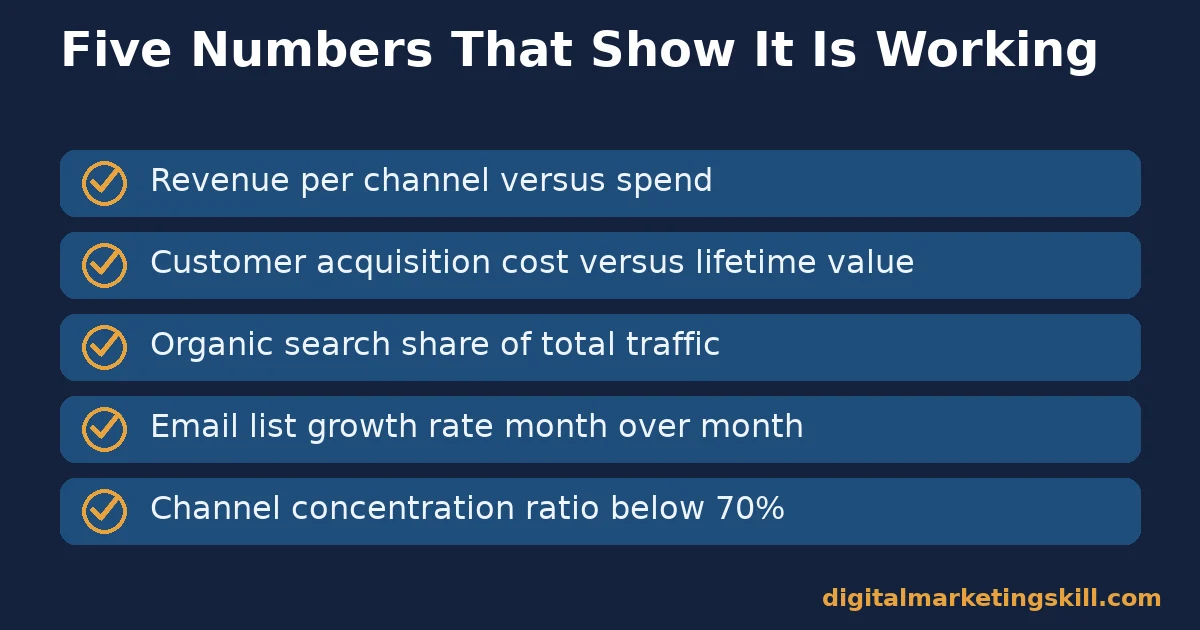
Five numbers show whether your strategy, as a whole, is working, beyond the per-channel metrics in Step Four above.
Five Numbers That Show the Strategy Is Working
- Revenue per channel versus spend. This divides revenue attributed to a channel by what you spent on it. Compare it across channels monthly to see which ones are actually earning their budget share.
- Customer acquisition cost. This is total spend divided by new customers gained. Track it alongside customer lifetime value, since a low acquisition cost means little if those customers rarely return.
- Organic search share of traffic. This is the percentage of visits from unpaid search. A rising share shows your content and SEO work is compounding, instead of requiring constant new spend.
- Email list growth rate. This tracks how fast your owned audience grows each month. A shrinking or flat list means your strategy is not building an asset you fully control.
- Channel concentration ratio. This is the share of total traffic or revenue coming from your single largest channel. A ratio above roughly 70% signals the single-point-of-failure risk described above.
How to Read These Numbers Together
Read revenue per channel and acquisition cost together first. A channel can look cheap per click and still be expensive per customer. Then check organic share and list growth, since both should rise over time as the strategy compounds, rather than needing constant new spend to stay flat.
Check the concentration ratio last, because it is a warning signal, not a performance number. A high ratio does not mean cut the leading channel. It means start building a second one before you are forced to.
The Most Useful Rule: Fund What Is Proven Before Funding What Is Promising
If you take one decision rule from this guide, make it this one. When budget is limited, give proven channels their full share first. Fund new or experimental channels only with what is left over.
Here is an illustrative example, with invented numbers. A small business has a $5,000 monthly marketing budget split evenly across five channels. One channel, email, consistently returns $20 for every $1 spent. Two others have never produced a traceable sale.
The owner shifts $2,000 of the untraceable spend into email and content, keeping $1,000 for genuine experiments. Over the next quarter, overall revenue per dollar spent rises, because money moved from unproven channels into a channel already shown to work.
The lesson is about sequencing, not about avoiding new channels entirely. Experiments still matter, but fund them from what is left after proven channels are properly resourced, not instead of them.
A Real Case: One Channel, Focused and Scaled
Olajire Jacob, a graduate of the Institute’s Master Diploma program, built a freelance practice around one specific service, rather than a broad list of offers. According to his account published on the Institute’s own reviews page, he charged an average of $500 to set up email marketing flows for clients in the US, UK and Canada, and scaled that focused service to $5,000 a month.
Limits: this is one self-reported result from a single graduate, published voluntarily on the Institute’s own site. It is not typical, and it depends heavily on effort, market and circumstances the Institute cannot control. Read the full earnings disclaimer before treating any result as a benchmark for your own outcome.
What the case shows, within those limits, is the pattern this guide describes. Pick one channel, in this case email, and go deep on it rather than spreading effort thin across many services at once.
Frequently Asked Questions About Digital Marketing Strategy
What is a digital marketing strategy?
A digital marketing strategy is a written plan that prioritizes channels by evidence of where your customers actually are. It sets a budget tied to revenue and defines the metrics that will show whether it is working.
How much should a business spend on a digital marketing strategy?
Gartner’s CMO survey found average marketing budgets at 7.7% of company revenue among larger companies, though smaller businesses often spend a higher percentage. Use that as a starting anchor, not a fixed rule.
Should my strategy rely mainly on Google?
Google carries close to 90% of global search referrals, which makes it important but risky to depend on alone. A strategy that also builds an email list or a second channel reduces the risk of an algorithm change cutting off most of your traffic.
How many channels should a digital marketing strategy include?
Most businesses do better owning two or three channels well than spreading thin effort across six. Keep a basic presence on a few other channels, so you are not starting from zero if priorities shift.
How often should I revisit my digital marketing strategy?
Review it on a fixed schedule, such as every quarter. Markets and algorithms change faster than most strategies get revisited, so a plan that was right previously can become quietly wrong without anyone noticing.
Is email marketing still worth including in a digital marketing strategy?
Yes. Litmus’s survey of nearly 500 marketing professionals found most companies report returns between $10 and $36, and some over $50, for every $1 spent on email. That beats most other channels.
What is the biggest mistake businesses make with their digital marketing strategy?
Relying on a single channel for most of their traffic or revenue. That concentration leaves the business exposed to one algorithm update, policy change or competitor move wiping out most of its visibility at once.
Your Next Step
Building a digital marketing strategy that compounds takes a repeatable framework more than a big budget. Digital Marketing Skill Institute teaches this hands-on through the Master Diploma in Digital & AI Marketing, ten practical courses including AI-powered SEO and content marketing, AI-powered Google Advertising, and AI-powered Google Analytics. It comes with unlimited 1-on-1 coaching and mentoring and real project work inside a U.S. partner company.
The diploma is dual US and UK accredited and recognized in more than 100 countries, and it is 100% online, so you can build these skills from anywhere in your country. Explore the Master Diploma program, read more stories on student reviews, browse the digital marketing blog, or go straight to apply. Learn more at Digital Marketing Skill Institute, wherever you are.
Every figure in this guide was checked against its original source before publication. Figures marked as illustrative are invented examples, not real results.
![9 Amazing Digital Marketing Skills to Make Money Online [With Proof]](https://digitalmarketingskill.com/wp-content/uploads/2019/07/9-Amazing-Digital-Marketing-Skills-to-Make-Money-Online-With-Proof-17.png)