Digital marketing training ranges from a free afternoon tutorial to an accredited diploma with mentoring and real client work. Each path teaches real skills. But employers hire for proof of those skills, not the time spent learning. So the right question is not which training is best. It is which path builds proof fastest for the job or clients you actually want.
Key Takeaways
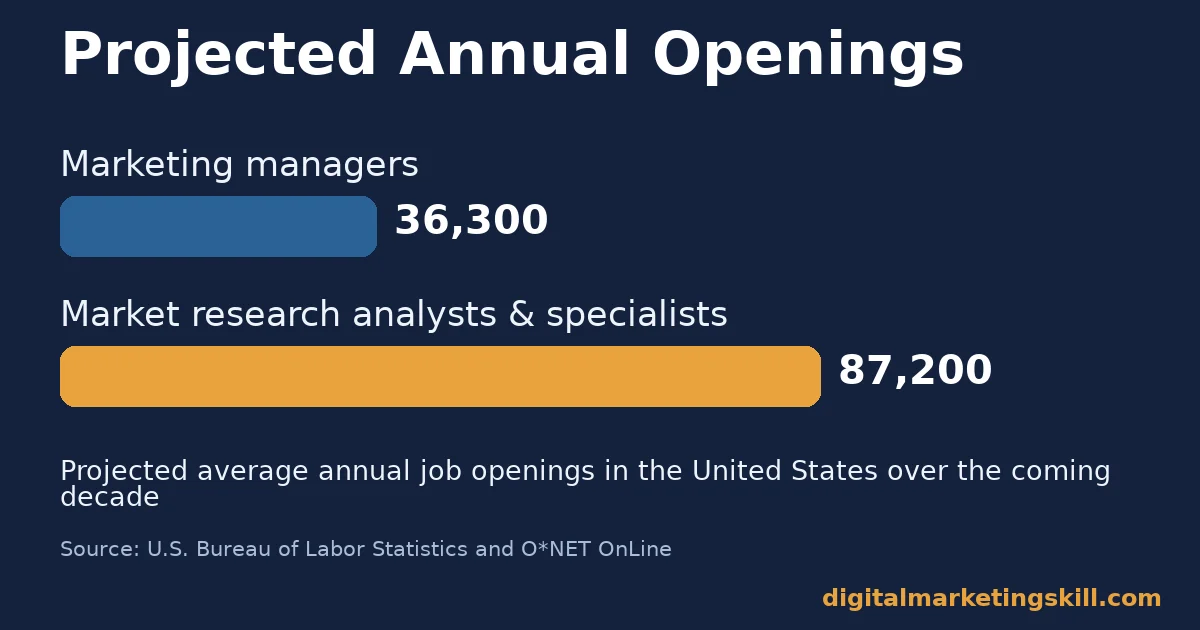
- Demand keeps rising. The U.S. Bureau of Labor Statistics projects employment of advertising, promotions and marketing managers to grow 6% over the coming decade, faster than the average for all occupations, with about 36,300 openings projected each year.
- Specialist roles grow even faster. O*NET OnLine, which draws on BLS data, rates growth for market research analysts and marketing specialists as “much faster than average,” with a median pay of $78,760 a year and about 87,200 openings projected annually.
- The audience is global and still growing. DataReportal’s Digital Global Overview report counted 5.56 billion internet users, 67.9% of the world’s population, and adults now spend an average of 6 hours and 38 minutes online every day.
- Disruption is the current baseline, not the exception. In HubSpot’s State of Marketing survey, 61% of marketers said marketing is going through its biggest disruption in 20 years, largely driven by AI tools.
- A certificate is not the proof employers check. Google’s own guidance on helpful content asks whether material shows “first-hand expertise,” which is exactly what a finished campaign or client result demonstrates and a course-completion badge does not.
In this guide
- What Most Advice On Digital Marketing Training Skips
- How Digital Marketing Training Actually Builds Job-Ready Skill
- Digital Marketing Training Comes in Three Paths
- How to Choose and Get the Most From Each Path
- Common Mistakes That Waste Digital Marketing Training Time
- How to Measure Whether Training Worked
- The One Rule: Match the Path to the Proof You Need
- A Real Case: From Employee to $1,500-Per-Client Freelancer
- Frequently Asked Questions About Digital Marketing Training
- Start With One Path, Then Build Proof
What Most Advice On Digital Marketing Training Skips
Most guides to digital marketing training compare course catalogs: which platform has the most videos, which certificate looks best on a profile, which option is cheapest. That comparison answers the wrong question.
The real decision is about proof. Every path, free or paid, can teach you the underlying digital marketing skills: SEO, email, paid ads or analytics. What differs is whether the path also hands you something a hiring manager or client can check: a finished project, a verified reference, a measurable result. This guide treats that gap as the main variable in choosing digital marketing training.
Here are the ground rules. The U.S. Bureau of Labor Statistics and O*NET OnLine figures below describe the United States labor market specifically. Read them as one large, well-documented market, not a global guarantee. The DataReportal Digital Global Overview and HubSpot State of Marketing figures are broader but still a snapshot, not a permanent ranking. The HubSpot figure is also self-reported by the marketers it surveyed. Treat all of it as evidence to weigh, not a settled fact.
This also matters because digital marketing training is not tied to one country’s job market. The underlying wage data is local, but the skill itself is not. Running a search campaign, writing an email sequence that converts, reading a dashboard correctly: these transfer across borders. A learner anywhere in your country can build the same portfolio of real projects. They can show it to a client or employer on the other side of the world, because the proof is the work, not a local qualification.
How Digital Marketing Training Actually Builds Job-Ready Skill
Skill-building happens in three stages: exposure, practice and proof. Exposure is watching or reading how a channel works. Practice is doing it yourself, usually on a low-stakes or practice account. Proof is doing it on something real enough that someone else can check the result.
Most free content stops at exposure. Most paid single-skill courses add practice through exercises. Few options reach proof. Proof requires a real budget, a real client, or a real mentor checking real work, and that costs more to provide than a video library.
This is also why the demand figures in the Key Takeaways matter here. The BLS projects faster-than-average growth for marketing managers. But a growing role does not lower the bar for any one applicant. It raises the number of comparably trained people competing for each opening. That makes the proof stage, not the exposure stage, the one that actually decides who gets hired.
What Changes First: Tasks, Not Titles
Training changes what you can do before it changes what you are called. A beginner who finishes a well-structured program can usually set up a campaign, read the resulting data and adjust it. That task-level competence gets tested in interviews and client calls, well before any job title changes.
This is why rushing to add a certificate to a profile without the underlying task competence tends to backfire. The first real request exposes the gap immediately.
Proof Beats a Certificate
A certificate says you attended. A finished, measurable project says you can perform. Google’s guidance on helpful content asks creators whether their material shows expertise “that comes from having actually used a product or service.” That is the same standard employers quietly apply to junior marketing hires: have you actually run the thing, not just learned about it.
So whichever path you choose, build toward one piece of proof you can show. Not just a badge you can list.
Digital Marketing Training Comes in Three Paths
Almost every option on the market fits one of three paths. Each is legitimate. Each also has a different ceiling on how much proof it produces.
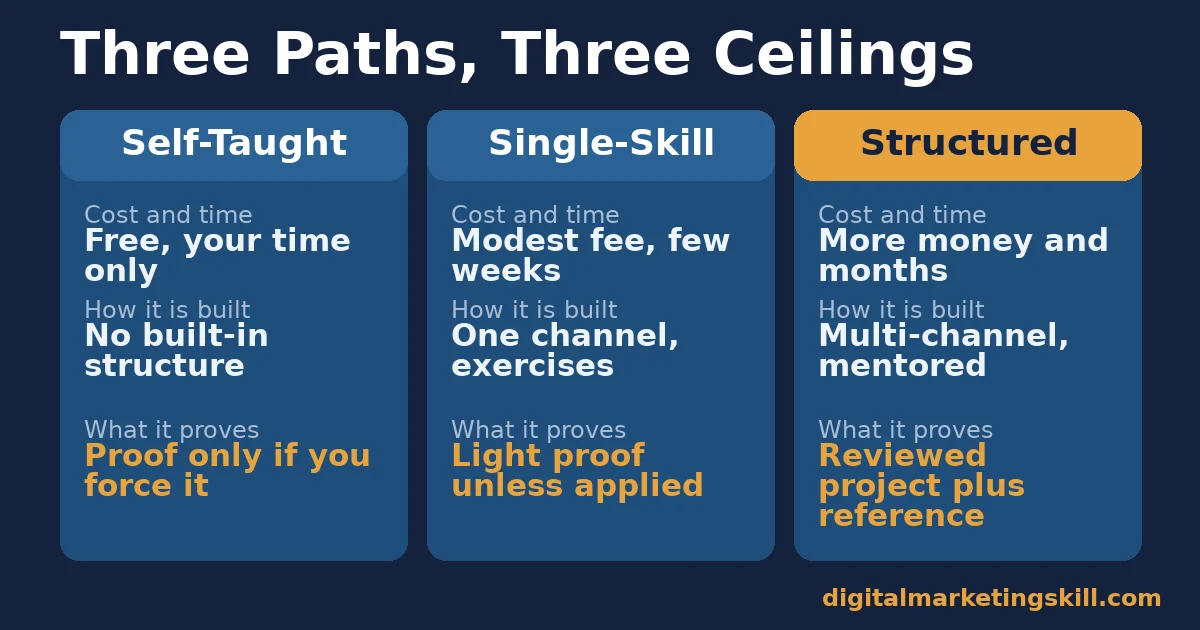
Cost and time scale roughly with how much proof a path hands you. Free, self-taught digital marketing training costs nothing but your hours, and it produces proof only if you force it to.
A single-skill course usually costs a modest fee and a few weeks. It produces one deep skill with light proof, unless you apply it afterward. A structured, mentored program costs more in both money and months. In exchange, it builds the proof, the reviewed project and the reference into the path itself, rather than leaving that up to you.
None of the three is wrong. The mismatch happens when someone picks the cheapest or fastest option while actually needing the proof that only the slower, costlier path reliably produces.
Self-Taught Learning: Built for Breadth, Not Proof
Self-taught learning means free articles, documentation, videos and practice accounts. It is the cheapest way to get broad exposure to every channel: search, social, email, analytics and paid media. It rewards curiosity and consistency.
Its ceiling is structure. Nothing forces you to finish a real campaign, and nothing checks your work against a standard. Without a deliberate plan, self-taught learners often collect fragments of many channels and a finished project in none.
Single-Skill Courses: Built for One Task, Fast
A single-skill course, paid or free, teaches one channel in depth: a search engine optimisation audit, a paid social campaign, an email sequence. It is efficient once you already know which skill a job or client needs.
Mobile-specific skills deserve priority here. Pew Research Center found that 91% of U.S. adults own a smartphone, and 16% rely on one for internet access entirely. A campaign that is not built mobile-first starts at a disadvantage with a large share of any audience.
Its ceiling is breadth and feedback. You finish knowing one task well. But most single-skill courses grade quizzes, not real campaigns, so the proof problem remains unless you apply the skill to a real account afterward.
Structured Programs: Built for a Guided, Verifiable Record
A structured, mentored program covers multiple channels in sequence. It pairs each one with coaching and, in stronger programs, real project work on a live budget. The record it produces, a finished campaign, a mentor’s sign-off, a reference letter, is the kind of proof a resume line cannot fake.
Its ceiling is cost and pace. It usually asks for more time and money upfront than a single free course. So it suits someone ready to commit to finishing, not someone still testing whether marketing interests them at all.
How to Choose and Get the Most From Each Path
Once you know which path fits your stage, close its specific gap. Do not just consume more of it.
Self-Taught Learning: Lead With a Portfolio, Not a Reading List
If you are learning for free, set a rule. For every topic you study, finish one artifact: a real audit of a small business’s website, a mock email sequence for a product you admire, or a before-and-after of a page you optimised. Collect these in one place, so the breadth becomes visible proof instead of private notes.
Single-Skill Courses: Lead With One Real Campaign
After a single-skill course, apply the skill to a real account within a week. Your own account, a friend’s small business, or a volunteer nonprofit all work. A single real campaign you can describe in specific numbers outweighs three finished courses with no application.
Structured Programs: Lead With the Mentoring and the Work Reference
If you choose a structured program, use the parts that create proof on purpose. Ask your mentor to review actual client-facing work, not just assignments. Request a reference letter tied to a specific, measurable project, rather than general attendance. That reference is the artifact a hiring manager or client will actually read.
Common Mistakes That Waste Digital Marketing Training Time
Most wasted training time traces back to one of two habits. Both are easy to fix once you can name them.
Chasing Every Channel Before Finishing One
It feels productive to sample SEO this week, paid social next week and email the week after. In practice, this pattern leaves you with shallow exposure everywhere and a finished project nowhere. A hiring manager scanning a portfolio, or a prospective client scanning a pitch, will ask about depth in one area, not a list of topics you have seen. If you catch yourself starting a new topic before finishing the last one’s real project, that is the signal to stop and finish first.
Skipping Outside Review of Your Work
The second habit is finishing work alone and never asking anyone qualified to review it. Self-review catches obvious mistakes. It misses the blind spots that someone experienced will spot immediately: a weak call to action, a missing tracking setup, a headline that buries the point a reader needs to see first. A single honest review from a mentor, a more experienced peer, or even a paying client’s feedback teaches more than another week of solo practice. Build at least one review point into any training plan, free or paid.
How to Measure Whether Training Worked
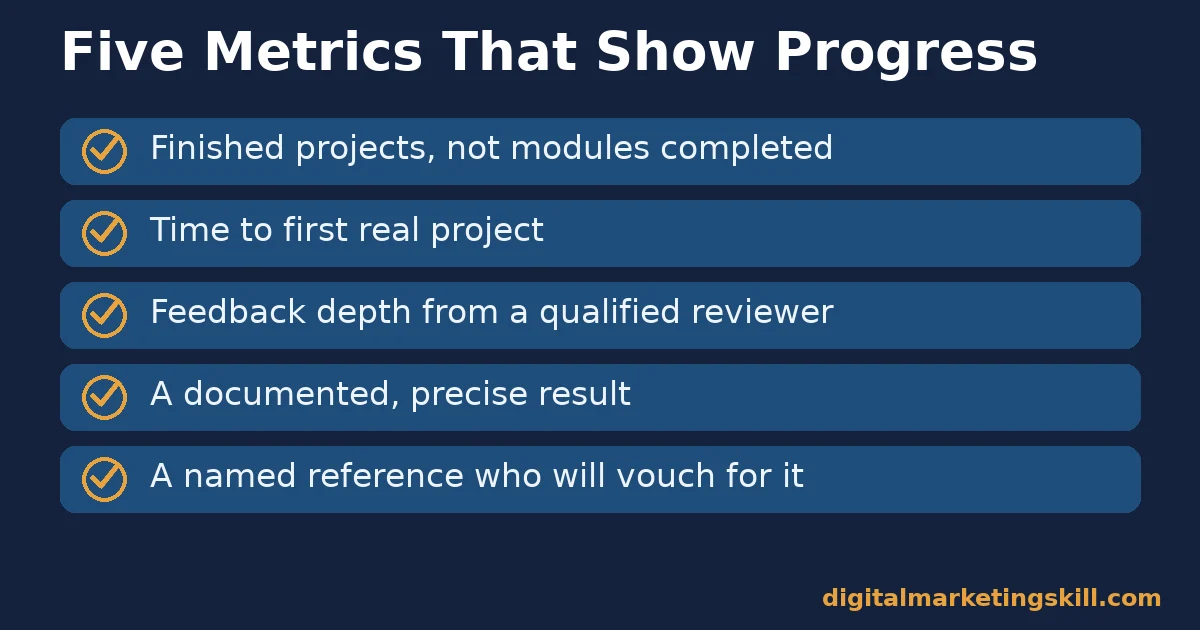
Training “worked” when it changes what you can produce and what you can prove, not when you finish the material. Track these against each other.
Five Metrics That Show Real Progress
- Finished projects. The count of campaigns, audits or sequences you took from start to a measurable result, not modules completed.
- Time to first real project. How many weeks after starting training before you worked on something with a real budget or a real audience, even small.
- Feedback depth. Whether anyone qualified reviewed your actual work and told you specifically what to change, versus an automated quiz score.
- A documented result. A number you can state precisely: a conversion rate, an open rate, a cost per lead, from something you ran yourself.
- Named reference. Someone willing to confirm, by name, what you did and how it went.
How to Read These Metrics Together
No single metric proves readiness. Many finished projects with shallow feedback mean confidence without correction. One project with deep feedback and a named reference often beats ten self-graded exercises. Read the five together. Treat the reference and the documented result as the two that matter most once you are job-hunting or pitching clients.
The One Rule: Match the Path to the Proof You Need
Here is the clearest useful rule in this guide: choose the path that forces the proof you are still missing, not the path with the most content. Already know a channel but never finished a real campaign? Skip another course and go find a real account. Know several channels shallowly with no mentor checking your work? A structured program’s feedback loop is worth more than its syllabus. Still finding out whether marketing interests you? Free self-taught learning with a self-imposed portfolio rule is the cheaper, lower-risk test.
Illustrative, invented numbers: imagine two learners who each spend 100 hours on digital marketing training. Learner A finishes six free courses and zero real campaigns. Learner B finishes two courses and three real campaigns with documented results. In an interview, Learner B has three specific stories to describe. Learner A has none. The hours spent were equal. The proof produced was not.
A Real Case: From Employee to $1,500-Per-Client Freelancer
Among the outcomes published on Digital Marketing Skill Institute’s reviews page, graduate Damola Akanbi left employment and now works as a freelance digital marketer, averaging $1,500 per client running campaigns. The published account attributes the shift to finishing real, mentored project work, not just completing course modules.
Treat the specifics of any single published story with care. The account does not disclose every step between training and the first paying client, so do not assume the sequence matched the framework in this guide exactly. What is verifiable is the published outcome itself: a named graduate now running paid client campaigns. That is the kind of checkable result this guide argues digital marketing training should aim to produce.
Read this as one documented account, not a typical or guaranteed outcome. Results vary by effort, market and client. The Institute’s earnings disclaimer sets out that context in full. Read it before treating any single case as a baseline for your own plan.
Frequently Asked Questions About Digital Marketing Training
How long does digital marketing training usually take to produce a hireable skill level?
It depends on the path and the hours you put in, but most learners need a few months of consistent practice, not a single weekend, to produce a finished project they can confidently describe in an interview or client pitch. Someone studying a few hours a week will naturally take longer to reach that point than someone training full time, so judge progress by finished projects rather than calendar time.
Do I need a certificate to get hired in digital marketing?
A certificate can help a profile pass an initial screen, but it rarely wins the role on its own. Hiring managers consistently ask for a finished example of your work, so pair any certificate with at least one real, documented project. If you have to choose between adding another certificate and finishing one more real project, finish the project first.
Is free digital marketing training good enough on its own?
Free training can teach every core concept well. Its main limitation is structure and feedback, so add a self-imposed rule to finish real projects and seek outside feedback rather than relying on course completion alone. Treat free digital marketing training as the raw material and your own discipline as the part that turns it into proof.
Which digital marketing skill should I learn first?
Start with the channel tied to the role or client work you actually want, because depth in one channel with a finished project usually beats shallow exposure to five. Our breakdown of what digital marketing covers is a useful map before you pick. SEO, paid social and email are common, well-documented starting points, and tools like those in our keyword research tools guide help you test a search-focused path quickly.
Our guide to freelancing fundamentals walks through how to pick a first service to offer, once you have one channel you can run confidently.
Can I switch into digital marketing without a marketing degree?
Yes. The field hires heavily on demonstrated skill and results, not degree subject. That is exactly why a portfolio of finished, documented projects matters more than the credential path you took to get there. Career changers from sales, customer support, teaching and writing backgrounds often transfer well, because those roles already train the communication and problem-solving habits that digital marketing training then points at a specific channel.
How do I know when my training is complete enough to look for work or clients?
Treat it as complete enough once you can describe, with real numbers, at least one project from start to result, and name someone who can vouch for the work. Not once you finish a fixed number of course hours. If you cannot yet answer a specific question, such as what the campaign cost or what changed because of it, treat that gap as your next training priority rather than a sign you need an entirely different path.
Start With One Path, Then Build Proof
Pick the path that matches your stage honestly. Self-taught if you are still testing your interest. A single-skill course if you already know the channel you need. A structured, mentored program if you want a guided sequence with real project work and a verifiable reference behind it.
Digital Marketing Skill Institute’s Master Diploma in Digital & AI Marketing is built around that proof-first idea. Nine practical, AI-powered courses cover SEO and content, Google Advertising and Analytics, email marketing automation, lead generation, and social media marketing and advertising. The program includes unlimited one-on-one mentoring and coaching, plus real project-based work experience inside a U.S. partner company from day one. The diploma is dual US and UK accredited and recognised in more than 100 countries, and the whole program runs 100% online, so you can study and do the real project work from anywhere in your country.
Whichever path you choose, visit Digital Marketing Skill Institute for the fuller course breakdown, and browse the blog for more practical guides on digital marketing training. When you are ready for a structured, mentored path, you can apply directly. The goal either way is the same: finish something real, document the result, and let that proof, not the hours logged, open the next door wherever in your country you happen to be. You can start that process at digitalmarketingskill.com today.
Every figure in this guide was checked against its original source before publication. Figures marked as illustrative are invented examples, not real results.
![9 Amazing Digital Marketing Skills to Make Money Online [With Proof]](https://digitalmarketingskill.com/wp-content/uploads/2019/07/9-Amazing-Digital-Marketing-Skills-to-Make-Money-Online-With-Proof-17.png)