
An effective email marketing strategy succeeds when it protects list health and measures real revenue, not just open rates. Apple’s privacy tools now distort open-rate data for most inboxes, so judge performance by click rate, deliverability and revenue per email instead.
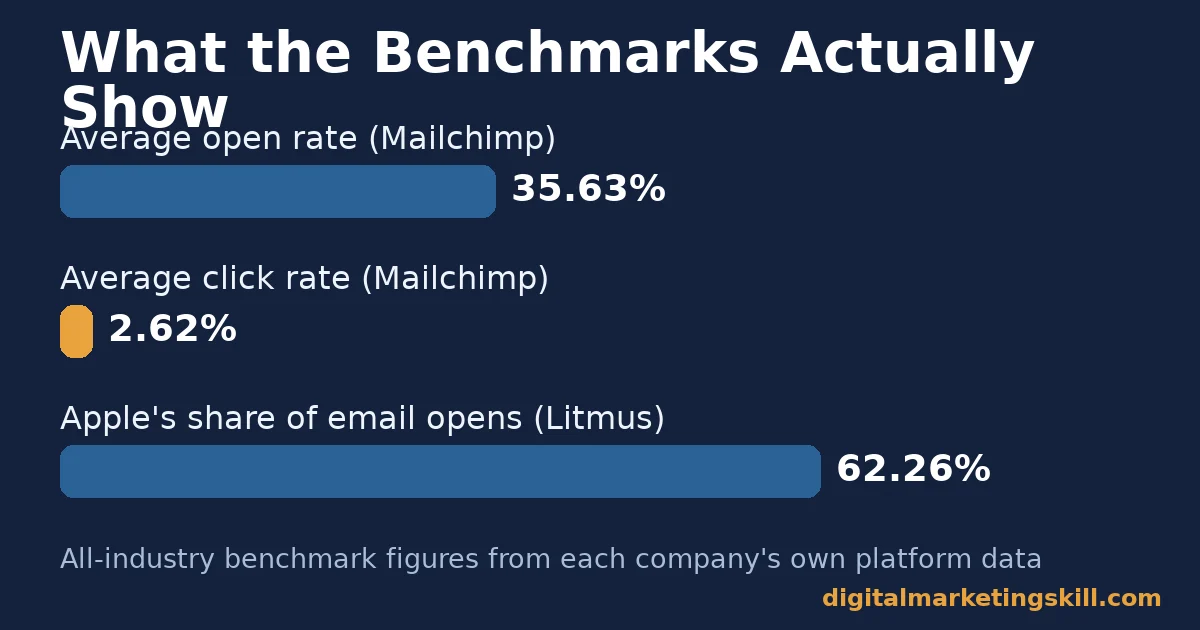
Mailchimp’s benchmark data puts the all-industry average open rate at 35.63% and click rate at 2.62%, across billions of delivered campaigns. Build your effective email marketing strategy around list health, automation and revenue.
Skip vanity metrics and focus on what actually moves revenue.
Key Takeaways
- Open rate is partly fiction now. Litmus found that Apple Mail, iPhone Mail and Apple’s Mail Privacy Protection together hold 62.26% of email client market share. That figure came from more than 1 billion opens the company analysed.
- Clicks still separate winners from the rest. Mailchimp’s all-industry benchmark puts the average click rate at 2.62% and the average unsubscribe rate at 0.22%, from billions of delivered campaigns.
- Automation massively outperforms broadcast sends. Omnisend found welcome automation emails generate $6.16 in revenue per email sent, versus $0.155 per email for regular campaigns, across more than 20 billion campaign emails from 27,000-plus brands.
- Lists decay fast without maintenance. HubSpot, citing Marketing Sherpa research on B2B contact data, reports that email databases degrade by about 22.5% a year.
- Email still returns more than most channels. The UK Data & Marketing Association’s Marketer Email Tracker put email ROI at almost GBP 41 for every GBP 1 spent. That figure is UK-specific, not worldwide.
In this guide
- What Most effective email marketing strategy Advice Gets Wrong
- How an effective email marketing strategy Actually Works
- What Differs Between a New List and a Mature One
- How to Lead With the Right Move at Each Stage
- How to Measure an effective email marketing strategy That Works
- The One Decision Rule: Protect the Sender Before You Chase the Send
- A Real Case: What Email ROI Studies Actually Measure
- Frequently Asked Questions About effective email marketing strategy
- Start With a List Health Check
What Most effective email marketing strategy Advice Gets Wrong
Most effective email marketing strategy advice is a simple checklist. Pick a tool. Write a welcome email. Send a newsletter. None of that is wrong. But it treats every list the same way. It also leans on open rate, the one number that privacy tools have made least reliable.
This guide treats an effective email marketing strategy as two connected jobs. One job is keeping a list healthy enough to reach inboxes. The other is routing effort toward the sends that measurably earn money. A new list needs a different first move than an old one, so this guide treats them separately throughout.
A few ground rules first. The Mailchimp, Omnisend and Litmus figures below are each one company’s own platform data. Each company reports its own numbers, so read them as evidence from large datasets, not an independent audit. The DMA figure is UK-specific. Treat every number here as a snapshot of recent behaviour. None of it predicts your own results.
How an effective email marketing strategy Actually Works
Three things decide whether an effective email marketing strategy earns money. Who you are allowed to email comes first. What you send them automatically comes second. What you choose to measure comes third. Get the first wrong and messages never arrive. Skip the second and you leave easy revenue on the table. Fumble the third and you optimise for a number that no longer means what it used to.
Permission comes first. A list built through genuine opt-in reaches inboxes. A bought or scraped list gets flagged fast. That damage then spreads to every other message you send from the same domain.
The FTC’s CAN-SPAM compliance guide sets the baseline rules for commercial email in the US. It requires honest headers, a working unsubscribe link and prompt removal. Most countries have an equivalent consent law, so check the rule that applies where your subscribers live.
The Three Levers in Plain Terms
List health is whether people on your list still want your email. It shows up as bounce rate, spam complaints and the decay rate above. Automation is anything that fires on a trigger rather than a calendar date. A welcome sequence is automation. So is a reminder after someone abandons a cart or a form.
Measurement is which numbers you actually act on each month, not the ones you glance at once and forget.
These three levers interact. A poorly permissioned list makes automation less effective, because triggered emails to uninterested people still hurt deliverability. Weak measurement hides which lever needs attention first. An honest effective email marketing strategy checks all three before blaming the content.
Most teams start in the wrong place. They rewrite subject lines or redesign templates before checking whether the list itself is healthy. That order is backwards. A beautifully designed email sent to a decayed, disengaged list will still underperform a plain-text email sent to a clean one. Fix the lever that is actually broken, not the one that is easiest to tinker with.
Why Open Rate Alone Can Mislead You
Open rate used to be a fair proxy for interest. Litmus’s own email client data shows Apple’s ecosystem now covers 62.26% of opens it tracks. That figure comes from more than a billion messages. The ecosystem includes Mail Privacy Protection. This feature pre-loads images for many opens, whether or not a person actually reads the email. The pre-load still counts as an open.
Think about what that means for a typical send. If six in ten of your opens come from an ecosystem that can register an open without a human looking at the screen, a rising open rate on its own proves very little. It might mean more people are genuinely curious. It might just mean more of your list uses an iPhone.
That does not make open rate useless. A sudden drop still signals a deliverability problem worth investigating right away. It simply means click rate, conversions and revenue per email deserve more weight than they used to. Clicks require an actual decision to act, which an automatic image pre-load does not.
What Differs Between a New List and a Mature One
The right effective email marketing strategy move depends on where your list already is. A list with 200 people needs different treatment from one with 50,000. Confusing the two is the most common reason strategies stall.
A New List: Built for Trust, Not Volume
A new list has little history with your domain. Mailbox providers watch it closely. Every send is a small test of whether people open, click or complain. The goal at this stage is a clean reputation, not a big first newsletter.
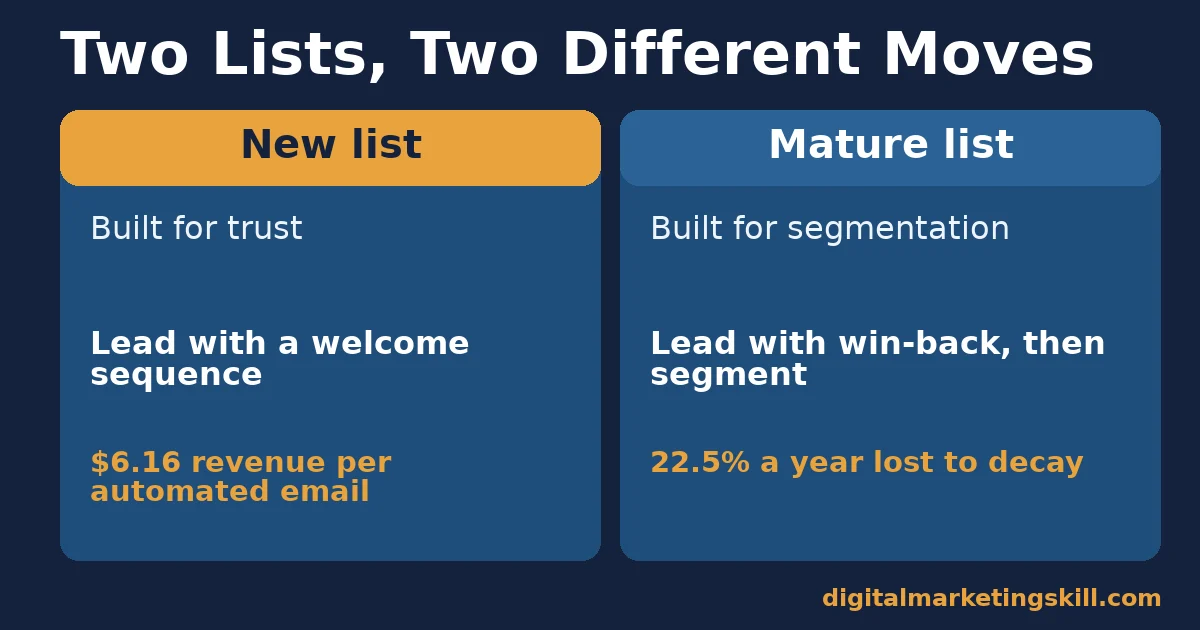
New subscribers also arrive with the most attention they will ever give you. Omnisend’s data shows welcome automation earning $6.16 per email sent. That is roughly forty times the $0.155 a regular campaign earns per send in the same dataset. That gap exists because welcome messages reach people at their most curious moment, automatically, every single time.
A Mature List: Built for Segmentation and Automation
A mature list has years of open and click history. That history is valuable data, not just a pile of contacts. The risk shifts from reputation-building to decay. HubSpot’s figure of roughly 22.5% annual database decay means a 50,000-person list can lose over 10,000 engaged contacts a year. Job changes, abandoned addresses and simple disinterest all add up.
None of that decay is a sign you did anything wrong. People change jobs, switch providers and lose interest in almost every list, regardless of how well it is run. The mistake is ignoring the decay rather than planning around it. A healthy effective email marketing strategy assumes a steady trickle of loss and budgets new signups and win-back sends to outpace it.
At this stage, the strategy question becomes which segments still earn their place on the list. It also becomes which automated sequences could replace a chunk of manual sending. A mature list that still relies only on a weekly blast is leaving the automation gap on the table, unused.
How to Lead With the Right Move at Each Stage
These two sections mirror the ones above. Start with whichever matches your list today. Fixing the matching problem first moves the numbers fastest.
A New List: Lead With a Welcome Sequence
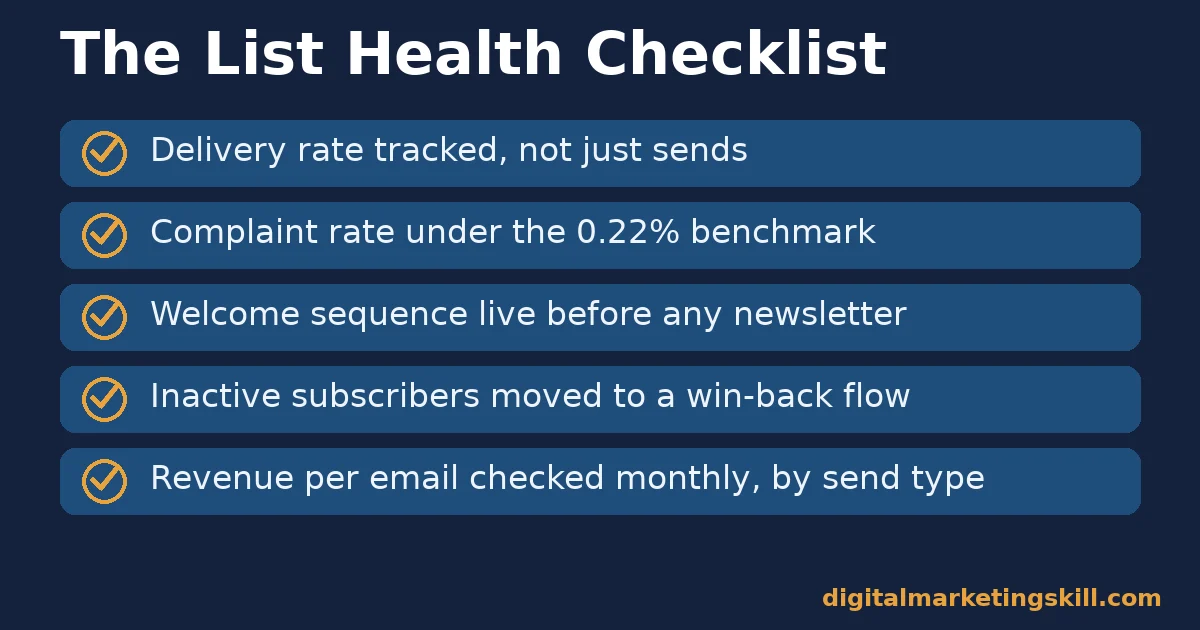
Build a short welcome sequence before you build a newsletter calendar. Three to five emails that deliver on your signup promise, spaced a few days apart, will do more for revenue than a single polished newsletter. That is the clear signal in the automation-versus-campaign gap in Omnisend’s data.
Warm the domain gradually too. Send to your most engaged early subscribers first. Keep volume modest for the first few weeks. Watch bounce and complaint rates every day during this stretch. A clean start matters more than a fast one, because mailbox providers remember a rocky launch for a long time.
A Mature List: Lead With Win-Back and Segmentation
Run a win-back sequence for subscribers who have not opened or clicked in several months. Remove the ones who still do not respond after that. This feels like a loss at first. But a smaller, engaged list reaches inboxes better than a larger, cold one. Mailbox providers judge sender reputation partly on how recipients actually engage.
Then segment what remains by real behaviour. Use what people clicked, bought or viewed, not just when they joined. Our guide to building an email marketing automation strategy covers specific sequences worth automating once a list is segmented this way.
How to Measure an effective email marketing strategy That Works
Measurement should follow the money, not the easiest number to pull. Each metric below is defined in one sentence. A short note explains how to read it next to the others.
Six Metrics That Show Real Performance
- Delivery rate. The share of sent emails that reach an inbox rather than bouncing. A falling delivery rate is the earliest warning of a reputation problem.
- Click-to-open rate. Clicks divided by opens, rather than by total sends. It is less distorted by Mail Privacy Protection. Omnisend’s ecommerce dataset puts the average around 2.44%.
- Unsubscribe and complaint rate. Mailchimp’s benchmark places the average unsubscribe rate at 0.22%. A rate well above that on a single send usually means the content missed its audience.
- Revenue per email sent. Total revenue attributed to a send, divided by the number of emails sent. It is the clearest single number for comparing a welcome sequence with a newsletter.
- List growth versus decay. New subscribers added, measured against the roughly 22.5% a year a list can lose to natural decay. A list that is not growing faster than it decays is shrinking, even while it looks stable.
- Automation share of revenue. The percentage of total email revenue coming from automated sends rather than manual campaigns. The benchmark data above suggests this share should be disproportionately high.
How to Read These Numbers Together
Start with delivery rate. If it is falling, fix list hygiene before anything else. No other number matters much if messages never arrive. If delivery is healthy but click-to-open is weak, the content or the targeting needs work, not the sending infrastructure.
Picture two sends with the same open rate. One has a high click-to-open rate and a low complaint rate. Its counterpart has a low click-to-open rate and a complaint rate near the 0.22% benchmark. The first send is doing its job. The second needs a different subject line, a clearer offer, or a smaller, better-matched audience, even though the raw open numbers look identical on a dashboard.
Check revenue per email across automation and campaigns separately too. If automation earns far more per send than campaigns, as the benchmark data above suggests it should, that is a clear signal. Invest more effort in a few well-built sequences rather than more manual newsletters.
Review these six numbers monthly, on a fixed day, so small shifts show up before they become a real problem. A one-page dashboard works better here than a long report nobody opens.
The One Decision Rule: Protect the Sender Before You Chase the Send
If you take one decision rule from this guide, make it this one. Never let short-term send volume put your sender reputation at risk. A damaged domain reputation can take months to repair. It affects every email you send during that time, not just the risky one that caused it.
Here is an illustrative example, with invented numbers. A small newsletter sends to its full 10,000-person list every week, including thousands who have not opened in over a year. Complaint rate creeps up to 0.4%, well above Mailchimp’s 0.22% benchmark. Deliverability starts slipping into spam folders.
The team suppresses anyone inactive for six months, down to a 6,500-person engaged core. It rebuilds the rest slowly through a separate win-back sequence. Within two months, delivery to the inbox improves. Revenue per email rises too, even with fewer total recipients on the active list.
The lesson is simple. A smaller, engaged list beats a larger, cold one almost every time. Mailbox providers route mail based on how recipients treat it, not on how many people you technically have permission to email.
What Protecting the Sender Looks Like Day to Day
This is also why vanity list size is a poor goal for an effective email marketing strategy. A founder proud of a 50,000-name list, most of it inactive, is sitting on a liability, not an asset. Every send to that dead weight quietly trains mailbox providers to trust your domain less, which then hurts delivery to the subscribers who would have genuinely read the message.
Protecting the sender also means pacing growth. A list that doubles overnight through a single viral post or a purchased add-on looks like a win, but it sends a flood of unfamiliar addresses through your sending infrastructure at once. Warm new segments in gradually, the same way you would warm a brand-new domain, rather than blasting the whole batch on day one.
A Real Case: What Email ROI Studies Actually Measure
The widely quoted claim that email returns tens of dollars for every dollar spent comes from real industry surveys. But it is worth seeing what those surveys actually measure. The UK Data & Marketing Association’s Marketer Email Tracker reported ROI rising to almost GBP 41 for every GBP 1 spent. That number came from a survey of UK marketers about their own channel performance.
That figure has real limits worth stating plainly. Marketers self-reported it while estimating their own channel’s return. It is specific to UK respondents, in UK pounds. Email also sits inside a broader marketing mix in that survey, not an isolated experiment with a control group. A number from a different country, currency or method will not match it exactly.
The case still matters because of what it does show. Among the marketers who tracked return at all, email consistently outperformed other channels in their own reporting. Treat it as a strong directional signal for prioritising email in your own effective email marketing strategy. It is not a guarantee of a specific return for any one business.
Frequently Asked Questions About effective email marketing strategy
What is the first step in building an effective email marketing strategy?
Confirm how you collect consent, then set up a short welcome sequence before you plan a newsletter calendar. A clean, consent-based list that is warmed up gradually reaches inboxes far better than a bought or scraped one.
How often should I email my list?
There is no single right frequency. Watch delivery rate, click-to-open rate and unsubscribe rate after each change. Settle on the frequency that keeps those numbers stable for your own list, rather than copying another brand’s schedule.
Why did my open rate suddenly jump or drop?
Apple’s Mail Privacy Protection, which Litmus found covers the majority of email client opens it tracks, can pre-load images regardless of whether someone reads the message. Treat a sudden open-rate change as a signal to check click-to-open rate and delivery rate instead.
Is email marketing still worth the effort?
Industry surveys, including the UK Data & Marketing Association’s own tracker, continue to report strong returns for email relative to other channels. The exact figure is self-reported and country-specific, so judge your own results by revenue per email, not by an industry-wide number.
How big does my list need to be before automation is worth building?
Automation is worth building at almost any size. A welcome sequence fires the same way whether ten or ten thousand people join. Omnisend’s data shows automated sends earning far more per email than manual campaigns, a gap that favours building automation early.
Should I remove subscribers who never open my emails?
Yes, after a genuine win-back attempt. Keeping unengaged addresses on an active sending list raises complaint and bounce rates. That hurts delivery for the subscribers who do want your email.
What is a good click-to-open rate?
There is no universal good figure, since it varies by list and industry. Omnisend’s ecommerce dataset averages around 2.44%. Compare each send with your own list’s recent average, rather than an industry number from a different sector.
Do I need separate strategies for a newsletter and an online store?
The core effective email marketing strategy is the same: protect list health, automate the highest-value triggers and measure revenue per email. A store adds triggers like abandoned cart and post-purchase follow-up, while a newsletter leans more on welcome and win-back sequences.
Start With a List Health Check
An effective email marketing strategy improves fastest when you fix list health and automation before writing another newsletter. Pull your delivery rate, unsubscribe rate and automation revenue share this week. Compare them against the benchmarks above, then fix the weakest one first.
If you want to build this skill properly, the Master Diploma in Digital & AI Marketing at Digital Marketing Skill Institute includes an AI-Powered Lead Generation and Email Automation track among its four AI-powered tracks, ten courses in total, with a Full Stack option for completing all four.
It comes with unlimited 1-on-1 coaching and mentoring and a U.S. Project Internship with a verified U.S. Work Reference Letter. The diploma is dual US and UK accredited and recognised in more than 100 countries.
The programme is 100% online, so you can study and apply this effective email marketing strategy from anywhere in your country. Explore more guides on the Digital Marketing Skill Institute blog, including our guides on improving email open rates, boosting email click-through rate, setting up newsletters people actually open and our wider introduction to what email marketing is and how it fits your funnel.
When you are ready, apply for the Master Diploma wherever you live, or start from the Digital Marketing Skill Institute homepage.
Every figure in this guide was checked against its original source before publication. Figures marked as illustrative are invented examples, not real results.
![9 Amazing Digital Marketing Skills to Make Money Online [With Proof]](https://digitalmarketingskill.com/wp-content/uploads/2019/07/9-Amazing-Digital-Marketing-Skills-to-Make-Money-Online-With-Proof-17.png)






