

Emerging marketing trends matter only if they change what you measure or where you spend. Right now, three shifts matter most. Google kept third-party cookies in Chrome instead of removing them. Short-form video now delivers the highest ROI of any content format, four years running. AI search overviews already touch a meaningful share of Google queries. This guide names the emerging marketing trends that actually move numbers, and what to do about each one.
Key Takeaways
- Cookies are staying, for now. Google’s own Privacy Sandbox blog confirms Chrome will not roll out a new prompt to remove third-party cookies, reversing years of planned deprecation.
- Short-form video leads on ROI. HubSpot’s State of Marketing research ranks short-form video the top ROI content format for the fourth year running, ahead of long-form video and livestreaming.
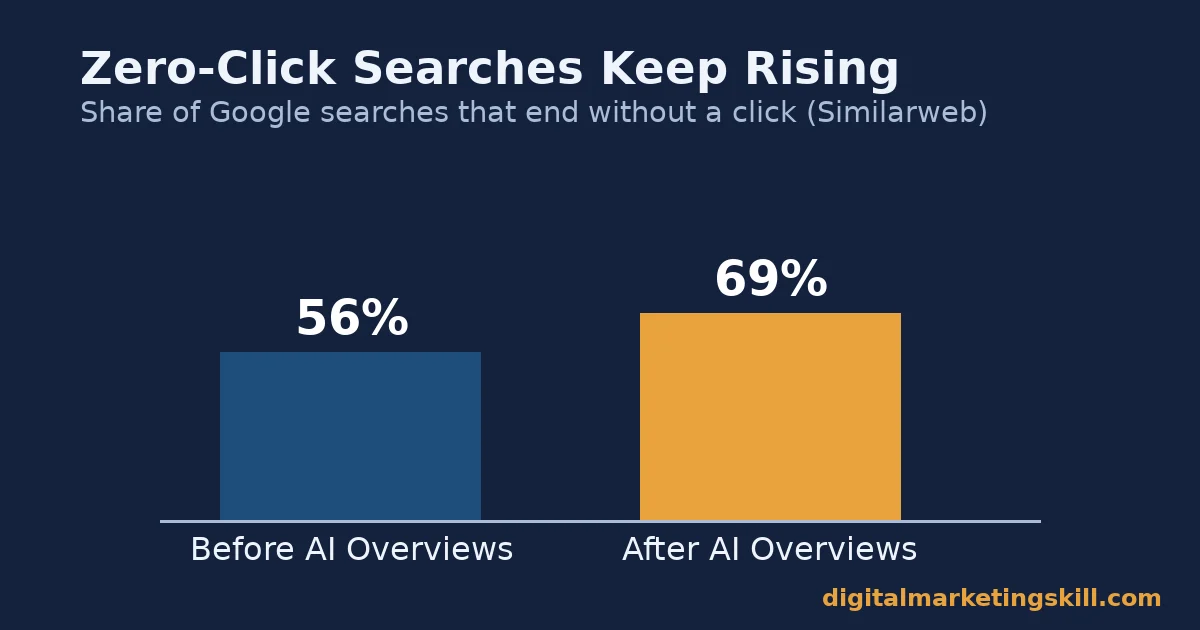
- AI search overviews already reshape clicks. Similarweb’s analysis found zero-click Google searches grew from 56% to 69% in the year after AI Overviews launched in the US.
- Generative AI adoption jumped fast. Content Marketing Institute and MarketingProfs found 81% of B2B marketing teams now use generative AI tools, up from 72% a year earlier.
- Personalization rewards the companies already doing it well. McKinsey’s research on personalization reports faster-growing companies draw a notably larger share of revenue from personalized experiences than slower-growing peers.
In this guide
- What Most Emerging Marketing Trends Roundups Get Wrong
- Why These Emerging Marketing Trends Actually Matter
- How These Trends Differ by Your Channel Mix
- What to Do Differently for Each Channel
- Why Generative AI Adoption Jumped So Fast
- Personalization Still Separates Fast Growers From the Rest
- How To Measure Whether An Emerging Marketing Trend Is Actually Worth Acting On
- A Simple Plan: Pick the Shift That Hits You Hardest
- The Most Useful Rule: Match the Fix to Where Your Traffic Actually Comes From
- Signs An “Emerging” Trend Is Not Actually Worth Chasing Yet
- A Worked Example: Reallocating a Content Budget
- A Real Case: Why Google Reversed Course on Cookies
- Frequently Asked Questions About Emerging Marketing Trends
- Start With the Shift That Hits Your Channel Mix Hardest
What Most Emerging Marketing Trends Roundups Get Wrong
Most trend articles just list buzzwords. AI. Short-form video. Personalization. None of that tells you what to change this quarter. A list is not a plan.
This guide covers three emerging marketing trends with documented, named evidence behind them. For each one, it explains the mechanism. It shows what differs depending on your channel mix. Then it shows what to do differently. Treat every figure as a snapshot, not a permanent ranking. Search behavior and platform policy both move fast.
Here are the ground rules. Google’s own blog post is the most reliable source for Google’s own policy. Similarweb and Semrush publish their own analyses. Those are third-party measurements, not Google’s official numbers, so read them as informed estimates. The McKinsey personalization figures cited below are quoted at their original wording from McKinsey’s published research on personalization, though the McKinsey site could not be reached directly during this research pass, so treat that one figure with slightly more caution than the rest.
Why These Emerging Marketing Trends Actually Matter
Each emerging marketing trend here changes a different lever. Cookie policy changes how you target and measure ads. AI search overviews change how much organic traffic reaches your site at all. Format preference changes where your content budget earns the most attention per dollar. Confusing the three wastes effort on the wrong fix.
Treat these as emerging marketing trends in the literal sense: each is still moving, not settled. A policy, a platform algorithm or a format preference can shift again within a year. That is exactly why this guide names the mechanism behind each shift rather than just the current number, since a mechanism tends to outlast the specific figure attached to it today.
Cookies: A Reversal, Not a Deprecation
Google spent years signaling it would remove third-party cookies from Chrome. On its own Privacy Sandbox blog, Google now says it will “maintain our current approach to offering users third-party cookie choice in Chrome.” The post adds it “will not be rolling out a new standalone prompt for third-party cookies.” That is a reversal, not a delay.
This does not mean privacy pressure disappeared. Other browsers still block third-party cookies by default. Regulation keeps tightening too. It means Chrome, the browser most of your audience likely uses, is not forcing an immediate rebuild of your tracking stack.
AI Search Overviews: Fewer Clicks, Not Fewer Searches
AI Overviews answer a query directly inside the results page. Similarweb’s analysis found zero-click searches, where a user never clicks through to any website, grew from 56% to nearly 69% in the year after AI Overviews launched in the US. People still search. They just click less.
Semrush’s own analysis of over 200,000 keywords found AI Overviews peaked at nearly a quarter of all Google queries, before settling lower. The exact share moves. The direction does not. A growing slice of searches now get answered without a click to any site, including yours.
How These Trends Differ by Your Channel Mix
A paid-search-heavy business, a content-led business and a social-first business each feel these three shifts differently. The fix for each is not the same.
Paid Search and Display: Built on Targeting You Can Keep
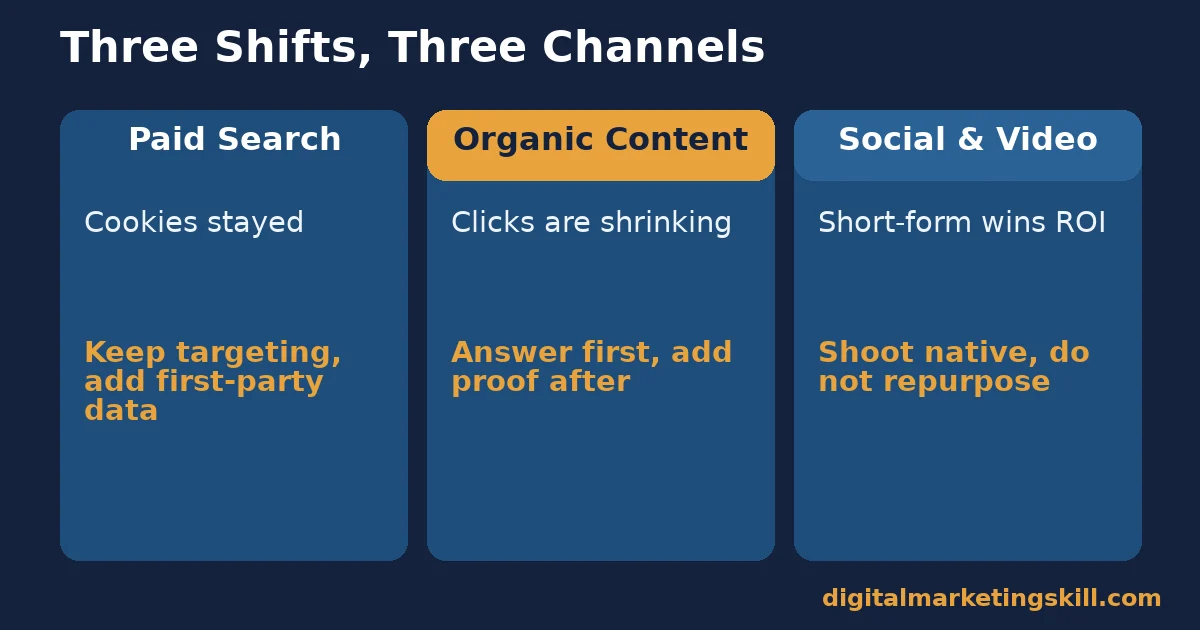
If you run paid search or display ads, the cookie reversal is good news. Your existing retargeting and measurement setup keeps working in Chrome without an emergency rebuild. That does not mean standing still. Other browsers already restrict third-party cookies, so first-party data collection still pays off over time.
Organic Content: Built on Traffic That Is Quietly Shrinking
If you depend on organic search traffic, AI Overviews are the real threat. A rising zero-click share means fewer visits per ranking position, even if your rank stays the same. Content built only to rank loses the most ground. It needs a reason for a human to click through anyway.
Social and Video: Built on a Format That Already Won
If your budget sits in social content, the format question is mostly settled. HubSpot’s own research places short-form video at the top of the ROI table for the fourth consecutive year, ahead of long-form video and livestreaming. The open question is not whether to use it, but how much of your budget to shift toward it.
What to Do Differently for Each Channel
Once you know which shift hits your channel mix hardest, the next step looks different for each one.
Paid Search and Display: Lead With First-Party Data Anyway
Keep your current targeting running, since Chrome is not forcing a change. Build first-party data collection in parallel, through email capture, loyalty programs or logged-in experiences. Other browsers have not stopped moving just because Chrome did. Future regulation has not stopped moving either.
Organic Content: Lead With Answers Worth a Click Anyway
Write the direct answer first, the way a search summary would present it, then follow with something a summary cannot replace: a worked example, a calculator, a named case or an opinion backed by evidence. If an AI Overview can fully answer the query from your page alone, give the reader a reason to still click through. Our on-page SEO checklist covers the structural fixes that make a page easier for both a reader and an AI summary to parse correctly.
Social and Video: Lead With Native Short-Form, Not Repurposed Clips
Do not just chop a long video into short pieces. HubSpot’s own data on preferred length puts the sweet spot between 21 and 60 seconds, built for a vertical, sound-off-friendly feed, not trimmed from something built for a different format. See our guide to video marketing for beginners for how to plan a shoot around that format instead of editing it down afterward.
Why Generative AI Adoption Jumped So Fast
Content Marketing Institute and MarketingProfs found 81% of B2B marketing teams now use generative AI tools, up from 72% the year before, based on a survey of 980 B2B marketers. That is a fast jump for enterprise tool adoption.
The same research found a gap worth noting: most AI content users have not yet seen better content performance from it. Adoption outran results. That gap is the actual opportunity. Teams that move past basic drafting into genuine workflow integration, not just faster first drafts, are the ones most likely to see the performance gains others are still waiting on. Our guide to picking AI marketing tools worth using covers how to tell a genuine workflow upgrade from a faster way to produce the same mediocre first draft.
This distinction matters because a tool is not a strategy. A team that adds a generative AI tool to its existing process, without changing the process itself, typically gets faster output at the same quality level, not better output. The adoption jump from 72% to 81% measures only how many teams picked up a tool. It says nothing about how many teams changed their actual workflow around it. That harder, slower step is what produces the performance gains the survey itself found were still missing for most users.
Personalization Still Separates Fast Growers From the Rest
McKinsey’s research on personalization reports that companies growing faster than their peers draw a meaningfully larger share of revenue from personalized experiences. The reported range for revenue lift from getting personalization right spans roughly 10 to 15%, with company-specific results varying by sector and execution.
This is not a new trend. It is a trend that keeps compounding. The gap between companies that do personalization well and companies that do not appears to widen over time, not narrow, as more customer data becomes available to the companies already equipped to use it. In practice, personalization at this scale usually runs through marketing automation tools that trigger a tailored email, offer or recommendation from existing customer data, rather than a person manually customizing each message.
The size of the gap matters more than its direction. A company already ahead on personalization is not just capturing a one-time lift. It is compounding a data advantage that a company starting later has to spend years catching up on. Among all the emerging marketing trends covered here, that compounding effect is the strongest argument for starting now, rather than waiting for a cleaner, more mature version of the tooling.
How To Measure Whether An Emerging Marketing Trend Is Actually Worth Acting On
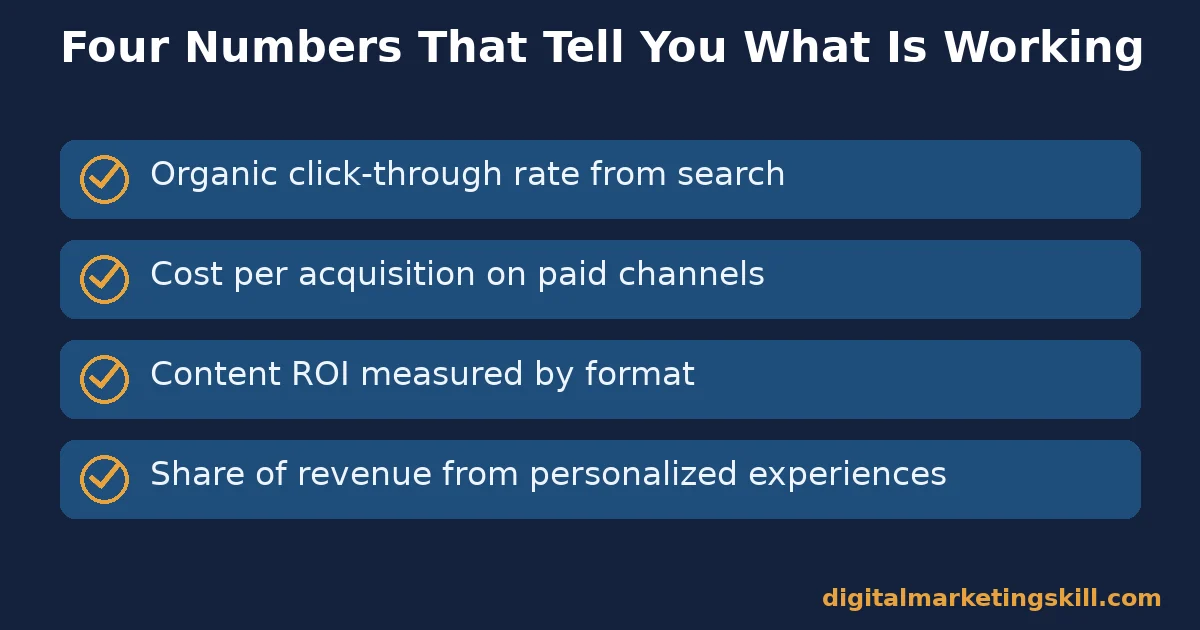
Before reorganizing a budget around any of these emerging marketing trends, check four numbers. Each one is defined in one sentence below, with a note on how to read it.
- Organic click-through rate from search: the share of impressions that turn into a visit, which tells you directly whether AI Overviews are already eating into your own traffic, rather than traffic in general.
- Cost per acquisition on paid channels: what you pay per converted customer through ads, the number that tells you whether the cookie reversal actually changed your targeting costs or not.
- Content ROI by format: revenue or leads generated per hour or dollar spent producing a format, measured for your own audience rather than borrowed from an industry average.
- Share of revenue from personalized experiences: the portion of revenue tied to a personalized email, recommendation or offer, which is the number McKinsey’s research ties to faster growth.
Read all four against your own history, not a single external benchmark. A benchmark tells you where the industry sits. Your own trend over the last two quarters tells you whether a specific emerging marketing trend is actually touching your numbers.
A Simple Plan: Pick the Shift That Hits You Hardest
Do not try to act on all three shifts at once. Pick the one that affects your actual channel mix the most, fix that first, then measure before moving to the next one.
If organic search drives most of your traffic: rewrite your top ten pages to answer the query directly in the first two sentences, then add one element an AI summary cannot replicate.
If paid media drives most of your traffic: keep current campaigns running, but start a first-party data project this quarter regardless.
When social drives most of your traffic: shift new production budget toward native short-form video before investing further in long-form content.
The Most Useful Rule: Match the Fix to Where Your Traffic Actually Comes From
Do not adopt a trend because it is trending. Adopt it because it addresses the channel that already drives your results. A business with 80% of its traffic from paid search gains almost nothing from obsessing over AI Overviews. A business living on organic content gains almost nothing from short-form video alone. Among all the emerging marketing trends in this guide, the one worth your time is the one tied to the channel that already drives your results, not the headline.
Signs An “Emerging” Trend Is Not Actually Worth Chasing Yet
Not everything labelled an emerging marketing trend deserves a budget line. A few signs are worth checking before you commit resources to one.
- The only source is a vendor selling the solution. A platform’s own blog post about its own feature is marketing, not independent evidence. Look for a second, unrelated source before trusting the number.
- The sample size is never stated. A figure with no named sample size is harder to trust. Look for one that states exactly how many marketers, pages or searches it covers.
- The trend describes a tool, not a changed outcome. “Everyone is using AI” describes adoption, not results. The Content Marketing Institute’s own research above shows adoption and results are not the same thing; chase the outcome, not the headline.
- It would require abandoning a channel that is still working. An emerging marketing trend is a reason to test and measure, rarely a reason to drop a channel that is already converting at a known rate.
None of this means ignore new developments. Treat every “trend” claim the way this guide treats its own figures, with a named source and a stated sample. Confirm you can explain the mechanism in one sentence before you reallocate a single dollar toward any single emerging marketing trend.
A Worked Example: Reallocating a Content Budget
Illustrative, invented numbers. Picture a team splitting its content budget evenly across blog posts, long-form video and short-form video. If short-form genuinely delivers the highest ROI for their audience, the way HubSpot’s broader research suggests it does for many marketers, shifting even one-third of the long-form video budget into short-form could plausibly lift overall content ROI within a quarter. The actual size of that lift depends entirely on the audience and platform, not the shift alone.
A Real Case: Why Google Reversed Course on Cookies
Google’s own blog gives the clearest documented reason for the cookie reversal. Years of building replacement technology met low industry adoption and continued regulatory pressure. Faced with that, the company chose to keep the existing system rather than force a transition nobody had fully adopted. That is a rare case of a major platform publicly reversing a multi-year roadmap once the evidence did not support finishing it.
The lesson for marketers is not “trust Chrome forever.” It is that platform roadmaps are not guarantees. Building toward first-party data and owned channels protects you whichever way the next reversal goes.
Frequently Asked Questions About Emerging Marketing Trends
Are third-party cookies actually gone or not?
No. Google confirmed on its own Privacy Sandbox blog that Chrome will keep third-party cookies and will not roll out a new removal prompt. Other browsers still restrict them by default, so first-party data collection still matters.
Is this list of emerging marketing trends complete?
No, and it is not meant to be. This guide covers three emerging marketing trends with strong, named evidence behind them: cookie policy, AI search behavior and generative AI adoption. It adds personalization and format preference as supporting context. It does not try to cover every trend circulating in marketing media.
Should I stop investing in SEO because of AI Overviews?
No. Searches have not dropped, but a growing share of them end without a click. The fix is writing content worth clicking through for, not abandoning search entirely.
Is short-form video right for every business?
Not automatically. It wins on ROI for many marketers surveyed. A business whose buyers research through long documents or detailed comparisons may still need long-form content alongside it.
How fast is generative AI adoption actually moving in marketing teams?
Content Marketing Institute’s survey found adoption jumped from 72% to 81% of B2B marketing teams in one year. That is fast for any enterprise software category.
Does personalization only matter for large companies?
No. McKinsey’s research describes revenue lift ranges that apply across company sizes. Execution capacity and available data naturally differ by company size, though.
What is the single biggest mistake in chasing trends?
Adopting a trend because it is popular, rather than because it addresses the channel that already drives your results. Match the fix to your actual traffic mix first.
How many emerging marketing trends should a small team try to act on at once?
One. Trying to react to every emerging marketing trend at once usually means no single change gets measured properly. You end up unable to tell which one actually helped. Pick the shift tied to your biggest traffic source, apply the matching fix, and measure before moving to the next.
How often should I re-check these emerging marketing trends?
Review the underlying numbers, zero-click share, cookie policy, your own content ROI by format, once a quarter. Platform policy and search behavior both move faster than most marketing calendars. A yearly review of these emerging marketing trends misses too much.
Do these emerging marketing trends apply outside the US?
The mechanisms apply broadly, since Chrome, Google Search and short-form platforms operate worldwide, though the exact percentages cited here come from US-weighted or global studies and may shift somewhat by market. Confirm your own regional numbers before reallocating a full budget.
Start With the Shift That Hits Your Channel Mix Hardest
Pick the one shift, from cookies, AI search or format preference, that most affects your actual traffic mix. Fix that first. Measure it. Then move to the next one. Chasing all three at once usually means finishing none of them properly.
If you want structured help turning these shifts into a working strategy, look at the Institute’s Master Diploma in Digital & AI Marketing, offered at digitalmarketingskill.com. It includes an AI-Powered Google Specialist track for search and paid media, and an AI-Powered Social Media Management and Advertising track for short-form video and content. Both sit inside ten courses across four AI-powered tracks, with a Full Stack option for completing all four.
The program includes unlimited 1-on-1 coaching and mentoring and a U.S. Project Internship with a verified U.S. Work Reference Letter. It is dual US and UK accredited and recognised in more than 100 countries, 100% online, so you can apply these skills anywhere in your country. Learn more about the Master Diploma program, read outcomes on the reviews page, or browse the blog hub for more guides. Go straight to the application page to start, wherever you live. Visit digitalmarketingskill.com again to explore the full curriculum.
Every figure in this guide was checked against its original source before publication. Figures marked as illustrative are invented examples, not real results.
![9 Amazing Digital Marketing Skills to Make Money Online [With Proof]](https://digitalmarketingskill.com/wp-content/uploads/2019/07/9-Amazing-Digital-Marketing-Skills-to-Make-Money-Online-With-Proof-17.png)






