
Facebook and Instagram strategies work when they move a stranger through a short path to checkout. They quietly fail when they stop at likes. Meta’s own reported data shows that a billion people already message a business every single week across its apps. This guide covers the path from view to sale, what differs by channel, and one simple rule for deciding exactly where to fix that path first.
Key Takeaways
- About 3 in 10 US adult social media users say they bought something after seeing an influencer post about it. About 4 in 10 follow influencers at all.
- One billion people message a business every week on WhatsApp, Messenger and Instagram Direct, per Meta’s own data.
- Roughly 40% of Meta’s advertisers worldwide, more than 4 million accounts, already run click-to-message ads that open a chat instead of a landing page.
- The average online cart abandonment rate is 70.22%, an aggregate of 50 studies. Most lost sales happen after a product is already chosen.
- Social proof and a visible path to checkout matter more than post volume. A page that sells well usually removes friction, not adds content.
In this guide
- Why Most Facebook and Instagram Strategies Stall at Likes
- How a Follower Actually Becomes a Customer
- What Differs by Channel in Facebook and Instagram Strategies
- How to Lead With Each Channel: Facebook and Instagram Strategies in Practice
- Measuring What Actually Sells: Define Every Number First
- The One Decision Rule: Fund the Step With the Biggest Drop-Off
- Common Mistakes That Undo Good Facebook and Instagram Strategies
- A Real Case: Mixing Creators Lifted Sales for a Wellness Brand
- Frequently Asked Questions About Facebook and Instagram Strategies
- Turn This Into a Repeatable Sales Channel
Why Most Facebook and Instagram Strategies Stall at Likes
Most advice on Facebook and Instagram strategies stops at growing an audience. Likes, follows and comments feel like progress. But none of them is a sale. The real gap is the handoff: the moment a browsing follower becomes a paying customer.
That handoff gets skipped because it is harder to teach than posting tips. A content calendar is easy to hand someone on day one. A working path from a stranger’s first view to a finished purchase takes longer to build. It is the part most generic advice leaves out entirely.
Two ground rules. This is a worldwide playbook. Currency and region-specific platforms are named only when the data is regional. This is an informed method built from platform and industry data, not a settled formula. Shopping features and algorithms change often, so test each tactic against your own numbers before scaling it.
About 3 in 10 US adult social media users say they have bought something after seeing an influencer or content creator post about it, according to a Pew Research Center survey of over 6,000 US adults. Only about 4 in 10 follow influencers at all, which is one reason our guide to matching creator tier to budget treats a smaller, well-chosen partnership as the safer starting point.
That gap between following and buying is exactly what a good path closes. Closing it is less about a clever new tactic. It is mostly about removing the small frictions between an interested viewer and a finished purchase.
How a Follower Actually Becomes a Customer
A sale on Facebook or Instagram rarely happens on the first view. A person sees a post and forms an impression. They need a reason to trust the seller before they tap buy. That reason is usually social proof, a clear product view, or an easy way to ask a question.
Most of that trust-building and buying still breaks down before checkout. The average online cart abandonment rate is 70.22%, an aggregate of 50 separate studies spanning two decades, according to Baymard Institute. Most of the work of a sale happens after someone already wanted the product. It rarely happens before.
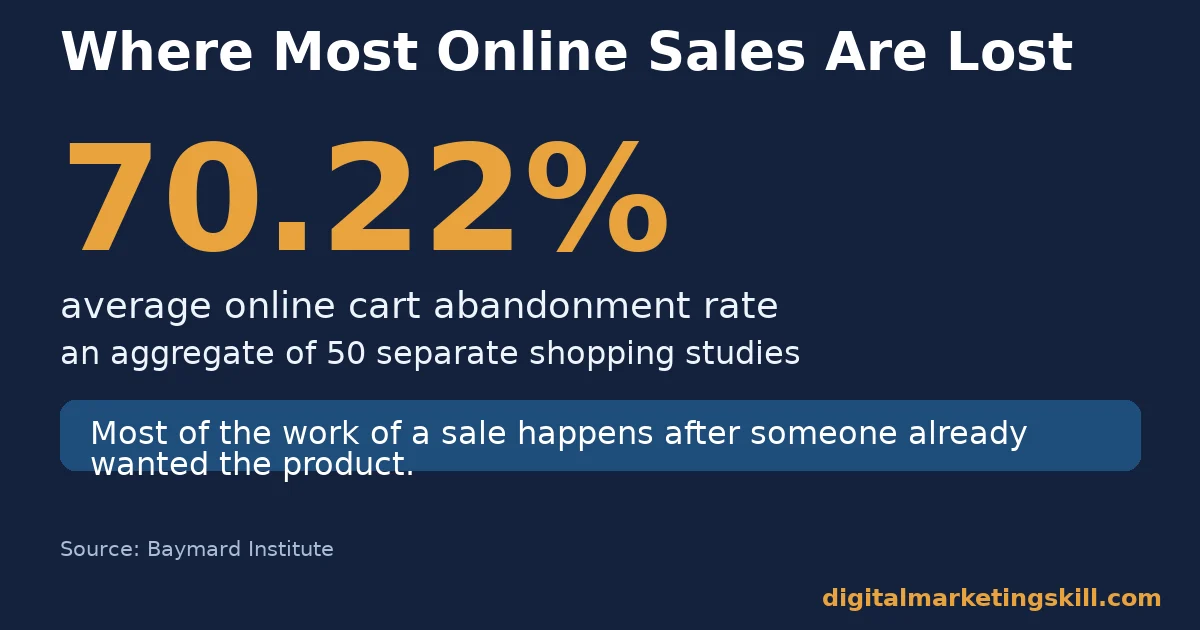
The practical lesson: Facebook and Instagram strategies work by removing friction at each step of that path. Adding more posts on top of a broken path just sends more people into the same leak.
What Differs by Channel in Facebook and Instagram Strategies
Feed posts, Stories, Reels, shopping tags, Marketplace and direct messages each do a different job on the way to a sale. Good Facebook and Instagram strategies treat each one as a separate tool, not a copy-paste target for the same caption. Knowing which does what tells you where to invest first.
Think of each channel as a stage in a single conversation, not as six copies of the same post. Our guide on growing a small business on Instagram covers the account setup these channels rely on.
Feed Posts: Built for Trust
A feed post is usually the first proper introduction, not the close. It works best carrying social proof: a real customer photo, a review quote, or a before-and-after. Strangers trust other customers faster than they trust a brand’s own claims about itself.
This is also where Facebook and Instagram strategies most often go wrong. A feed stacked with product shots and no third-party proof reads as an ad, and people scroll past ads out of habit. Mix in a customer’s own words at least as much as your own claims.
Stories and Reels: Built for Discovery
Stories and Reels are built to reach people outside your existing audience through recommendation surfaces, not just your current followers. They work best with a fast hook and one clear next step, such as a sticker or a comment prompt, rather than a long pitch.
Treat Reels as the top of your path, not the close. A viewer who has never heard of you needs a reason to stop scrolling in the first second. Then they need one single, simple action: follow, tap a sticker, or visit your profile. Asking a cold viewer to buy in the same breath usually fails both jobs at once.
Shopping Tags: Built for Frictionless Browsing
Product tags let someone see a price and details without leaving the app, a feature Meta documents in its own Business Help Center. That removes one of the biggest drop-off points: the extra tap out to a slow or unfamiliar external site.
Tag every product you can, even in posts that are not primarily about selling. A behind-the-scenes photo with one tagged item still gives a curious viewer a one-tap path to price and checkout, without changing the tone of the post itself.
Facebook Marketplace: Built for Local, Ready-to-Buy Intent
Facebook Marketplace reaches people actively searching to buy nearby, a different intent than someone scrolling a feed for entertainment. Listings there work best with a clear price, real photos from multiple angles, and a fast reply to the first message. Local buyers often compare several sellers within the same hour. Our guide on using Facebook Marketplace to grow a business covers the listing details that matter most.
Direct Messages: Built for Closing the Sale
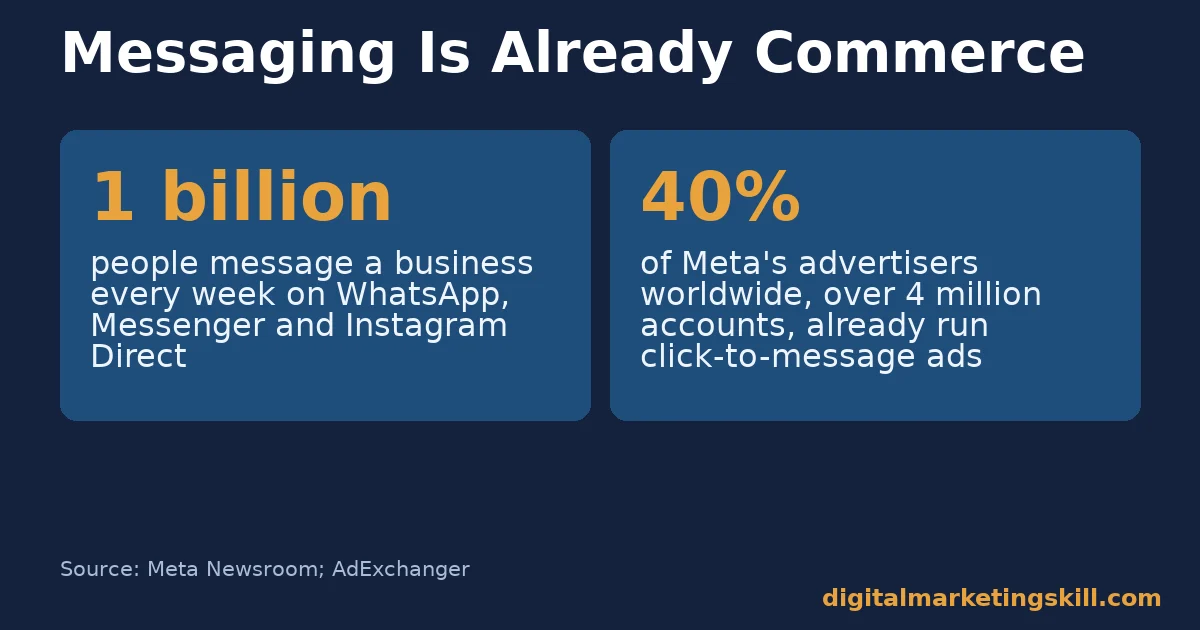
A direct message is where a hesitant buyer asks their last question before paying. Meta reports that one billion people message a business every week across its apps. Roughly 40% of its advertisers worldwide, more than 4 million accounts, already run click-to-message ads that open a chat instead of a landing page. Treat a DM as a sales conversation, not an inbox to clear at the end of the day.
The best Facebook and Instagram strategies treat a DM thread like a short sales call. One unanswered question is often the entire reason a ready buyer disappears. A slow reply can undo everything a good feed post and a good product tag already achieved.
How to Lead With Each Channel: Facebook and Instagram Strategies in Practice
Knowing what each channel is built for is step one. Step two is a concrete habit for each one, so good Facebook and Instagram strategies survive a busy week instead of staying a good idea on a slide.
Lead With Feed Posts: Show Proof, Not Just Product
Post real customer results before you post more product shots. One believable before-and-after, with permission, usually earns more trust than five polished product photos in a row. Ask every happy customer for a photo or a line of feedback. Build a simple rotation so proof appears roughly as frequently as promotion.
Lead With Stories and Reels: One Clear Action per Post
Give every Story or Reel exactly one next step: a sticker, a swipe-up, or a comment prompt. A post asking for three different actions reliably gets none of them. Plan the next step before you film, not after, so the content is built around it instead of the action feeling bolted on.
Lead With Shopping Tags: Remove the Extra Tap
Tag products directly in posts and Stories wherever the feature is available in your market. Price and checkout then sit one tap away, instead of a full site visit away. Review your tags monthly. An out-of-stock or discontinued item left tagged quietly erodes trust in every post that still carries it.
Lead With Marketplace: Treat Every Listing Like a Local Storefront
Keep listings current, priced clearly, and answer the first message within minutes where you can. Ready-to-buy local shoppers rarely wait long for a reply. A stale listing with an old price is often worse than no listing at all, because it damages trust before a conversation even starts.
Lead With DMs: Answer Fast or Automate the First Reply
Set an automatic first reply that answers the two or three questions buyers ask most. Hand off to a person for anything specific. Speed matters more than a perfect script in that first reply. A short, honest answer beats a long, polished one that arrives an hour late.
Measuring What Actually Sells: Define Every Number First
Facebook and Instagram strategies are only as good as what you measure. A page can look busy and still be losing money if nobody is tracking where the sale actually happened. Here is what each term means and how to read it.
- Click-through rate: the share of people who saw a post and tapped through to a product or link. Read it as a sign the hook worked, not that the sale happened.
- Conversion rate: the share of visitors who completed a purchase, as Google Analytics defines it. Compare it against your own site’s average, not a generic benchmark, since niches vary widely.
- Cost per purchase (if running ads): ad spend divided by completed sales. Track it per format, so you can see whether Reels or feed ads actually sell more cheaply.
- Response time: how long a DM or comment question waits for a reply. Slow response time is one of the most common, fixable reasons a ready buyer walks away.
Check these weekly while testing a new format, then monthly once your numbers settle into a stable, repeatable pattern.
The One Decision Rule: Fund the Step With the Biggest Drop-Off
Decision rule: find the single step in your path, from view to purchase, with the biggest percentage drop-off, and fix that step before adding anything new. More content rarely helps a path that is already leaking at one specific point.
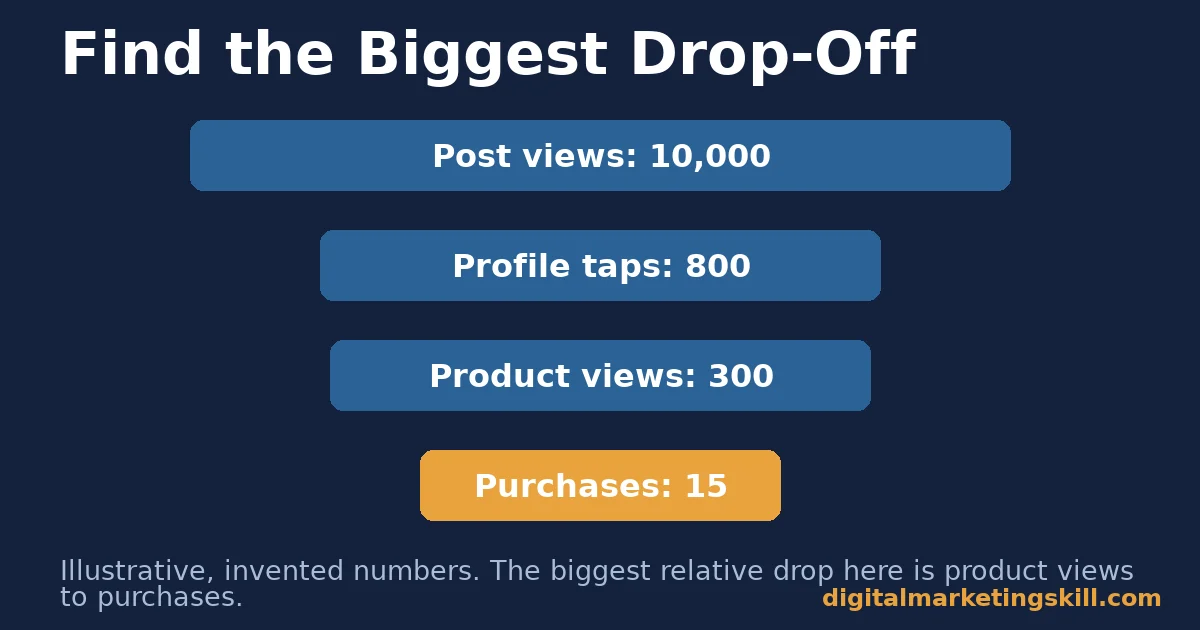
Illustrative, invented numbers to show the rule at work: a page gets 10,000 post views, 800 profile taps, 300 product views and 15 purchases. The biggest relative drop is between product views and purchases. Under the rule, the next move is fixing checkout friction or adding social proof at that step. It is not posting more content to drive additional views.
Revisit the rule every few weeks. The step with the biggest drop-off tends to move once you fix the current one, so the next weak point is rarely the same as the last.
Common Mistakes That Undo Good Facebook and Instagram Strategies
Four mistakes show up again and again, across niches, page sizes and markets, regardless of how carefully the rest of the content calendar was planned. Checking your own page against this list takes a few minutes. It often finds the real cause of a flat conversion rate faster than any new tactic would.
Selling Before Trust Is Built
Pitching a cold viewer in the first post they see skips the step that makes people buy from strangers at all. Lead with proof or a useful answer, and let the offer follow once someone has seen you more than once.
Treating One Channel as the Whole Strategy
A page that only posts to the main feed misses the discovery reach of Reels and the closing power of DMs. Good Facebook and Instagram strategies use each channel for the job it is actually built for, not as a single repeating broadcast.
Letting DMs Sit Unanswered
A question left unanswered for a day often means a sale lost to a competitor who replied first. Even a short acknowledgment, promising a fuller answer soon, keeps a hesitant buyer from walking away entirely.
Not Tracking Where Sales Actually Come From
Without basic tracking, it is easy to credit the wrong channel for a sale that really started somewhere else. Use link tagging or a simple “how did you hear about us” question at checkout. That keeps the numbers guiding your next decision real.
A Real Case: Mixing Creators Lifted Sales for a Wellness Brand
LOMOJI, a wellness brand making herbal self-care products, tested two creator strategies inside an Advantage+ sales campaign with partnership ads. The test is a case study published by Meta. One version used only wellness-focused creators. The other mixed creators across lifestyle, beauty, fitness and parenting categories.
The mixed-creator version delivered a 74.6% increase in purchases. It also had a 42% lower cost per purchase, compared with the wellness-only version, per the published case study.
The limits matter here. This is one published case from one brand, in one market, not a controlled study across many brands. The lift came from creator mix specifically, not from Facebook and Instagram strategies in general.
Treat it as a reason to test creator diversity yourself, not a guaranteed result. Meta published this case as part of its own success-story library. It is a real, documented outcome, though not an independent or peer-reviewed study.
Frequently Asked Questions About Facebook and Instagram Strategies
Which works better for sales, Facebook or Instagram?
Neither wins outright; they usually work together as part of the same Facebook and Instagram strategies. Instagram tends to suit visual, discovery-driven browsing, while Facebook still carries strong group and Marketplace behaviour in many markets. Test both with the same offer and the same product tags before committing more budget to one over the other.
Do I need a large following to sell on Facebook and Instagram?
No. A smaller, genuinely interested audience with a clear path to checkout usually outsells a large, passive following. Focus on removing friction in the path before chasing follower count. A bigger audience with the same leaky checkout just produces a bigger leak.
How many posts a week should I publish to drive sales?
There is no fixed number. A consistent, lower-volume schedule with real social proof tends to outperform frequent, generic posting. Watch your conversion rate, not your post count, to judge whether the schedule works. Give any new schedule at least a few weeks before judging it.
Are Reels worth the production effort for a small business?
Often yes, because of their reach into non-followers, but only if each one ends with one clear next step. A Reel that entertains without a next step rarely converts, no matter how many views it gets. A viewer who was never asked to do anything simply moves on to the next one.
Is it safe to sell directly through DMs?
Yes, when you keep records of the order and payment outside the chat itself, such as an invoice or order confirmation. Treat DM selling as a real sales channel with the same documentation you would use anywhere else. Include a clear return or refund policy stated up front.
What is a good conversion rate for social media traffic?
It varies widely by niche and price point, so use your own site’s average as the benchmark rather than a single industry number. Compare social traffic’s conversion rate against your other channels over the same period. Treat a big gap between channels as a clue, not a verdict, until you know why it exists.
Should I run ads before I fix my organic path?
Generally no. Ads sending traffic into a path that already leaks badly just make the leak more expensive. Fix the biggest drop-off step first, then use ads to bring more people into a path that already converts. Every dollar spent then works with a system that already sells, not against one that does not.
How do Facebook and Instagram strategies differ for a service business versus a product business?
A product business can often close the sale inside the app, through shopping tags or a DM. A service business usually needs one extra step, such as a booking link or a short call. Its Facebook and Instagram strategies should treat the DM or comment as the start of a conversation, not the final step.
Turn This Into a Repeatable Sales Channel
Facebook and Instagram strategies that drive real sales come from measuring the whole path, not from a bigger content calendar. That is the kind of hands-on, campaign-level skill the Master Diploma in Digital & AI Marketing at Digital Marketing Skill Institute is built around.
What the Social Media Track Covers
The AI-Powered Social Media Management and Advertising track covers organic strategy, paid campaigns and performance reporting on real accounts. It includes unlimited 1-on-1 coaching and mentoring, plus a U.S. Project Internship with a verified U.S. Work Reference Letter, built in from day one.
It is one of four AI-powered tracks, alongside lead generation and email automation, Google advertising and analytics, and WordPress and SEO. Together they make up a ten-course Master Diploma, with a Full Stack option covering all four. The program is dual US and UK accredited, recognised in more than 100 countries, and runs 100% online.
Where to Go Next
See the full track breakdown on the Master Diploma program page. Read real outcomes on the student reviews page. See how a Facebook page can earn directly in our guide to monetizing a Facebook page, or browse more practical guides on the digital marketing blog.
When you are ready, apply here. Whether you sell from a small page or manage social for a growing brand, you can build this skill from wherever you live, and so does Digital Marketing Skill Institute itself, built to work the same way no matter where you study from.
Every figure in this guide was checked against its original source before publication. Figures marked as illustrative are invented examples, not real results.
![9 Amazing Digital Marketing Skills to Make Money Online [With Proof]](https://digitalmarketingskill.com/wp-content/uploads/2019/07/9-Amazing-Digital-Marketing-Skills-to-Make-Money-Online-With-Proof-17.png)






