

A freelance writer gets paid to write for clients instead of one employer. The path looks simple: pick a niche, build proof, pitch clients, and raise rates over time. Few writers run it as a repeatable system. That gap is why some freelance writers earn a living while others stall at one low-paying gig.
Key Takeaways
- A freelance writer’s income varies widely. Payscale puts the median US hourly rate at $30.28, with a range of $15.45 to $50.42 across 139 profiles.
- The US Bureau of Labor Statistics projects about 11,900 annual openings for writers and authors, a US-only figure, not a global one.
- Freelance and gig work is a global pattern, not a US one. The World Bank estimates 154 to 435 million people worldwide do online gig work.
- A niche beats a general pitch. Clients hire a freelance writer for proof in their specific format, not a broad writing skill.
- Portfolio proof, not a resume, is what moves a freelance writer from pitch to paid project.
In this guide
- Why Most Freelance Writer Advice Skips The Hard Part
- How A Freelance Writer Actually Gets Paid Work
- How The Freelance Writer Path Differs By Format
- How To Lead With Each Freelance Writing Path
- How Much A Freelance Writer Actually Earns
- The One Decision Rule For Choosing A First Niche
- A Real Case: What A Narrow Niche Changed
- Frequently Asked Questions About Becoming A Freelance Writer
- Turning Freelance Writing Into A Repeatable Practice
Why Most Freelance Writer Advice Skips The Hard Part
Most guides tell a freelance writer to “write every day” and “pitch more clients.” Both are true, and both skip the actual blocker. Clients do not hire a writer in general. They hire proof. Proof that a specific writer can do a specific job, in a specific format, on a predictable schedule.
So the real gap is proof, not effort. A freelance writer with three strong samples in one format beats a freelance writer with twenty scattered samples across ten formats. The first looks like a specialist. The second looks like a hobbyist, even with more total writing behind them.
That snap judgment is not unusual. The Nielsen Norman Group’s eyetracking research found readers scan a page in an F-shaped pattern rather than reading it in full. That is exactly how a busy client skims a portfolio page.
Two Ground Rules Behind This Guide
Two ground rules keep this guide honest.
First, pay figures below come from named sources with their scope stated. A figure from a US survey is a US figure, not a global one, and this guide says so every time.
Second, nobody can promise a fixed income from freelance writing. Results depend on niche, hours worked, and client relationships. This guide makes no earnings guarantee, for any freelance writer, in any market.
How A Freelance Writer Actually Gets Paid Work
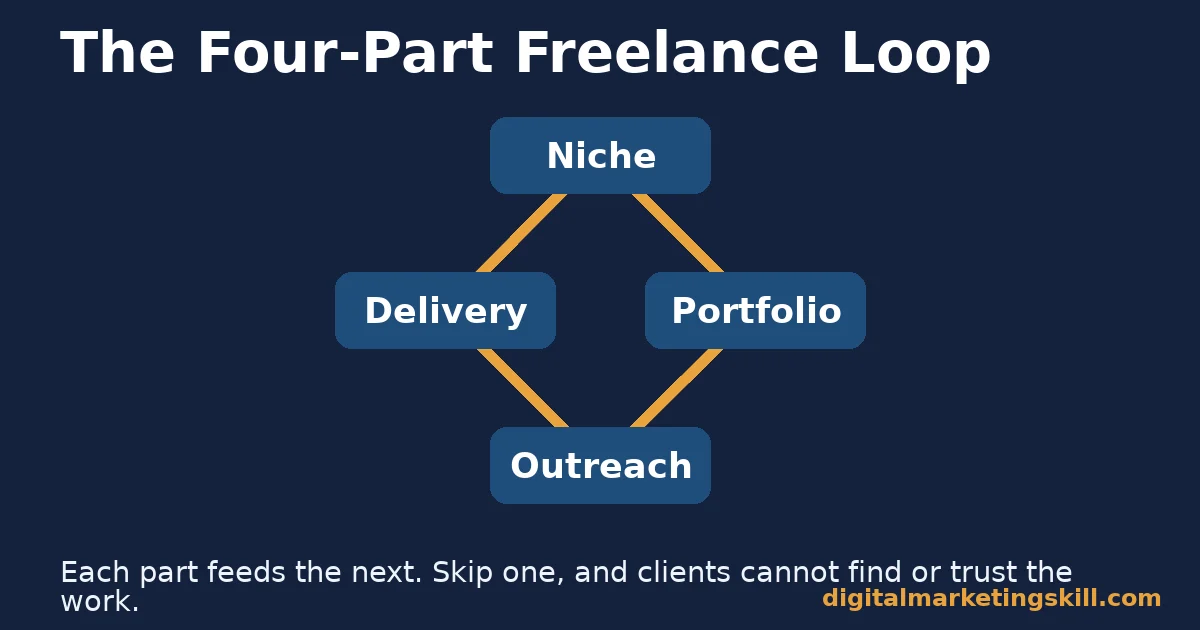
Four parts drive the system behind a working freelance writing practice, and they repeat as a loop.
The Four-Part Path
- Niche definition. One or two formats and industries a freelance writer can point to with real samples, not a general “I write anything” pitch.
- Portfolio proof. Published samples, even self-published ones, that show the exact format a target client needs.
- Outreach channel. A consistent way to reach clients: platforms, cold pitching, referrals, or guest posts, repeated on a schedule.
- Rate and delivery. A clear rate, a reliable delivery process, and a record of meeting deadlines that earns repeat work.
Outreach channels are not interchangeable either. Freelance platforms give a new freelance writer visibility fast, but they also put every pitch next to dozens of competing bids, so rates start lower there than almost anywhere else.
Cold pitching takes longer to produce a first reply, yet it skips the price competition entirely, because the client never sees a list of rival quotes. Referrals are the slowest channel to build and the fastest once it exists, since a referred freelance writer usually skips the pitch stage altogether.
Skip the niche step and a freelance writer competes on price against everyone. Skip the portfolio step and even a skilled writer gets ignored, because a client cannot verify a claim they cannot see. And skip the outreach step and the best samples sit unseen, which is why all four parts need to run together, not one at a time.
Signs A Freelance Writer’s Pitching Needs A Reset
Not every stalled pitch means the whole plan is wrong. Most of the time, only one part of the loop is the actual problem. Finding which part saves a freelance writer from rewriting a portfolio that was never the issue, or from chasing new clients when the real fix is a higher rate. A few patterns show a freelance writer is stuck on one part of the loop:
- Pitches go out, replies do not come back. The niche or the portfolio does not match what the pitch promises.
- Clients reply, but rates stay low. The portfolio proves general competence, not a specific, higher-value skill.
- One client pays well, then work dries up. The outreach channel never grew beyond a single relationship.
- Work is steady, but every project is urgent and rushed. The delivery process has no buffer, so rates cannot rise without burning out.
Freelance Writer Paths By Starting Point
A total beginner and a career-switcher with existing writing experience need the same four parts, built from different starting points. Usually, a beginner needs to build the portfolio from scratch, with self-published or low-paid first samples, before outreach produces real replies.
A career-switcher often already has writing samples from a previous job, even if they were never labelled as a portfolio. The fastest move for a career-switcher is reframing existing work (reports, internal documentation, marketing copy) as proof for a specific freelance writer niche, rather than starting a portfolio from zero.
A side-hustle freelance writer, working around a full-time job, faces a third starting point: limited hours rather than limited proof. For this path, the four-part loop still applies, but the outreach channel matters most, since a slow, steady channel like referrals fits better around a day job than a time-intensive cold-pitching campaign.
How The Freelance Writer Path Differs By Format
Not every freelance writer builds the same kind of practice. The format someone chooses changes what proof matters, what clients pay, and how stable the work is.
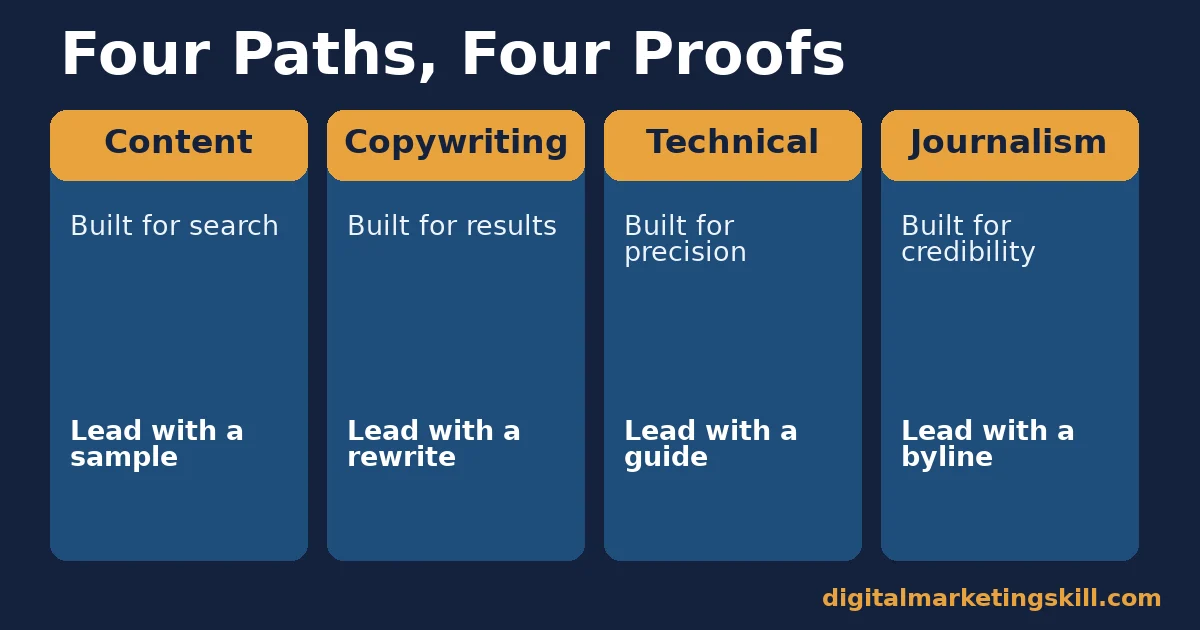
Content Writing: Built For Volume And Search Traffic
Content writing covers blog posts, articles and web pages written to inform and to rank in search. A freelance writer in this lane is judged on clarity, structure and whether a reader keeps reading. That matters because Ahrefs’ study of roughly 14 billion pages found 96.55% earn no monthly Google traffic at all.
A clear content writing process is what moves a sample out of that majority. Google’s own guidance on people-first content asks the same question a client should ask of any sample: does it show depth a dozen other pages do not already offer?
Copywriting: Built For Persuasion And Direct Response
Copywriting covers sales pages, ads and email campaigns written to move a reader toward one action. Clients pay more per word here because a weak sales page costs them revenue directly. Copywriting as a discipline rewards measurable results over polished prose. A freelance writer who can show a before-and-after conversion lift, even a small one, stands out fast in this format.
Technical Writing: Built For Precision And Longevity
Technical writing covers manuals, documentation and how-to guides for products or software. A freelance writer here needs accuracy more than style. The work tends to be the most stable of the four, since documentation needs updating long after it is first written. Repeat work follows naturally, because the same product keeps shipping new features that need new documentation.
Journalism: Built For Credibility And A Byline
Freelance journalism covers news, features and investigative pieces for publications. Pay per piece is often lower than copywriting. Still, a strong byline in a known outlet becomes portfolio proof that opens higher-paying work in every other format.
A content marketing client, for instance, trusts a journalist’s research habits even outside news writing. That is one reason content marketing teams often hire former journalists.
How To Lead With Each Freelance Writing Path
Picking a format is only the first move. Each one rewards a different opening move from a freelance writer trying to land the first few clients.
Content Writing: Lead With A Self-Published Sample
Start a simple blog or publish on a platform that accepts guest posts, then pitch with that link. Clients hiring for content writing want to see organised headings, a clear answer early, and a byline they can check, not a resume. Studying SEO writing basics before that first sample goes live makes the difference obvious to a client within the first paragraph.
Copywriting: Lead With A Before-And-After Rewrite
Take a real, public sales page or ad and rewrite it as a sample, labelled clearly as a practice rewrite. This shows persuasion skill without waiting for a first paying client, and it is the fastest proof a new copywriting business can produce.
Technical Writing: Lead With A Documented Process
Pick a tool or process already known well. Write a short how-to guide for it, formatted the way real documentation looks: numbered steps, screenshots or diagrams, and a clear scope. Precision in that one sample does more than a long list of unrelated writing credits. A reviewer checking technical accuracy notices a missing step far faster than a reader skimming a blog post would.
Journalism: Lead With A Local Or Niche Pitch
Large outlets reject most cold pitches. A smaller, niche or local publication is more likely to say yes to a first-time freelance journalist. That first byline becomes the credibility a bigger pitch needs later.
How Much A Freelance Writer Actually Earns
Pay for a freelance writer depends on format, experience and client type. The figures below are reference points, not promises, and every freelance writer’s actual number will move around them.
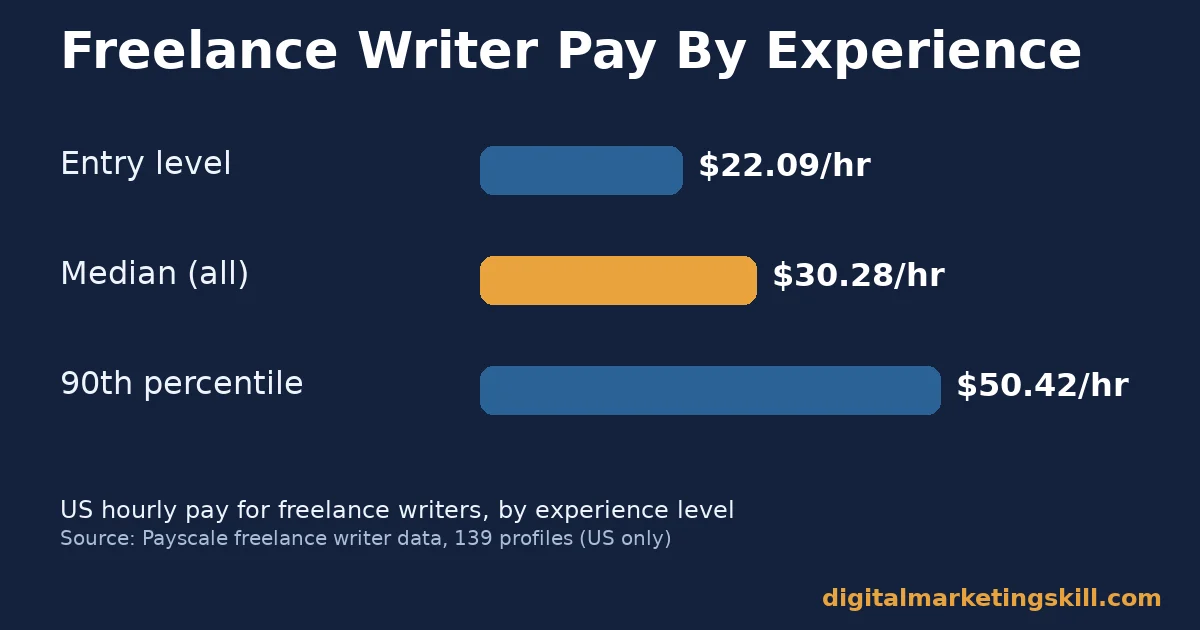
- Entry-level rate. Payscale’s data puts entry-level freelance writers in the US around $22.09 an hour, before a writer has built a niche or a track record.
- Median rate. The median across Payscale’s 139 US profiles is $30.28 an hour, with a 10th-to-90th percentile range of $15.45 to $50.42.
- Job market size. The US Bureau of Labor Statistics counts about 140,300 writer and author jobs. It projects roughly 11,900 openings each year, mostly from people leaving the field rather than new demand.
- Global gig participation. The World Bank estimates 154 to 435 million people worldwide do online gig work, a figure that spans every gig category, not writing alone.
Why These Figures Vary So Much
These numbers mix two different things worth separating. The BLS and Payscale figures describe the US market specifically. The World Bank figure describes the global gig economy broadly, across every kind of gig work, not writing alone.
A freelance writer anywhere in your country can read these as context, not as a local guarantee. Local client budgets and currencies change the real number. Payscale’s own data also shows 94% of freelance writers in its sample receive no health benefits through their work. That is a reminder that a quoted hourly rate rarely tells the whole story.
Common Pricing Mistakes New Freelance Writers Make
Even a well-chosen niche underperforms if the pricing habits around it stay generic. A few pricing habits quietly cap a freelance writer’s income before a niche even gets the chance to help:
- Pricing by the hour alone. A fast, experienced freelance writer earns less per piece than a slower one charging the same hourly rate, which punishes skill instead of rewarding it.
- Never raising rates with existing clients. A rate set at the start of a relationship often stays flat for years unless the freelance writer asks for a review.
- Quoting before scope is clear. A vague project brief leads to a vague quote, and vague quotes are the easiest ones for a client to negotiate down.
- Competing only on price. A freelance writer without a niche has nothing to compete on except being the cheapest option in the room.
The One Decision Rule For Choosing A First Niche
New freelance writers often try to stay general, hoping a wider net catches more clients. Use one rule instead: pick the narrowest niche where a client’s problem is also expensive to get wrong.
Illustrative, invented numbers: imagine two niche options. Option A is “general blog writing,” a format thousands of writers already offer. Option B is “onboarding documentation for small software teams,” a format few writers specialise in, where a confusing guide costs the client real support time.
Under the rule above, Option B wins the slot. It has a smaller pool of clients. Still, a client will pay more to fix an expensive problem than a cheap one. That gap in willingness to pay is what the rule is built to find.
A Real Case: What A Narrow Niche Changed
ProBlogger’s long-running freelance writing job board, cited across the freelance writing industry, has repeatedly observed a pattern: writers who list a specific specialty in their pitch get more responses than writers who list “all topics.” The platform does not publish a controlled study with a percentage figure. Treat this as a widely observed pattern from a long-running job board, not a measured statistic.
The limit on this case matters. It is an industry observation, not an audited result. It does not say how much more a specialist earns, only that a specific pitch outperforms a generic one in response rate. Treat it as a direction to test for any freelance writer, not a number to expect.
The pattern lines up with the four-part loop described earlier. A specific pitch works because it pairs a clear niche with a portfolio that proves it, not because specificity is persuasive on its own.
A freelance writer who tests one narrow niche for a defined period, then checks the reply rate against a previous general pitch, gets a direct answer for their own market. That beats relying on someone else’s observation alone.
Frequently Asked Questions About Becoming A Freelance Writer
How do I become a freelance writer with no experience?
Write two or three sample pieces in one chosen format, publish them somewhere public (a personal blog works), and pitch smaller clients or publications first. Experience comes from the first few paid projects, not from waiting until a resume looks ready.
Do I need a degree to become a freelance writer?
No. Clients hire for proof of skill, shown through samples and past work, not credentials. A writing-related degree can help with some technical or academic niches, but it is not a requirement for most freelance writing work.
How long does it take to become a full-time freelance writer?
Most freelance writers build toward full-time income over months, not weeks. It takes time to build a portfolio, find a reliable outreach channel and raise rates. Keeping a part-time income source during that period reduces financial pressure while the practice grows.
How many clients does a freelance writer need?
Most sustainable freelance writers work with three to six active clients at once, rather than one large client or dozens of small ones. That spread limits the damage if a single client pauses work, without spreading attention too thin to deliver well. A freelance writer with only one client is effectively an employee without the benefits, since a single pause in that relationship removes the entire income.
Is freelance writing oversaturated?
The market is crowded for generalists and genuinely open for specialists. A niche with real client demand usually has far fewer qualified writers than a generic one. So specialising is the direct answer to saturation, not a side benefit of it. “Oversaturated” usually describes the general pitch, not the niche underneath it.
How do freelance writers handle slow income months?
Experienced freelance writers keep a buffer of savings. They spread work across several active clients and treat outreach as an ongoing task, not something to do only when work runs out. Income naturally varies project to project, so the buffer matters more than any single high-paying month.
What should a freelance writer charge for a first project?
Research the market rate for the chosen niche first, using sources like Payscale’s data above as a starting reference, then price close to that range rather than far below it. Charging too little signals low quality as often as it attracts clients, and it makes raising rates later harder.
What tools does a freelance writer need to get started?
A word processor, a way to send invoices, and a simple portfolio page cover the basics. Nothing more elaborate is required to land a first paying project. Most of the remaining tools get added only once a specific niche makes them useful, not before.
Turning Freelance Writing Into A Repeatable Practice
A freelance writer earns the title once the four-part loop runs on its own: niche, portfolio, outreach and delivery, each feeding the next. The format differs by writer, but the loop does not, and neither does the discipline of checking it on a schedule instead of only when work runs dry.
Digital Marketing Skill Institute’s Master Diploma in Digital & AI Marketing covers content and AI marketing. It teaches the research, writing and optimisation skills a freelance writer uses to build a specialist practice. The programme is dual US and UK accredited, recognised in more than 100 countries, and runs 100% online, with unlimited 1-on-1 coaching and mentoring alongside real project work inside a U.S. company.
Explore the Digital and AI Marketing Training Course, browse more guides on the digital marketing blog, or see outcomes on the reviews page. Ready to build a freelance writer practice of your own, anywhere in your country? Apply to the program through Digital Marketing Skill Institute, or visit digitalmarketingskill.com to learn more.
Every figure in this guide was checked against its original source before publication. Figures marked as illustrative are invented examples, not real results.
![9 Amazing Digital Marketing Skills to Make Money Online [With Proof]](https://digitalmarketingskill.com/wp-content/uploads/2019/07/9-Amazing-Digital-Marketing-Skills-to-Make-Money-Online-With-Proof-17.png)






