A freelance writer portfolio is the one asset that gets you hired without a single interview. Clients judge your work before they judge your pitch. A clear portfolio, built around real samples and a visible process, turns strangers into paying clients faster than any cold email ever will.
Key Takeaways
- 65% of writers and authors are self-employed, and median pay sits at $76,910 a year (US Bureau of Labor Statistics).
- Business and marketing ghostwriting rates range from 50 cents to $1.00 per word, or $87.50 to $125 per hour (Editorial Freelancers Association, 1,100+ members surveyed).
- Average copywriter pay is $77,506 a year, ranging from $45,871 to $130,959 (Indeed, 807 salaries).
- “Nearly every job posting expects a writer to provide a writing sample” (Write the Docs hiring guide), which makes a weak portfolio an instant filter against you.
- Replacing a lost client costs several times more than keeping one, so a portfolio built for repeat work pays off twice (Harvard Business Review).
In this guide
- Why Most Freelance Writer Portfolios Fail To Convert
- Why A Portfolio Beats A Resume For Freelance Work
- What Belongs In A Freelance Writer Portfolio
- How To Actually Build Each Part Of Your Portfolio
- How To Measure Whether Your Freelance Writer Portfolio Is Working
- The One Decision Rule: Fix Your Samples Before You Redesign Your Site
- A Real Case: From $8,000 To Niche Authority
- Frequently Asked Questions About A Freelance Writer Portfolio
- Where To Learn Freelance Writer Portfolio Skills Properly
Why Most Freelance Writer Portfolios Fail To Convert
Most freelance writer portfolios are just a pile of links. No structure, no story, no proof of results. A client scanning dozens of pitches skips anything that takes effort to understand.
This guide treats your freelance writer portfolio as a sales tool, not a scrapbook. Every section below exists to answer one client question: can this person do the specific job I need done?
This is an informed approach based on current hiring patterns, not a guarantee. Your results will depend on your niche, your rates, and how consistently you pitch.
Most writers build their first portfolio backward. They collect every piece they have ever written, post it all, and hope a client connects the dots. Clients do not have time to connect dots. A working portfolio does that connecting for them, in the order a busy person actually reads.
The fix is not more content. It is less content, arranged on purpose. A tighter portfolio with three sharp samples beats a sprawling one with twenty unsorted links, every single time a client actually opens it.
Why A Portfolio Beats A Resume For Freelance Work
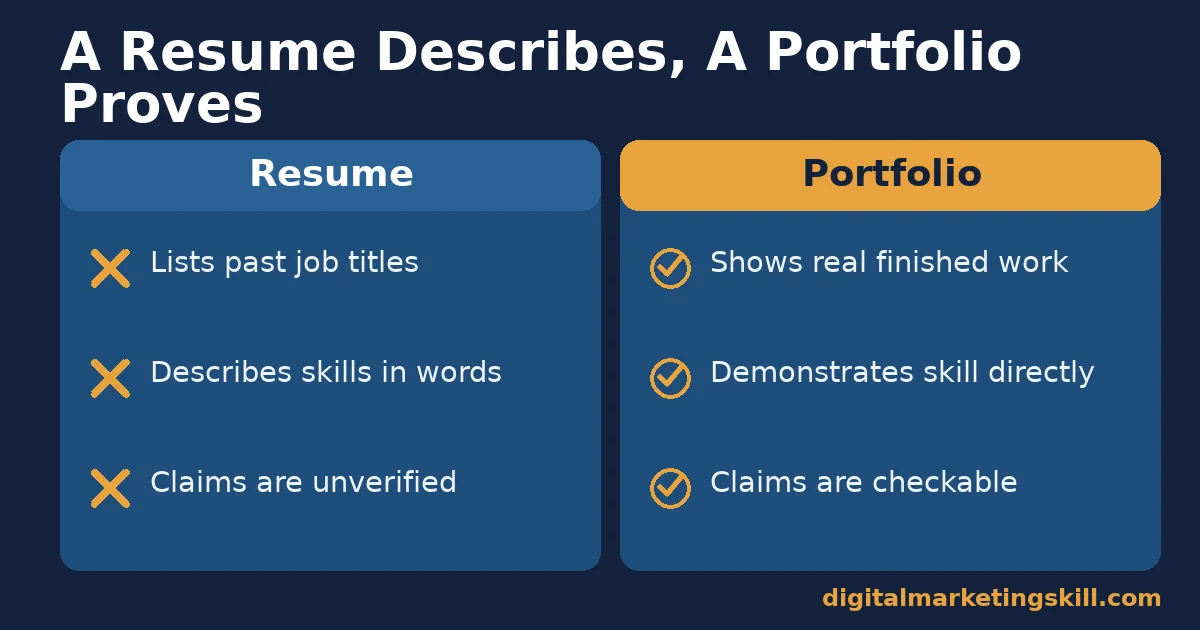
A resume lists what you have done. Your portfolio proves you can do it again. Clients hiring freelancers are not filling a seat; they are buying a specific outcome, on a deadline, without training you first.
That is why “nearly every job posting expects a writer to provide a writing sample,” according to the Write the Docs hiring guide. A sample answers the real question in seconds: does this writer sound like someone who understands my industry?
A resume cannot do that. It describes experience. A portfolio demonstrates it, in the client’s own words and format, before a single email is exchanged.
This matters even more for freelance writers. 65% work for themselves, per BLS data, rather than inside an agency with a brand name doing the convincing for them. Without that reputation behind you, your portfolio has to do the work alone.
Median pay for writers and authors sits at $76,910 a year. That figure blends entry-level bloggers with specialized consultants. Where you land on that range depends heavily on how clearly your portfolio proves you belong near the top of it.
What Belongs In A Freelance Writer Portfolio
A working freelance writer portfolio needs four things. Skip one, and the whole thing reads as unfinished. Each piece reinforces the others, so treat this as a checklist, not a menu to pick from.
Writing Samples: Built For Proof
Samples are the core of the portfolio. Three to five strong pieces beat fifteen mediocre ones, because each weak sample quietly lowers the average quality a client assumes you deliver. Choose samples that match the work you want next, not just the work you are proudest of.
If you write in a specific niche, such as fintech, health, or B2B software, say so clearly next to each sample. Niche-specific proof removes the client’s biggest fear: that you will need weeks to learn their industry before producing anything usable.
Arrange your samples from strongest to weakest, not from newest to oldest. Most clients stop scrolling after the first two or three pieces, so your weakest sample should never be the first thing they see. If a piece no longer represents your current skill level, remove it rather than let it drag down the average.
Format matters too. Instead of a bare link, add a one-line caption explaining what the piece was for and what result it was written to drive. A caption turns a plain link into context a busy client does not have to guess at.
Rates And Positioning: Built For Clarity
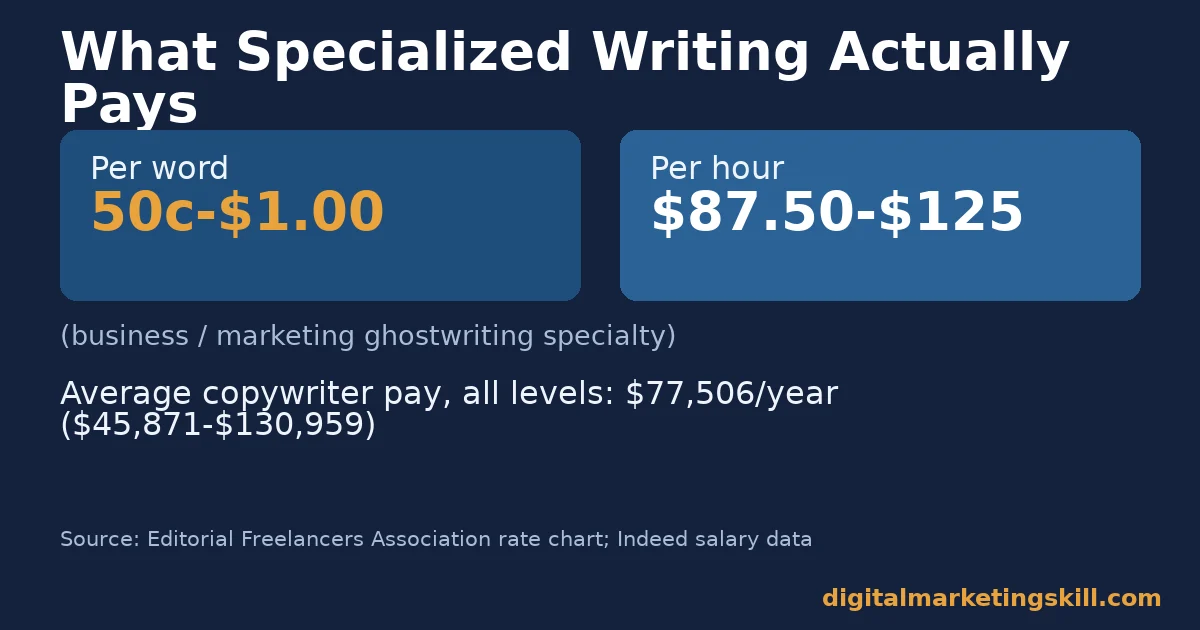
Business and marketing ghostwriting pays 50 cents to $1.00 per word, or $87.50 to $125 an hour, per the Editorial Freelancers Association’s latest member survey. Knowing where you sit in that range before a client asks protects you from underpricing out of nerves.
State your specialty plainly: “I write case studies for B2B SaaS companies” tells a client exactly who you are for. A vague “I write anything” signals the opposite: that you have not yet picked a lane worth paying a premium for.
Average copywriter pay sits at $77,506 a year, per Indeed’s salary data. The full range runs from $45,871 to $130,959, depending on specialty and client type. A portfolio that clearly targets one profitable niche is one of the few levers you control that pushes you toward the top.
Credibility Signals: Built For Trust
Results matter more than adjectives. A line like “helped a client’s email sequence lift open rate by double digits” does more work than “excellent communicator and team player.” Where you can, attach a number, a logo, or a named outcome to every project.
If you lack client results yet, publish original pieces on a personal blog or a platform like Medium. A consistent publishing habit signals reliability, which is the trait most clients actually hire for.
Ask every satisfied client for a short testimonial focused on the outcome, not a generic compliment. “Delivered three case studies on time that our sales team now uses in every pitch” tells a future client far more than “a pleasure to work with.” Specific outcomes are what get screenshotted and reused; vague praise gets skimmed and forgotten.
Pair each testimonial with the sample it describes, right next to it, instead of grouping all testimonials in a separate section. Seeing the proof and the praise together, in the same glance, is far more convincing than making a client flip between two parts of the page.
Presentation: Built For Speed
A client should understand what you offer within ten seconds of landing on your portfolio. Lead with your specialty, then your best three samples, then simple contact information. Nothing else needs to come first.
A cluttered homepage with ten competing calls to action does the opposite of what a portfolio is for. It makes a busy client decide, correctly, that working with you will also feel cluttered.
Check your portfolio on a phone before you call it finished. Most clients open a shared link on mobile first, often from an email or a message. A layout that only works on a laptop screen loses them before they reach your first sample.
How To Actually Build Each Part Of Your Portfolio
Knowing what belongs in a freelance writer portfolio is not the same as having one. Here is where to start on each piece, in the order most writers can realistically tackle them.
Samples: Lead With Your Target Niche
Do not wait for paid work before you have samples. Write two or three unpaid pieces, clearly labeled as self-initiated, in the exact niche you want to be hired into. A labeled spec piece still proves range and voice, and it is far better than an empty portfolio.
Positioning: Lead With One Sentence
Write a single sentence that states your niche, your format, and your ideal client, such as “I write onboarding emails for B2B SaaS companies.” Put it at the very top of your portfolio. Everything else on the page should support that one sentence, not compete with it.
Credibility: Lead With The First Client
Your first real client is worth more than ten unpaid samples, because a named result survives client scrutiny that a self-assigned piece cannot. Once you land that first paid project, ask directly for a short, specific testimonial about the outcome, not just a compliment about your attitude.
If the client is hesitant to give a public testimonial, ask for permission to describe the project in general terms instead, without naming them. A described, anonymized win still beats having no proof of paid work at all.
Keep the language in every testimonial as close to the client’s own words as possible. Overly polished, generic-sounding praise can read as written by you instead of by them, which quietly undercuts the credibility it was meant to build.
Presentation: Lead With A Single Page
You do not need a custom website on day one. A single well-organized page, even a free one, outperforms a half-built multi-page site that looks abandoned. Expand the site only after you have samples worth expanding around.
Avoid building your entire presence inside a platform you do not control. A profile page on a freelance marketplace can disappear or change its rules overnight. Treat any marketplace profile as a secondary channel. Your own simple page is the one link you always control, even if every marketplace you use shuts down tomorrow.
How To Measure Whether Your Freelance Writer Portfolio Is Working
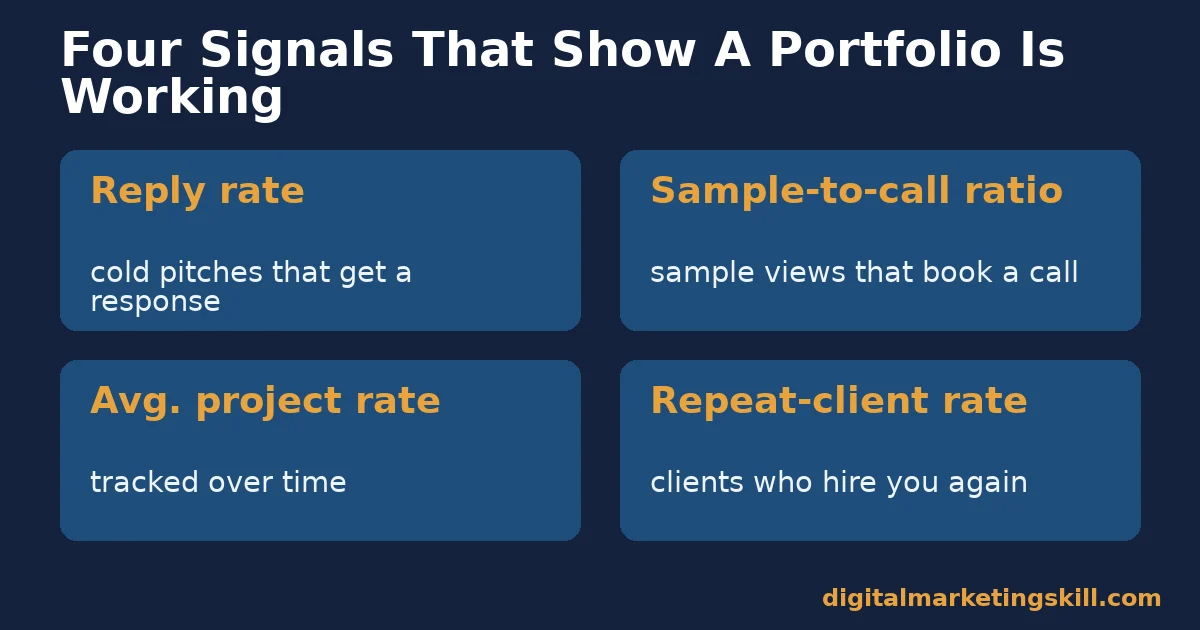
A freelance writer portfolio is a tool, so treat it like one. Track these four signals against your own pitching activity, not against anyone else’s numbers.
- Reply rate: the share of cold pitches that get any response. A low reply rate often points to a weak or unclear portfolio, not a weak pitch email.
- Sample-to-call ratio: how often a client who views your samples books an intro call. This isolates whether your samples alone are doing their job.
- Average project rate: your typical rate per word, per hour, or per project, tracked over time. A rising average means your positioning and credibility signals are working.
- Repeat-client rate: the share of clients who hire you again without a new pitch. This is the number that eventually matters most, since repeat work needs no new portfolio visits at all.
Reading The Four Numbers Together
Read these together. A healthy reply rate with a low sample-to-call ratio suggests your pitch is strong but your samples are not closing the gap. A low repeat-client rate despite good projects often means your delivery is fine, but your follow-up after the project ends is missing.
Keep these four numbers in a simple spreadsheet, updated monthly. Without that tracking, every portfolio decision is a guess. With it, you are responding to real signal instead.
Review the spreadsheet every few months, not after every single pitch, so short-term noise does not drive long-term decisions. One slow week rarely means anything on its own. A consistent three-month trend in any of these four numbers almost always does.
The One Decision Rule: Fix Your Samples Before You Redesign Your Site
If your reply rate is low, audit your three best samples before you touch your site’s design. A beautiful freelance writer portfolio with weak or mismatched samples still fails to convert. Samples are what clients actually read. Design is only the frame; samples are the picture inside it.
Illustrative, invented numbers: imagine you send 20 pitches a month and get 2 replies, a 10% reply rate. If your samples do not match your target niche, swapping in three niche-specific pieces, with no other changes, often lifts that number before any redesign would. This is not a guaranteed outcome for every writer, but it shows why sample quality usually comes before presentation.
The same logic applies to your rate positioning. A freelance writer portfolio that undersells its own niche, by hiding behind a generic “content writer” label, will struggle to justify rates near the top of the Editorial Freelancers Association’s range, no matter how polished the design looks.
A Real Case: From $8,000 To Niche Authority
Joel Klettke, founder of Case Study Buddy, built his freelance writing business by niching into one format: case studies. According to his account on the Being Freelance podcast, his business grew from around $8,000 in its first year to nearing $1.5 million Canadian in annual revenue. An early client relationship helped establish his credibility in the space.
The lesson is not the revenue figure itself. It is the mechanism. A narrow, provable specialty, backed by visible samples in that exact format, let him charge consulting-level rates instead of competing on price with generalist writers. This is one published account, not a guaranteed outcome; results will vary by niche, market, and effort.
Notice what the case does not claim. It does not say niching down guarantees seven-figure revenue, and neither does this guide. What it shows is a repeatable pattern: pick one format, build visible proof in it, and let that proof do the selling. A long list of unrelated samples cannot do the same job.
Frequently Asked Questions About A Freelance Writer Portfolio
Do I need a portfolio website, or can I use a free platform?
A free platform is enough to start. What matters is organization and clarity, not the platform’s price tag. Upgrade to a custom site only once you have enough samples and clients to justify the extra investment. A domain name you own is a small, worthwhile upgrade once you are pitching regularly.
How many samples should a freelance writer portfolio include?
Three to five strong, niche-relevant samples outperform a long list of unrelated pieces. Quality and relevance matter more than quantity, since each sample sets the client’s expectation for every piece after it. You can always add more once you have proven demand in a specific format.
What if I have no paid writing experience yet?
Write spec pieces in your target niche and label them clearly as self-initiated samples. A labeled spec piece still proves your range and voice, and it beats an empty portfolio every time.
Should I list my rates in my freelance writer portfolio?
Listing a rate range can filter out clients who cannot afford you, which saves time on both sides. Many writers prefer to quote per project instead, once they understand the scope. Either approach can work if applied consistently, and switching between the two too often sends a confusing signal.
How often should I update my portfolio?
Update it after every project that produces a result worth showcasing, and remove your weakest sample whenever you add a stronger one. A portfolio that never changes quietly signals a business that has stalled. Set a recurring reminder every few months to review it. Do this even if nothing feels urgent enough to change on its own.
Does niching down actually pay more than staying general?
The Editorial Freelancers Association’s rate data shows specialized business and marketing writing commands $87.50 to $125 an hour, well above typical generalist rates. A narrow, well-proven specialty consistently outearns a broad, unproven one. Clients pay a premium for someone who already understands their exact type of project.
Can a portfolio replace a personal pitch email?
No. A strong portfolio makes a pitch email more convincing, but it rarely generates work entirely on its own. Pair a focused portfolio with direct, consistent outreach for the fastest results. Treat the portfolio as the proof behind every claim your pitch email makes.
Should I include every client I have ever worked with?
No. Include only the clients and samples that support the niche you want more of. A single irrelevant project can confuse a client about what you actually specialize in, even if the work itself was good. Save those pieces for a private file instead of your public portfolio.
Where To Learn Freelance Writer Portfolio Skills Properly
Building a freelance writer portfolio is one skill inside a much bigger toolkit: positioning, client outreach, and the marketing skills that keep work coming in. Digital Marketing Skill Institute‘s Master Diploma in Digital & AI Marketing teaches exactly that, through four AI-powered tracks built from ten courses in total, including a track built specifically for AI-Powered Lead Generation and Email Automation. A Full Stack option lets you complete all four tracks for a fifth certificate.
Every student gets unlimited 1-on-1 coaching and mentoring, plus a U.S. Project Internship with a verified U.S. Work Reference Letter. That letter is exactly the kind of named, checkable credibility signal this guide recommends building into your own portfolio. The program carries dual US and UK accreditation and is recognised in more than 100 countries, delivered 100% online, so you can build your freelance career from anywhere in your country.
Browse more career guides on the Digital Marketing Skill Institute blog, read real outcomes on the reviews page, or go straight to the Master Diploma program page for the full curriculum. Wherever you live, you can apply here to start. For related reading, see this guide to turning freelance writing into a copywriting business and this breakdown of freelance marketplaces worth using. Learn more about the Institute at digitalmarketingskill.com, wherever you are, and start exploring whenever you’re ready.
Every figure in this guide was checked against its original source before publication. Figures marked as illustrative are invented examples, not real results.