A copywriting business is a freelance or agency service that writes sales and marketing copy for paying clients instead of one employer. It earns through hourly, per-project or retainer pricing. The businesses that grow fastest usually pick one niche and one pricing model before chasing more clients.
This guide covers how a copywriting business actually earns, what differs by pricing model, how to measure progress, and the one rule for picking a niche before anything else.
Key Takeaways
- Business and marketing copywriting rates range from 50 cents to $1 a word, or $87.50 to $125 an hour. That is according to the Editorial Freelancers Association’s own rate chart, based on over 1,100 member responses.
- The average copywriter salary is $77,506 a year, per Indeed’s own salary data from more than 800 reported salaries. A copywriting business with several clients can realistically out-earn that figure.
- Picking one niche before taking general clients is the clearest pattern behind copywriting businesses that scale past a one-person operation.
- Pricing structure matters as much as the rate itself. Hourly, per-project and retainer pricing each suit a different stage of a copywriting business, not just a personal preference.
- One well-documented case, Case Study Buddy, grew from roughly $8,000 in its first year to nearing $1.5 million in annual revenue. Its founder niched into one specialty and repositioned as a consultant.
In this guide
- The Copywriting Business Gap: What Most Guides Skip
- How A Copywriting Business Actually Makes Money
- What Differs By Pricing Model
- How To Lead With Each Pricing Model
- How To Measure A Copywriting Business
- The One Decision Rule For Picking Your Niche First
- A Real Case: From Freelance Copywriter To A Niche Agency
- Frequently Asked Questions About Starting A Copywriting Business
- Where To Learn The Skills Behind A Copywriting Business
The Copywriting Business Gap: What Most Guides Skip
Most copywriting business guides list the same six steps. Pick a niche. Build a portfolio. Find clients. Few explain which pricing model to start with. Fewer still explain how to tell if the business is actually profitable once client turnover and unpaid pitching time get counted. That gap matters. A copywriting business can look busy and still lose money every month.
Two ground rules come first. This is a working framework, not a guarantee. Results depend on your niche, your existing network, and how much time you can commit before the first paying client arrives. The rate figures here are a snapshot too, not a permanent benchmark. Market rates shift with demand, and with how AI tools change what clients expect from written copy. Treat every number as a starting point to test, not a fixed target.
Below is a map of how a copywriting business actually earns money, grouped by pricing model. One rule follows for picking a niche before anything else.
One more note before the mechanics. This guide, published by digitalmarketingskill.com, focuses on the pricing logic behind a copywriting business, not on any single platform for finding clients. Freelance marketplaces like Fiverr’s own client guides, referral networks and direct outreach all work, and the right mix depends on your niche more than any general rule.
How A Copywriting Business Actually Makes Money
A copywriting business earns in one of three ways. It charges by the hour, by the project, or by a recurring retainer. Each model changes how predictable the income is, and how much the business depends on constantly finding new clients. Self-employment is already the norm in this field. 65% of writers and authors are self-employed, according to the US Bureau of Labor Statistics. So the pricing model you pick matters more than whether freelancing itself is viable.
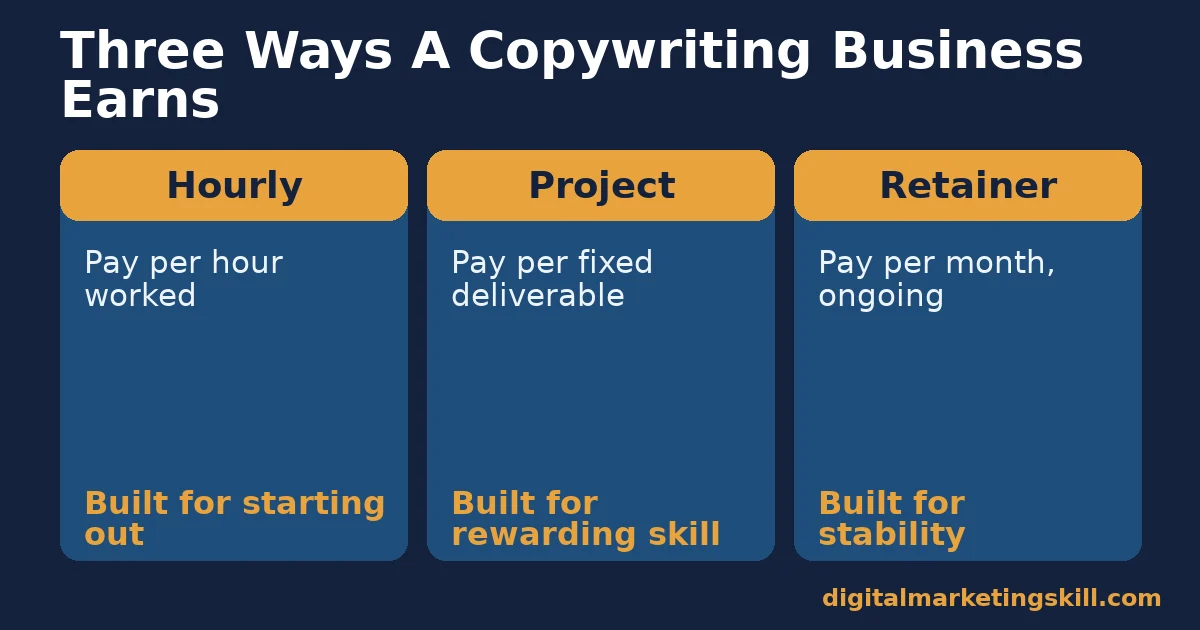
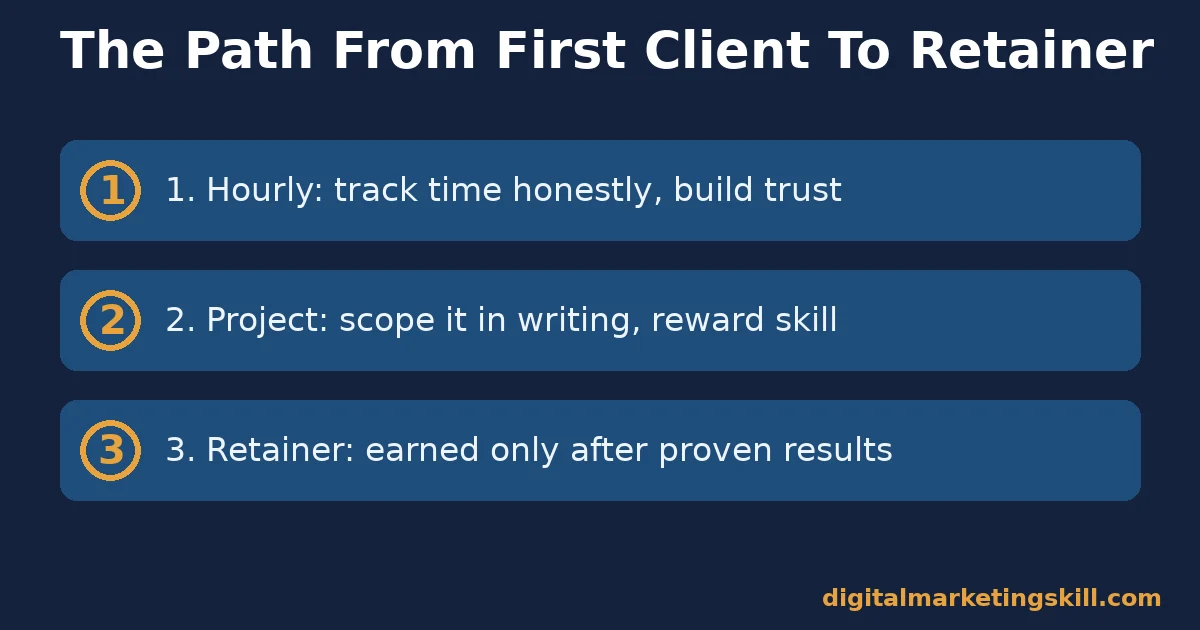
Hourly pricing is the simplest to start with. It needs no estimating skill. A new copywriting business can charge an hourly rate from day one, track time honestly, and get paid for exactly the work done. The downside is a hard ceiling. Income can only grow by raising the rate or working more hours, and both run out eventually.
Project pricing changes the incentive. A business quotes a fixed fee for a defined piece of work, a landing page, an email sequence, a set of ads, regardless of how long it actually takes. Get faster at the work, and the effective hourly rate rises without ever raising the quoted price. This is the model most experienced freelancers prefer once they can estimate accurately, precisely because skill gets rewarded instead of hours.
Retainer pricing is the model most established copywriting businesses grow into. A client pays a fixed amount every month for ongoing access, rather than paying per piece. This smooths income and removes the need to pitch new work constantly. It only works once a business has proven results worth paying for consistently.
Why The Pricing Model Matters More Than The Rate
Two copywriting businesses can charge the same rate and earn very differently, purely because of the model behind it. An hourly business trades time for money directly, with no leverage. A retainer business builds income that survives a slow sales month. Picking the model is a strategic choice, not an afterthought added after the price is set.
Most new copywriting businesses mix models without meaning to. One client pays hourly, another pays per project, and nobody tracks which one actually earns more per hour worked. That mix is fine early on. It only becomes a problem when the business keeps taking hourly work out of habit, long after project or retainer pricing would pay noticeably better for the same clients. Revisit the mix every few months, not once and never again.
What Differs By Pricing Model
Each pricing model suits a different stage of a copywriting business. Here is what makes each one different.
Hourly Pricing: Built For Getting Started
Hourly pricing favors speed of entry over scale. It lets a new copywriting business take on work immediately. You don’t need estimating experience to quote a fair project price yet. It is also the easiest model for a client to understand and approve quickly.
Project Pricing: Built For Rewarding Skill
Project pricing is built to reward getting faster and better at the work. The fee stays fixed regardless of hours spent. It needs more estimating confidence than hourly work. That is why most copywriting businesses move to it only after a few hourly projects.
Retainer Pricing: Built For Stability
Retainer pricing is the quietest model to run day to day. There is no fresh negotiation every month, no new scope document to argue over. It delivers predictable income and a closer client relationship. It depends on trust that usually only exists after a client has already paid for, and liked, project or hourly work first. Few clients hand a new copywriting business a retainer on the very first job.
How To Lead With Each Pricing Model
Knowing what each model does well is half the job. Here is how to lead with each one, matched to the three stages above.
Hourly Pricing: Lead With Honest Time Tracking
Track every minute honestly from the first client onward. Count the research and revision time that feels invisible too. A copywriting business that underprices its own hours early on sets a client expectation that is painful to raise later. Decide the hourly rate before the first call, not during it. Quoting a number under pressure, mid-conversation, almost always produces a lower rate than one decided calmly beforehand.
Project Pricing: Lead With A Clear Scope, Not A Guess
Write out exactly what is included before quoting a price. How many revisions. What counts as a separate project. A copywriting business that quotes vaguely ends up doing unpaid extra rounds of revision. That quietly turns a good project rate into a bad hourly one. Put the scope in writing before the work starts, even for a repeat client. Memory fades, and a written scope protects both sides when a project runs longer than expected.
Retainer Pricing: Lead With Proven Results First
Earn the retainer conversation by delivering strong project work first. Then propose the retainer once a client has a reason to want ongoing access. Pitching a retainer to a brand-new client usually fails. Not because the price is wrong, but because you haven’t earned the trust that justifies it yet. Raise the retainer idea only after a client has already said, in some form, that they want more of what you’ve already delivered.
How To Measure A Copywriting Business
Four numbers tell you whether a copywriting business is actually working, beyond how busy it feels.
The Four KPIs To Track
- Effective hourly rate. Total income from a project divided by the actual hours it took, including revisions and unpaid pitching time. This number exposes whether project pricing is actually paying better than hourly would have.
- Client retention rate. The share of clients who return for a second project or move to a retainer. A copywriting business with strong retention spends far less time and money finding new clients every month. Harvard Business Review’s own research puts the cost of winning a new customer at five to 25 times the cost of keeping an existing one.
- Proposal-to-client conversion rate. The share of pitches or proposals that actually become paid work. A low number here usually means a niche or pricing problem, not a writing-quality problem.
- Niche concentration. The share of total income coming from your primary niche or industry. A rising number here usually tracks with rising rates, since specialists consistently out-earn generalists in copywriting.
Review these four numbers monthly, not after every single project. A single bad client or a single slow month rarely reflects the real trend of the business.
Why Most New Copywriting Businesses Skip This Step
Tracking four numbers sounds simple, but most new copywriting businesses skip it anyway. Client work feels urgent. Bookkeeping does not. The problem is that a business can feel busy and successful for months while its effective hourly rate quietly drops, simply because nobody is watching that one number. Busyness and profitability are not the same thing, and only the numbers can tell them apart. A spreadsheet with four columns, updated once a month, is usually all it takes to catch the problem early.
Write the numbers down somewhere visible, next to the client or project they measure. A copywriting business that never checks its own effective hourly rate often feels busier every month while actually earning less per hour, simply because nobody noticed the slide.
The One Decision Rule For Picking Your Niche First
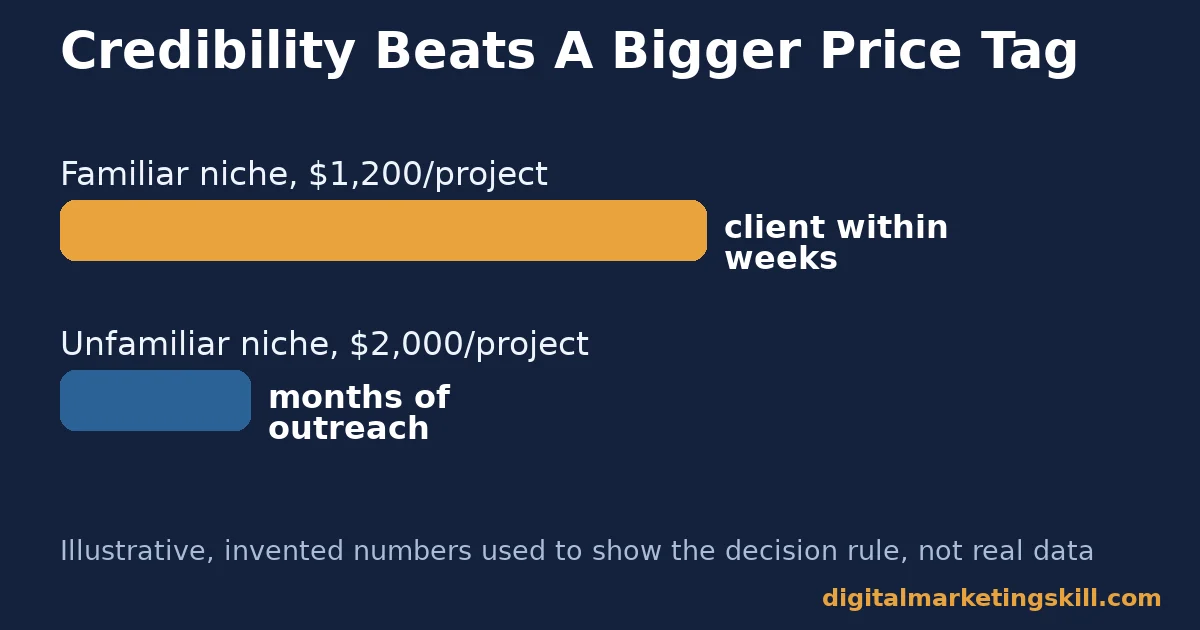
Pick the niche where you already have the most credibility, not the niche that pays the most on paper. A past job, a personal connection, or a portfolio piece already written closes the first few clients far faster than an unfamiliar high-paying niche ever will.
Illustrative, invented numbers show the logic. Picture two niches. One pays an average of $2,000 a project with no existing credibility. The other pays $1,200 a project, but you already know the industry and three potential clients by name. That $1,200 niche likely lands a paying client within weeks. The higher-paying, unfamiliar niche might take months of cold outreach to land the first one, if it lands at all. Revenue from a slower-but-certain start usually beats a faster-but-uncertain one across a copywriting business’s first year.
A Real Case: From Freelance Copywriter To A Niche Agency
Joel Klettke started as a solo freelance copywriter before founding Case Study Buddy, a copywriting business built around one specific service: writing case studies for other companies. In its first year, the business made roughly $8,000. He landed an early client in HubSpot and repositioned himself as a consultant rather than a general copywriter. Work accelerated through five figures, then into the hundreds of thousands. The company now nears $1.5 million CAD in annual revenue, according to his own account on the Being Freelance podcast.
This case has limits. The figures are in Canadian dollars, self-reported in an interview rather than audited financials, and reflect one founder’s specific niche and market timing. The underlying pattern still generalises. A copywriting business built around one narrow, well-proven specialty, positioned as expert consulting rather than general writing, tends to command meaningfully higher rates than a generalist one.
Notice what the case does not show, too. It does not show overnight success. The first year made roughly $8,000, not six figures. Growth took years of compounding referrals and case studies, each one making the next pitch easier than the last. There is no shortcut around that compounding. Each project either becomes a reference for the next pitch, or it doesn’t, and the ones that do are what actually drive the growth curve.
Frequently Asked Questions About Starting A Copywriting Business
Do I need to be an expert writer to start a copywriting business?
No. Strong writing skill helps, but plenty of successful copywriting business owners build a team of writers rather than writing every piece themselves. Managing client relationships, pricing and quality control matters just as much as the writing itself. Plenty of agency owners in this space haven’t written a single client piece in years. They edit, manage and sell, while a small team of writers does the drafting.
How much should a beginner charge when starting a copywriting business?
Start near the lower end of the hourly range for your experience level. Don’t underprice drastically just to win the first client. A rate that is too low is hard to raise later, since existing clients expect their price to stay roughly the same. Build the first rate increase into the plan from day one, even if it’s small, so raising it later doesn’t feel like an unusual request to either side.
Is it better to niche down or stay general when starting out?
Niche down as soon as you have enough evidence of what works. A general copywriting business competes on price against every other generalist. A niched one competes on expertise, which supports higher rates and faster trust with new clients.
How long does it take to land the first paying client?
It varies widely. A focused niche with an existing network often lands a first client within weeks. A cold, unfamiliar niche can take months. Treat the first client search as the real test of whether the chosen niche has enough demand. If weeks of focused outreach produce nothing, that is useful information too. It may mean the niche needs adjusting before the pricing or the pitch does.
Should a copywriting business charge hourly, by project, or by retainer?
Start hourly to build confidence and get paid fairly while you’re still learning to estimate. Move to project pricing once estimating feels reliable. Offer retainers only to clients who have already seen strong results from project work.
What is the biggest mistake new copywriting businesses make?
Taking every client in every industry just to stay busy. It feels productive short term. But it slows down the specialisation that actually drives higher rates, and it makes referrals far less effective, since nobody can clearly describe what the business is known for.
Can a copywriting business grow without hiring other writers?
Yes, up to a point. One person’s hours cap a solo copywriting business, no matter how high the rate climbs. Hiring other writers, even part-time, is usually what separates a six-figure solo practice from a business that keeps growing past it. The transition is rarely smooth. Managing another writer’s quality takes time away from billable work at first, which is exactly why niching down matters: a tighter niche makes training a new writer much faster.
Do clients care about certifications, or just results?
Mostly results. A strong portfolio and a clear case study of past work usually convince a client faster than a certificate alone. That said, training that builds real, demonstrable skill, not just a certificate, still shortens the time it takes to produce work good enough to show a client in the first place.
Where To Learn The Skills Behind A Copywriting Business
Want to build a copywriting business on top of real digital marketing skills, not just writing ability? That is exactly what the Master Diploma in Digital & AI Marketing at Digital Marketing Skill Institute is built around. The programme runs four AI-powered tracks, built from ten courses in total: AI-Powered Social Media Management and Advertising, AI-Powered Lead Generation and Email Automation, AI-Powered Google Specialist, and AI-Powered WordPress and SEO Specialist. A Full Stack option lets you complete all four. The Lead Generation and Email Automation track lines up closely with the email and landing page copy most copywriting businesses get hired to write.
Every track includes unlimited one-on-one coaching and mentoring, a U.S. Project Internship with a verified U.S. Work Reference Letter, and dual US and UK accreditation recognised in more than 100 countries. All of it runs 100% online, so you can build client-ready skills from anywhere in your country, wherever you live. Apply here to start. Browse more breakdowns like this one on the Digital Marketing Skill Institute blog, or read more student outcomes on the reviews page. Learn more about Digital Marketing Skill Institute, open to learners anywhere in your country.
Every figure in this guide was checked against its original source before publication. Figures marked as illustrative are invented examples, not real results.