
Co-Marketing is when two or more businesses team up to create and promote a shared marketing campaign, such as a webinar, guide or event, so each reaches the other’s audience. Both partners put in time, ideas or money. In return, both get new attention and new leads. As a result, co-marketing can grow your reach faster and more cheaply than working alone.
Key Takeaways
- Co-marketing is a joint campaign between partners with similar audiences.
- Common formats include webinars, guides, reports, events and giveaways.
- Partners share costs, skills and audiences.
- It differs from co-branding, where companies build a new product together.
- Clear goals and a written agreement keep both sides happy.
What Is Co-Marketing?
Co-marketing is a simple idea. You find a business that serves the same kind of customer but does not compete with you. Then you make something useful together and both promote it.
MarketingProfs puts it this way: “Co-marketing entails teaming up with one or more businesses to develop a marketing campaign.” It also notes the difference from co-branding. With co-branding, companies create a new product together. By contrast, co-marketing is about a shared campaign, not a shared product.
Here is an everyday example. Picture a local bike shop and a nearby café. They run a Saturday morning ride that ends with coffee. The bike shop brings riders, and the café brings regulars. So both businesses meet new people at almost no extra cost.
Online, it works in the same way. For instance, an accounting app and a payroll app might host a joint webinar for small business owners. Each one emails its own list. Then both share the sign-ups and follow up.
Why It Matters
Why do marketers like co-marketing? First, it gives you access to a trusted audience you could not reach alone. Second, you split the work and the cost. Third, a respected partner can lend you credibility, especially if you are a smaller brand. In addition, MarketingProfs notes that partners can learn more about each other and about themselves. Finally, it is a strong way to grow brand awareness and leads at the same time.
How Co-Marketing Works
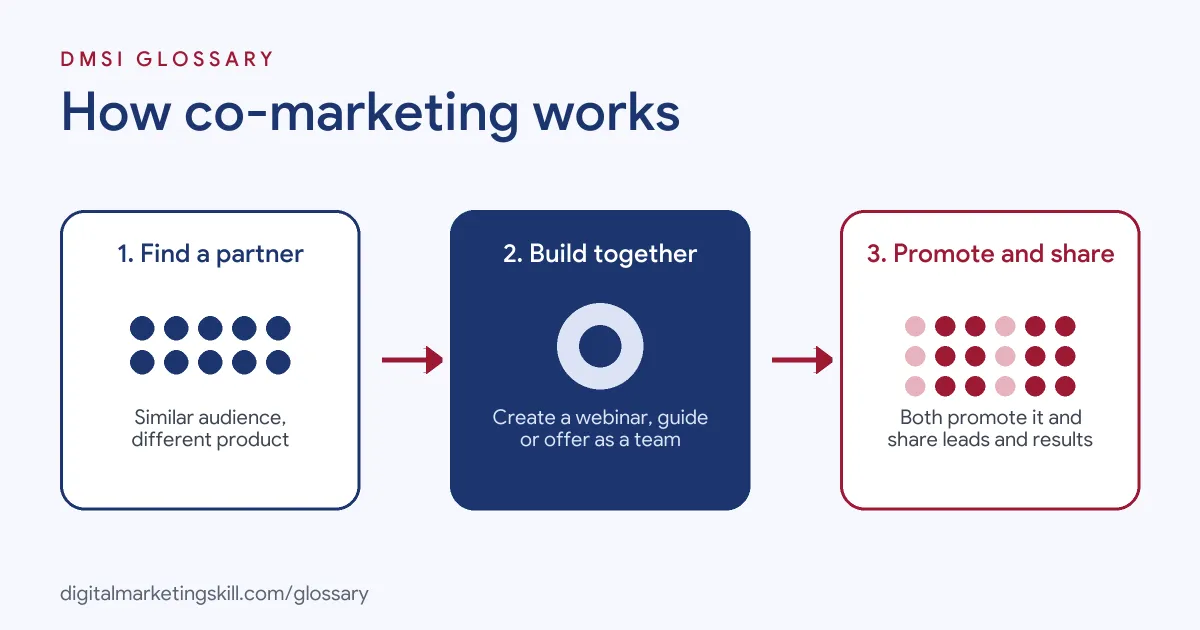
Co-marketing follows three main steps. First, you find the right partner. Then you build a campaign together. Finally, you both promote it and share the results.
Finding the Right Partner
Above all, a good partner has a similar audience but a different product. For example, a project management tool and a time-tracking tool serve the same teams. However, they solve different problems. So they can help each other without competing. Also, check that the partner’s values and tone fit yours, because your names will sit side by side.
Building the Campaign
Next, you agree on what to make. Popular formats include:
- Webinars and live events with a speaker from each side.
- Guides and reports that combine both partners’ knowledge, often as gated content.
- Giveaways where each partner adds a prize.
- Joint blog posts, podcasts or videos as part of your content marketing.
- Bundles or joint offers for customers of both brands.
So which format should you pick? First, think about what your shared audience needs most. For example, busy owners may prefer a short checklist to a long report. Also, play to each partner’s strengths. If one of you is great on camera, a webinar makes sense. However, if both teams love to write, a joint guide may be easier. Finally, keep the scope small for a first campaign, so you can launch on time.
Promoting and Sharing Results
Then both partners promote the campaign to their own channels. That usually means email, social media and website banners. After that, you share the leads in line with privacy rules and your sign-up form wording. Finally, you compare results against the goals you set at the start. Using UTM parameters helps you see which partner sent which visitors.
Agreeing the Rules
Even friendly partners need clear rules. MarketingProfs advises setting complementary goals, a realistic timeline and a clear split of tasks. It also suggests a formal agreement that covers goals, timelines, responsibilities and content. So everyone knows who does what, and by when.
Measuring Success
So how do you know it worked? First, look at the goal you agreed. For example, if the goal was leads, count sign-ups from each partner. Then check how many of those leads became customers later. Also, look at softer signs, such as new followers or mentions. In addition, ask each partner what they learned about the audience. Finally, note the cost in time and money. That way, you can compare the campaign with other channels and decide if you want to run it again.
When Co-Marketing Works Best
Co-marketing works best when both brands bring something the other lacks. For instance, one partner may have a large email list, while the other has deep expertise. Likewise, one may be strong on social media and the other on events. However, it works less well when one side expects the other to do all the work. So be honest from the start about what you can give. Also, start with a small project, such as one webinar. Then, if it goes well, you can plan a bigger campaign together.
Examples of Co-Marketing
- Two software firms. An email tool and a design tool create a joint guide on newsletter design. Each promotes it to its list. As a result, both collect sign-ups from the other’s audience.
- A fitness studio and a healthy food shop. They run a four-week challenge together. The studio offers classes, and the shop offers recipes and discounts. So each business meets new local customers.
- A recruitment agency and a CV-writing service. They host a free webinar on job hunting. Then each follows up with its own offer to the attendees who agreed to hear from them.
Co-Marketing vs Co-Branding vs Affiliate Marketing
| Point | Co-Marketing | Co-Branding | Affiliate Marketing |
|---|---|---|---|
| What partners create | A shared campaign or content | A new joint product | Links or promotions for one brand |
| How partners gain | Shared reach and leads | Sales of the joint product | Commission on sales |
| Effort | Shared by both sides | High, with long planning | Mostly on the affiliate |
| Typical length | One campaign or a series | Often long term | Ongoing |
In short, co-marketing is a team effort on a campaign. Affiliate marketing, by contrast, pays a partner for each sale they send.
How to Run a Co-Marketing Campaign
- Set your goal. Decide what you want, such as leads, sign-ups or new followers.
- List possible partners. Look for brands that serve your audience but don’t compete with you.
- Pitch a clear idea. Show the partner what they gain, not just what you gain.
- Agree the details in writing. Cover goals, tasks, deadlines, budget, brand use and how leads are shared.
- Create the asset together. Build the webinar, guide or offer, and review it on both sides.
- Launch and promote. Each partner shares it with its audience on the agreed dates.
- Follow up and report. Nurture the new leads, then share results and lessons with your partner.
Best Practices for Co-Marketing
- Pick a matching audience. The best partner serves the same people with a different product.
- Make it useful. Give the audience real value, not two sales pitches.
- Split the work fairly. Both sides should put in a similar effort.
- Be clear about data. Tell sign-ups who will contact them, and follow privacy rules.
- Track each partner’s share. Use separate links so you can see where results came from.
- Keep the relationship going. A good first campaign can lead to a longer partnership.
Common Mistakes to Avoid
- Choosing a partner for size alone. A big audience that doesn’t match yours brings few useful leads.
- Skipping the agreement. Without written terms, small issues can turn into big arguments.
- Uneven promotion. If one partner barely shares the campaign, results and trust both suffer.
- Sharing leads without consent. Make sure your sign-up form says clearly who will use the data.
- Forgetting the follow-up. New leads go cold quickly if nobody contacts them.
Where You’ll Use Co-Marketing at Work
Co-marketing appears in partnership, brand and integrated marketing roles. For example, real remote job listings say:
- “We need a marketer who can identify and build relationships with external partners that own relevant audiences, then tap into those spaces with persuasive and engaging co-marketing campaigns” (Co-Marketing & Partnerships Manager).
- “Lead a steady cadence of co-marketing campaigns with Roo’s strategic partners, and turn customer and success stories into integrated campaigns, press, and thought leadership.” (Senior Brand & Integrated Marketing Manager).
Learn It in the Lead Generation and Email Track
You can learn how to plan joint campaigns and turn the leads into customers in the AI-Powered Lead Generation and Email Automation track. Every track includes a U.S. Project Internship from day one, with unlimited 1-on-1 mentoring.
Frequently Asked Questions
What is an example of co-marketing?
A common example is two software companies hosting a joint webinar. Each promotes it to its own audience, and both gain new leads.
What is the difference between co-marketing and co-branding?
Co-marketing is a shared campaign. By contrast, co-branding means two companies create a new product together.
How do I find a co-marketing partner?
Look for businesses that serve your audience but sell something different. Then pitch an idea that clearly benefits them too.
Who owns the leads from a co-marketing campaign?
That depends on your agreement. Usually, both partners get the leads, as long as the sign-up form makes this clear to people.
Is co-marketing only for big brands?
No. Small and local businesses can run simple joint events, offers or content with very little budget.
Sources: MarketingProfs: Your Guide to Co-Marketing; Mailchimp: Partner Marketing; Adobe: Partnership marketing guide; remote job listings on Himalayas and Himalayas.