
SMART objectives are targets written to be Specific, Measurable, Achievable, Relevant and Time-bound. The format turns a vague wish such as “grow our Instagram” into a clear commitment such as “reach 5,000 followers by 30 June through three Reels a week”. Everyone can then see what success looks like, who is responsible and when to check. In marketing, SMART objectives link a big business goal to the campaigns, channels and numbers you track each week.
Key Takeaways
- SMART stands for Specific, Measurable, Achievable, Relevant and Time-bound.
- The idea was first set out by management consultant George T. Doran in the journal Management Review.
- A goal is the broad aim. Objectives are the measurable steps that show you are getting there.
- Each objective needs one metric, a starting point, a target and a deadline.
- SMART helps with clarity, but it does not choose your strategy for you, so pair it with research.
What Are SMART Objectives?
A SMART objective is a short statement that passes five tests. If any test fails, the objective is too loose to manage. Public health teams at the U.S. Centers for Disease Control and Prevention (CDC) use the same five letters to write programme objectives, which shows how widely the format has spread beyond business.
In marketing, objectives sit between strategy and tactics. Your marketing strategy sets the direction. SMART objectives then turn that direction into numbers. Finally, your key performance indicators show week by week whether you are on track.
Goals vs Objectives
People often mix up the two words. A goal is broad, such as “become the best-known yoga studio in Leeds”. An objective is one measurable step towards it, such as “get 300 five-star Google reviews by the end of the quarter”. One goal usually has three to five objectives under it.
What SMART Stands For
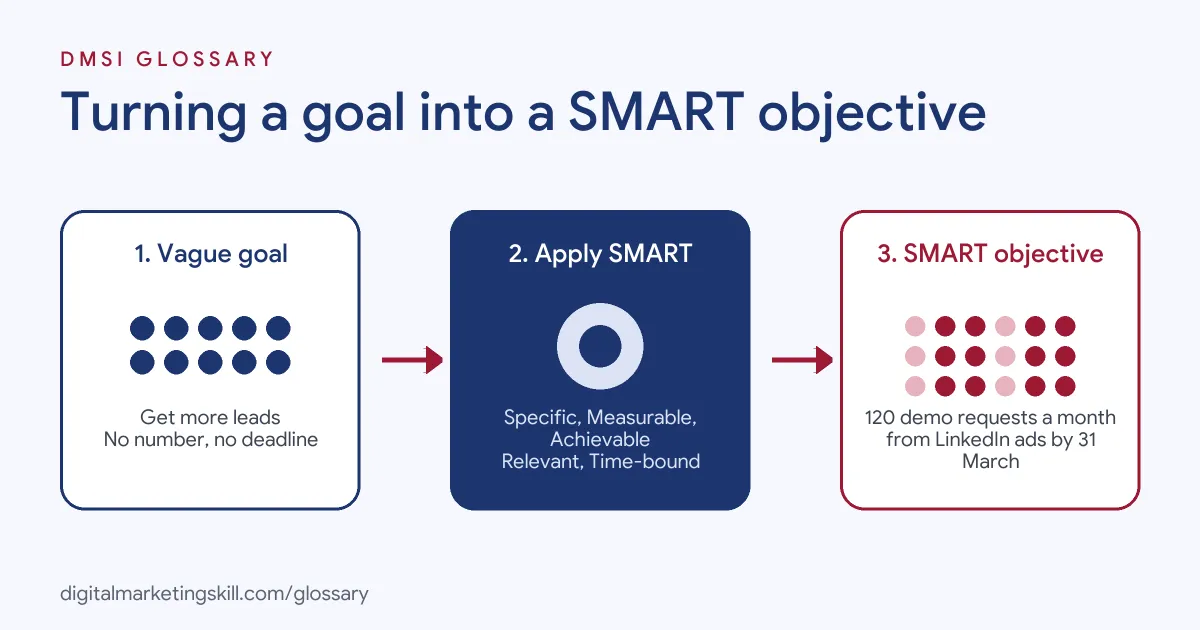
Doran’s original letters were Specific, Measurable, Assignable, Realistic and Time-related. Over time, most teams swapped in Achievable and Relevant. The table shows the common version and the question each letter asks.
| Letter | Meaning | Question to ask | Marketing example |
|---|---|---|---|
| S | Specific | What exactly will change, and for whom? | More demo requests from UK HR managers |
| M | Measurable | Which number proves it? | Demo form submissions in Google Analytics |
| A | Achievable | Can we do it with our budget and team? | From 80 to 120 a month, not 80 to 800 |
| R | Relevant | Does it move the business goal? | Demos lead to paid plans, so yes |
| T | Time-bound | By when? | By 31 March, reviewed every Monday |
Specific
A specific objective names the result, the audience and usually the channel. “Improve email” is not specific. “Raise the click rate of our weekly newsletter to small business owners” is.
Measurable
You need one clear metric and a starting number, known as a baseline. Without the baseline, you cannot tell whether a target is bold or easy. Check that you can actually track the number before you commit to it.
Achievable
Look at past results, budget and team time. A useful rule is to aim above your recent trend but within reach of what similar campaigns have delivered. If you have never run ads, a tenfold jump in leads is a guess, not an objective.
Relevant
The objective must serve the bigger goal. Likes on a meme page might be easy to grow, but if the business needs sales calls, that number is a distraction.
Time-bound
Add a deadline and check-in dates. A deadline creates urgency, and regular reviews give you time to fix a campaign before it is too late.
SMART Objectives Examples in Digital Marketing
Here are examples for common channels. Each one has a metric, a baseline or target, a channel and a deadline. The businesses are made up.
- SEO: Grow organic sessions to our blog from 4,000 to 6,000 a month by the end of September by publishing eight new guides and updating twelve old ones.
- Paid search: Cut cost per lead on Google Ads from £42 to £30 within eight weeks by pausing weak keywords and testing two new landing pages.
- Social media: Increase Instagram engagement rate from 1.8% to 3% by the end of the quarter with three Reels and two carousels each week.
- Email: Lift newsletter click rate from 2.1% to 3% over the next six sends by testing subject lines and moving the main link higher.
- Lead generation: Collect 400 new email subscribers in 60 days through a free checklist promoted on LinkedIn and the blog.
- Freelance career: Win three paying clients in the next 90 days by sending ten tailored proposals a week.
How to Write SMART Objectives
- Start with the goal. Write the business aim in one sentence, for example “grow online sales”.
- Pick the one metric that best shows progress, such as orders, leads or revenue.
- Find your baseline. Pull the last three months from analytics so you know where you are starting.
- Set a target. Use past trends and budget to choose a number that stretches but is realistic.
- Name the channel and actions. Say how you will get there, such as “through retargeting ads and a weekly email”.
- Add the deadline and owner. Write who is responsible and when you will review progress.
- Test it against the five letters. If one is missing, rewrite it.
A simple template helps: [Increase or reduce] [metric] from [baseline] to [target] by [date] through [main actions], owned by [person].
Worked Example: From Vague Goal to SMART Objective
Imagine a small online bakery that says, “We want more sales from social media.” Here is how the team rewrites it, one letter at a time.
- Specific: More online cake orders from Instagram followers in London.
- Measurable: Orders tagged with an Instagram link in their shop platform. Last quarter averaged 40 a month.
- Achievable: They have £300 a month for ads and one person posting, so they aim for 60 a month, a 50% rise.
- Relevant: Cake orders are their main profit line, so the objective directly supports the business.
- Time-bound: They give themselves until the end of next quarter, with a check every Friday.
The final objective reads: “Grow Instagram-sourced cake orders in London from 40 to 60 a month by the end of next quarter, through four Reels a week and £300 a month in retargeting ads, owned by our social media lead.” Anyone in the team can now see the target, and the Friday check shows early whether the plan needs to change.
SMART Objectives vs OKRs
Objectives and key results (OKRs) are another popular way to set targets. With OKRs, you write an inspiring objective and then three or so measurable key results under it. Key results are usually SMART in style. The main difference is spirit: OKRs often aim high on purpose, so hitting 70% can count as good, while a SMART objective is meant to be achieved in full. Many marketing teams use OKRs for the quarter and SMART objectives for individual campaigns.
Common Mistakes to Avoid
- Vanity metrics. Impressions and followers are easy to measure but often have little link to sales.
- Too many objectives. Ten objectives for one small team means none get proper attention. Three to five is plenty.
- No baseline. “Grow traffic by 20%” means nothing if nobody knows the current number.
- Setting and forgetting. An objective with no review dates usually gets checked only when it is too late.
- Treating SMART as strategy. The format makes a target clear, but it cannot tell you whether it is the right target. Researchers have also noted that the framework has limited scientific testing, so use judgement as well.
Where You’ll Use SMART Objectives at Work
You will write SMART objectives in campaign briefs, monthly client reports, marketing plans and job interviews. Hiring managers often ask how you would measure a campaign, and a clear SMART answer shows you think in results. Freelancers use them in proposals too, because a client can easily see what they are paying for.
For a full planning walkthrough, read our digital marketing plan guide and our list of digital marketing KPIs.
Learn It in the Full Stack Track
Setting objectives spans every channel, so the best fit is the Full Stack option, which covers all four tracks. You take all ten courses, starting with AI fundamentals for strategy and planning, and complete one portfolio project from each track, each with clear objectives and results. You also work on a U.S. Project Internship from day one, with unlimited 1-on-1 mentoring.
You may also like our glossary entries on the North Star Metric and SWOT analysis.
Frequently Asked Questions
What are SMART objectives?
They are targets that are Specific, Measurable, Achievable, Relevant and Time-bound. The format makes it clear what success looks like and when it is due.
What is an example of a SMART objective in marketing?
“Increase demo requests from 80 to 120 a month by 31 March through LinkedIn ads and two new landing pages.” It names the metric, baseline, target, channel and deadline.
Who created SMART objectives?
Management consultant George T. Doran first described the idea in the journal Management Review. His letters were slightly different, using Assignable and Realistic.
What is the difference between SMART goals and SMART objectives?
Many people use the terms the same way. Strictly, a goal is the broad aim and objectives are the measurable steps towards it.
How many SMART objectives should a campaign have?
Usually one to three. Fewer objectives keep a small team focused and make reporting simple.
Are SMART objectives the same as KPIs?
No. The objective is the target, such as 120 demos a month. The KPI is the number you track to see progress, such as weekly demo requests.
Sources: Wikipedia: SMART criteria (Doran, Management Review); CDC Evaluation Brief: Writing SMART Objectives; The Hartford: Why you should set SMART goals; Rhode Island SBDC: SMART goals for small business owners.