A digital marketing plan turns scattered tactics into one system with clear goals, a realistic budget and a way to measure results. Most small businesses skip this step. They run campaigns with no fixed budget rule and no way to tell what worked.
This guide walks through a practical nine-step process. It shows what changes as a business grows, and gives one decision rule for setting a budget that fits your stage.
Key Takeaways
- A documented plan changes outcomes. CoSchedule’s survey of 515 marketers in 75 countries found that marketers who document their strategy are 414% more likely to report success than those who do not.
- Marketing budgets vary sharply by business model. The CMO Survey (Duke University’s Fuqua School of Business, 281 US marketing leaders) found average budgets at 9.4% of company revenue. B2C product companies allocate about 15.5%, while B2B product companies allocate about 6.4%.
- New businesses need a different budget rule. The US Small Business Administration recommends new businesses budget 12-20% of revenue in their first two years to build awareness, dropping toward 7-8% once established.
- Buyer personas change what sales teams see, not just marketing. A Thomson Reuters case reported by Demand Gen Report found documented personas linked to a 175% increase in marketing-attributed revenue and a 72% reduction in lead conversion time at that company.
- Most organizations have a strategy; few have it written down. Content Marketing Institute’s B2B research, as reported by MarTech, found that only a minority of B2B marketers have a documented content strategy. A similar share has a strategy that exists only as an idea in someone’s head.
In this guide
- What Most Digital Marketing Plan Advice Gets Wrong
- How a Digital Marketing Plan Actually Works
- A Digital Marketing Plan Changes by Business Stage
- How to Plan for Each Stage
- The Nine Steps of a Digital Marketing Plan
- The Most Useful Rule: Set Your Budget by Stage, Not by Habit
- How to Measure Whether the Plan Is Working
- An Illustrative Case: Fixing a Plan With No Budget Rule
- Frequently Asked Questions About Digital Marketing Plans
- Start With One Section, Not the Whole Document
What Most Digital Marketing Plan Advice Gets Wrong
Most guides to building a digital marketing plan give you a checklist: set goals, know your audience, pick channels, track results. None of that is wrong. But it treats every business the same way. A business with no customer data yet needs a different plan from one with three years of campaign history.
This guide fills that gap. It explains how the planning process actually works, what changes as a business grows, and which budget rule fits each stage. The budget figures below come from surveys with named sample sizes. Read them as benchmarks from the businesses surveyed, not universal rules, since your own numbers will sit above or below the average depending on your margins and goals.
How a Digital Marketing Plan Actually Works
A digital marketing plan is the document that turns a strategy into action. It names your goals, your audience, your budget, your channels and your metrics. Then it sequences the work so each step feeds the next. Skip a step, and the ones after it rest on a guess instead of a decision.
The planning loop runs in order. Goals set the destination. Audience research shows who you are reaching. Budget sets how much you can test. Channel choice matches that budget to where your audience spends time.
Execution turns the choices into campaigns, and measurement tells you whether to repeat, adjust or stop. Most plans fail not because one step is wrong, but because the loop never closes. Teams set goals at the start of the cycle and never return to measurement until the next one begins.
Plan vs. Strategy: Why the Difference Matters
A marketing strategy is the reasoning: why you compete the way you do, who you serve and what makes your offer different. A marketing plan is the execution layer underneath it, with specific budgets, channels, timelines and owners. Confusing the two is common and costly, because a team can spend weeks debating strategy questions that a one-page plan would already answer through action.
In practice, write the strategy first, in a few sentences. Before you lock in channels, it helps to compare the main digital marketing strategies available, so the plan rests on a documented choice rather than a guess. Then let the plan answer every remaining “how” question: how much budget, how it splits by channel, how often you check results. If you cannot answer “how” for a line in your plan, you have written a goal, not a plan.
A Digital Marketing Plan Changes by Business Stage
The biggest mistake in most templates is treating every business as if it already has traffic, customer data and a working channel mix. New businesses have none of that. Growing businesses have some. Established businesses have years of it, so each stage needs a different plan.
New Businesses: Built for Discovery, Not Scale
A new business has no proven channel and no customer data to analyze. Its plan is really a discovery process disguised as a plan. The goal at this stage is not maximum reach. It is learning which one or two channels bring in people who actually buy, fast enough that the business can afford to keep testing.
The Small Business Administration recommends new businesses in their first two years budget 12-20% of revenue toward marketing, higher than the typical ongoing rate, because early awareness has to be built from nothing. That budget should fund narrow tests, not broad brand campaigns. A new business cannot yet tell a strong channel from a weak one without data.
Growing Businesses: Built on Early Data
A growing business has a channel or two that already brings in customers, plus enough data to see which campaigns pay back and which do not. Its plan should protect what works while testing one new channel at a time. Testing everything at once makes it impossible to tell which change caused which result.
The CMO Survey found average marketing budgets across its 281 surveyed US leaders sit at 9.4% of revenue. B2B service companies sit closer to 9%, and B2B product companies closer to 6.4%. A growing business usually sits near its category average once its first channel is proven, then adjusts up or down based on its own return.
Established Businesses: Built on History
An established business has years of campaign data, named customer segments and a baseline for what normal performance looks like. Its plan is less about discovery and more about reallocation. That means moving budget from channels with falling returns to ones with rising returns, without disrupting revenue that already depends on the current mix.
The CMO Survey found B2C product companies allocate the most revenue to marketing, about 15.5%, reflecting shorter sales cycles and more frequent repeat purchases than B2B categories. An established business should compare itself against its own category figure. A B2B services firm spending like a B2C retailer is solving the wrong problem.
How to Plan for Each Stage
Each stage above needs a different first move in the plan itself. Match your plan to the stage you are actually in, not the stage you want to reach next.
New Businesses: Lead With a Narrow Test
Pick one or two channels where your specific audience already spends time. Set a 60 to 90-day test budget, and define in advance what “working” looks like, such as a specific cost per lead or a minimum number of sales. Resist the pull to be present everywhere. A thin presence on five channels teaches you less than a focused test on one.
Document the test like an experiment: starting budget, channel, audience, message and the metric that decides whether you continue. That record becomes the first page of your next plan.
Growing Businesses: Lead With the Channel That Already Works
Before adding a new channel, increase budget on the channel that is already converting, up to the point where cost per result starts rising. That extra spend is usually the highest-return money in the plan, because you already know the message and audience work.
Only after that channel shows diminishing returns should you open a second one. Fund it from a separate, smaller test budget, so a slow start there does not starve the channel that pays the bills.
Established Businesses: Lead With Reallocation, Not Addition
Review every channel’s trailing return each quarter, and move a fixed share of budget, for example 10%, from the weakest performer to the strongest. This builds a regular reallocation habit instead of letting budget sit in a channel out of inertia.
Keep one small test budget separate from this reallocation. An established business that only optimizes existing channels eventually misses a new one worth entering.
The Nine Steps of a Digital Marketing Plan
With the stage-specific thinking in place, here is the sequence that turns it into a written plan. Work through these in order, because each step narrows the choices for the next one.
Steps 1 to 4: Set the Foundation
- Set goals with a number and a deadline. “Grow brand awareness” is not a goal. “Generate 50 qualified leads a month by the end of the quarter” is. A specific, measurable, achievable, relevant and time-bound goal gives every later step something to aim at.
- Build one or two buyer personas from real data. Pull from your existing customers, support tickets and sales calls rather than guessing. A documented persona, built on evidence, does more for your plan than a vivid but invented one.
- Run a competitive scan. Note three competitors’ pricing, messaging and the channels where they show up. You are not copying their plan. You are finding the gap they are leaving open.
- Run a short SWOT review. List your strengths, weaknesses, opportunities and threats in one sentence each. This step exists to catch blind spots, not to produce a long document.
Steps 5 to 9: Build and Launch the Plan
- Set the budget using your stage’s rule. Apply the new, growing or established guidance above, then adjust for your own margins. A business with thin margins cannot spend at the same rate as one with healthy margins and stay solvent.
- Choose channels that match your audience and your budget. Fewer channels done well outperform many channels done thinly. Match the channel to where your buyer personas already spend time, not to where competitors happen to be.
- Write the tactics under each channel. For each channel, name the specific content, cadence and offer, not just the channel name. “Social media” is a channel. “Two reels a week showing the product in use, linking to a lead form” is a tactic.
- Put the plan on a content calendar. Assign dates, owners and launch windows. A plan without a calendar stays a document. A plan with a calendar becomes work that gets done.
- Define the metrics before you launch, not after. Decide which numbers prove success for each channel before the first campaign runs, so you are not choosing a favorable metric once you have already seen the results. Our guide to Google Analytics reports covers how to build the dashboard that tracks them.
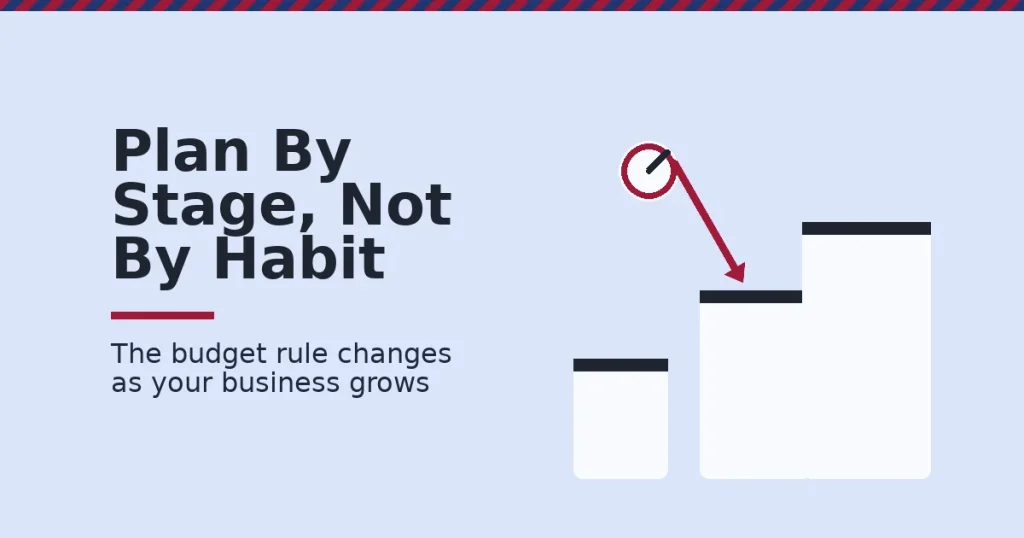
The Most Useful Rule: Set Your Budget by Stage, Not by Habit
If you take one decision rule from this guide, make it this one. Most businesses set next year’s marketing budget by adding a small percentage to the prior year’s number. That habit ignores the stage you are actually in.
Instead, check your stage first. New businesses budget 12-20% of revenue to build initial awareness, per the Small Business Administration’s guidance.
Growing and established businesses settle nearer their category’s average from the CMO Survey, 6.4% to 15.5% depending on business model. They then move budget toward whichever channel is proving its return today. Setting the number by stage and category, rather than by habit, is usually the single biggest improvement a business can make to its digital marketing plan.
Here is an illustrative example, with invented numbers. A growing business budgets a flat 8% of revenue every cycle, regardless of what is working. Its paid search channel is returning $4 for every $1 spent, while its display ads return $1.10. Reallocating just 15% of the display budget into paid search, without changing the total budget, produces more leads than the prior cycle at the same spend.
How to Measure Whether the Plan Is Working
A plan is only as good as the system that tells you whether it worked. Each metric below is defined in one sentence, with a note on how to read it and how to use it alongside the goals you set in step one.
Five Metrics That Show a Plan Is Working
- Cost per lead. Total channel spend divided by the number of leads it produced. Falling cost per lead at steady lead quality shows a channel is maturing well.
- Customer acquisition cost. Total marketing and sales spend divided by new customers won. Compare it against the revenue a typical customer brings over their lifetime, not against a single prior period alone.
- Channel-level return. Revenue attributed to a channel divided by what you spent on it, related to the broader ROI in digital marketing concept. This is the number that should drive the reallocation decisions described above.
- Goal completion rate. The share of plan goals hit within their deadline. A plan that consistently misses its own deadlines needs fewer, better-scoped goals, not more effort.
- Persona-fit rate. The share of new customers who actually match your documented buyer persona. A low rate suggests the plan is attracting the wrong audience even if volume looks healthy.
Review these monthly for a new business and quarterly for a growing or established one. New businesses need to catch a failing test fast, while established businesses are watching slower, larger trends.
An Illustrative Case: Fixing a Plan With No Budget Rule
Here is a second illustrative case, with invented numbers, showing how the planning sequence changes a real decision. A small professional services firm spends evenly across five channels because “that is what the agency recommended.” It has no documented persona and no quarterly review.
After building one persona from actual client data and running a competitive scan, the firm finds that two of its five channels reach almost no one who matches that persona. It moves 40% of the budget from those two channels into the one channel where its persona is most active, and adds the quarterly reallocation habit described above.
Over two quarters, cost per lead on the surviving channels falls, because the remaining budget is now concentrated on the audience that actually buys.
The lesson is not that five channels is wrong, or that one channel is right. It is that a documented persona and a scheduled review turn a budget split based on habit into one based on evidence.
Frequently Asked Questions About Digital Marketing Plans
What is the difference between a marketing plan and a marketing strategy?
A marketing strategy explains why you compete the way you do and who you serve. A digital marketing plan is the execution layer underneath it, setting the specific budget, channels, calendar and metrics that put the strategy into action.
How much should a small business spend on a digital marketing plan?
It depends on your stage. The Small Business Administration suggests 12-20% of revenue for a new business in its first two years. The CMO Survey found established companies averaging 9.4% of revenue, ranging from about 6.4% for B2B products to 15.5% for B2C products.
How often should I update my digital marketing plan?
Review goals and budget quarterly at minimum. Treat any new product launch or major market shift as a trigger for an earlier review, since a plan revisited only once a cycle cannot catch a channel that stopped working months earlier.
Do I need buyer personas if my business is small?
Yes, and one documented persona built from real customer data is more useful than three invented ones. A documented persona, built from actual client data rather than guesswork, is what let the illustrative professional services firm above find and fix a misallocated budget.
What is the most common reason a digital marketing plan fails?
The planning loop never closes. Many plans set goals and channels in detail, then never return to measurement, so the next plan gets built on the same assumptions instead of what was actually learned.
Should I write a full SWOT analysis for a digital marketing plan?
A short one is enough. One sentence each for strengths, weaknesses, opportunities and threats catches blind spots before you commit a budget. A long SWOT document rarely changes the plan that follows it.
How many channels should a digital marketing plan include?
Fewer than most templates suggest. A new business usually tests one or two channels, and a growing business adds a second only once the first shows diminishing returns. Doing fewer channels well outperforms a thin presence across many.
Start With One Section, Not the Whole Document
A digital marketing plan does not need to be finished to be useful. Pick the section that is weakest in your current approach, often the budget rule or the buyer persona, and rebuild just that section using the steps above. Measure the next quarter against the one before, then move to the next section.
If you want structured practice building a digital marketing plan like this, Digital Marketing Skill Institute teaches it hands-on inside the Master Diploma in Digital & AI Marketing. The program is built from four AI-powered tracks totalling ten execution-first courses: AI-powered social media management and advertising, AI-powered lead generation and email automation, AI-powered Google specialist work, and AI-powered WordPress and SEO. A Full Stack option covers all four.
It includes unlimited 1-on-1 coaching and mentoring and a U.S. project internship with a verified U.S. work reference letter. The diploma is dual US and UK accredited and recognized in more than 100 countries.
The program is fully online, so you can build these planning skills from anywhere in your country. Explore more guides on the Digital Marketing Skill Institute blog, read real outcomes on reviews, and when you are ready, apply for the Master Diploma or start from the Digital Marketing Skill Institute homepage.
Every figure in this guide was checked against its original source before publication. Figures marked as illustrative are invented examples, not real results.