
The Social Selling Index (SSI) is a free score from 0 to 100 that LinkedIn gives every member. It rates how well you use LinkedIn to build a professional brand, find the right people, engage with useful content and build relationships. You can check yours at any time on LinkedIn’s SSI dashboard, and you do not need a paid Sales Navigator plan to see it. Marketers, freelancers and sales teams use it as a quick health check for their LinkedIn habits.
Key Takeaways
- The SSI is a number from 0 to 100, made of four pillars worth up to 25 points each.
- The four pillars are professional brand, finding the right people, engaging with insights and building relationships.
- Anyone with a LinkedIn account can see their score for free at linkedin.com/sales/ssi.
- The dashboard also ranks you against people in your industry and in your network.
- A high score shows good habits, not guaranteed sales. LinkedIn itself says the score does not always reflect how effective a seller is.
What Is the Social Selling Index?
LinkedIn describes the SSI as a 0 to 100 metric that shows how well someone establishes a professional brand, finds the right prospects, engages with insights and builds relationships on the platform. In short, it turns your everyday LinkedIn activity into one number.
It grew out of social selling, which means using social networks to find, understand and build trust with potential buyers before you ever pitch. Instead of cold calls, you share helpful posts, comment on what buyers care about and connect with the right decision-makers. The SSI measures how consistently you do those things.
Because the term is searched so often, many people simply want to know their own number. However, the score is most useful when you read the four parts separately, because each one points to a different habit you can improve.
How the SSI Is Calculated
LinkedIn’s social selling guide says each of the four elements gets a value up to 25, and the four values add up to your total. LinkedIn does not publish the exact formula. Still, the four pillars tell you clearly what kinds of activity count.
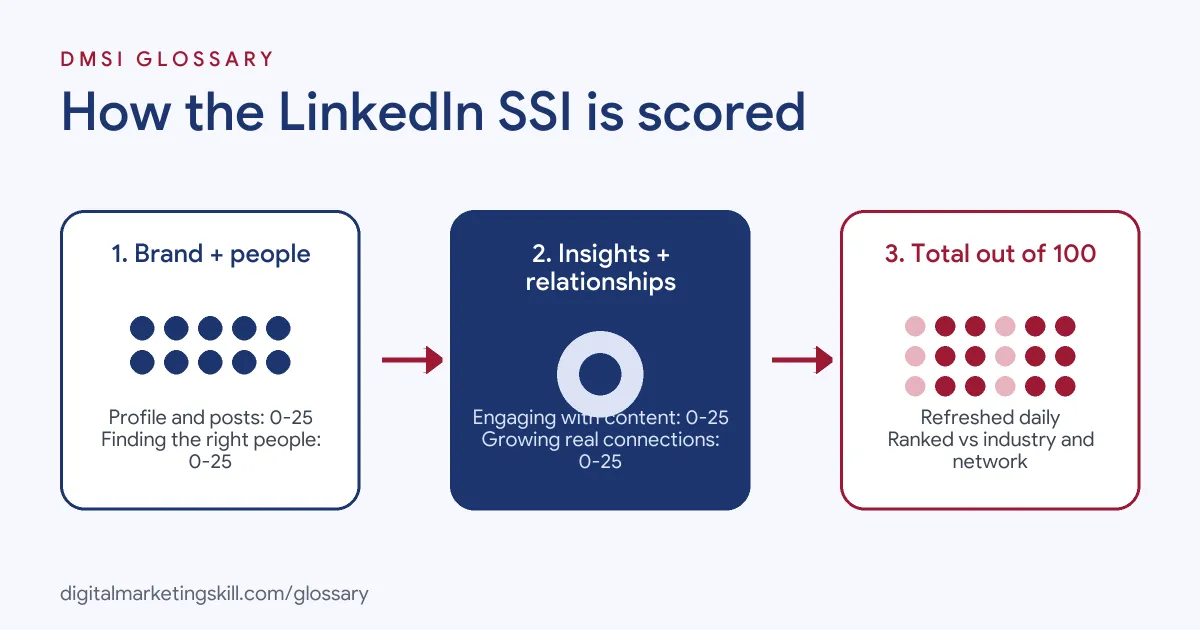
1. Establish Your Professional Brand
This pillar looks at how complete and buyer-focused your profile is, and whether you publish content people engage with. A clear headline, a photo, a banner, an About section that says who you help, and regular posts all feed it. Our guide to LinkedIn optimisation walks through each profile section.
2. Find the Right People
This pillar rewards targeted searching rather than random connecting. Searching for people by role, industry or company, viewing relevant profiles and saving leads all count. In other words, LinkedIn wants to see you looking for the buyers who match your buyer persona.
3. Engage with Insights
This pillar measures how you take part in conversations. Thoughtful comments, shares with your own view added, and posts that start discussion help here. Simply liking posts does little. As a result, a few useful comments a day usually move this pillar more than a burst of reactions.
4. Build Relationships
The last pillar looks at the quality of your network. Connecting with decision-makers and people inside target companies, and having those requests accepted, lifts the score. Mass invitations that people ignore or decline do the opposite.
How to Check Your SSI Score
- Log in to LinkedIn on a desktop browser.
- Open the SSI dashboard at linkedin.com/sales/ssi.
- Read your total out of 100 at the top of the page.
- Check the four bars to see which pillar is lowest.
- Compare your ranks against your industry and your network, shown as percentiles.
The dashboard refreshes daily, so small changes from one day to the next are normal. A weekly check is enough to spot real trends.
What Is a Good SSI Score?
LinkedIn does not set an official pass mark. In practice, the most useful comparison is the industry and network rank on your own dashboard, because a score of 55 may be strong in one field and average in another. The table below is a rough guide many trainers use.
| Score range | What it usually means | Where to focus |
|---|---|---|
| 0 to 30 | A basic profile with little activity | Finish your profile and post once a week |
| 30 to 55 | Some activity, but not targeted | Search for and connect with your ideal buyers |
| 55 to 75 | Active, focused use of LinkedIn | Improve the quality of comments and posts |
| 75 and above | Strong, consistent social selling habits | Keep the routine and track real leads |
How to Improve Your SSI
Start with your lowest pillar, because it has the most room to grow. Then build a short daily routine that touches all four.
- Brand: Rewrite your headline for the buyer, not your job title. For example, “I help clinics fill appointments with Google Ads” says more than “PPC Specialist”. Then post one useful idea a week.
- People: Run two or three searches a week for your target roles, and save the best matches as leads or in a simple list.
- Insights: Leave three thoughtful comments a day on posts your buyers read. Add a fact, a question or a short example.
- Relationships: Send a few personal connection requests each week to people at target companies. Mention why you want to connect.
Here is a made-up example. A freelance social media manager starts at 38. Her lowest pillar is finding people, at 6 out of 25. She spends ten minutes a day searching for marketing managers at local restaurant groups and connecting with a short note. Two months later her score is in the low 60s, and more importantly she has booked four discovery calls. The score rose because her habits changed, and the calls came from the same habits.
Does the SSI Actually Matter?
It matters as a habit tracker, not as a goal. LinkedIn’s own page notes that a high SSI score “doesn’t always represent the efficacy of a sales person.” That is a fair warning. You could raise the number with busy work and still win no clients.
So pair the SSI with real results. For instance, track profile views from your target roles, replies to your messages, calls booked and deals closed. If the SSI rises and those numbers rise too, your routine is working. If only the SSI rises, change what you post and who you connect with.
Some sales teams on LinkedIn Sales Navigator share SSI scores with managers. In that case, agree as a team on which real outcomes count most, so the score never becomes the only target.
Common Mistakes to Avoid
- Chasing the number. Automation tools that send hundreds of invitations may lift activity but damage trust and can break LinkedIn’s rules.
- Ignoring the weakest pillar. Many people only post content, so their brand score is high while relationships stay low.
- Generic comments. “Great post!” adds nothing. A specific point or question does far more.
- Connecting with everyone. A large but random network makes it harder to reach your buyers.
Where You’ll Use Social Selling at Work
Social selling appears in real marketing job listings. One remote marketing manager role asks you to help sales staff “leverage social selling tactics to generate opportunities” on LinkedIn. Another, for a LinkedIn social media manager, wants “a good understanding of current trends in digital marketing and social selling”.
So the skill matters for social media managers, B2B marketers and freelancers who win clients through LinkedIn. Knowing how the SSI works helps you coach a team and explain which daily actions matter.
Learn It in the Social Media Track
You can build these LinkedIn skills in the AI-Powered Social Media Management and Advertising track. It covers AI fundamentals, content creation with graphics and video, social media marketing and analytics, and social media advertising. Your portfolio project is a paid social campaign that you plan, create and run for a real brand. You also get unlimited 1-on-1 mentoring and a U.S. Project Internship from day one.
Next, read our guide to LinkedIn lead generation. You may also like our glossary entries on LinkedIn marketing and personal branding.
Frequently Asked Questions
What is the Social Selling Index on LinkedIn?
It is LinkedIn’s score from 0 to 100 for how well you use the platform to build a brand, find the right people, engage with insights and build relationships.
How do I check my Social Selling Index?
Log in to LinkedIn and visit linkedin.com/sales/ssi. The page shows your total, your four pillar scores and your rank against your industry and network.
Is the SSI free?
Yes. Any LinkedIn member can see their score without paying for Sales Navigator.
What is a good SSI score?
There is no official target. Many trainers treat 55 to 75 as solid and 75 or more as strong, but your industry rank is a better guide.
How often does the SSI update?
The dashboard refreshes daily, so it reacts quickly when your activity changes. Check it weekly to see real trends.
Does a higher SSI mean more sales?
Not on its own. LinkedIn notes the score does not always reflect how effective a seller is, so track replies, calls and deals as well.
Sources: LinkedIn Sales Solutions: The Social Selling Index; LinkedIn Sales Solutions: What is social selling; LinkedIn SSI dashboard; remote job listings on Himalayas and Himalayas.