
LinkedIn lead generation works when profile, content and outreach pull in the same direction. LinkedIn’s own newsroom lists more than 1.3 billion members, and B2B marketers rate it the platform most likely to reach real decision-makers. This guide shows the system behind that result, not just a list of tactics.
Key Takeaways
- The audience is already there. LinkedIn’s own newsroom lists more than 1.3 billion members worldwide, spanning most industries and seniority levels.
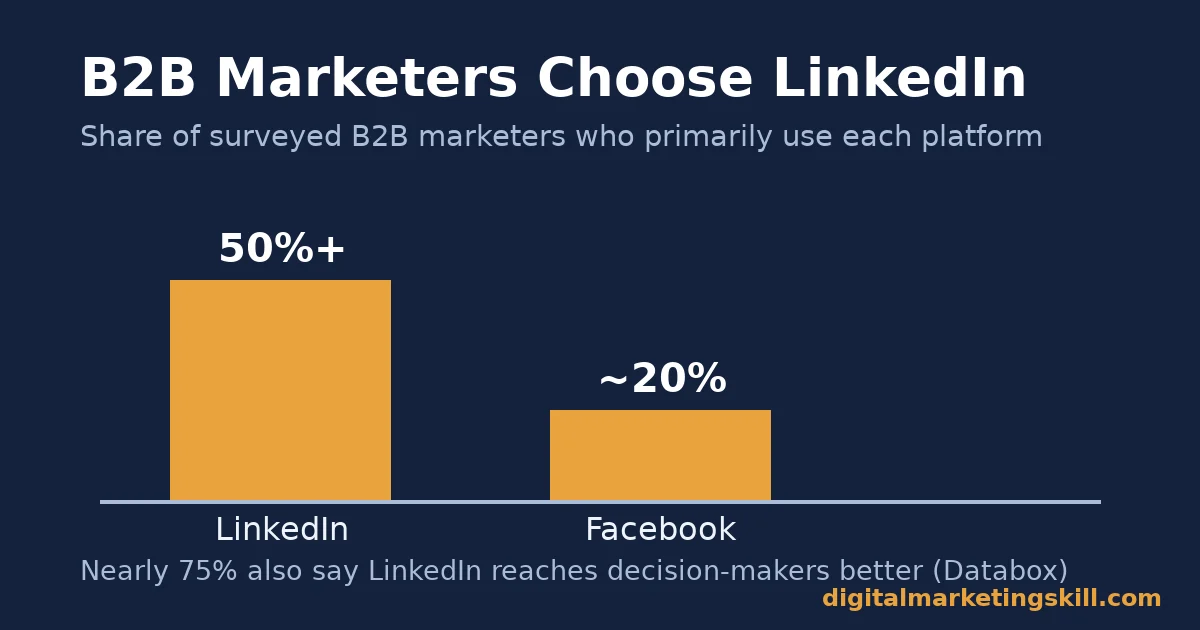
- B2B marketers already prefer it. Over 50% of surveyed B2B marketers primarily use LinkedIn, compared with about 20% for Facebook (Databox).
- It reaches decision-makers. Nearly 75% of the same marketers say LinkedIn reaches decision-makers better than Facebook (Databox).
- Format changes results. LinkedIn carousel posts earn a median engagement rate of 21.77%, roughly three times video or single-image posts (Buffer).
- Most buyers are not ready yet. LinkedIn’s own B2B Institute research with Ehrenberg-Bass found that about 95% of potential B2B buyers are out of market at any given time.
In this guide
- Why LinkedIn Lead Generation Needs Its Own System
- How LinkedIn Lead Generation Actually Works
- What Differs by Approach
- How to Lead With Each Approach
- Measuring LinkedIn Lead Generation
- The One Decision Rule
- A Real Case: Turning One-to-One Relationships Into Clients
- Frequently Asked Questions About LinkedIn Lead Generation
- Build Your LinkedIn Strategy With Support
Why LinkedIn Lead Generation Needs Its Own System
Most advice treats LinkedIn like any other social network: post often, grow followers, hope for leads. That approach misses how LinkedIn actually works. It is a professional network first, so people judge your profile and content as a signal of competence, not just content. This guide reflects the same framework taught hands-on at Digital Marketing Skill Institute.
Professional intent changes behaviour, too. In a survey LinkedIn itself ran of nearly 16,000 members across 17 countries, about 80% said networking is important to career success. And 70% of people hired in a single recent year joined a company where they already had a connection. That professional mindset is why a credible profile and a relevant network matter more here than on other platforms.
Ground rules before the detail. LinkedIn’s own figures describe its platform, so read them as self-reported scale, not independent proof of results for your business. The Databox and Buffer figures come from their own survey panels and customer datasets. Treat every number here as a directional snapshot, not a guarantee.
Why Most of Your Audience Isn’t Ready Yet
The 95-5 rule matters most. LinkedIn’s B2B Institute research with Ehrenberg-Bass found that about 95% of potential B2B buyers are not in the market to buy right now.
A separate Databox survey of B2B marketers found over 50% primarily use LinkedIn for B2B marketing compared with about 20% for Facebook, and nearly 75% say LinkedIn reaches decision-makers better.
A working LinkedIn lead generation system has to serve both groups: a small in-market share who are ready to talk, and a much larger group who need to remember you when they finally are. Our wider guide to lead generation covers the same split across every channel, not just LinkedIn.
How LinkedIn Lead Generation Actually Works
The mechanism has three linked parts. A strong profile and content build credibility with people who are not ready to buy yet. Connections and groups build reach into the right audience. Direct outreach and lead forms convert the small, ready-to-buy share into real conversations.
Each part feeds the next. Credibility without reach means nobody sees your content. Reach without outreach means connections sit idle instead of becoming conversations. Skipping straight to outreach without the first two means cold messages land on strangers who have no reason to trust you yet.
Profile and Content: Credibility for the 95%
Your profile is the first thing a prospect checks before replying to any message. A vague headline or an empty About section costs you credibility before the conversation starts. Treat your profile as a landing page: clear value, proof, and a reason to connect.
Content does the slow work of staying visible to the 95% who are not ready yet. Buffer’s analysis of nearly 2 million posts across 220,000+ accounts found LinkedIn’s median engagement rate sits around 6.2%. Carousel posts specifically earn a median of 21.77%, about three times video or single-image posts.
The same engagement principles that work across social media apply here: consistency and relevance beat posting volume alone.
Connections and Groups: Reach Into the Right Audience
Random connections do not build a useful network. Connect with people who match your actual buyer: a title, an industry, a company size. Join groups where those same people already discuss their problems, and contribute before you ever pitch anything. A cluttered network of strangers only slows down every later step of LinkedIn lead generation.
Scale varies by market. Pew Research’s social media fact sheet, based on a survey of 5,022 US adults, found about 25% of US adults use LinkedIn, well behind Facebook and Instagram. That US figure is one country’s snapshot, not a global rate, but it is a reminder that LinkedIn’s audience skews toward working professionals rather than the general population.
Comments and group discussions compound slowly. Each thoughtful comment on a prospect’s post is a small, free impression that a cold ad cannot buy. Over months, this is what keeps you visible to the 95% who will eventually move into the 5%.
Quality matters more than volume here. One useful comment that adds a real insight does more than ten generic ones that just say “great post.” The goal is to be remembered as someone who knows the subject, not someone who shows up everywhere without saying much.
Outreach and Lead Forms: Converting the 5%
This is where LinkedIn lead generation becomes measurable. Lead Gen Forms, built into LinkedIn’s ad platform, pre-fill a prospect’s contact details from their profile, which removes the friction of typing on a phone.
Direct messages to warm connections convert at a different rate than cold ones, so warm the relationship with content and comments first. A warm message reads as a continuation of a real interaction. A cold one reads as spam, even with the same words.
Keep the first message short and specific. One clear reason to connect, one relevant observation, and one low-pressure question works better than a long pitch about your services.
Timing matters as much as targeting. A message sent right after someone views your profile, reacts to your post or joins a shared group lands in a context the prospect already remembers. The same message sent cold, weeks later, reads as a stranger’s pitch rather than a continuation of an existing interaction.
A paid search advertising benchmark context is useful here: across channels, cost per lead varies enormously. Judge LinkedIn’s paid cost per lead against your own numbers over time rather than a single outside average. The discipline behind that comparison is the same one covered in our guide to conversion rate optimization, applied to a lead form instead of a landing page.
What Differs by Approach
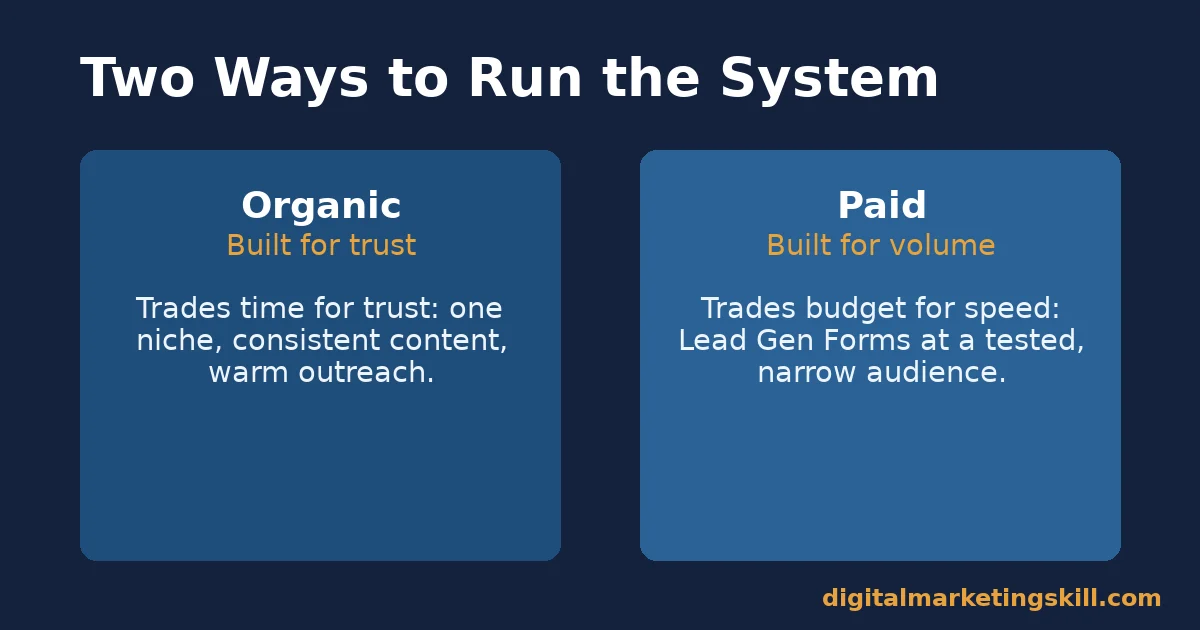
The three-part mechanism above stays the same, but two different approaches use it differently. One leans on organic effort and relationships. The other leans on paid reach and forms. Most businesses eventually use both, in sequence.
Organic LinkedIn Lead Generation: Built for Trust
Organic LinkedIn lead generation trades time for trust. It costs little beyond the hours spent posting, commenting and messaging, but results build slowly over months, not days. It suits a narrow, well-defined niche where a handful of real conversations is enough to matter, such as a consultant or a boutique agency selling a high-value service.
Paid LinkedIn Lead Generation: Built for Volume
Paid LinkedIn lead generation trades budget for speed and scale. Lead Gen Forms and sponsored content can reach a precise audience quickly, but every lead has a cost, and poor targeting burns budget fast. It suits a business that already knows its offer converts and wants more volume of the same result, rather than one still testing whether the offer works at all.
How to Lead With Each Approach
The sections below mirror the two approaches above. Start with whichever fits your current budget and timeline, and treat the other as a later addition rather than a competing choice.
Organic: Lead With One Niche and Consistent Content
Pick one narrow audience you can describe in a sentence, then publish content for that audience alone. Use carousels where useful, since Buffer’s data shows they substantially outperform other formats on LinkedIn. Comment on ten relevant posts a week before you post your own.
Once content earns reliable engagement, add direct outreach to warm connections, referencing something specific from their recent activity. Generic connection requests convert far worse than ones tied to a real, visible reason to talk. The same patience pays off beyond LinkedIn too: our guide to content marketing tactics covers the step-by-step approach to turning content into leads on any channel.
Paid: Lead With a Narrow Test Before You Scale
Run a small Lead Gen Forms campaign against a tightly defined audience before committing a larger budget. Track cost per lead and lead quality together, since a cheap but poorly qualified lead costs more in sales time than it saves in ad spend.
Once a campaign proves itself on a small budget, scale it gradually while watching cost per lead for drift. A sudden rise usually means the audience is saturated or the offer needs refreshing. Our broader look at social media marketing principles that actually grow a page covers the same saturation pattern across other paid channels.
A 30-Day Starter Plan for Either Approach
You do not need a big plan to start LinkedIn lead generation. This simple sequence works whether you lean organic, paid, or a mix of both.
- Week one: fix the profile. Rewrite your headline and About section around the problem you solve, not your job title alone.
- Week two: pick the niche. Choose one audience you can describe in a sentence, and connect only with people who match it.
- Week three: publish and comment. Post twice, and leave ten genuine comments on posts from your target audience.
- Week four: start outreach. Message the warmest connections first, referencing something specific from their recent activity.
At the end of the month, check connection acceptance rate and content engagement rate. Keep what worked, adjust what did not, and repeat the cycle with a slightly wider net.
Measuring LinkedIn Lead Generation
A LinkedIn lead generation effort without measurement is a guess with a professional-looking profile attached. Track a small number of defined metrics on a fixed schedule.
Four Metrics That Show It Is Working
- Connection acceptance rate. The share of connection requests accepted. A low rate usually means poor targeting or a weak, generic request message.
- Content engagement rate. Reactions, comments and shares divided by impressions. Buffer’s roughly 6.2% median is a rough industry yardstick, not a target for every post.
- Lead form or message reply rate. The share of outreach that gets a real reply, not just a view. This is the clearest signal that your targeting and message both work.
- Cost per qualified lead. For paid campaigns, total spend divided by leads that meet your own quality bar, not just form fills. A cheap lead that never replies again is not actually cheap.
How to Read These Numbers Together
Read the four metrics as a chain. If connection acceptance is strong but engagement is weak, your targeting works but your content does not. If engagement is strong but reply rate is weak, your outreach message is the weak link, not your visibility. Fixing the wrong stage first wastes months on a problem that was never there.
The One Decision Rule
If you take one rule from this guide, make it this one. Never add paid LinkedIn spend to an approach that is not yet converting organically.
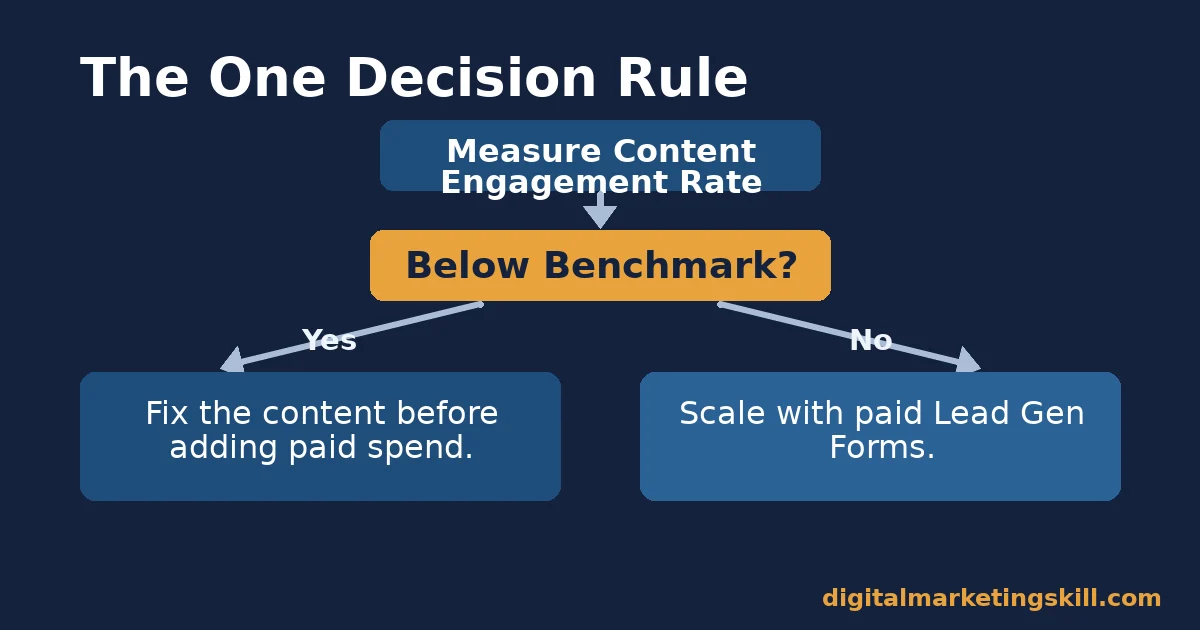
Here is an illustrative example, with invented numbers. A consultant posts on LinkedIn for a month, earns a 2% engagement rate, well under Buffer’s roughly 6.2% median, and considers running Lead Gen Forms to speed things up. Paid spend on top of weak content would only pay to show more people a message that is not landing.
Fixing the content first, by narrowing the audience and testing a carousel format, lifts engagement to 7%, closer to Buffer’s top-performing format benchmark. Only then does paid spend make sense, because now it amplifies something that is already working rather than masking something that is not.
The same rule applies to outreach. Scaling cold messages against a weak profile just produces more ignored messages, not more qualified leads. Rewrite the profile and the opening message first, then scale the volume once replies start coming in.
The rule also protects you from judging too early. A new profile and a handful of posts need a few weeks before engagement settles into a reliable pattern. Outreach campaigns need at least a few dozen messages before a reply rate means anything. Apply the decision rule once you have enough data, not after the first few attempts.
A Real Case: Turning One-to-One Relationships Into Clients
Damola Akanbi, a Digital Marketing Skill Institute student, built a client business around relationship-driven acquisition rather than broad advertising. According to the DMSI reviews page, he quit his job and now averages $1,500 per client running digital marketing campaigns.
The published case does not specify LinkedIn by name. But the underlying mechanism matches this guide closely: a credible profile, consistent visibility and direct, warm outreach to the right people, rather than broad, unfocused prospecting. That is the same mechanism behind organic LinkedIn lead generation.
Individual results vary, and this is one published case, not a guaranteed outcome. See the Institute’s earnings disclaimer for context on income claims. Treat it as proof the relationship-first model can work, not as a promise of a specific number for your own business.
The deeper lesson is about focus. One clear service, sold directly to the right people, often beats a broad pitch sent to everyone. That focus is exactly what a narrow LinkedIn niche is built to support.
Frequently Asked Questions About LinkedIn Lead Generation
What is LinkedIn lead generation?
It is the process of finding and converting potential customers through LinkedIn, using a combination of profile credibility, content, connections and direct outreach or paid lead forms. It works best as a connected system, not a single tactic used alone, because each part makes the next one more effective.
Is LinkedIn actually good for lead generation?
For B2B businesses, yes. Over 50% of surveyed B2B marketers primarily use LinkedIn, and nearly 75% say it reaches decision-makers better than Facebook, according to Databox. Results still depend on targeting, content quality and follow-up, not the platform alone, so treat LinkedIn as a channel to execute well rather than a shortcut.
How long before LinkedIn lead generation produces results?
Organic efforts usually take two to three months of consistent posting and outreach before results become reliable, since most of the audience starts out not ready to buy. Paid campaigns can produce leads faster, but still need a few weeks of testing before cost per lead stabilises into a number you can trust.
Should I post content or run ads first?
Start with organic content and outreach on a narrow niche. Add paid Lead Gen Forms once your content earns engagement above your own historical average, so paid spend amplifies something that already works instead of masking a weak message.
What makes a LinkedIn connection request work?
A short, specific reason tied to the other person’s recent activity, role or shared interest. Generic, templated requests convert far worse than ones that show you actually looked at their profile before reaching out.
How many connections do I need before LinkedIn lead generation works?
There is no fixed number. A smaller, well-targeted network of a few hundred relevant connections usually outperforms a large, unfocused one of several thousand, because relevance drives reply rate more than raw size ever does.
Do I need a paid LinkedIn account to generate leads?
No. A free account with a strong profile, consistent content and direct outreach can generate leads. Paid tools and ads add reach and automation, but they are not required to start, especially in a narrow niche with a small addressable audience.
How do I know if my LinkedIn lead generation is working?
Track connection acceptance rate, content engagement rate, reply rate and cost per qualified lead together. If one metric sits well below your own historical average, that is the stage to fix before scaling spend or volume into it.
Can LinkedIn lead generation work for a small, local business?
Yes, especially for business-to-business services. A local accountant, consultant or agency can use LinkedIn to reach decision-makers at nearby companies directly, often more precisely than a broad local ad campaign would.
Build Your LinkedIn Strategy With Support
Turning profile, content and outreach into one working system is exactly what Digital Marketing Skill Institute teaches hands-on. The Master Diploma in Digital & AI Marketing is built around four AI-powered tracks totalling ten courses. These include AI-Powered Lead Generation and Email Automation, directly covering the outreach and conversion stages in this guide, with a Full Stack option if you want to learn all four tracks together.
It comes with unlimited 1-on-1 coaching and mentoring and a U.S. Project Internship with a verified U.S. Work Reference Letter. The programme is dual US and UK accredited, recognised in more than 100 countries, and fully online.
You can study and apply this system from anywhere in your country. Explore more guides on the Digital Marketing Skill Institute blog and read more student outcomes on the reviews page. When you are ready, apply for the Master Diploma or start from the Digital Marketing Skill Institute homepage. Wherever you live, the same system applies: build credibility first, then add reach and paid volume once it is converting.
Every figure in this guide was checked against its original source before publication. Figures marked as illustrative are invented examples, not real results.
![9 Amazing Digital Marketing Skills to Make Money Online [With Proof]](https://digitalmarketingskill.com/wp-content/uploads/2019/07/9-Amazing-Digital-Marketing-Skills-to-Make-Money-Online-With-Proof-17.png)






