
A Tripwire Offer is a low-priced paid product that turns a new lead into a first-time buyer, so they are more likely to buy bigger offers later. It usually comes right after someone grabs a free lead magnet or joins your email list. The goal is not profit on the first sale. Instead, it builds trust and moves people from “interested” to “customer” with very little risk.
Key Takeaways
- A tripwire offer is a small, cheap paid product that leads to a first purchase.
- It usually sits after a free lead magnet and before your main offer.
- Its job is to change a lead into a buyer, not to make a big profit.
- Good tripwires solve one small, real problem quickly.
- Buyers then move into upsells, email follow-ups and your core product.
What Is a Tripwire Offer?
Most people don’t buy an expensive product from a brand they’ve just met. That’s because a big price feels risky. However, a small price feels safe. So a tripwire offer uses this idea to get a first “yes”.
Spiffy, a checkout platform, puts it clearly: “A tripwire is a low-priced paid offer designed to turn a lead into a buyer and create a path to higher-value purchases.” In other words, the tripwire is a doorway, not the destination.
Here is an everyday example. Say you download a free meal plan from a nutrition coach. Then, on the thank-you page, you see a full recipe pack for a small fee. You buy it because it’s cheap and useful. As a result, you are now a customer, not just a contact. Later, the coach offers you a full coaching programme.
Above all, price is the key lever. For instance, Astra’s guide notes that tripwires are “typically priced between $1 and $20.” Still, the right price depends on your market and your main product. Spiffy adds that the price “should be low enough to reduce friction but high enough to create a real buying decision.”
Why It Matters
Why not just sell the main product straight away? First, the jump from free to expensive is large. So many leads never take it. Fortunately, a tripwire makes that jump smaller.
Second, people who buy once tend to buy again. ActiveCampaign’s glossary explains that “higher-cost purchases result in higher friction and reduced willingness to pay.” So a small first purchase breaks that barrier. In addition, buyers give you payment details and a clear signal of intent. As a result, later offers become much easier.
Finally, a tripwire can help cover your ad costs. That’s because even a small sale brings money back in. As a result, it can lower your real customer acquisition cost over time.
How a Tripwire Offer Works
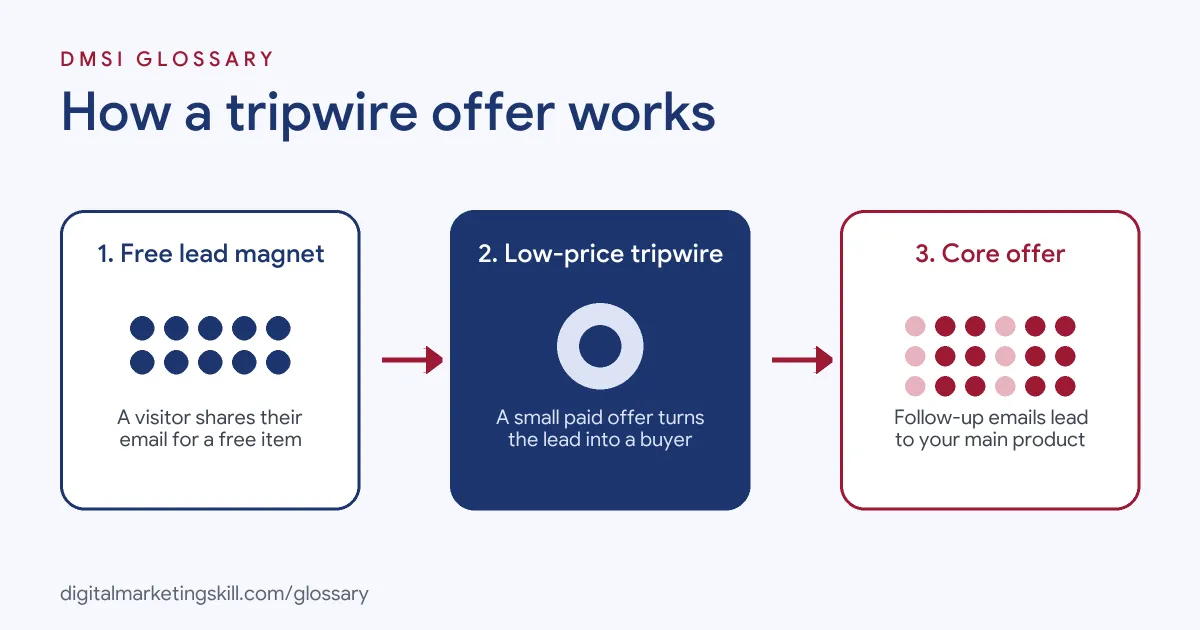
A tripwire sits inside a wider sales funnel. Each step moves a person a little closer to your main offer. So the tripwire works best when the steps before and after it are clear.
Step 1: Capture the Lead
First, you attract people with a free lead magnet, such as a checklist or short guide. Usually, they share their email to get it. Now they are a lead, but they haven’t paid anything yet.
Step 2: Present the Tripwire
Next, you show the tripwire offer. Often this appears on the thank-you page or in the first welcome email. Ideally, the offer links closely to the free item. For example, a free checklist might lead to a low-cost template pack that does the work for you.
Step 3: Follow Up and Upsell
After the purchase, the buyer moves into a new segment. Then you send them a different email sequence. Astra’s guide explains that upsells can lead “to your core (or high ticket) offer.” Meanwhile, people who didn’t buy keep getting nurture emails instead.
Step 4: Sell the Core Offer
Finally, you present your main product or service. By now, the buyer has paid you once and seen value. So trust is higher, and the bigger price feels less risky.
What Makes a Good Tripwire
Not every cheap product works as a tripwire. First, it must feel like a bargain. In other words, the value should clearly beat the price. Second, it should be quick to use. For example, a template someone can use in ten minutes beats a long ebook they never open. Third, it must point to your main offer. So when the buyer finishes, they should want the next step.
In addition, the offer should match the lead magnet. If someone grabbed a free social media checklist, a paid content calendar makes sense. However, a paid tax guide would not. Matching keeps the journey smooth and the message clear.
Examples of Tripwire Offers
- An online course creator. The creator gives away a free video lesson. Then they offer the first two modules of the full course at a small price. Later, buyers get an offer for the complete programme.
- A design agency. The agency offers a free brand checklist. After that, it sells a low-cost brand audit. Then clients who like the audit often ask for a full brand project.
- A skincare shop. The shop sells a small sample box at a low price. So customers can test products before they commit. Later, the shop emails them offers on full-size bundles.
Tripwire Offer vs Lead Magnet vs Core Offer
| Point | Lead magnet | Tripwire offer | Core offer |
|---|---|---|---|
| Price | Free | Low | Full price |
| Main goal | Capture an email | Win a first purchase | Drive profit |
| What the person gives | Contact details | A small payment | A bigger payment |
| Typical format | Checklist, guide, quiz | Template, mini-course, trial | Full course, service, product |
| Funnel stage | Top | Middle | Bottom |
How to Create a Tripwire Offer
- Start with your core offer. Know what you want people to buy in the end. Then work backwards.
- Find one small problem. Pick a quick win that links to your main product.
- Build a simple product. For example, create a template, workbook, mini-course or short audit.
- Set a low but real price. Make it an easy yes, but not so cheap that it looks worthless.
- Place it after your lead magnet. Show it on the thank-you page or in your first emails.
- Write a clear sales page. Explain what they get, how fast it helps and why the price is low.
- Set up follow-up emails. Tag buyers and send them an email sequence that leads to your core offer.
- Track the numbers. Measure how many leads buy the tripwire, and how many go on to buy more.
Best Practices for Tripwire Offers
- Solve a real problem. Spiffy warns the offer “should solve a real small problem, not feel like a bait offer.”
- Link it to your main product. The tripwire should make your core offer feel like the obvious next step.
- Deliver fast. In general, instant access or quick delivery keeps the good feeling going.
- Keep checkout simple. Similarly, use a short form and trusted payment options.
- Add a related upsell. A well-matched next offer can raise order value. This is a form of upselling.
- Test your price. Then try small changes and watch both sales and later upgrades.
Common Mistakes to Avoid
- Making it too cheap. A price that is too low can attract bargain hunters who never buy again.
- Offering something unrelated. If the tripwire doesn’t link to your core offer, buyers won’t move on.
- Weak follow-up. For example, without a clear next step, the tripwire is just a cheap one-off sale.
- Overpromising. Also, a tripwire that underdelivers damages trust before you even pitch the main product.
- Hiding costs. Clear pricing matters, too. Any extra fees, such as shipping, should be easy to see.
- Judging it on profit alone. Instead, measure how many tripwire buyers go on to buy your core offer.
Where You’ll Use Tripwire Offers at Work
You’ll use tripwire offers in funnel and lifecycle roles. For example, email marketers, funnel builders and growth marketers plan them as part of lead nurturing. Also, course creators, coaches and online shops often hire freelancers to build tripwire funnels on tools such as landing page builders and email platforms. In these jobs, you’ll write the offer copy, set up checkout, tag buyers and report on how many leads become customers.
Tripwires also connect to wider skills. For instance, you’ll need to know how a landing page converts, how to segment buyers and how to read funnel reports. So learning tripwires helps you grow as an all-round lead generation marketer.
Learn It in the Lead Generation and Email Track
You can learn tripwire offers, funnels and email follow-ups in the AI-Powered Lead Generation and Email Automation track. Every track includes a U.S. Project Internship from day one, with unlimited 1-on-1 mentoring.
Frequently Asked Questions
Why is it called a tripwire?
Essentially, the name suggests a small step that sets something bigger in motion. In this case, a small purchase starts the buying relationship.
How much should a tripwire offer cost?
It should be low enough to feel easy but high enough to feel like a real choice. The right price depends on your market and your main product.
Is a tripwire the same as a lead magnet?
No. A lead magnet is free and captures an email. By contrast, a tripwire is paid and creates a first purchase.
Where should I show a tripwire offer?
Most brands show it on the thank-you page after a lead magnet. However, others place it in the first few welcome emails.
Do tripwire offers work for services?
Yes. For example, a short paid audit, consultation or workshop can work well as a tripwire for a service business.
Sources: Spiffy: Tripwire; Astra: Complete Guide to Tripwire Funnels; ActiveCampaign: What is Tripwire Marketing?.