
You grow your business with digital marketing by combining four channels: email, organic search, social media and your own website. Each channel does a different job. Most growth stalls when owners lean on only one. This guide shows what each channel is built for, how to lead with it, and how to measure growth.
Key Takeaways
- Email pays back fast. Every $1 spent on email marketing returns about $36 on average, more than almost any other channel (Litmus).
- Most pages never get found. 96.55% of web pages get zero organic traffic from Google, based on a study of roughly 14 billion pages (Ahrefs).
- Small businesses are already online. 72% of small businesses now have a website and 52% run social media marketing (LocaliQ).
- Email is the most-used distribution channel. 87% of small businesses use email to distribute their content (Oberlo).
- The audience is enormous and worldwide. More than 6 billion people are online globally, so a working digital channel can reach almost anyone, anywhere (DataReportal).
In this guide
- Why Most “Grow Your Business” Advice Fails
- How Digital Marketing Helps You Grow Your Business
- The Four Channels That Grow Your Business
- Common Mistakes That Stop You From Growing Your Business
- How to Lead With Each Channel
- How to Measure Whether You Are Growing Your Business
- The One Rule to Grow Your Business Faster
- A Real Case: Small Changes, Measurable Growth
- Your Next Step
- Frequently Asked Questions About Growing Your Business With Digital Marketing
Why Most “Grow Your Business” Advice Fails
Most advice tells you to “be on social media” or “start a blog.” It rarely says what to do next. That advice is not wrong. But it skips the one idea that helps you grow your business: match each channel to the stage of the customer journey it serves best.
This guide names that gap. Then it fills it. The figures below come from named studies. Each one has its own scope and limits. Some are global surveys. Some are vendor research. One case is a single company’s own result. Treat every number as a snapshot, not a permanent ranking. Read the source notes before you act on any single figure.
How Digital Marketing Helps You Grow Your Business
Digital marketing helps you grow your business through three linked steps. First, it gets a potential customer’s attention. Next, it builds enough trust for them to act. Finally, it gives them an easy way to buy or enquire. Traditional marketing can manage the first step. Digital channels can do all three, and you can measure each one.
Scale matters here too. More than 6 billion people are online worldwide. That is roughly three-quarters of the global population, according to DataReportal’s global digital research. A small business with no local storefront can still reach a meaningful share of that audience. Digital channels do not depend on geography the way a shop window does.
Attention still does not arrive on its own. Search engines, social platforms and inboxes reward specific, consistent behaviour over random bursts of activity. One viral post or one well-ranked page can bring a short spike. Lasting growth comes from a channel performing reliably, month after month, not from a single lucky result.
Scale is also why smaller businesses can compete here. A larger company can outspend you on advertising. It cannot out-answer a business that understands its own customers better. The next section breaks down the four channels that can grow your business, and what each one is built to do.
The Four Channels That Grow Your Business
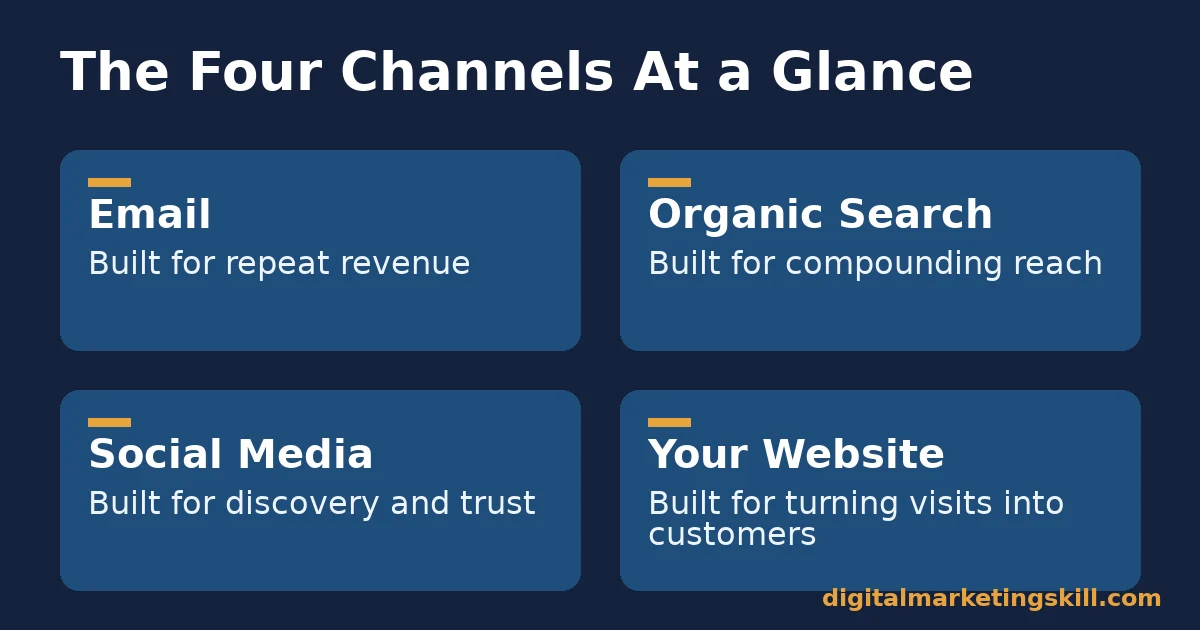
Each channel below plays a different role. Running all four the same way is the most common reason owners stay busy without seeing growth.
Email Marketing: Built for Repeat Revenue
Email is built for selling to people who already know you. It performs best with existing contacts, past customers and warm leads. Every message lands directly in front of someone who chose to hear from you. That direct line is why email marketing returns about $36 for every $1 spent on average, according to Litmus’s email marketing ROI research.
Returns vary a lot by industry and list quality. The $36 figure is an average across many companies, not a guarantee for any one list. Email is weak at reaching strangers. It depends on another channel to grow the list in the first place, which is one reason to run more than one channel if you want to grow your business steadily.
Organic Search: Built for Compounding Reach
Organic search is built to find people who are already looking for an answer. A well-optimised page keeps attracting visitors for months or years after you publish it. That is why organic search drives an estimated 53% of all trackable website traffic, according to a BrightEdge analysis of tens of billions of sessions.
The gap between potential and reality is large. Ahrefs studied roughly 14 billion pages in its search traffic study. It found that 96.55% get zero organic traffic from Google. Reach through search compounds, but only for the small share of pages built around a real search question.
Social Media: Built for Discovery and Trust
Social media is built to introduce your business to strangers. Over time, it also shows that you are reliable. It rewards frequency and personality more than any other channel. That is also why 52% of small businesses run social media marketing, per LocaliQ’s Small Business Marketing Trends Report.
Social reach is rented, not owned. A platform change can cut your visibility overnight. Social media works best as a discovery engine that feeds your email list and website. It should not be the only place your business lives online if your goal is to grow your business for the long term.
Your Website: Built for Turning Visits Into Customers
Your website is built to convert attention from every other channel into an enquiry, a sale or a subscriber. It is the one channel you fully control. That is why 72% of small businesses now have a website, according to the same LocaliQ research.
A website that only describes your business wastes the traffic the other three channels send it, unless it also offers a clear next step. The fix is structural, not cosmetic. It is where most owners should start if they want to grow your business without spending more on ads.
Common Mistakes That Stop You From Growing Your Business
Check whether one of these five mistakes already explains a flat growth curve before you change anything. Each one is easy to miss from the inside. The business still looks active even while it stalls.
Running Only One Channel
Relying on a single channel, usually social media or paid ads, leaves a business exposed to one platform’s algorithm or pricing. When that channel’s cost or reach shifts, growth stops overnight. Nothing else was feeding the pipeline.
Never Building an Owned Audience
Followers and traffic that only exist on someone else’s platform can disappear with one policy change. An email list is different. It is an asset you keep even if a platform changes its rules. That is why list-building deserves attention from day one, not after a channel stops working, if you are trying to grow your business on a stable footing.
Asking for Too Much, Too Soon
A first-time visitor is rarely ready to buy. Pages that only offer a large purchase, with no smaller first step, convert far fewer visitors than pages that offer an easy first action, such as a free resource or a short consultation.
Not Tracking Where Customers Come From
Without source tracking, it is easy to credit the wrong channel for growth. You then spend more on the channel that deserves the least credit. A simple analytics setup that separates traffic by source removes most of this guesswork.
Copying Competitors Instead of Answering Customers
Matching a competitor’s content or posting schedule rarely works. It ignores what your own customers actually ask. The channels above work best when every page, email and post answers a real question your audience already has.
Here is a quick check for this mistake. List your last ten pieces of content, from any channel. Write down the specific customer question each one answers. If you cannot name a question for several of them, that content was likely written to match a competitor, not to grow your business through your own audience’s real needs.
How to Lead With Each Channel
Knowing what each channel is built for only helps once you change what you do first. The moves below mirror the four channels above.
Email Marketing: Lead With a Simple List-Building Offer
Start with one clear reason to join your list, such as a short guide, a discount or a useful checklist related to what you sell. Put the signup form where visitors already are, not only on a separate page. Send a short welcome sequence that explains what subscribers will get and how often.
Our guide to growing an email list walks through list-building tactics in more detail. Our introduction to email marketing covers the basics of sending your first campaigns.
Organic Search: Lead With One Keyword-Focused Page at a Time
Pick one question your ideal customer searches for. Write one page that answers it completely. Resist the urge to cover ten topics on one page. Google’s own guidance on helpful, people-first content rewards pages that fully satisfy a single search intent over pages that skim many.
Our guide on optimising a blog post for search engines breaks this down into a repeatable checklist for each new page.
Social Media: Lead With Consistency, Not Virality
Post on a schedule you can actually keep, even if that means fewer posts. A steady, recognisable presence builds more trust than one viral post followed by silence. It is also easier to measure and improve.
Our guide to social media management covers how to plan and run that schedule without it taking over your week.
Your Website: Lead With One Clear Next Step
Every page on your site should offer exactly one obvious next action: book a call, buy a product or join the list. Pages that offer five competing buttons convert worse than pages that offer one. Visitors hesitate when every option looks equally important.
Track whether visitors complete that one action before you add anything else to the page. A page that quietly fixes its single next step can outperform a full redesign, and it is often the cheapest way to grow your business this month.
How to Measure Whether You Are Growing Your Business
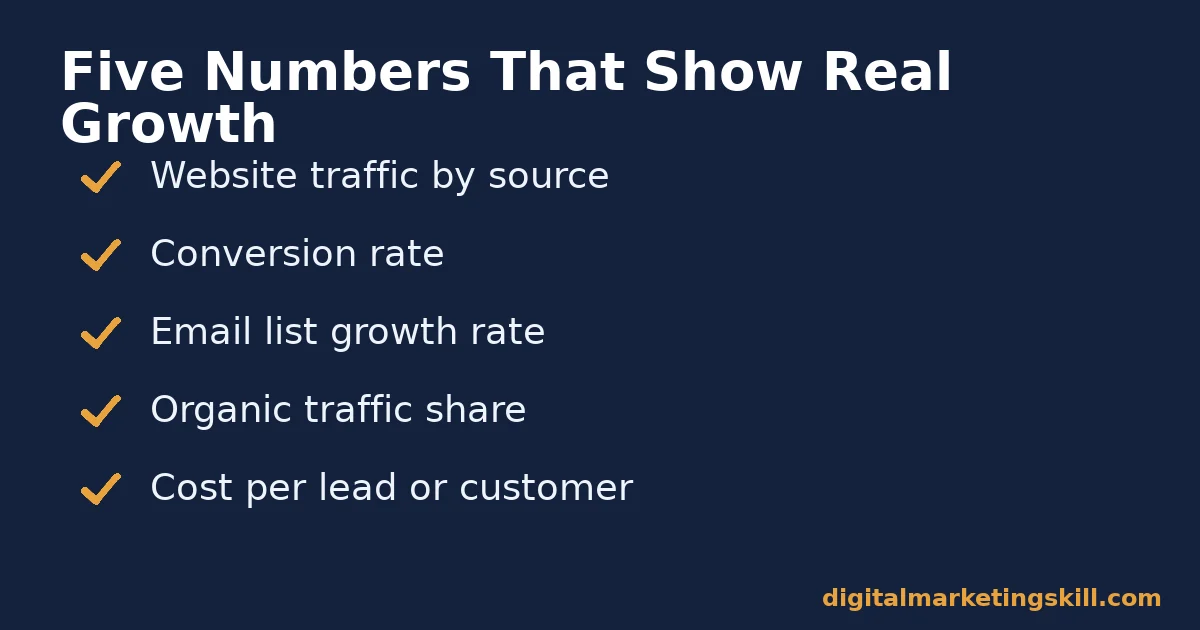
Busy activity is not the same as growth. These five numbers show whether you are actually growing your business.
- Website traffic by source. The number of visits arriving from search, social, email and direct visits, usually shown in your analytics tool’s acquisition report. Track the trend for each source separately, not the combined total.
- Conversion rate. The share of visitors who complete your one clear next step, calculated as conversions divided by visits. A low but improving rate usually matters more than a high but flat one.
- Email list growth rate. New subscribers minus unsubscribes, divided by your list size, over a set period. It tells you whether your list-building offer still works.
- Organic traffic share. The percentage of total traffic coming from unpaid search results. A rising share means your content compounds rather than depending on constant promotion.
- Cost per lead or customer. Total channel spend divided by leads or customers gained from that channel. Compare it across channels before you decide where to spend more.
Reading the Numbers Together
Read these five together, not one at a time. Rising traffic with a flat conversion rate usually points to a website problem, not a traffic problem. That pattern is exactly what the decision rule below addresses.
A falling email list growth rate, paired with steady website traffic, usually points to a weak list-building offer rather than a weak website. A rising cost per lead, with traffic and conversion rate both flat, usually means a paid channel has become less efficient.
In that case, pause the channel before you spend more on it. Checking these numbers together, instead of in isolation, turns a dashboard into a decision you can act on this week. It is one of the simplest habits for anyone who wants to grow your business without guessing.
The One Rule to Grow Your Business Faster
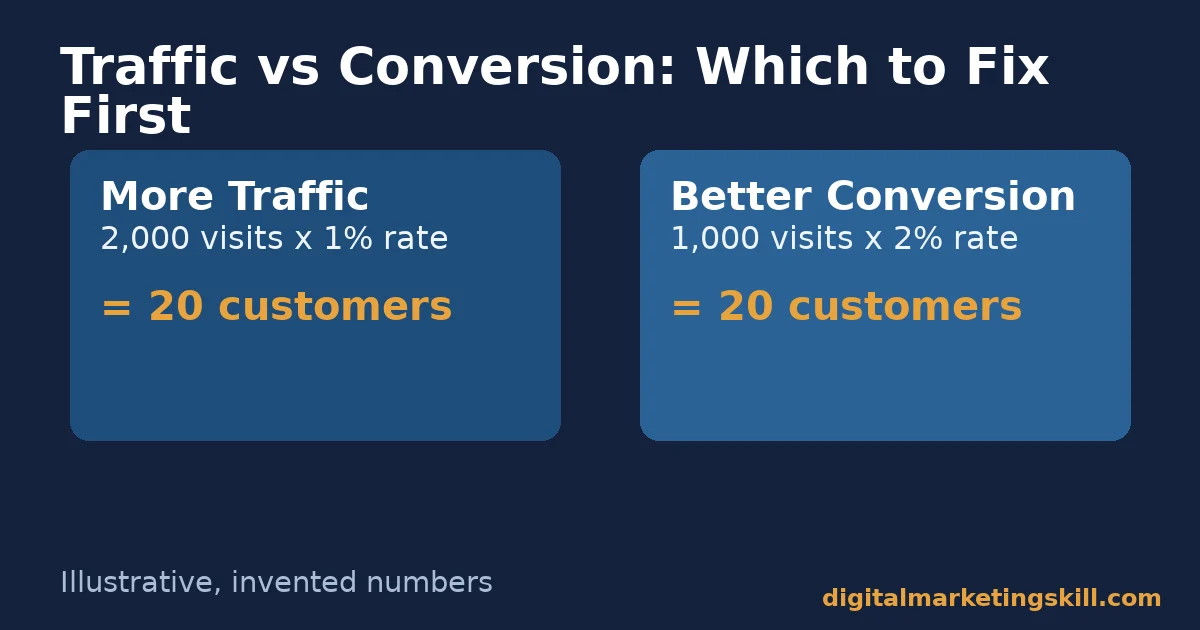
If you act on only one idea here, use this one: improve your website’s conversion rate before you spend more to send it traffic. Every extra visitor you buy or earn is wasted at the same rate your current traffic is wasted.
Here is an illustrative, invented example to show why. Say a site gets 1,000 monthly visits and converts 1% into customers, for 10 customers. Doubling traffic to 2,000 visits at the same 1% rate produces 20 customers. Raising the conversion rate to 2%, with no added traffic, also produces 20 customers. That second path is usually far cheaper than doubling traffic through ads or content.
Most small business websites have room to improve conversion rate before they need more traffic. The first-step fixes above, like one clear next action, cost nothing to test, and they are often the fastest way to grow your business this quarter.
Start with the page that already gets the most visits. A small conversion gain there affects more people than the same gain on a page few visitors ever see. Change one thing at a time, such as the headline or the button text. Compare the conversion rate for at least two to four weeks before you decide whether the change helped.
A Real Case: Small Changes, Measurable Growth
Partnero, a software company, used email marketing to measurably improve how many subscribers opened its messages. The team tested subject lines and sent emails at times aligned with each subscriber’s time zone. Average open rate rose from 37% to 47%, a 10 percentage point gain, according to a case study published by MailerLite.
This is one company’s own result, published by the email platform it uses. Treat the exact figure as specific to that list and audience, not a universal benchmark. The underlying lesson still applies to almost any business: testing small, specific changes to an existing channel often beats starting a brand-new one if your goal is simply to grow your business with what you already have.
Your Next Step
You do not need to run all four channels perfectly at once. Pick the channel that matches where your current customers already are. Fix your website’s one next step. Measure the five numbers above every month, and you will grow your business in a way you can actually see.
If you want structured, practical training across every channel in this guide, the Master Diploma in Digital & AI Marketing from Digital Marketing Skill Institute is built from ten execution-first courses across four AI-powered tracks: AI-Powered Lead Generation and Email Automation, AI-Powered WordPress and SEO Specialist, AI-Powered Social Media Management and Advertising, and AI-Powered Google Specialist, with a Full Stack option for completing all four.
Every track includes unlimited 1-on-1 coaching and mentoring, a U.S. Project Internship with a verified U.S. Work Reference Letter, and dual US and UK accreditation recognised in more than 100 countries. The program is 100% online. You can study and apply these channels to grow your business from anywhere in your country.
Explore the full Master Diploma program structure, browse more guides on the Digital Marketing Skill Institute blog, or read student reviews before you apply. Whatever stage your business is at, the aim is the same: fewer, better-aimed channels, measured consistently, wherever you live. You can start today at https://digitalmarketingskill.com/.
Frequently Asked Questions About Growing Your Business With Digital Marketing
What is the fastest way to grow your business with digital marketing?
There is no single fastest channel for every business. Fixing your website’s conversion rate is usually the quickest win, because it improves the value of traffic you already have before you spend anything more on reaching new people.
Do I need to be on every social media platform?
No. Choose the one or two platforms where your actual customers already spend time, and post there consistently. Spreading effort across five platforms usually produces weaker results than doing two platforms well.
How long does organic search take to grow a business?
Organic search typically takes several months to show meaningful traffic. Search engines need time to crawl, index and rank new or updated pages. It rewards patience and consistency more than any quick technique.
Is email marketing still effective for small businesses?
Yes. Email remains one of the highest-returning channels because it reaches people who already chose to hear from you. That is also why a large share of small businesses still rely on it to distribute content and offers.
How much should a small business spend on digital marketing?
There is no fixed figure that fits every business. It depends on your margins, your sales cycle and which channels you already run well. Start by tracking cost per lead on your current spend, then grow the channels with the best ratio.
What is the difference between digital marketing and internet marketing?
Internet marketing refers specifically to promotion that happens over the internet, such as a website or online ads. Digital marketing is broader. It includes internet marketing plus mobile apps, SMS and any other digital channel, so internet marketing is a subset of digital marketing.
Can a very small business realistically compete using digital marketing?
Yes. Most digital channels reward relevance and consistency more than budget size. A small business that answers its customers’ specific questions better than a larger competitor can out-rank and out-convert that competitor in organic search and email.
Should I hire an agency or learn digital marketing myself?
Either can work. Owners who understand the basics of each channel make better decisions even when they do hire help, because they can judge results instead of only trusting a report. Many small business owners start by learning the fundamentals, then outsource only the parts that need specialist time, such as technical SEO or paid ad management.
Either path works, as long as you keep reviewing the five numbers above yourself. No agency feels the result of a slow month the way the business owner does.
Every figure in this guide was checked against its original source before publication. Figures marked as illustrative are invented examples, not real results.
![9 Amazing Digital Marketing Skills to Make Money Online [With Proof]](https://digitalmarketingskill.com/wp-content/uploads/2019/07/9-Amazing-Digital-Marketing-Skills-to-Make-Money-Online-With-Proof-17.png)






