
A home based business is any company you run mainly from your house, not a rented office. You use the internet, a phone and your own skills to find clients or sell products. It fits around family life and cuts overhead. Done well, it can beat a salary within a year.
Key Takeaways
- Nonemployer businesses are a real force. Census Bureau data counted 30+ million such businesses, bringing in close to $1.8 trillion, 6.4% of GDP.
- Remote work favours women. The Bureau of Labor Statistics reports 24.9% of employed women teleworked in a month, against 20.5% of men.
- Freelance platforms are large. Upwork’s filings show $787.8 million in revenue; Fiverr’s filings show $430.9 million, up 10.1%.
- Women start businesses at a lower rate than men. The Global Entrepreneurship Monitor found 10.7% of women active, versus 13.2% of men, across 51 economies.
- Self-employment still trails employment. The BLS women’s labor-force databook puts women’s self-employment rate below men’s.
In this guide
- The Home Based Business Gap: What Most Lists Get Wrong
- How A Home Based Business Actually Works
- What Differs By Home Based Business Model
- How To Lead With Each Model’s Strength
- Measuring Whether Your Home Based Business Is Working
- The One Decision Rule For Picking Your First Home Based Business
- A Real Case: Turning One Freelance Skill Into Recurring Client Work
- Frequently Asked Questions About Home Based Business
- Your Next Step Toward A Home Based Business
The Home Based Business Gap: What Most Lists Get Wrong
Most “home based business ideas” articles list the same ten jobs. They rarely help you choose between them. Copywriting, dropshipping and virtual assistant work pay differently. They start differently. They suit different people.
Instead, this guide groups home based business ideas into three working models. It names what each model is built for, and gives one simple rule for picking your first move. However, treat every figure below as a snapshot: company filings change each quarter, and national surveys are a sample, not a full count of every household.
How A Home Based Business Actually Works
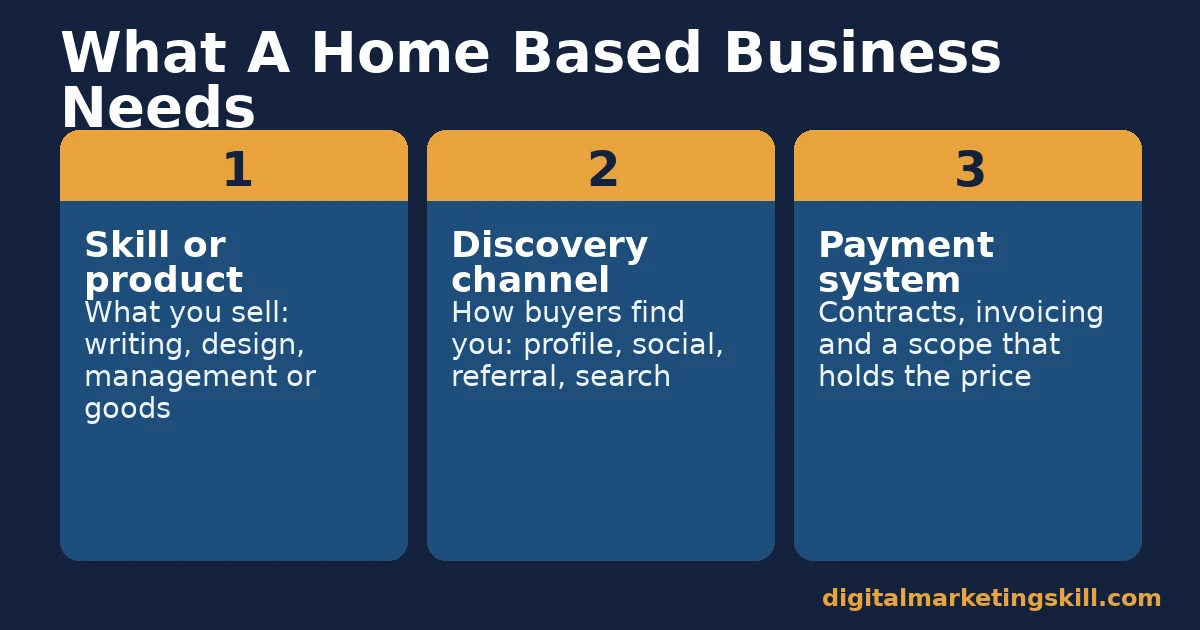
Every home based business runs on the same three parts. You need a skill or product, a way for buyers to find you, and a system for getting paid. Skip any one part and the business stalls, no matter how good the idea sounded.
First, the skill or product is what you actually sell: writing, design, marketing management, or physical goods. Next, the discovery channel is how a buyer finds you. For example, that could be a freelance marketplace profile, a social media presence, a referral network, or your own website ranking in search engines.
Finally, new founders often skip the payment system. It covers contracts and invoicing, plus currency conversion if you work across borders. For service sellers, it also means a clear scope, so a client cannot expand the job without expanding the price.
A home based business removes one classic barrier: the cost of a physical location. That barrier matters at scale too. The Census Bureau’s own nonemployer statistics count more than 30 million U.S. nonemployer businesses. That is the category almost every home based business starts in. Together they generate close to $1.8 trillion in revenue.
What Differs By Home Based Business Model
Before comparing models, it helps to name the tools almost every home based business needs, whatever the idea. A dedicated work space, even a corner of a room, keeps client calls and family noise apart.
Keeping a separate business bank account also keeps taxes simple from month one. Add a basic invoicing tool and a cloud storage folder for contracts, and the minimum kit is complete — none of it needs to cost much to start.
Not every home based business idea behaves the same way once you are running it. The three models below differ in three ways: how fast you get paid, how much you can scale, and how much specialist skill you need on day one.
Service Businesses: Built For Fast Cash Flow
Service businesses sell your time, skill or management of a task. Copywriting, graphics design, virtual assistance, social media management, email marketing, paid-ads management and SEO work all fall here. You can usually land a first paying client within weeks. The barrier to entry is a portfolio and a pitch, not inventory or capital.
However, the ceiling is lower unless you specialise. A generalist virtual assistant competes mainly on price. By contrast, a virtual assistant who only serves e-commerce founders can charge more, and so can a copywriter who only writes email sequences, because the client is paying for expertise, not just hours.
Platform data backs the scale of this model. Upwork’s investor filings report $787.8 million in full-year revenue and 785,000 active clients. Fiverr’s filings report $430.9 million in revenue with 3.1 million active buyers. Both figures are company-reported, not independently audited.
Product Businesses: Built For Scale Without Your Hours In It
Product businesses sell a physical or digital item. That includes dropshipping, a print-on-demand store, or your own e-commerce site. Once the listing, supplier and fulfilment are set up, a sale does not need your direct time the way a client call does. That is what lets this model scale past what one person can personally handle.
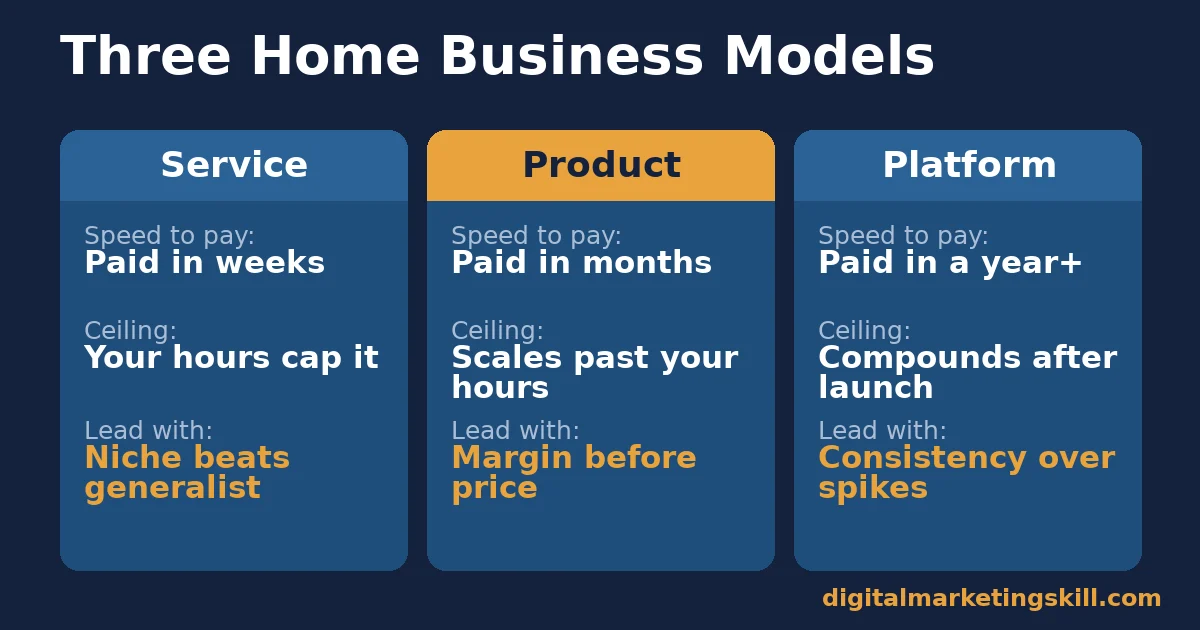
However, the trade-off is slower early cash flow and real operating risk. First you pick a niche, then you vet a supplier, then you often wait weeks to see whether a product actually sells, before any revenue arrives. Meanwhile, a bad supplier choice can damage your reputation before you even notice the pattern.
A home based product business still benefits from the model’s core advantage. The Census Bureau’s own nonemployer data shows that nonemployer businesses, as a group, generate close to $1.8 trillion in revenue. That is 6.4% of GDP, almost entirely earned without a traditional office or staff.
Platform and Content Businesses: Built For Reach Beyond One Client At A Time
This model covers podcasting, coaching, online courses and other work where you build an audience once, then sell to it again and again. That is the opposite of a service business, where each new client means starting the pitch over.
Even so, it is the slowest model to pay off, because an audience worth monetising takes months of steady output before it exists. But it is also the only model of the three where income can keep rising without you adding more billable hours, since the same episode, course or piece of content keeps earning after it is made.
Global remote-work acceptance is what makes this viable from a spare room. The Bureau of Labor Statistics recorded 24.9% of employed women teleworking in a recent month, against 20.5% of employed men. The audience for home-made content is itself increasingly working from home.
How To Lead With Each Model’s Strength
Picking a model is step one. Succeeding in it means leading with what that model is actually good at. Do not fight its natural shape.
Service Businesses: Lead With Niche Authority
First, pick one industry or one task, and say so everywhere: your profile headline, your portfolio, your outreach message. For instance, “Email marketing for online course creators” beats “digital marketer” every time a client compares five profiles, because it tells them you already understand their problem.
Price by the outcome you create, not the hours you spend. Do this once you have three or four finished projects to show. A client paying for “an email sequence that recovers abandoned carts” will pay more than one buying “ten hours of your time.” The work can be identical.
Product Businesses: Lead With Margin Discipline
Calculate your true margin before you set your price, not after. That means product cost, platform fees, shipping and returns. Dropshipping and print-on-demand sellers who skip this step often find their “profitable” product loses money. A marketplace commission and a refund can erase the profit fast.
Test a product with a small ad budget before you commit to it as your main offer. A product business built on one well-tested item usually beats a storefront with fifty untested ones. Every added listing adds support work, with no proof it will sell.
Platform And Content Businesses: Lead With Consistency Over Quality Spikes
First, publish on a fixed schedule for months before you judge whether the format works, because audience platforms reward consistency with distribution. In practice, one excellent episode surrounded by silence rarely beats a steady, merely-good weekly habit.
Build a direct line to your audience as early as possible: an email list, a community, or a course waitlist. A social media following you cannot message directly is rented attention. An email list or community you own is the asset that lets you sell to the same audience twice.
Measuring Whether Your Home Based Business Is Working
Four numbers tell you more about a home based business than “how busy do I feel.” Track them every month, from day one, even while the business is still small.
The Four Numbers To Track
- Revenue per hour worked. Divide total income by hours actually spent on the business. This tells you whether you are building a job or a business. A business’s revenue-per-hour should rise as you gain clients or sales. A job’s stays flat.
- Client or customer acquisition cost. This is what you spend, in money or time, to win one paying client or sale. If this number rises while your price does not, your channel is wearing out. You need a second one.
- Repeat-revenue share. This is the percentage of this month’s income that came from a client or customer you already had last month. A rising repeat share means the business is compounding. A flat or falling one means you start from zero every month.
- Runway. This is how many months you could cover your own expenses from savings, if the business earned nothing. Let this number guide how boldly you can try a slower model, like product or platform work, versus a faster-paying service model.
Read these four numbers together, not alone. A high revenue-per-hour with a low repeat-revenue share often means one thing. You are good at closing one-off work, but you have not yet built anything that compounds. That points you toward the niche-authority and consistency moves described above.
The One Decision Rule For Picking Your First Home Based Business
Match The Model To Your Runway
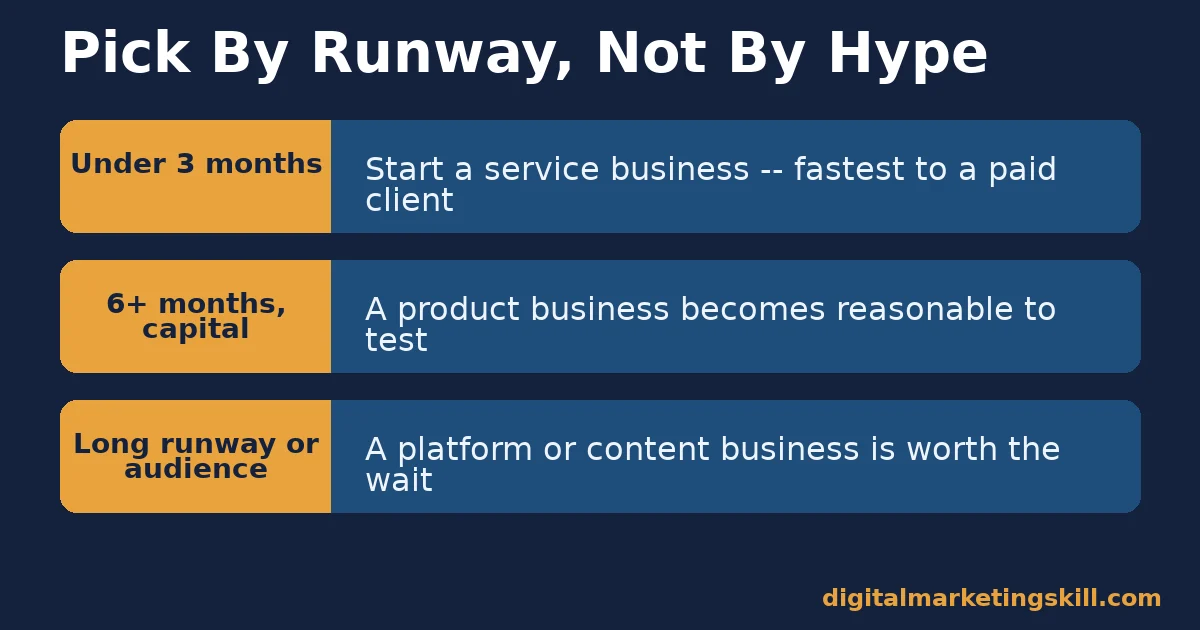
Pick the model that matches your runway. Do not pick the one with the most exciting upside. If your runway is under three months, start a service business. It is the only model of the three that can realistically produce a paid client inside thirty days.
If your runway is six months or longer, and you have some capital to test with, a product business becomes reasonable. You can absorb a slow first launch while you learn supplier and marketing fit.
If you already have an audience, or a runway long enough to build one patiently, a platform or content business is worth the wait. Its payoff compounds in a way the other two models do not.
Then Check The Model Against Your Skills
Skill fit matters as much as runway. A confident writer or organiser will find service freelancing faster to start than someone who dislikes pitching clients directly, even with the same runway. Be honest about which tasks genuinely hold your attention, because a home based business you resent doing rarely survives the slow months every model has.
Illustrative, invented numbers: picture three women, each starting with $0 in business revenue. One has a three-month runway and takes on freelance social media clients. She could realistically bill her first client inside four weeks.
Another has a year of runway and launches a niche product store. She might not see steady profit until month five or six, after dropping two products that did not sell.
A third builds a podcast audience, and she might not earn much until month eight or nine. However, by month twelve, her per-hour return can overtake both of the others, because the same back-catalogue of episodes keeps attracting new listeners without new work.
Watch For The Isolation Trade-Off
A home based business trades commuting and office politics for something else: working mostly alone. That suits many people well, but it can wear on others, especially in the service and product models where there is no team around you on a hard day.
Build in some outside contact on purpose. A weekly call with another freelancer, a local co-working morning, or an online community for your niche can replace the casual conversation an office provides, without undoing the flexibility that made a home based business appealing in the first place.
A Real Case: Turning One Freelance Skill Into Recurring Client Work
Olajire Jacob, a graduate of Digital Marketing Skill Institute’s training programme, described starting out by charging around $500 to set up email marketing automation. Clients were in the US, UK and Canada. Over time, by adding more automation and strategy services for the same type of client, that work grew into roughly $5,000 a month in recurring revenue. This is described on the Institute’s own reviews page.
The limits of this case are real. It is one self-reported account, published by the training provider itself, not an independent audit. Results like this are not typical or guaranteed. Income depends on the niche, the client’s budget, local competition and the time a person can commit. See DMSI’s own earnings disclaimer before you treat any single story as your own benchmark.
What the case does show, reliably, is the pattern behind the “lead with niche authority” rule above. The jump in income came from doing more of the same specific service, for the same type of client. It did not come from switching ideas.
Frequently Asked Questions About Home Based Business
What is the easiest home based business to start with no money?
Service-based freelancing is the easiest home based business to start with no money, because it needs a skill and an internet connection, not inventory or ad budget. For example, writing, virtual assistance, social media management and basic graphic design are common starting points, and most begin on a freelance marketplace profile.
How much can a home based business realistically earn?
Earnings vary a lot by model, niche, hours and market. No single figure applies to every home based business. Track your own revenue-per-hour from month one. That gives you a real baseline, instead of someone else’s best-case story.
Do I need a business licence to run a home based business?
Requirements differ by country, state or city, and they also depend on whether you sell products, services or both. So check your own local government’s small-business guidance before you trade. Generally, simple freelance service work needs minimal registration, while reselling products or hiring staff usually triggers more formal rules.
Which home based business scales the best?
Product, platform and content businesses scale further than pure service work, because income is not capped by the hours one person can personally bill. However, they typically take longer to reach steady profit, so the “best” model depends on your runway, not on scale alone.
Can a home based business replace a full-time salary?
It can. Freelance-platform and small-business revenue data show the model is large enough to support full-time income for many of the people running it. Replacing a salary reliably takes specialisation, a repeat-client base, and steady tracking of the numbers in the measurement section above. It rarely happens by luck alone.
Is dropshipping still a viable home based business?
Dropshipping is still viable as one version of the product-business model, although margins are thinner than they once were, because more sellers now compete in the same supplier catalogues. So it works best as a cheap way to test product-market fit — treat it as a test, not a guaranteed path to passive income.
How many hours a week does a home based business need?
Most service businesses need at least ten to fifteen focused hours a week to land and keep a first client, though the exact number depends on your niche and pricing. Product and platform businesses often need less weekly time once set up, but more upfront hours while you build the store, supplier relationships or content library.
Your Next Step Toward A Home Based Business
Whichever model fits your runway, the skills behind all three are the same. Client acquisition, content, email, paid ads, search visibility, and the WordPress or e-commerce platforms that host it all. Digital Marketing Skill Institute teaches these across its Master Diploma in Digital & AI Marketing.
The programme runs four AI-powered tracks: AI-Powered Social Media Management and Advertising, AI-Powered Lead Generation and Email Automation, AI-Powered Google Specialist, and AI-Powered WordPress and SEO Specialist. In addition, a Full Stack option covers all four.
Every track includes unlimited one-on-one coaching and mentoring, plus a U.S. Project Internship that leads to a verified U.S. Work Reference Letter. That, in turn, is useful proof of experience when you pitch your first home based business clients.
The diploma is dual accredited and recognised in more than 100 countries. The whole programme runs 100% online. You can study and build your home based business from anywhere in your country.
Learn more at digitalmarketingskill.com, see the full structure on the Master Diploma programme page, or browse more guides on the blog. When you are ready, you can apply here — wherever you live, the application process is the same. You can also simply visit https://digitalmarketingskill.com/ and explore the curriculum yourself.
Every figure in this guide was checked against its original source before publication. Figures marked as illustrative are invented examples, not real results.
![9 Amazing Digital Marketing Skills to Make Money Online [With Proof]](https://digitalmarketingskill.com/wp-content/uploads/2019/07/9-Amazing-Digital-Marketing-Skills-to-Make-Money-Online-With-Proof-17.png)






