An inbound marketing strategy attracts potential customers with useful content, then converts and nurtures them into buyers instead of interrupting people with outbound ads. It uses content, a fast website, landing pages, email and social media, and each channel suits a different stage. This guide shows what the evidence says works best at each stage, and how to measure it.
Key Takeaways
- Content and search win trust first. HubSpot’s global survey of more than 3,400 marketers rated website, blog and SEO content the highest-ROI channel at 27%, ahead of paid social at 26% and email at 22%.
- Most inbound marketing strategies fail on planning, not effort. Content Marketing Institute’s survey of B2B marketers found 42% blame unclear goals, and 39% blame content that does not match the buyer’s journey.
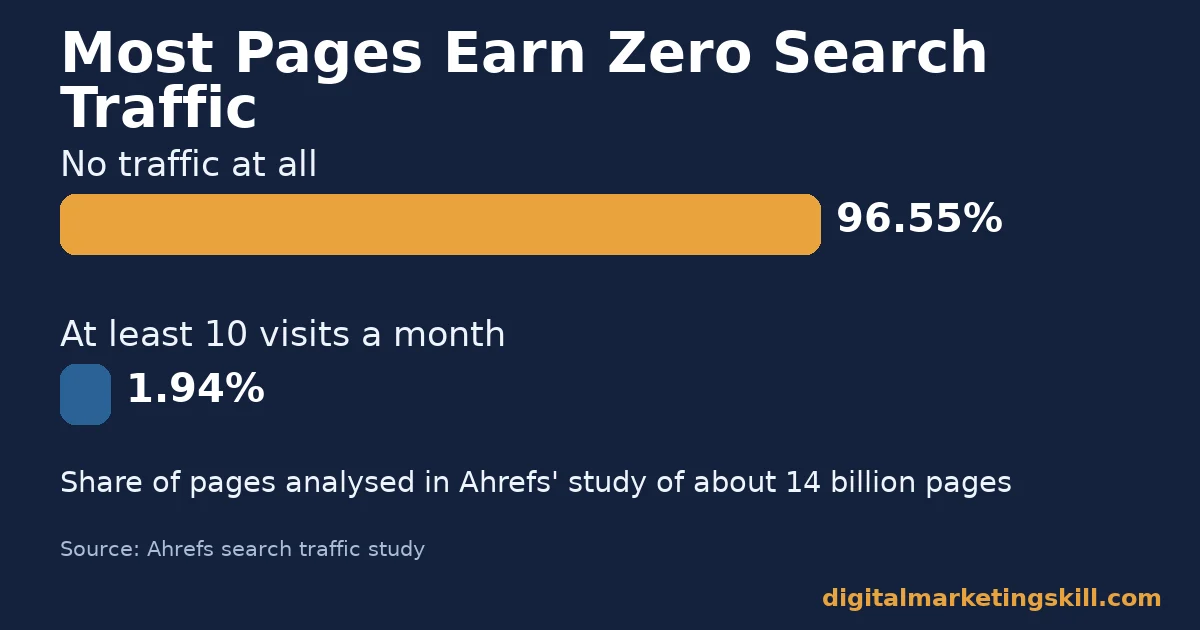
- Being found is the hard part. Ahrefs analysed about 14 billion pages and found 96.55% earn no traffic from Google.
- Shorter forms convert more leads. A HubSpot analysis of more than 40,000 landing pages, summarised by Cobloom, found conversion rate drops as a form asks for more fields.
- Email keeps leads moving cheaply. Mailchimp’s benchmark puts the average email click rate at 2.62% across its customer base.
In this guide
- What Most Inbound Marketing Strategy Advice Skips
- How an Inbound Marketing Strategy Moves a Stranger to a Buyer
- What Differs by Channel in an Inbound Marketing Strategy
- How to Lead With Each Channel in Your Inbound Marketing Strategy
- How to Measure an Inbound Marketing Strategy
- The Decision Rule: Fund the Weakest Stage, Not the Favourite Channel
- A Real Case: A Headline Rewrite That Changed Conversion, Not Traffic
- Frequently Asked Questions About Inbound Marketing Strategy
- Start by Diagnosing Your Weakest Stage
What Most Inbound Marketing Strategy Advice Skips
Most guides explain the funnel well: attract, convert, close, delight. Few compare the channels inside it. They give content, SEO, email and social equal weight. The evidence shows they do not perform equally at every stage.
This guide ranks each channel by the job it is actually good at. Treat every figure here as a snapshot from the organisation that published it, not a permanent ranking, because channel performance shifts as platforms and search algorithms change.
Two ground rules first. HubSpot and Content Marketing Institute collect self-reported answers from the marketers they survey, so read those figures as sentiment plus outcome, not independent proof. Ahrefs and the landing page studies measure real pages instead. That gives a stronger read on what visitors and search engines actually do.
None of this means self-reported data is useless. It still shows what marketers believe is working and why a strategy stalls, which is valuable context before you look at the harder page-level numbers. Use both kinds of evidence together: sentiment data to understand intent, and page data to confirm what actually happened.
How an Inbound Marketing Strategy Moves a Stranger to a Buyer
An inbound marketing strategy runs through four stages. You attract a stranger with content or search visibility. You convert that visitor into a lead with an offer. Sales closes the lead into a customer. Then you delight the customer so they return or refer others. Each stage needs a different channel doing a different job.
The attract stage depends on being discoverable, not just visible. Ahrefs studied roughly 14 billion pages and found that 96.55% receive no traffic from Google at all, and only 1.94% reach even ten visits a month. Publishing content is not the same as attracting anyone.
The convert stage depends on the offer and the form, not the traffic volume. A visitor who arrives interested but meets a long form, a vague call to action or a slow page leaves without becoming a lead. That wastes everything the attract stage just earned.
Why Each Stage Rewards a Different Channel
Content and search earn attention because they answer a question someone already has. That makes them strongest at the attract stage. Landing pages and forms earn commitment, because that is where a visitor hands over their contact details. Email and retargeting earn the close and delight stages, because the person already knows your brand.
Mixing these up causes the most common mistake in an inbound marketing strategy. Teams judge a landing page by how much traffic it pulls in. Or they judge a blog post by how many leads it converts directly. Each channel was built for a different stage of the same journey.
What Differs by Channel in an Inbound Marketing Strategy
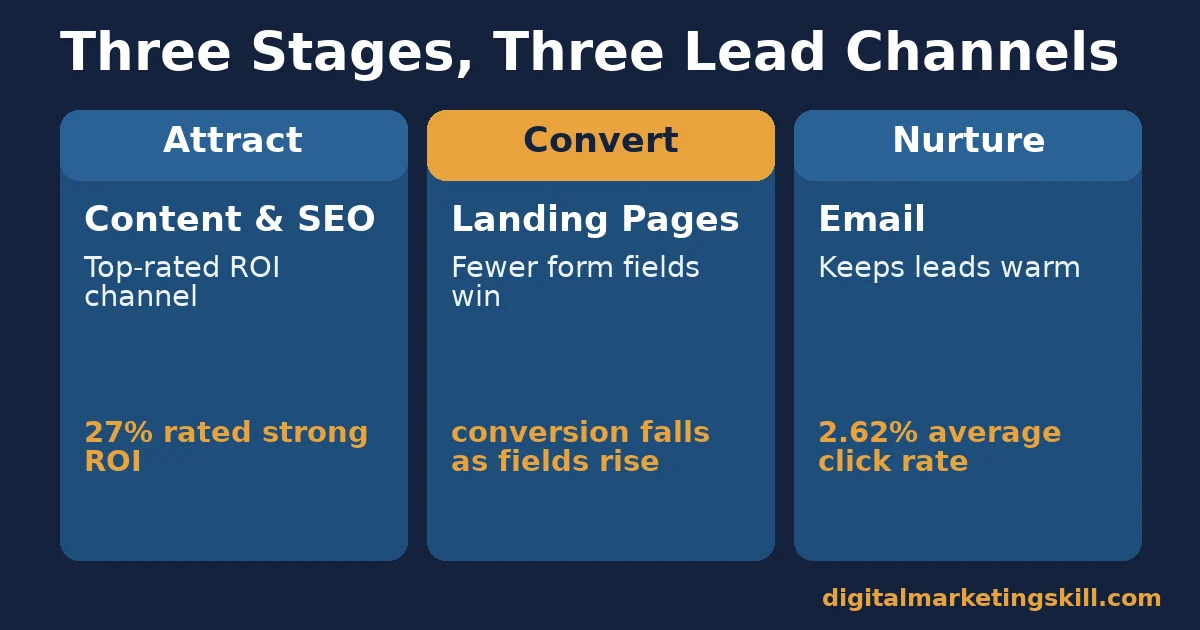
Five channels carry most inbound marketing strategy work: content marketing, your website and SEO, landing pages, social media and email. The sections below pair what each channel does well with what to actually do about it.
Content Marketing: Built to Earn Trust Before a Sale
Content marketing answers a question a prospect already has, before they are ready to talk to sales. Content Marketing Institute’s survey found 42% of B2B marketers blame unclear goals for weak content marketing results, and 39% blame content that does not match where the buyer actually stands in their journey.
That gap matters for an inbound marketing strategy. Content written for the wrong stage attracts the wrong kind of attention. A detailed comparison guide suits someone close to buying. A plain explainer suits someone who just discovered the problem.
Website and SEO: Built to Be Found at the Moment of Need
Your website and its search visibility exist to be found the moment someone searches for a solution. HubSpot’s global State of Marketing survey asked more than 3,400 marketers to rate channel ROI, and website, blog and SEO content topped the list at 27%, ahead of paid social at 26% and email at 22%.
SEO only pays off when content matches real search demand. Ahrefs’ study of about 14 billion pages found that most earn no search traffic at all. That usually means the topic missed what people actually type into Google, not that the writing was weak.
Landing Pages: Built to Turn Interest Into a Lead
A landing page has one job. It turns an interested visitor into a lead by trading something useful for their contact details. Judge it by conversion rate, not by the traffic it attracts on its own.
Two things most often break that conversion. HubSpot’s analysis of more than 40,000 customer landing pages, summarised by Cobloom, found conversion rate falls as a form asks for more fields, so every extra field carries a cost. Separately, Unbounce analysed roughly 35,000 landing pages and found that adding video rarely lifts conversion, and can slightly reduce it on pages built around one call to action.
A landing page can also recover visitors who almost converted and did not. A published case study from OptinMonster describes a hotel booking site that used an exit-intent popup, shown only when a visitor was about to leave a half-finished booking. It recovered 53% of those abandoning visitors.
Treat that figure as one vendor-published company’s result rather than a typical rate. The mechanism still generalises: catching interest at the moment it is about to leave is cheaper than attracting a fresh visitor.
Social Media: Built to Distribute, Not to Close
Social media distributes content and starts conversations; it rarely closes a sale directly. Inside an inbound marketing strategy, its job is to carry attention somewhere else. It moves people from where they already spend time back to a landing page or article.
HubSpot’s survey rated paid social a close second to website and SEO content, at 26% among marketers who called it a strong-ROI channel. That places social just behind owned content, which fits its role as a distribution channel rather than the final conversion step.
Email Marketing: Built to Keep a Warm Lead Moving
Email keeps a lead moving after it has already converted once. It uses the trust of an opt-in relationship rather than cold outreach. Mailchimp’s benchmark report, covering its own customer base, puts the average click rate across all industries at 2.62%. Open rates are increasingly distorted by privacy features that pre-load images before anyone reads a message.
Use that 2.62% figure as a floor to compare against, not a target to chase blindly. A sequence that beats your own past average is doing its job inside an inbound marketing strategy, whatever another company’s industry average says.
How to Lead With Each Channel in Your Inbound Marketing Strategy
Knowing what a channel does well is only half the job. These five sections mirror the channels above and turn each one into a specific first move.
Content Marketing: Lead With the Buyer’s Real Question
Start every piece of content with the exact question a buyer at that stage is asking. Do not start with the feature you want to promote. Map each piece to attract, convert or close, since Content Marketing Institute’s data points to journey misalignment as a top reported cause of weak results.
Write the plain answer in the opening two sentences. Then support it with specific numbers and named sources. A vague introduction loses the search-intent match that made the content worth publishing in the first place.
Website and SEO: Lead With the Search Term, Not the Brand Name
Choose topics by the exact words people search, not the words your team prefers internally. Ahrefs found that the vast majority of pages get no search traffic, so the fastest fix for an inbound marketing strategy is usually matching proven search demand rather than inventing a new topic.
Once a page earns traffic, keep the page itself fast and easy to scan. A slow or cluttered page loses the visitor the SEO work just earned. Our guide on optimising a blog post for search engines covers the technical side in more depth.
Landing Pages: Lead With the Shortest Form That Still Qualifies the Lead
Cut every form field that is not required to follow up or qualify the lead. HubSpot’s landing-page analysis found conversion rate drops as fields increase, so each extra field needs to earn its place by improving who you can act on, not just who you can count.
Skip adding video to a landing page by default. Unbounce’s study found it rarely helps conversion, so spend that production time on a clearer headline and one specific call to action instead.
Social Media: Lead With a Promise the Linked Page Keeps
Write the social post to promise exactly what the linked content delivers, nothing more. A post that oversells sends visitors to a page that cannot match the promise. That wastes the reach social media is good at.
Post consistently rather than in bursts. Social’s role in an inbound marketing strategy is steady distribution, not a one-time spike. Track which posts actually drive visits to a landing page, not just likes or comments. Our guide to social media marketing principles covers how to build that consistency.
Email Marketing: Lead With a Trigger, Not a Calendar
Send the first email the moment someone converts on a landing page, while their interest peaks, instead of waiting for your usual send day. A triggered welcome message typically earns more attention than a generic newsletter slot.
Judge each sequence against your own past click rate rather than Mailchimp’s 2.62% industry figure, since your own list is the only fair comparison for a strategy already in motion. Our guide to improving email marketing results walks through the setup step by step.
How to Measure an Inbound Marketing Strategy
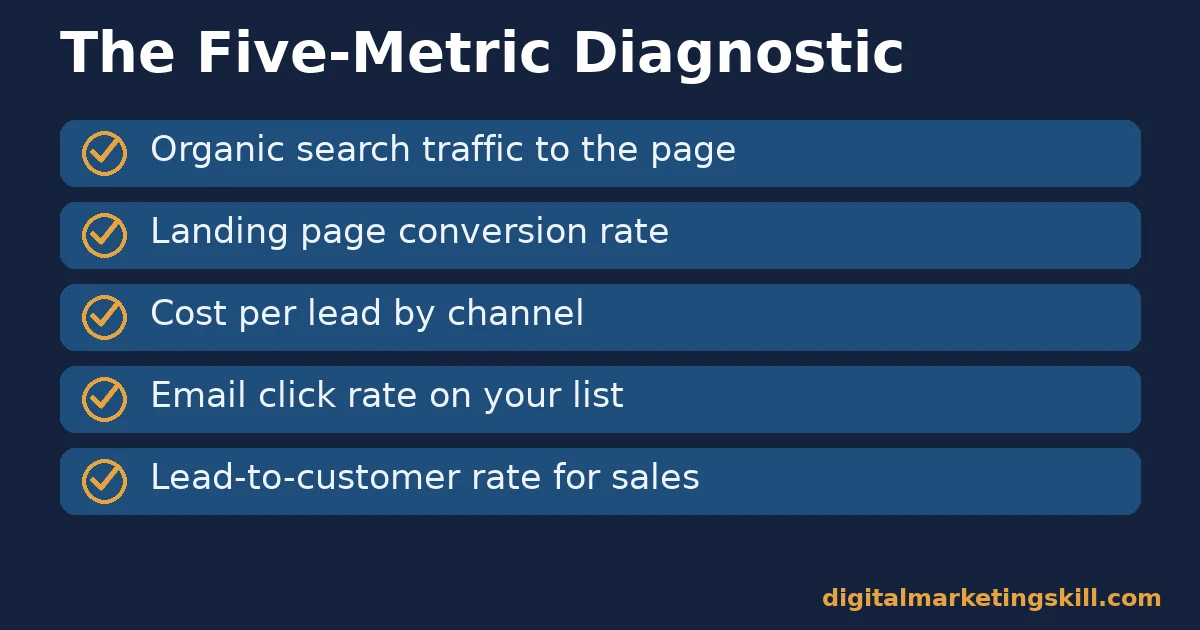
Measuring an inbound marketing strategy means tracking one metric per stage. That way you can tell which stage is actually broken, instead of guessing. Each metric below is defined in one sentence, with a note on how to read it.
Five Metrics That Show Where the Strategy Is Working
- Organic search traffic. Visits a page earns from unpaid search results. Ahrefs found most pages earn none, so steady organic traffic already signals that the topic matched real demand.
- Landing page conversion rate. The share of visitors who complete the form. Track it against your own past pages first, since the HubSpot form-field data shows this number is sensitive to form length.
- Cost per lead. Total spend on a channel divided by the leads it produced. This compares content, social and paid channels on the same basis instead of comparing raw traffic.
- Email click rate. The share of a list that clicks through to your site. Mailchimp’s 2.62% all-industry average is a rough external benchmark; your own history is the better one.
- Lead-to-customer rate. The share of leads a sales team actually closes. This number tells you whether the leads are the right kind, not just a large number.
Reading These Metrics Together
Read the five metrics in order, because each one points to a different stage. Low organic traffic means the attract stage needs better topic selection. Healthy traffic with weak conversion means the landing page or offer is the problem. Good conversion with a low lead-to-customer rate usually means the leads were never qualified in the first place.
Review these numbers monthly rather than daily. Search and email metrics are naturally noisy week to week. A trend across a full month gives a far more reliable signal than any single day’s number.
The Decision Rule: Fund the Weakest Stage, Not the Favourite Channel
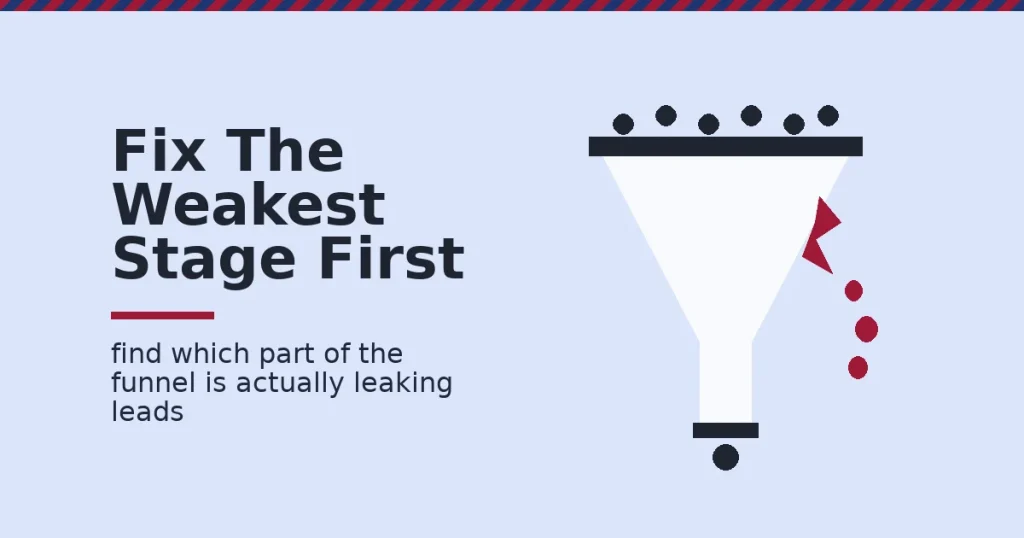
If you remember one rule from this guide, make it this one. Put your next hour or budget increase into whichever stage of the funnel is weakest right now. Do not put it into the channel your team enjoys working on most.
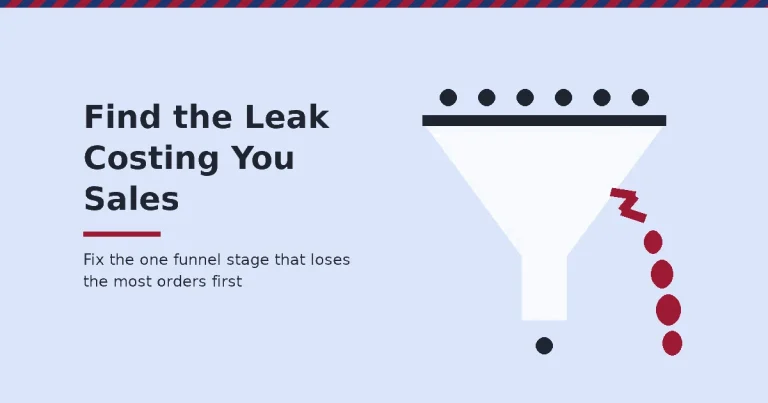
Here is an illustrative example, with invented numbers. A small services company gets 4,000 organic visits a month but only a 1% landing page conversion rate, producing 40 leads. Instead of writing more content, the team shortens its main offer form from seven fields to three. Conversion rate rises to 2.4%, producing 96 leads from the same traffic, without a single new piece of content.
The lesson generalises beyond this example. More traffic cannot fix a broken conversion stage, and a perfect landing page cannot fix a topic nobody searches for. Diagnose the weak stage with the metrics above before adding more of what you already have.
A Real Case: A Headline Rewrite That Changed Conversion, Not Traffic
Imsider, an online store builder, tested a single change to its landing page headline through a case study published by the testing platform Wingify. The original headline read like a feature description. The new version named the specific outcome a visitor would get.
Wingify’s case study reports that changing the headline to “Open your internet store in one evening” raised form submissions by 10%, a result the platform calls statistically significant. Traffic to the page did not change; only its ability to convert that traffic did.
Treat the exact 10% figure as one vendor-published company’s result, not a universal rate. The broader point still holds inside any inbound marketing strategy: a clearer, more specific promise on a page that already receives visitors often beats sending it more traffic.
Frequently Asked Questions About Inbound Marketing Strategy
What is an inbound marketing strategy in simple terms?
It is a plan to attract people with useful content and search visibility, convert their interest into a lead through an offer, and nurture that lead toward a sale. It replaces interrupting strangers with outbound ads.
What is the best channel for an inbound marketing strategy?
There is no single best channel, because each one suits a different stage. HubSpot’s global survey rated website, blog and SEO content the highest-ROI channel overall, but landing pages and email still handle the convert and nurture stages better.
How long does an inbound marketing strategy take to work?
Search-driven content usually takes months to earn steady traffic, since search engines need time to index and rank a page. Landing page and email changes can show results within weeks, because they affect visitors you already have.
Do I need a large budget to start an inbound marketing strategy?
No. The decision rule in this guide, fixing the weakest stage first, often costs nothing more than rewriting a headline or shortening a form. That is cheaper than producing new content or buying more traffic.
How do I know which stage of my inbound marketing strategy is broken?
Check the five metrics in this guide in order: organic traffic, landing page conversion, cost per lead, email click rate and lead-to-customer rate. The first weak number in that order usually points to the stage to fix.
Is social media part of an inbound marketing strategy?
Yes, but as distribution rather than conversion. Its job is to carry attention from where people already spend time toward a landing page or piece of content. It does not close the sale directly.
Should every landing page use a short form?
Shorter forms generally convert more visitors into leads, based on HubSpot’s analysis of tens of thousands of landing pages. But a short form that fails to qualify the lead can create contacts your sales team cannot use. Balance field count against what your team actually needs to follow up.
Can a small team run a full inbound marketing strategy?
Yes, but not all five channels at once. Start with the one or two stages your own numbers show are weakest, since the decision rule in this guide works at any budget. A small team that fixes one stage well usually beats a large team spreading thin effort across all five.
Start by Diagnosing Your Weakest Stage
An inbound marketing strategy works when each channel does the job it is actually built for, measured stage by stage rather than judged by overall traffic. Pick the metric in this guide that looks weakest. Fix that one stage, then measure it again before changing anything else. Our guide to content marketing challenges and how to fix each one uses the same diagnose-first approach across a whole content programme.
If you want guided practice building and measuring a strategy like this, Digital Marketing Skill Institute teaches these skills hands-on. The Master Diploma in Digital & AI Marketing covers practical courses in AI-powered SEO and content marketing, lead generation and email automation, and AI-powered Google Analytics.
It comes with unlimited 1-on-1 coaching and mentoring. You also get real project work inside a U.S. partner company, and the diploma is dual US and UK accredited and recognised in more than 100 countries.
The programme is fully online, so you can study and apply it from anywhere in your country. Browse more guides on the Digital Marketing Skill Institute blog, read student reviews, and when you are ready, apply for the Master Diploma or start from the Digital Marketing Skill Institute homepage.
Every figure in this guide was checked against its original source before publication. Figures marked as illustrative are invented examples, not real results.
![9 Amazing Digital Marketing Skills to Make Money Online [With Proof]](https://digitalmarketingskill.com/wp-content/uploads/2019/07/9-Amazing-Digital-Marketing-Skills-to-Make-Money-Online-With-Proof-17.png)