
Content marketing ROI is the revenue a piece of content generates, measured against what it cost to make and promote. Most teams never get a real answer. They measure traffic and shares instead. This guide shows how to measure content marketing ROI properly. It also covers the attribution trap that makes the number look better than it is.
Key Takeaways
- Measuring ROI is marketing’s top obstacle. HubSpot’s State of Marketing survey asked 1,500-plus marketers about their biggest challenges. Proving marketing ROI came first. 73% also say budget now faces more scrutiny.
- Attribution can lie by a huge margin. A large field experiment on eBay, published through the NBER, compared a naive before-after estimate against a true controlled experiment. The naive method showed over 4,100% ROI. The real, experimental ROI was negative 63%.
- Last-click is the default, and it is biased. Google Analytics defines last-click attribution as giving 100% of the credit to the final channel a customer clicked before converting, which systematically undercounts content read earlier in the journey.
- Data-driven models exist for a reason. Google Analytics’ data-driven attribution uses machine learning to study converting and non-converting paths, splitting credit across touchpoints instead of handing it all to the last click.
- Not every ROI challenge is measurement. A Content Marketing Institute survey found 40% of B2B marketers cite prompting action as their top content challenge, ahead of the 33% who cite measurement itself.
In this guide
- What Most Content Marketing ROI Advice Misses
- How Content Marketing ROI Actually Gets Calculated
- Three Ways Teams Estimate Content Marketing ROI
- How to Lead With Each Measurement Approach
- A Worked Example of the Same Journey, Measured Three Ways
- Five Mistakes That Inflate Content Marketing ROI
- How to Measure Content Marketing ROI in Practice
- The Content Marketing ROI Rule: Trust Trends, Distrust Precision
- A One-Week Plan to Set Up Real Measurement
- You Do Not Need Expensive Tools to Start
- A Real Case: What a True Experiment Revealed About Attribution
- Frequently Asked Questions About Content Marketing ROI
- Measure the Trend, Not Just the Number
What Most Content Marketing ROI Advice Misses
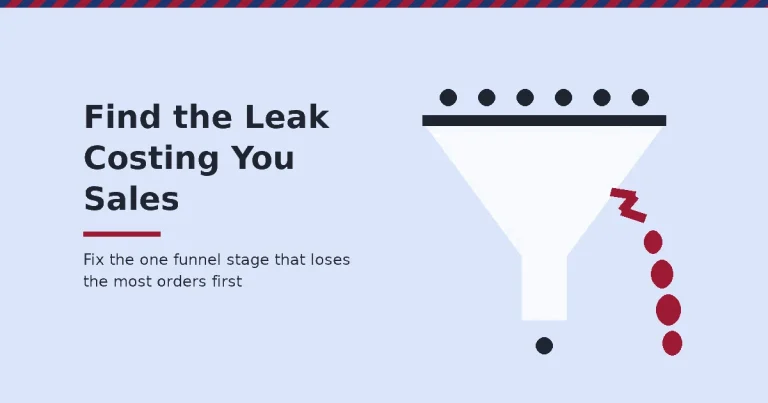
Most advice on content marketing ROI stops at traffic and shares. Those numbers are easy to pull from any dashboard. But neither one tells you whether content actually produced revenue, which is the only number a budget conversation really needs.
This guide covers three ways teams estimate content’s real contribution to revenue. It names the mistakes that inflate the number, and the one honest limit every content marketing ROI figure carries. It also covers what to measure instead, when a precise dollar figure is not possible.
A few ground rules first. The eBay experiment below studied paid search, not content marketing. We use it as a warning about attribution, not a content marketing statistic itself. The HubSpot and Content Marketing Institute figures come from vendor-run surveys. Read them as directional, not exact industry truth.
How Content Marketing ROI Actually Gets Calculated
Content marketing ROI has two sides: cost and return. Cost includes writer or agency fees, design, promotion spend and the time of whoever manages the content. Most teams track this side reasonably well.
Return is where the real work happens. It is not just the revenue from one sale. It is the share of that revenue that content fairly earned, compared against every other channel the buyer touched along the way.
The return side is harder. A single piece of content rarely closes a sale by itself. A prospect might read a guide, see three emails, click a retargeting ad, then convert weeks later. The question is how much of that final sale belongs to the guide.
This is where attribution models matter. Google Analytics defines last-click attribution simply. It gives 100% of the credit to the last channel a customer clicked before buying. That is easy to calculate. But it erases every piece of content a prospect saw earlier in their journey.
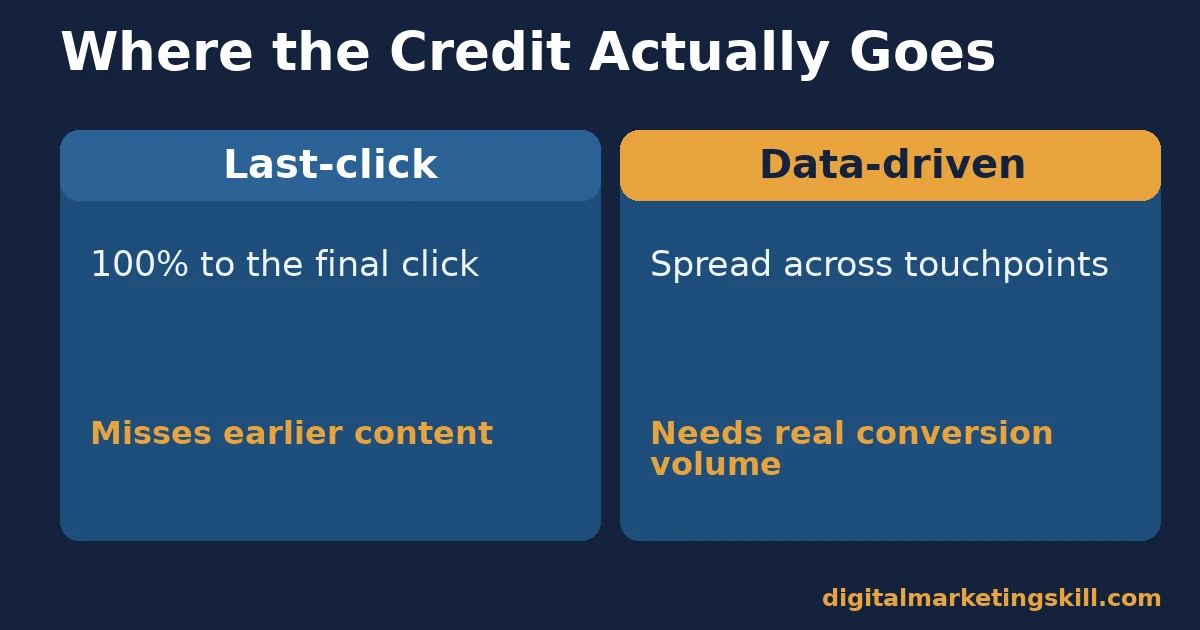
Data-driven attribution tries to fix that gap. It uses machine learning to study both converting and non-converting paths. Then it splits credit across touchpoints based on their actual contribution. The method is more honest. But it needs enough conversion volume to work, which rules it out for smaller sites.
Three Ways Teams Estimate Content Marketing ROI
No single method gives a perfect number. Each approach below trades some accuracy for practicality. Pick the one that matches your traffic volume and tools.
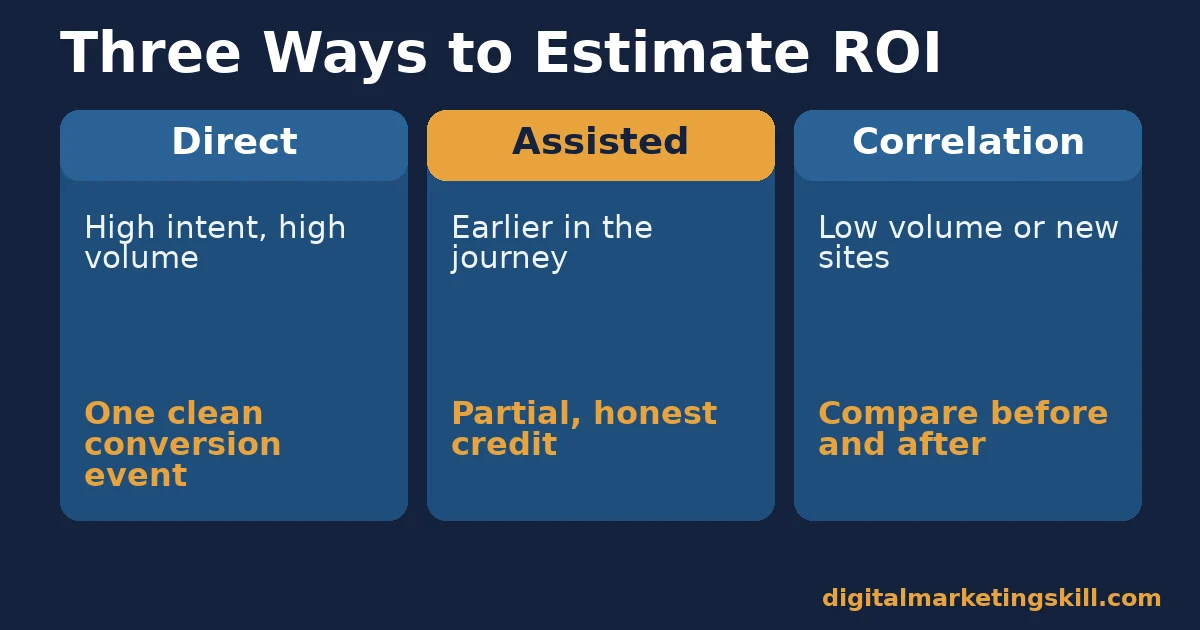
Direct Attribution: Built for High-Volume, High-Intent Content
Direct attribution tracks one specific action tied to one piece of content, like a demo request from a landing page. It works best close to a purchase decision. You also need enough traffic to trust the numbers.
Assisted Conversions: Built for Content Earlier in the Journey
Assisted conversion reports count a touchpoint that appeared in a conversion path, without being the final click. This credits awareness and consideration content for the role it played, even when a different channel closed the sale.
Most analytics platforms already track this, often under a name like “assisted conversions” or “top conversion paths.” It requires no extra setup, which makes it the easiest upgrade for a team that still relies on last-click alone.
Correlation Estimates: Built for When Attribution Is Not Possible
Sometimes conversion volume is too low to trust any attribution model. Compare periods instead. Did revenue, branded search or sales calls rise after a content push, compared with a similar period before it? This is weaker evidence. But it beats no evidence at all.
How to Lead With Each Measurement Approach
Each approach needs a different setup before it produces a trustworthy number. The sections below mirror the three approaches above.
Direct Attribution: Lead With a Single, Clean Conversion Event
Pick one clear action, a form fill, a demo booking, a purchase, and track it consistently for every piece of content. Mixing several conversion definitions across different pieces makes the resulting content marketing ROI figures impossible to compare.
Assisted Conversions: Lead With a Realistic Credit Split
Do not claim full credit for an assisted touchpoint. Report it alongside the channel that closed the sale, and treat the split as directional. The point is showing that content played a role, not claiming it alone caused the sale.
Correlation Estimates: Lead With a Clearly Labelled Estimate
Say plainly that the number is a correlation, not proof of cause. Compare it against a control period, or a similar segment that did not get the content push. That gives the estimate at least some basis for comparison.
A Worked Example of the Same Journey, Measured Three Ways
Here is an illustrative example, with invented numbers, showing how the three approaches above can disagree on the same customer journey.
A prospect reads a buyer’s guide, clicks a retargeting ad two weeks later, then signs up after a sales call. Using direct, last-click attribution, the sales call or the ad gets 100% of the credit. The guide gets nothing.
Using assisted conversions, the guide shows up as a touchpoint earlier in the path. It gets partial credit, even though it did not close the deal. Using correlation estimates, the team instead compares a month with the guide live against a similar month without it, and sees a modest lift in sign-ups overall.
None of the three numbers is wrong. Each measures a different slice of the truth. Reporting all three together, rather than picking the one that looks best, gives a much more honest picture of content marketing ROI.
This also protects you from a common trap. Picking whichever model makes a campaign look strongest, after the fact, is a form of the same attribution error the eBay experiment exposed. Decide your method before you see the results, not after.
Five Mistakes That Inflate Content Marketing ROI
Most inflated content marketing ROI numbers share the same handful of causes. Check your own reporting against this list before presenting a number to anyone else.
- Counting traffic or shares as the return. Neither one is revenue. A viral post with no conversions produced a content marketing ROI of zero, no matter how many people saw it.
- Using last-click attribution for every report. Last-click erases the influence of content that appeared earlier in the journey, understating its true contribution.
- Ignoring the cost side entirely. A piece that generates revenue but cost far more to produce and promote than it returned is not a success, even if the raw revenue number looks good.
- Measuring too short a window. Content, especially evergreen guides, keeps earning long after publication. A 30-day window understates its real lifetime return.
- Comparing content unfairly against paid channels. Paid channels show results fast and stop the moment you stop paying. Content compounds slowly. Judge each against its own typical payback period, not the other’s.
- Trusting one attribution model completely. Last-click, assisted conversions and correlation estimates each tell a partial story. Treating any one of them as the final word hides the parts of the picture the other two would have shown.
How to Measure Content Marketing ROI in Practice
Measure content marketing ROI with a small set of consistent metrics, not a single magic number. Each one below is defined in one sentence, with a note on how to read it.
Four Metrics That Build a Real ROI Picture
- Cost per piece. Total cost, writing, design, promotion, divided by the number of pieces published. Use this as the denominator in every ROI calculation you run.
- Assisted conversions. The number of conversions where a piece of content appeared in the path without being the final click. This captures influence that last-click attribution misses.
- Content-influenced revenue. Revenue from deals where a prospect engaged with content at any point before buying. Report it as influenced, not caused, since other channels played a role too.
- Payback period. How long it takes a piece of content’s attributed revenue to exceed its production and promotion cost. Evergreen guides often have a longer but more durable payback period than a one-off campaign asset.
How to Read These Numbers Together
Read the four metrics as a set, not in isolation. A low cost per piece with strong assisted conversions suggests an efficient content programme, even if direct attribution looks weak.
A long payback period is not automatically bad. Compare it against the content’s expected lifespan. A guide that keeps ranking for years can carry a longer payback period than a paid campaign and still be the better investment.
Watch the direction of each metric over time, not just its current value. Rising assisted conversions alongside a falling cost per piece is a strong sign your content marketing ROI is genuinely improving, even before a precise dollar figure is possible.
The Content Marketing ROI Rule: Trust Trends, Distrust Precision
If you take one decision rule from this guide, make it this one. Treat any single-point content marketing ROI figure with suspicion, and trust the direction of change over several months instead.
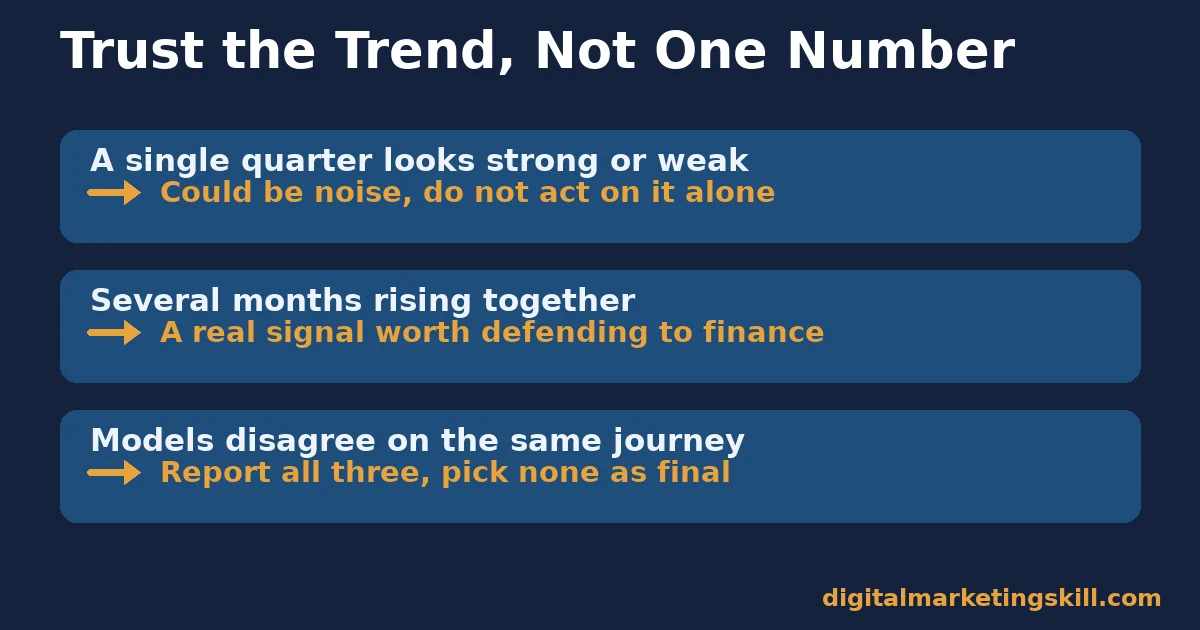
Here is an illustrative example, with invented numbers. A team reports content marketing ROI of 340% for one quarter using last-click attribution. Taken alone, that number invites either celebration or a budget cut if it drops.
Instead, the team tracks assisted conversions and content-influenced revenue over four consecutive quarters. The trend rises steadily even though the single-quarter last-click number swings widely. The trend, not the single figure, is what the team uses to defend the budget.
This also changes the conversation with finance. A rising trend across several quarters is a far stronger argument than any single quarter’s number, precise or not, because it is far harder to dismiss as noise or lucky timing.
A One-Week Plan to Set Up Real Measurement
You do not need an enterprise analytics stack to start measuring content marketing ROI honestly. Spend about an hour a day for one week.
- Day one: pick one conversion action. Choose the single action that matters most, a form fill, a demo request or a purchase. Confirm it is tracked consistently in your analytics tool.
- Day two: turn on assisted conversion reporting. Most analytics platforms already support this. Check which content shows up as a touchpoint, even when it did not get the final click.
- Day three: calculate cost per piece. Add up writing, design and promotion cost for your last ten pieces of content. Divide by ten.
- Day four: set a measurement window. Decide how long you will wait before judging a piece, based on your typical sales cycle, not an arbitrary 30 days.
- Day five: build a simple tracking sheet. List each piece of content with its cost, assisted conversions and content-influenced revenue in one place.
- Day six: set a correlation baseline. For content you cannot directly attribute, note current revenue or branded search volume. That gives you something to compare against later.
- Day seven: share the trend, not a single number. Present the last few months of data together, rather than one isolated figure from a single report.
You Do Not Need Expensive Tools to Start
Good content marketing ROI measurement does not require an enterprise martech stack. A free analytics tool, a spreadsheet and a consistent process get most teams most of the way there.
Spend your limited time setting up consistent tracking, not chasing a perfect attribution model. A simple, consistently applied method beats an advanced model nobody trusts, because the inputs are messy.
If you outsource any part of this, outsource the analytics setup rather than the writing. A freelance analyst can configure assisted-conversion tracking properly in a few hours, something most content teams would otherwise spend weeks figuring out on their own.
A Real Case: What a True Experiment Revealed About Attribution
Researchers Blake, Nosko and Tadelis ran a large field experiment on eBay. It was published through the National Bureau of Economic Research, and summarised by the Chicago Booth Review. eBay turned off its paid search ads for a random 30% of US markets, for 60 days. Then it compared sales against the markets where ads kept running.
A naive before-after comparison, the kind of simple math many attribution reports still use, suggested paid search returned well over 4,100% ROI. The real, controlled experiment found something very different: a true effect of negative 63%. Properly measured against a control group, the ads were likely losing money.
This case studied paid search, not content marketing. It also involved a very large company, with enough traffic to run a rigorous experiment. Few content teams can copy that at this scale. But the lesson still transfers. A number that looks strong under naive attribution can collapse under a real test. Treat every unverified content marketing ROI figure with the same caution.
Frequently Asked Questions About Content Marketing ROI
What is a good content marketing ROI?
There is no universal good figure, because cost structures and sales cycles vary enormously between businesses. Compare your own content’s ROI trend over time, and against your other marketing channels, rather than chasing an industry benchmark.
Why does content marketing ROI look different depending on the attribution model?
Because each model assigns credit differently. Last-click gives all the credit to the final touchpoint, while data-driven and assisted-conversion models spread credit across the whole journey, which usually raises content’s apparent contribution.
How long should I wait before measuring a piece of content’s ROI?
Longer than most teams assume, especially for evergreen content that keeps ranking and converting for years. Measure an initial window for early signal, then revisit the same piece’s attributed revenue again after six to twelve months.
Can a small business measure content marketing ROI without expensive tools?
Yes, using free tools like Google Analytics for assisted conversions and a simple spreadsheet for cost per piece. Precision will be lower than a large enterprise setup, but the trend over time is still meaningful.
Is traffic a reasonable proxy for content marketing ROI?
No. Traffic measures reach, not revenue. A page can carry heavy traffic and contribute nothing to revenue, while a lower-traffic page aimed at a buying-stage audience quietly closes deals.
Should I compare content marketing ROI directly against paid advertising ROI?
Only with caution. Paid advertising shows results fast and stops the moment spend stops, while content compounds slowly over a longer payback period. Judge each against its own typical timeline instead of a shared one.
What does the eBay paid search experiment have to do with content marketing?
Nothing directly. It studied paid search, not content. The lesson is about method, not channel: naive, uncontrolled measurement can make almost any channel look far more effective than it really is.
Who should own content marketing ROI reporting on a small team?
One person should own the tracking sheet and the attribution method, even if several people write and design the content itself. Without a single owner, most teams quietly stop measuring after a few months.
Does content marketing ROI matter for a brand-new website with little traffic?
Direct and assisted attribution need more traffic than a new site usually has. Start with correlation estimates instead, comparing simple signals like branded search or email sign-ups before and after a content push.
Measure the Trend, Not Just the Number
Content marketing ROI is real, but it is rarely a single clean number. Pick one attribution approach that matches your traffic volume. Track the four metrics above consistently. Judge the trend over several months rather than any single report.
Revisit your chosen approach every so often, not just once. As your traffic and conversion volume grow, a correlation estimate can graduate into a proper assisted-conversion report, and a small assisted-conversion setup can eventually support full direct attribution.
If you want to build this skill properly, Digital Marketing Skill Institute teaches it hands-on inside the Master Diploma in Digital & AI Marketing, which covers analytics and attribution alongside content, lead generation and paid media. It comes with unlimited 1-on-1 coaching and mentoring, plus real project work inside a U.S. partner company. The diploma is dual US and UK accredited, and recognised in more than 100 countries.
The programme is 100% online, so you can study from anywhere in your country. Explore more guides on the Digital Marketing Skill Institute blog, including our breakdowns of lead generation content strategy and email marketing lead conversion. Or start from the Digital Marketing Skill Institute homepage and go straight to the Master Diploma application.
Every figure in this guide was checked against its original source before publication. Figures marked as illustrative are invented examples, not real results.
![9 Amazing Digital Marketing Skills to Make Money Online [With Proof]](https://digitalmarketingskill.com/wp-content/uploads/2019/07/9-Amazing-Digital-Marketing-Skills-to-Make-Money-Online-With-Proof-17.png)