
Lead generation strategies are the specific, repeatable tactics a business uses to turn anonymous visitors into real contacts. A strong strategy offers something of clear value. In return, the visitor shares a way to reach them. The best lead generation strategies match the tactic to the channel, then get measured properly, instead of being copied from a generic list.
Key Takeaways
- Unbounce’s own Conversion Benchmark Report found a median landing page conversion rate of 6.6% across industries, based on 41,000+ landing pages and 57 million recorded conversions (Unbounce).
- Ruler Analytics reports an average lead conversion rate of 5.13% across 13 industries, drawn from more than 110 million tracked sessions (Ruler Analytics).
- Backlinko’s analysis of 11.8 million Google search results found that the average top-10 ranking page runs about 1,447 words (Backlinko).
- Content Marketing Institute and MarketingProfs found that 97% of surveyed B2B marketers have a content strategy in place, and 61% report improved content marketing effectiveness (CMI/MarketingProfs).
- Litmus’s State of Email survey found that 35% of marketing leaders report a $10 to $36 return for every $1 spent on email (Litmus).
In this guide
- What Most Lead Generation Advice Gets Wrong
- How Lead Generation Strategies Actually Work
- Lead Generation Strategies: What Differs By Channel
- How To Improve Your Lead Generation Strategies
- How To Measure Whether Your Lead Generation Is Working
- The One Rule For Choosing A Lead Generation Strategy
- Why Your Lead Generation Benchmark Depends On Your Industry
- A Real Case: What Happens When A Company Rewrites Its Lead Generation Content
- Why Content Quality Still Decides Whether A Content Offer Converts
- Common Mistakes In Lead Generation Strategies
- How To Prioritize Which Lead Generation Strategies To Test First
- Frequently Asked Questions About Lead Generation Strategies
- Where To Go From Here
What Most Lead Generation Advice Gets Wrong
Most lists of lead generation strategies read the same way. They name ten tactics. They give no sense of which one fits your business. That treats every channel as interchangeable. It is not.
A landing page, an email sequence, and a referral programme each capture a lead differently. Using the wrong lead generation strategy for your traffic wastes budget. This happens even when the tactic itself is sound in general.
This guide groups lead generation strategies by what the reader is doing when you capture them. Every figure below is checked against its original source. Each one is labelled by scope, such as self-reported or a single company’s data. Treat this as a current snapshot, not a permanent ranking.
How Lead Generation Strategies Actually Work
Every lead generation strategy follows the same basic exchange. You offer something of value. The visitor gives you a way to contact them in return. The value can be information, a discount, a tool, or a faster way to solve a problem they already have.
A strong offer is specific. A weak offer is vague. “Join our newsletter” asks for a commitment without showing a clear reward. A short guide that solves one named problem gives a far stronger reason to act right now.
Once you have contact details, the job shifts. A raw lead is not yet a customer. Nurture emails, retargeting ads, and direct outreach exist to move that lead closer to a decision, one small step at a time.
Why One Lead Generation Strategy Rarely Covers Every Channel
A tactic built for a cold stranger rarely works the same way on someone who already knows your brand. That is the core reason a single lead generation strategy, applied everywhere without adjustment, tends to underperform a set of strategies matched to each channel.
Lead Generation Strategies: What Differs By Channel
The same basic exchange plays out differently by channel. Here is how three common lead generation channels differ in what they get judged on.
Landing Pages: Built For One Offer
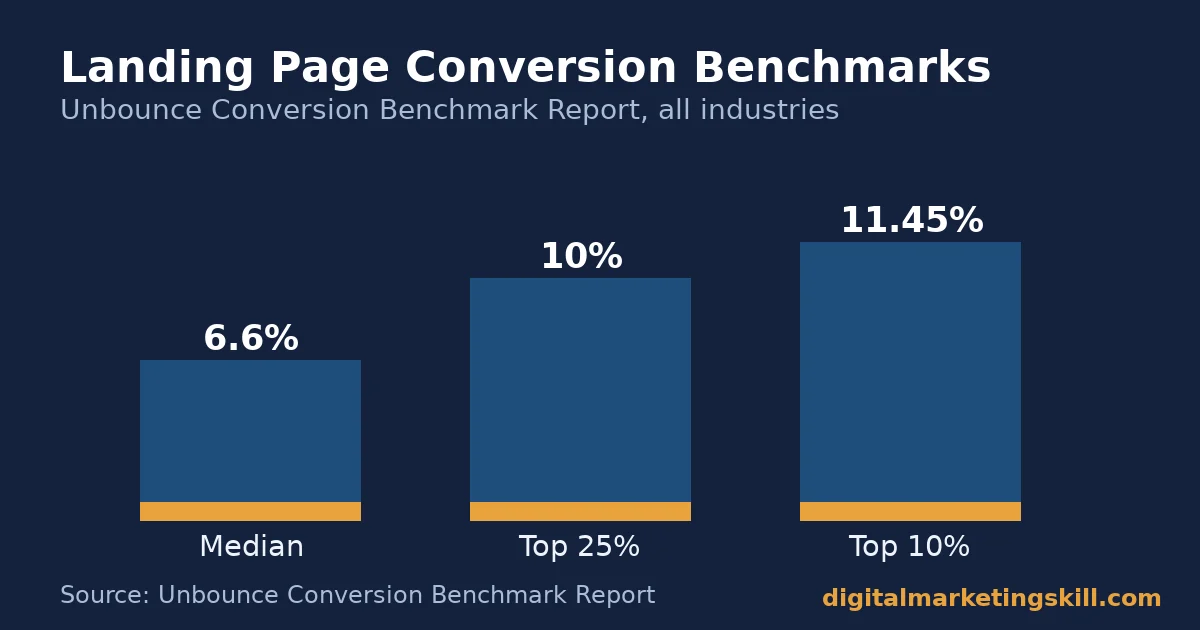
A landing page exists to convert one visitor type on one offer. Unbounce’s own report puts the median conversion rate at 6.6% across industries. The top 25% of pages convert at 10% or higher. That gap usually comes down to how tightly the page matches the ad or link that sent the visitor there.
Content Offers: Built For Search Intent
A content offer, such as a guide or template, earns a lead by answering a real question well. Backlinko’s study of 11.8 million search results found that top-10 pages average roughly 1,447 words. A lead-generating content piece usually needs real depth. A short pitch wrapped around a signup form rarely earns that trust.
Retargeting And Email: Built For Repeat Contact
Retargeting ads and nurture emails rely on repeat contact, not one moment of persuasion. Ruler Analytics reports an average lead conversion rate of 5.13% across tracked channels. That figure comes from repeated touches over time, not one single ad or email closing the deal alone.
How To Improve Your Lead Generation Strategies
Landing Pages: Match The Offer To The Click
Write the headline so it repeats the exact promise made in the ad that sent the visitor there. Remove every navigation link and distraction. Leave only the one action you want. Ask for the smallest amount of information you can actually use. Every extra form field gives a visitor one more reason to leave.
Content Offers: Answer The Question Fully First
Build the offer around one named problem, not a broad topic. Answer that problem fully before you ask for anything. A visitor who feels already helped is far more willing to trade an email address for more of the same.
Retargeting And Email: Space Out The Ask
Do not ask for the sale in the first message. Use the first few touches to remind, inform, or add a small amount of value. Save the direct offer for later in the sequence. A message that only ever asks for the sale gets tuned out fast.
How To Measure Whether Your Lead Generation Is Working
Track these four numbers, each defined in one sentence:
- Conversion rate is the share of visitors who complete your offer. It tells you whether the page or form itself is working.
- Cost per lead is your total spend on a channel, divided by the number of leads it produced. It tells you whether a channel is worth scaling.
- Lead-to-customer rate is the share of leads who eventually buy. It tells you whether you are attracting the right kind of lead, not just a high volume of them.
- Time to conversion is how long a lead typically takes to become a customer. It tells you how long a nurture sequence actually needs to run, and when to stop expecting a late conversion.
Reading These Numbers Together
A high conversion rate paired with a low lead-to-customer rate usually means the offer attracted the wrong audience. The page itself did not fail. A low conversion rate paired with a high lead-to-customer rate often means the offer is too demanding for a cold visitor, even though the leads it does produce are strong. Fix the matching problem first. Then fix the page.
The One Rule For Choosing A Lead Generation Strategy
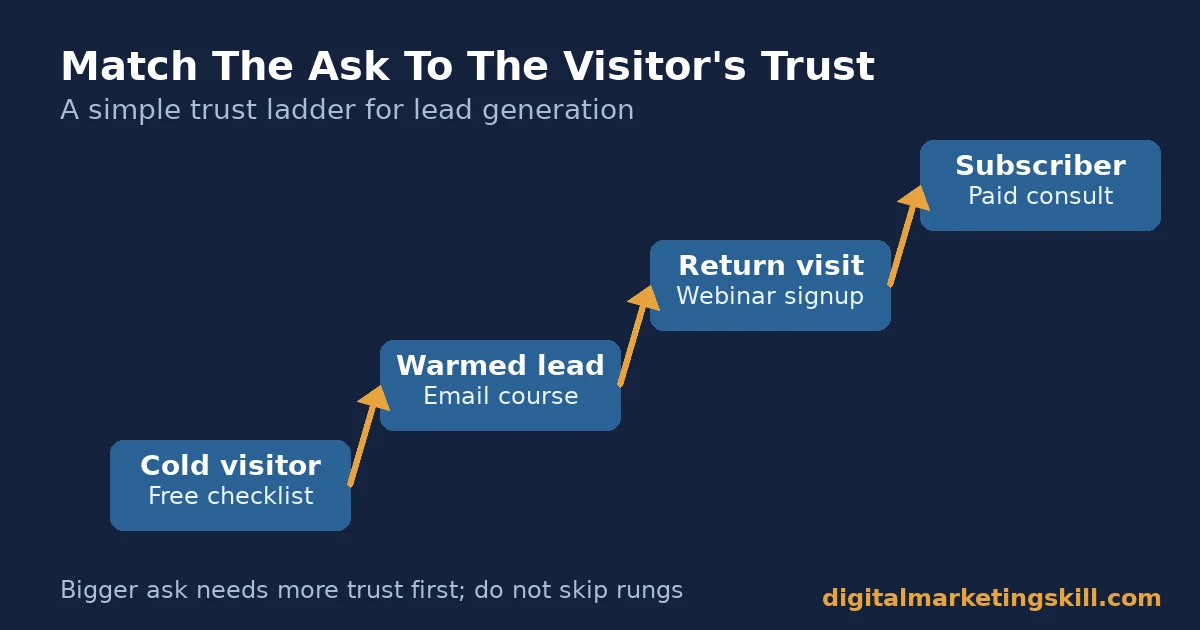
Match the channel to how much proof your visitor already has. A visitor who already trusts your brand needs less proof. You can ask for more from them. A cold visitor, reading a search result for the first time, needs a smaller, lower-commitment offer before they will hand over contact details.
Think of this as a ladder, not a single step. Each stage of trust supports a slightly bigger ask than the one before it. A cold visitor might only give an email for a free checklist. The same visitor, six weeks and several helpful emails later, may happily book a paid consultation. Trying to skip straight to the big ask on the first visit is the single most common reason a reasonable offer still underperforms.
Illustrative, invented numbers: say a cold search visitor converts at 2% on a demanding offer, but at 6% on a lighter one, such as a short checklist instead of a full consultation booking. The lighter offer may produce lower-quality leads individually. But three times the volume at a similar cost per lead usually outweighs that quality gap, once a proper nurture sequence is in place. Replace these numbers with your own real numbers before making a real budgeting decision.
Why Your Lead Generation Benchmark Depends On Your Industry
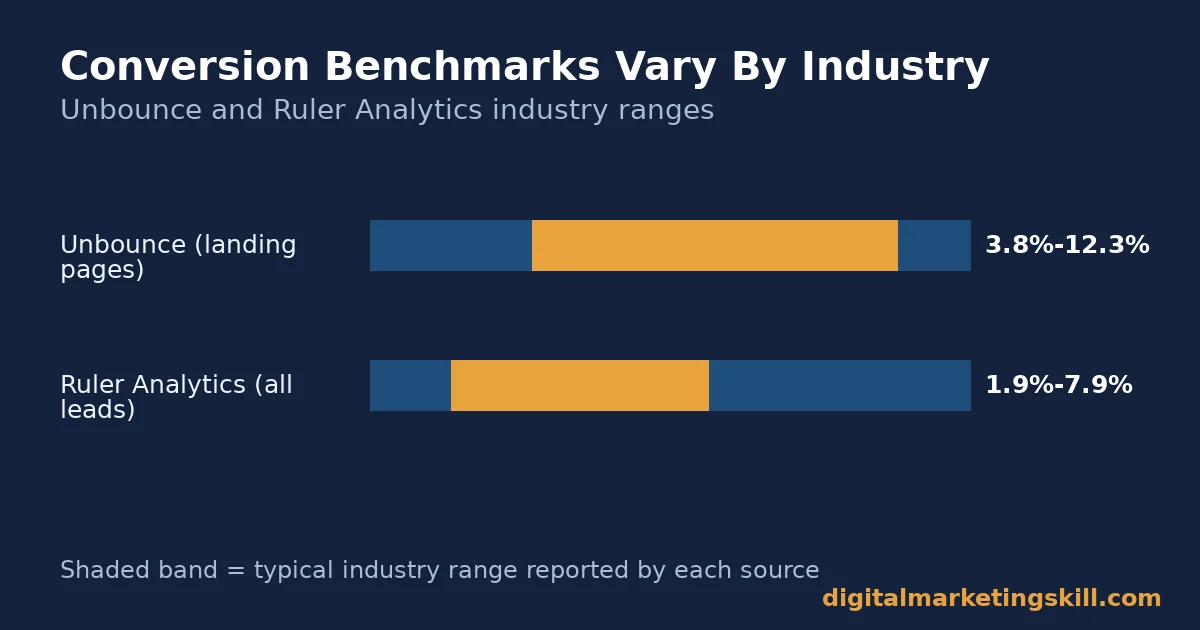
A single average number hides more than it reveals. Unbounce’s own benchmark report shows landing page conversion rates ranging from roughly 3.8% to 12.3% depending on industry, even though the overall median sits at 6.6%. Ruler Analytics reports a similarly wide spread, from about 1.9% in travel to 7.9% in automotive and legal, inside its 5.13% overall average.
That spread matters for how you judge your own lead generation strategies. A 4% landing page conversion rate might be a strong result in one industry and a weak one in another. Before you decide a strategy failed, compare it against a benchmark from a similar industry, not against the single headline average everyone quotes.
It also means you should treat any one benchmark as a rough guide, not a target to hit exactly. Your own traffic quality, offer, and audience will always move your real number away from any published average, in either direction.
A Real Case: What Happens When A Company Rewrites Its Lead Generation Content
HubSpot’s own blog has published what happened when its team stopped only publishing new lead-generating content, and started rewriting old posts instead. The company reports that posts published before a given month drove 76% of that month’s blog views, and 92% of its blog leads. It also reports that updating older posts increased their monthly organic search views by an average of 106%.
The limits matter here. This is one company’s self-reported, internal data, not an independently audited study. HubSpot also has unusual scale and an established content library most smaller sites will not match. Even so, the lesson holds up directionally. An old piece of lead-generating content, already ranking and already earning traffic, is often a faster lever than a brand-new piece with no search visibility yet.
Why Content Quality Still Decides Whether A Content Offer Converts
Google’s own guidance on helpful content names effort, originality, skill, and accuracy as the signals it looks for. A thin lead magnet, assembled quickly with no real insight, tends to fail on all four. It may still capture an email address once. But it rarely builds the trust that turns that lead into a customer later.
Content Marketing Institute and MarketingProfs found that 97% of surveyed B2B marketers already have a content strategy in place. 61% report improved content marketing effectiveness from following one. A documented strategy, even a simple one, usually separates a lead magnet that keeps converting from one that fades after its first week.
Good lead generation strategies also reuse proof wherever they can. A statistic, a short case, or a worked example used once in a blog post can be reused again in an email, an ad, and a landing page, without any extra research. Consistent proof across every touchpoint reinforces the same message instead of diluting it.
Distribution Still Decides Whether Anyone Sees The Offer
A strong content offer with no distribution plan rarely gets found. Share it through email, relevant social channels, and internal links from pages that already rank, rather than publishing it once and waiting.
Common Mistakes In Lead Generation Strategies
Three mistakes show up again and again in weak lead generation work, and none require a full rebuild to fix.
The first mistake is collecting an email address with no plan for what happens next. A lead with no follow-up sequence behind it is a wasted conversion. Build the nurture sequence before you launch the offer, not after the first leads arrive. Even a short, three-email sequence drafted in advance beats a fast scramble once the first leads start coming in.
The second mistake is chasing volume over fit. A lead generation offer that attracts the wrong audience in large numbers still produces a low lead-to-customer rate. A smaller, better-targeted list almost always converts to revenue faster than a larger, poorly-matched one.
The third mistake is a weak or missing sales funnel after the lead is captured. Capturing a lead is only the first step. Without a clear next step, even a well-targeted lead goes cold within days.
How To Prioritize Which Lead Generation Strategies To Test First
Most businesses cannot test every channel at once. A simple way to prioritize is to rank each candidate strategy on two things: how much traffic or audience you already have for it, and how directly it matches your current offer.
A business with an engaged email list but no landing page should build the landing page first. Meanwhile, a business with strong search traffic but a weak content offer should fix the offer before buying ads to send more traffic to it. Testing a new channel before fixing an obvious gap in an existing one usually wastes the new channel’s early momentum.
Give each new lead generation strategy a fixed, honest test window, such as four to six weeks, before judging it. A channel that looks weak after three days often just has not collected enough data yet. A channel that still looks weak after a full test window, with a reasonable budget behind it, is a fair candidate to pause or drop.
Write down the test window and the minimum budget before you start, not after you see early results. Deciding the rules in advance stops a promising early number from tempting you to extend a weak test, and stops a disappointing early number from tempting you to kill a channel too soon.
Where Chatbots And Live Chat Fit In
A chatbot or live chat widget captures leads from visitors who have a specific question and want an answer before they commit to a form. It works best alongside a landing page or content offer, not as a replacement for either. Treat it as one more channel to measure with the same four numbers as any other lead generation strategy, rather than as a set-and-forget feature.
Frequently Asked Questions About Lead Generation Strategies
What is the difference between a lead and a customer?
A lead has shared contact details and shown interest, but has not yet paid. A customer has completed a purchase. Most lead generation strategies exist to move someone from the first category to the second over a series of small steps.
Which lead generation strategy converts best?
No single strategy wins for every business. Published benchmarks show landing pages converting at a 6.6% median and other tracked channels averaging 5.13%. The right channel depends on how much trust your visitor already has before they arrive.
How many form fields should a lead generation form have?
Fewer fields generally produce more leads. Each additional field gives a visitor one more reason to abandon the form. Ask only for what you will genuinely use in your first follow-up message, and collect anything else later. A simple name-and-email form, for example, usually outperforms a longer form that also asks for a phone number and company size up front.
Is cold outreach still an effective lead generation strategy?
Cold outreach can work, but it depends heavily on how specific the message is. A generic cold message performs far worse than one that references something specific about the recipient’s actual situation. Treat cold outreach as one more channel to measure, not a free pass that skips the usual tracking.
How long should a lead nurture sequence run?
It depends on the buying cycle. A low-cost, fast-decision product may need only two or three emails. A considered, higher-cost decision can reasonably take several weeks. Track your own time-to-conversion number rather than copying another business’s sequence length.
Do I need a large budget to start generating leads?
No. A well-targeted content offer, or an organic social strategy, can generate leads with little to no media spend. It generally takes longer to build momentum than a paid channel does, so plan for that trade-off. Many businesses start with one free or low-cost lead generation strategy, prove it works, and only add paid spend once they can see the real cost per lead and lead-to-customer rate behind it.
Should I run several lead generation strategies at once, or focus on one?
Start with one or two lead generation strategies you can measure properly, rather than spreading a small budget across five channels at once. Once a channel reliably produces leads at a cost per lead you are happy with, add a second channel rather than replacing the first.
What is lead scoring and do I need it?
Lead scoring assigns points to a lead based on signals such as job title, company size, or how many pages they viewed, so your sales team can focus on the leads most likely to buy first. Small businesses with a low lead volume can often skip formal scoring and simply call leads in the order they arrive. Scoring becomes genuinely useful once lead volume is high enough that sales cannot follow up with everyone quickly. At that point, even a simple scoring rule, such as prioritizing anyone who visited the pricing page, saves real time.
Where To Go From Here
Lead generation works best as part of a complete marketing skill set, not a single tactic learned in isolation. If you want to build landing pages, nurture sequences, and paid retargeting into one connected system, the Master Diploma in Digital & AI Marketing at Digital Marketing Skill Institute runs four AI-powered tracks: AI-Powered Social Media Management and Advertising, AI-Powered Lead Generation and Email Automation, AI-Powered Google Specialist, and AI-Powered WordPress and SEO Specialist. All four are built from ten courses in total, with a Full Stack option for completing every track.
Every track includes unlimited 1-on-1 coaching and mentoring, a U.S. Project Internship with a verified U.S. Work Reference Letter, and dual US and UK accreditation recognised in more than 100 countries. The whole program runs 100% online, so you can build a lead generation skill set from anywhere in your country.
Browse the full program on the Master Diploma page, read real outcomes on the reviews page, or explore more guides on the digital marketing blog. Wherever you live, strong lead generation skill travels with you, so whenever you are ready, you can apply here from anywhere via digitalmarketingskill.com.
Every figure in this guide was checked against its original source before publication. Figures marked as illustrative are invented examples, not real results.
![9 Amazing Digital Marketing Skills to Make Money Online [With Proof]](https://digitalmarketingskill.com/wp-content/uploads/2019/07/9-Amazing-Digital-Marketing-Skills-to-Make-Money-Online-With-Proof-17.png)






