Social media business growth depends less on posting often and more on where your audience actually spends time. Over 5.66 billion people now use social platforms worldwide. But each platform rewards a different kind of content and a different kind of attention. This guide shows which platform fits which goal, and how to measure real growth instead of vanity metrics.
Key Takeaways
- Reach is now global by default. DataReportal’s latest Global Overview report counts 5.66 billion social media identities worldwide, 68.7% of the world’s population, each using an average of 6.75 platforms a month.
- Attention is the real currency. The average global user spends 18 hours 36 minutes a week on social platforms, per the same DataReportal report.
- Slow replies cost sales. The Sprout Social Index found 73% of social users say they will buy from a competitor if a brand does not respond on social.
- Discovery happens on social first. DataReportal found more than 30% of adult internet users discover new brands through social media ads, with ads ranking as the top awareness driver for 16 to 34 year-olds.
- Different platforms serve different goals. No single platform serves every stage of social media business growth; matching the platform to the goal matters more than being everywhere at once.
In this guide
- What Most Social Media Business Growth Advice Misses
- How Social Platforms Actually Drive Growth
- Matching Platforms To Growth Goals
- Common Mistakes That Stall Social Media Business Growth
- How To Build A Platform Plan Instead Of A Posting Schedule
- How To Measure Social Media Business Growth Properly
- Why This Framework Works Across Industries
- The One Rule: Match The Platform To The Mechanism, Not The Trend
- A Real Case: What Rising Social Commerce Sales Show And Do Not Show
- Frequently Asked Questions About Social Media Business Growth
- Build A Social Media Strategy That Actually Grows A Business
What Most Social Media Business Growth Advice Misses
Most advice says the same thing: post consistently, use hashtags, go live sometimes. None of that is wrong. But it skips the decision that matters most: which platform actually fits your business and your goal.
This guide answers that question directly. It breaks social media business growth into the goals a business actually has. It matches each goal to the platforms built for it, and gives a simple way to measure whether it is working.
A few ground rules first. The figures below come from named, dated reports. Each has its own scope and sample. Platform behaviour changes quickly, so treat these as a snapshot, not a permanent ranking. The platform-matching framework in this guide is our own synthesis, built to be useful, not an academic model.
How Social Platforms Actually Drive Growth
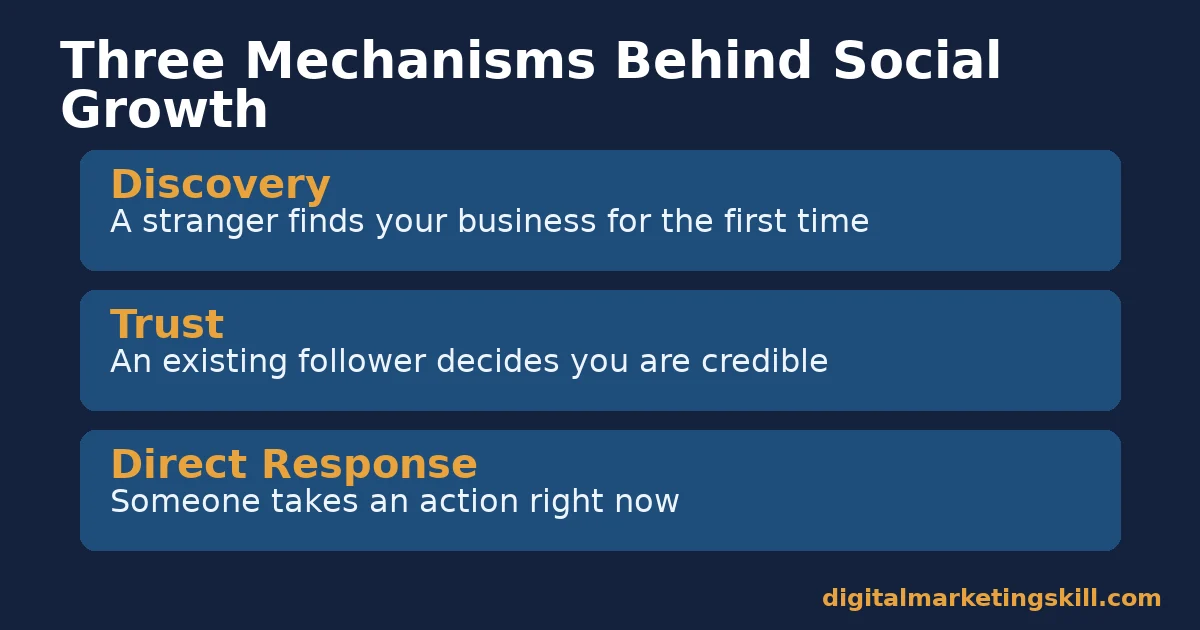
Every platform drives growth through one of three mechanisms. These are discovery, trust, and direct response. Discovery means a stranger finds your business for the first time. Trust means an existing follower decides you are credible. Direct response means someone takes an action right now, like clicking a link or messaging you.
Confusing these three is the most common mistake in social media business growth. A business posting discovery content and measuring it by direct sales will always look like it is failing. This happens even when the content is working exactly as it should.
The confusion runs both ways. A business that only posts direct-response content, constant offers and calls to action, often sees engagement fall over time. As a result, followers tune out an account that never gives them anything beyond a sales pitch. Each mechanism needs the others to keep working.
Matching Platforms To Growth Goals
Each major platform is genuinely better at one of the three mechanisms above. Picking based on where your audience already spends time is the single highest-leverage decision in social media business growth, more than personal preference. Platform popularity itself varies by country; in the United States, Pew Research Center found YouTube and Facebook remain the most-used platforms among adults, so verify your own audience’s platforms rather than assuming a global pattern applies locally.
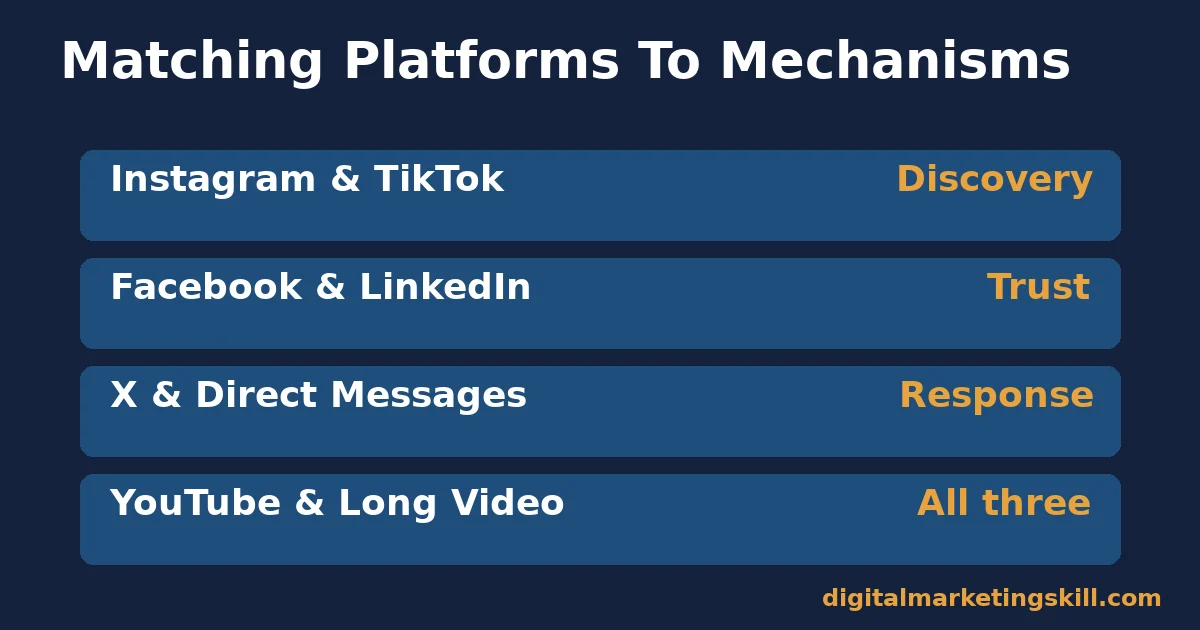
Instagram And TikTok: Built For Discovery
Short-form video spreads to people who have never heard of you. Both platforms’ algorithms are built to surface new content to new audiences, not just to existing followers. This matches DataReportal’s finding that social ads are the top brand-discovery driver for 16 to 34 year-olds, which makes discovery platforms strong for reaching people who are not searching for you yet.
The tradeoff is depth. Discovery content earns a view, not necessarily a relationship. A business relying only on this layer sees reach without repeat engagement, unless it also varies its social media content enough to give people a reason to follow.
Facebook And LinkedIn: Built For Trust
Facebook groups and LinkedIn posts reward sustained, consistent presence. A single viral moment matters far less here. People follow a business here because they already have some reason to trust it, and they expect that trust to be reinforced over time.
This is where reviews, case studies and expert commentary do the most work, and it overlaps heavily with B2B social media strategy. A single post rarely converts a stranger; a consistent pattern of useful posts converts a follower who has been watching for weeks.
X And Direct Messaging: Built For Response
Fast-moving platforms and direct messages reward immediate, specific replies. Someone asking a question in a comment or a message has high intent right now; the Sprout Social Index finding that 73% will buy elsewhere if ignored applies most sharply here.
This layer is where social media business growth becomes measurable in real time. A fast, specific reply can close a sale within minutes. A slow or generic one loses it just as fast.
YouTube And Long-Form Video: Built For All Three
Long-form video is the exception to the one-mechanism rule. A well-made video can introduce a new viewer to your business, build trust through demonstrated expertise, and end with a clear next step, all in one piece of content. The cost is production time. That is why most businesses treat it as a supplement, not a replacement, for the faster platforms above.
Common Mistakes That Stall Social Media Business Growth
Three mistakes show up again and again, across almost every size of business. Spotting them early saves months of wasted effort.
Mistake One: Chasing Every New Platform
A new platform launches, gets press coverage, and businesses rush to claim a handle there. But early traction on a brand-new platform rarely transfers into lasting social media business growth unless your actual audience is also there. So check for your audience first, then join, not the other way around.
Mistake Two: Copying Competitor Content Exactly
Watching competitors is useful for ideas. Copying their exact format assumes their audience, their trust level and their response habits match yours, which is rarely true. Their follower base may already trust them for reasons specific to their history. That trust is not something a single post format can replicate on its own. So use competitor content as a starting point, then adjust to your own data on what actually gets a reply or a sale.
Mistake Three: Treating Every Comment The Same
A comment asking a direct question needs a direct, fast answer. By contrast, a comment that is just friendly chatter does not need the same urgency. Businesses that respond to everything with the same generic reply lose the advantage the response mechanism is supposed to give them.
How To Build A Platform Plan Instead Of A Posting Schedule
A posting schedule asks “what do I post today.” A platform plan asks a different question: “which mechanism am I missing.” The second question produces social media business growth; the first just produces content.
Step One: Audit Your Mechanism Gap
List your last ten posts. Mark each as discovery, trust, or response. Most businesses find they are heavily weighted toward one mechanism and almost silent on another. That gap is usually the fastest fix available. This single audit, done honestly, often reveals more than weeks of reading general social media business growth advice.
Step Two: Assign One Platform Per Mechanism
Pick one platform to lead on discovery, one to lead on trust, and a clear process for response across all of them. You do not need five platforms done well; you need each mechanism covered by at least one.
Step Three: Protect Response Time
Assign someone, even part-time, to monitor comments and messages daily, which also doubles as basic social listening. Given that 73% of users say they will buy from a competitor after being ignored, this single habit often has the fastest payoff of the three steps.
How To Measure Social Media Business Growth Properly
Followers alone tell you almost nothing. Use these four measures instead, matched to the three mechanisms above.
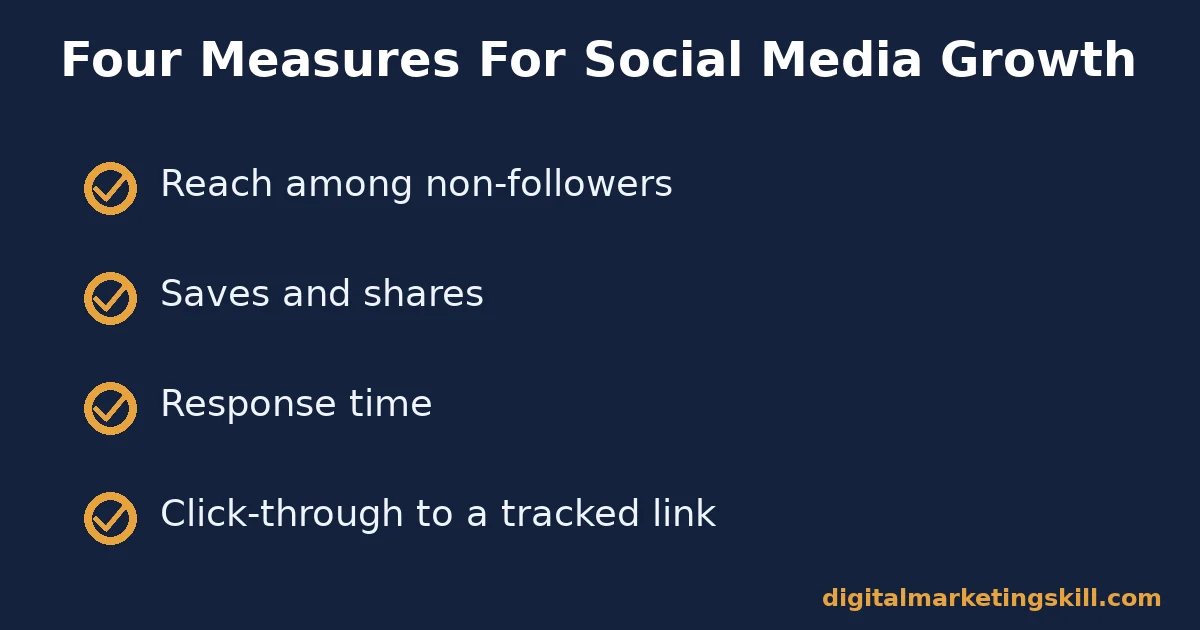
- Reach among non-followers: how many people who do not already follow you saw your content. This isolates real discovery from preaching to your existing audience.
- Saves and shares: a stronger trust signal than likes, since a save or share requires someone to value the content enough to act on it later or pass it on.
- Response time: the average time between a comment or message and your reply. This is the number most directly tied to the 73% competitor-switching statistic above.
- Click-through to a tracked link: the clearest direct-response number, since it shows intent moving off the platform and toward your business.
Review all four together, monthly. A business strong on reach but weak on response time is leaking the easiest wins. A business strong on response but invisible in reach has nothing new coming in behind it.
Avoid judging short-term swings too harshly. A single viral post can spike reach without changing the underlying pattern, and a single slow week on response time does not undo months of good habits. Instead, look for the trend across a quarter, not the result of any one post.
Why This Framework Works Across Industries
A software company, a local bakery and a freelance consultant look nothing alike on the surface. However, each one still needs the same three things from social media: new people to find them, existing followers to trust them, and a fast reply when someone is ready to act.
What differs between industries is the mix, not the mechanisms themselves. A consumer brand often leans heavily on discovery and response, since buying decisions happen fast. A professional service often leans on trust, since buying decisions take longer and depend more on credibility built over months.
This is also why copying another industry’s exact playbook usually disappoints. A B2B consultant adopting a retail brand’s discovery-heavy TikTok strategy is solving the wrong problem, since their buyers are not deciding on impulse. Matching the mix to your own buying process, not to what looks exciting elsewhere, is what makes social media business growth repeatable rather than lucky.
The One Rule: Match The Platform To The Mechanism, Not The Trend
If there is one decision rule for social media business growth, it is this: before posting anything, name which mechanism it serves, and post it where that mechanism actually works.
Illustrative, invented example: a local bakery posts a trending audio video on TikTok, expecting direct sales. It gets thousands of views but few orders, because TikTok served the discovery mechanism, not the response one. The bakery then adds a simple Instagram story highlight answering delivery questions and starts replying within the hour on Facebook Messenger. Orders rise, not because the TikTok video failed, but because the bakery finally covered the response mechanism the video was never built to deliver.
A Real Case: What Rising Social Commerce Sales Show And Do Not Show
eMarketer puts US social commerce sales at over $85 billion, growing close to 20% year over year, as platforms add native checkout features that let a purchase happen without ever leaving the app. This is a real, measurable shift in how direct-response social media business growth works today.
The case shows that reducing friction between discovery and purchase genuinely increases sales, since removing even one extra tap or page load measurably changes conversion. It is a real trend with real revenue behind it.
It does not show that every business benefits equally. Social commerce suits low-consideration, impulse-friendly products far more than complex or high-ticket services. Buyers of those products still expect research and a conversation before paying. Treat the trend as a strong option for the right product, not a universal strategy.
The lesson generalises beyond checkout buttons. Wherever social media business growth stalls, the fix is usually removing friction at the exact moment someone is ready to act, not adding more content earlier in the journey.
Frequently Asked Questions About Social Media Business Growth
How many social media platforms should a small business use?
Fewer than you think. Covering the three mechanisms, discovery, trust and response, properly on two platforms beats a weak presence spread across five, and matches our broader guide on how to use social media to promote your content. Pick based on where your specific audience already spends time, not based on which platforms feel trendy.
How long does social media business growth take to show results?
Trust-building content on platforms like Facebook and LinkedIn typically takes months of consistency before it compounds. However, discovery content can show faster spikes, and spikes without a trust layer behind them rarely convert into lasting growth. Expect weeks for early signals and months for a stable pattern. Patience is part of the strategy, not a sign it is failing.
Is organic social media enough, or do I need paid ads?
Organic content builds trust and answers questions well, but DataReportal’s finding that over 30% of adults discover brands through social ads shows paid reach still drives real discovery. Most businesses benefit from organic content covering trust and response, with a modest paid budget covering discovery to new audiences.
What is the biggest mistake businesses make with social media for growth?
Measuring every platform by the same metric. A discovery platform judged on direct sales looks like a failure even when it is working. Match the metric to the mechanism, covered earlier in this guide, before judging any platform a waste of time.
Does posting frequency matter for social media business growth?
Less than consistency and response time. A business posting three times a week and replying within the hour usually outperforms one posting daily but ignoring comments for days. Frequency helps discovery; response time protects the sales that frequency generates.
Which social media platform has the best return for a new business?
There is no universal answer, since it depends on your product and audience, but a new business can start by matching its product type to a mechanism: visual, impulse-friendly products often start with discovery platforms, while services with longer consideration often start with a trust platform instead.
Do I need a large following for social media business growth?
No. A smaller, responsive following that trusts you and acts on your content outperforms a large, silent one. Instead, response time and genuine engagement are what the statistics in this guide actually connect to revenue, not raw follower count.
Build A Social Media Strategy That Actually Grows A Business
Social media business growth comes from matching the right platform to the right mechanism, then protecting response time once attention arrives, wherever you are building your business in your country.
The Digital Marketing Skill Institute’s Master Diploma in Digital & AI Marketing is built to teach exactly this kind of platform-specific skill. It runs on four AI-powered tracks, totalling ten execution-first courses: AI-Powered Social Media Management and Advertising, AI-Powered Lead Generation and Email Automation, AI-Powered Google Specialist, and AI-Powered WordPress and SEO Specialist, with a Full Stack option for completing all four.
The Social Media Management and Advertising track covers the discovery, trust and response mechanisms in this guide in direct, practical detail. Every track includes unlimited one-on-one coaching and mentoring, plus a U.S. Project Internship with a verified U.S. Work Reference Letter, and the diploma carries dual US and UK accreditation, recognised in more than 100 countries, delivered 100% online wherever you are in your country.
Start with the Master Diploma in Digital & AI Marketing page, read real outcomes on the reviews page, or go straight to the application page to start building a platform plan that actually grows your business. Explore more guides on the Digital Marketing Skill Institute blog, or learn more at digitalmarketingskill.com and digitalmarketingskill.com.
Every figure in this guide was checked against its original source before publication. Figures marked as illustrative are invented examples, not real results.