
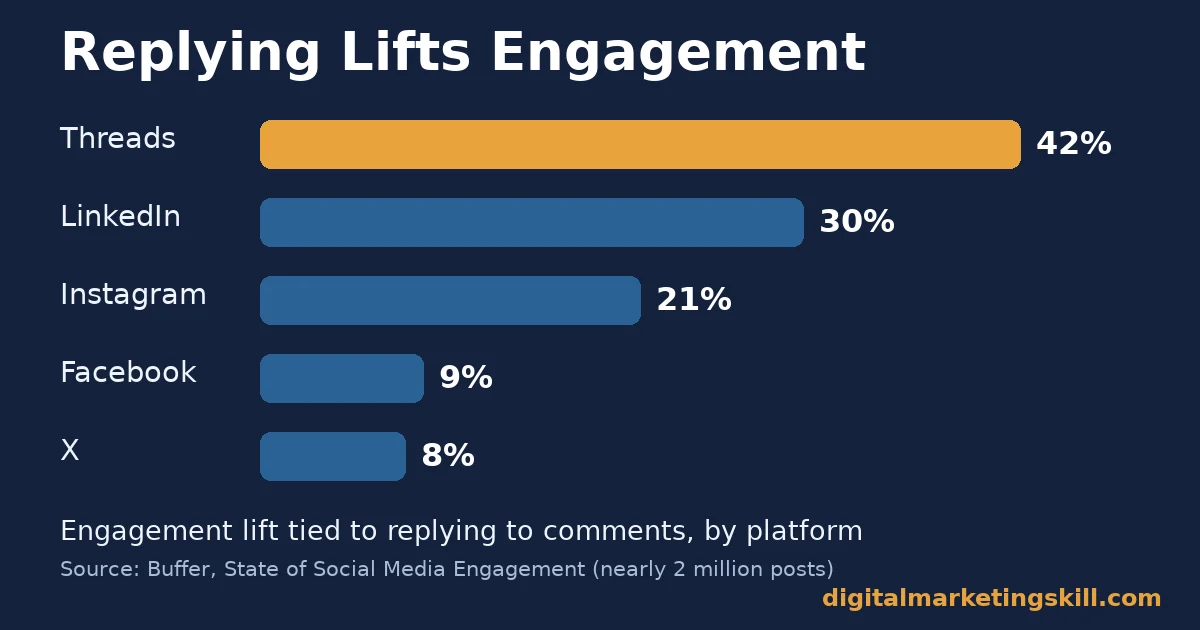
Social media marketing principles are the small set of rules, such as value, consistency and feedback, that decide whether a page grows or stalls. Having a profile is not a strategy. Buffer’s analysis of nearly 2 million posts found that replying to comments lifted engagement by up to 42% on some platforms, while accounts that stopped posting lost an average of 32 followers a week compared to accounts that kept showing up.
Key Takeaways
- Replying moves the needle. Buffer found reply-driven engagement lifts of up to 42% on Threads, 30% on LinkedIn, and 21% on Instagram.
- Silence has a real cost. Accounts posting ten or more times a week gained about 32 more followers weekly than accounts that went quiet.
- Not every format performs equally. LinkedIn carousels earned a median engagement rate around three times higher than plain video or image posts.
- Engagement rates differ by platform. Median engagement ranged from about 6.2% on LinkedIn down to roughly 2.5% on X, across millions of posts.
- Five principles still hold up. Value, presence, feedback, focus and consistent effort remain the core of any social media marketing strategy, regardless of which platform is trending.
In this guide
- What Most Social Media Marketing Advice Misses
- How Social Media Marketing Principles Work Together
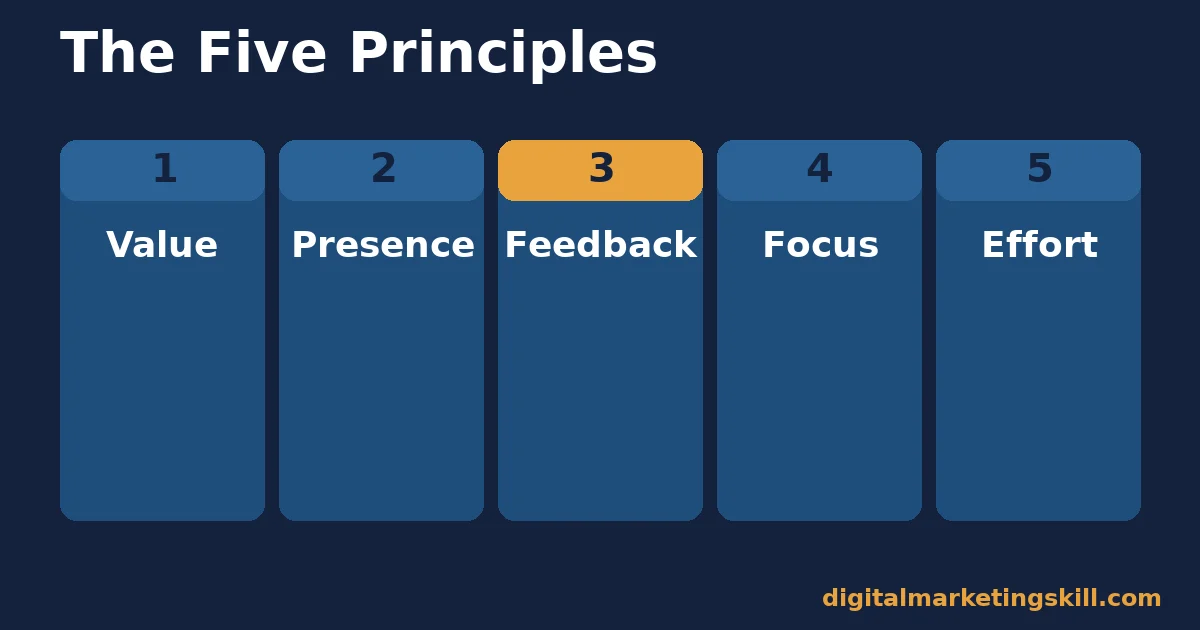
- The Five Social Media Marketing Principles
- How to Apply Each Principle This Month
- Choosing Where to Focus First
- How to Measure Whether the Principles Are Working
- The Most Useful Rule: Fix Feedback and Presence Before Chasing New Content
- Common Mistakes That Break These Principles
- Frequently Asked Questions About Social Media Marketing Principles
- Audit One Principle This Week
What Most Social Media Marketing Advice Misses
Most advice says the same thing: post more, post everywhere, and stay active. None of that is wrong. But it skips the harder question: active doing what, exactly?
A brand can publish daily and still get almost no engagement. Posting without a plan behind it wastes time and budget. The social media marketing principles in this guide answer the harder question directly.
The Buffer figures below come from a very large dataset across real accounts. Read them as strong patterns across platforms, not a guarantee for any single page or niche.
How Social Media Marketing Principles Work Together
No single principle carries a strategy on its own. Good content with no consistency fades. Consistent posting with no value feels like noise. The five principles below work as a set, not a checklist to pick from.
Before applying any of them, answer one question honestly: what is this page actually trying to achieve? Brand awareness, website traffic, sales or loyalty each call for a slightly different mix of the same five principles.
Why Plans Without Principles Fail
A content calendar alone only answers when to post. It does not answer why a post should exist or what happens after it goes live. For the scheduling side of this problem, this guide to building a content calendar is a useful companion to the principles below.
The Five Social Media Marketing Principles
Each principle answers a different failure mode. Together, they cover most of what separates a growing page from a stalled one.
The Principle of Value
Content has to give the reader something: an answer, a laugh, or a reason to come back. Self-promotion without value reads as noise. For format ideas that lean on this principle, see this list of social media content types.
The Principle of Strong Online Presence
Showing up once is not presence. Buffer’s analysis of 4.8 million channel-weeks found that accounts posting ten or more times a week gained roughly 32 more followers a week than silent accounts. Consistency compounds.
The Principle of Feedback
Ignoring comments and questions signals that nobody is home. Buffer found that replying to comments lifted engagement by as much as 42% on Threads, 30% on LinkedIn, and 21% on Instagram, with smaller but still real lifts elsewhere.
The Principle of Focus
A focused page, built around one clear theme, usually outperforms a page trying to be everything to everyone. Format matters here too: Buffer found LinkedIn carousels earned a median engagement rate around three times higher than plain video or image posts on that platform.
How to Apply Each Principle This Month
Understanding five principles matters less than acting on them. Each one has one concrete starting action.
Value: Audit Your Last Ten Posts
Look at your last ten posts and ask, honestly, whether each one gave the reader something or just talked about the brand. Fix the ratio before writing anything new.
Presence: Set One Realistic, Repeatable Schedule
Pick a posting frequency you can actually sustain for a month, then hold it. A smaller, consistent schedule beats a heavy one you abandon after two weeks.
Feedback: Reply Within One Business Day
Set a simple rule: every comment and question gets a reply within one business day. Because replying is where Buffer found some of the largest engagement lifts, this single habit often pays off faster than new content.
Focus: Pick One Platform to Go Deep On First
Choose the one platform where your actual audience already spends time, and commit to doing it well before expanding. A focused page on one platform usually beats a thin presence spread across five.
A Thirty-Day Plan to Apply All Five Principles
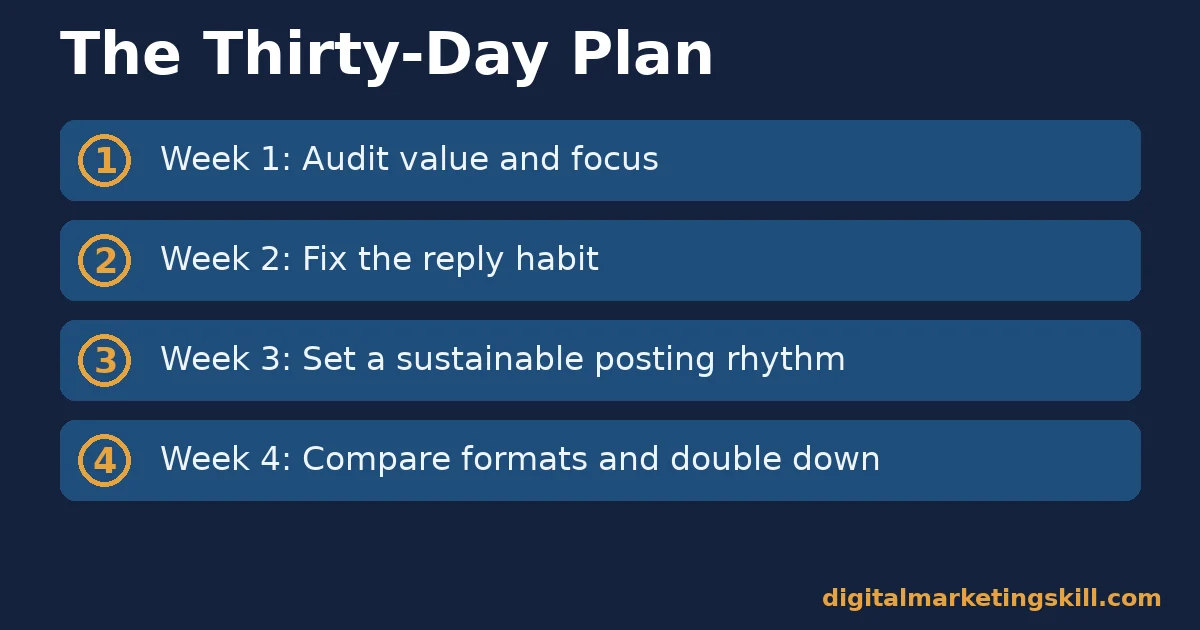
Reading about five principles is easy. Applying all of them at once is not. Splitting the work into weekly stages keeps the plan realistic for a small team or a single person running the page.
Week One: Audit Value and Focus
Review the last month of posts. Mark each one as either giving the reader value or simply promoting the brand. Note how scattered or focused the topics have been.
Week Two: Fix the Reply Habit
Set a rule that every comment and message gets a reply within one business day, and actually clear the backlog this week. This is usually the fastest-moving change of the four weeks.
Week Three: Set a Sustainable Posting Rhythm
Pick a realistic number of posts per week, lower than feels ambitious, and hit it without fail for the full week. A modest, consistent rhythm beats an ambitious one abandoned by week two.
Week Four: Compare Formats and Double Down
Look at engagement by format from the previous three weeks. Shift slightly more effort toward whichever format performed best, rather than spreading effort evenly across every format available.
By the end of the thirty days, all five social media marketing principles have been touched at least once: value through the audit, presence through the posting rhythm, feedback through the reply habit, and focus through the format comparison. Repeat the cycle monthly rather than treating it as a one-time fix.
Choosing Where to Focus First
Different platforms reward different formats and effort levels. Buffer’s data shows median engagement around 6.2% on LinkedIn, 5.6% on Facebook, 5.5% on Instagram, and roughly 2.5% on X, measured across millions of posts. Those numbers shift over time, so treat them as a snapshot, not a permanent ranking.
Rather than chasing the platform with the highest number today, pick the one where your specific audience is already active. A smaller, engaged audience on the right platform outperforms a large, indifferent one on the wrong platform.
Pew Research Center surveyed 5,022 US adults and found 84% use YouTube, 71% use Facebook, and 50% use Instagram, though these figures are US-only and will differ elsewhere. The honest answer to “which platform should we focus on” is rarely a single global number. It is whichever platform your own audience actually uses, confirmed by your own data rather than a general survey.
A Quick Way to Check, Instead of Guessing
Ask a sample of your existing customers or email subscribers which platform they check most often. That short, direct question usually beats any general industry ranking, because it reflects your audience, not an average one.
Where to Find Content That Actually Delivers Value
The value principle is easy to state and hard to apply without a concrete source of ideas. A few repeatable sources work for almost any brand, regardless of size.
Answer the Questions Customers Already Ask
Every support inbox, comment section and sales call generates real questions. Turning those questions into posts guarantees the content answers something a real person actually wanted to know.
Show the Process, Not Just the Result
A behind-the-scenes look at how something gets made is often more engaging than the polished final result alone. It also naturally supports the focus principle, since it reinforces what the brand actually does.
Curate Outside Information Your Audience Would Miss Otherwise
Not every post needs to be original. Sharing a genuinely useful outside resource, with your own short take added, can deliver as much value as a fully original post, as long as it is relevant to your specific audience.
Reuse One Good Idea Across Several Formats
A single strong idea can become a short video, a carousel, and a text post without feeling repetitive, since each format reaches people differently. This also supports the focus principle, because the underlying message stays consistent even as the format changes.
How to Measure Whether the Principles Are Working
A follower count alone hides most of what matters. A few sharper signals show whether the five principles are actually being applied.
Four Signals Worth Tracking
- Reply time to comments and messages. A slipping reply time usually means the feedback principle is being skipped, not that the team is simply busy.
- Engagement rate by format, not just overall. Comparing formats shows whether the focus principle is pointed at what actually performs on that platform.
- Posting consistency over the last month. A visual calendar of actual posting dates quickly reveals gaps the presence principle is meant to close.
- Repeat engagement from the same followers. People commenting more than once signal that the value principle is landing, not just reaching an audience.
Track these four together. A high engagement rate with slow reply times, for example, usually means good content is being undercut by weak feedback habits. None of the four signals needs an expensive tool to check; a simple spreadsheet updated weekly is enough to spot the pattern early, before a small gap turns into a stalled page.
A Short Recap Before Moving On
Value asks whether the content is worth the reader’s time. Presence asks whether the page shows up often enough to matter. Feedback asks whether questions and comments get answered. Focus asks whether the page tries to be one clear thing or everything at once. All four social media marketing principles feed into the fifth, which is simply sustained effort over time.
The Most Useful Rule: Fix Feedback and Presence Before Chasing New Content
If only one change is possible this month, fix reply time and posting consistency before producing more content. Those two principles are cheapest to improve and, according to Buffer’s data, carry some of the clearest measurable lifts.
Illustrative, invented example: two pages post the same five pieces of content in a month. One replies to every comment within a day and posts on a steady schedule. The other posts the same content but replies rarely and skips weeks at a time. The first page’s steadier presence and faster feedback, not better content, is usually what explains the gap in results.
A Real Case: Turning Social Engagement Into Real Client Work
Several students on the Digital Marketing Skill Institute reviews page describe applying these same principles for real clients. Eunice Bolaji built a working ecommerce site while still learning, which depended on driving engaged traffic through social channels rather than passive posting. Olajire Jacob set up marketing flows for clients and later scaled that work further.
Results like these vary by market, product and effort, and are not typical for every student; see the Institute’s earnings disclaimer for the full context. What both cases share is the pattern this guide describes. Applying the principles to real, specific work, not posting on autopilot, is what produced a result worth showing.
Common Mistakes That Break These Principles
Treating Social Media as a Broadcast Channel
Posting without replying turns a social page into a one-way billboard. That breaks the feedback principle immediately, no matter how good the content is.
Posting in Bursts, Then Going Quiet
A burst of ten posts followed by two silent weeks reads as inconsistency to both followers and the platform’s own algorithm. Steady, sustainable effort beats sporadic bursts.
Trying to Be Active on Every Platform at Once
Spreading the same limited effort across five platforms usually means none of them gets enough attention to work. One platform, done well, beats five done thinly.
Copying a Competitor’s Tactics Without Checking Fit
A format that works for one brand’s audience can fall flat for another. Before copying a competitor, check whether your own audience actually behaves the same way on that platform.
Chasing Follower Counts Over Engagement
A large but passive following looks impressive and does little else. A smaller audience that replies, shares and acts on what you post is worth more to a business than raw follower numbers, because it reflects the value and feedback principles actually working.
Frequently Asked Questions About Social Media Marketing Principles
What are the most important social media marketing principles?
Value, consistent presence, fast feedback, and clear focus consistently matter most. Each covers a different reason pages stall, so skipping one usually limits the others.
How often should a business post to follow the presence principle?
There is no universal number. The key is picking a frequency you can sustain consistently, since steady, sustainable posting outperforms a heavy schedule abandoned after a few weeks.
Does replying to comments really affect social media marketing results?
Yes. Large-scale analysis of posts across platforms found engagement lifts of up to 42% tied directly to replying, making feedback one of the highest-leverage habits available.
Should a small business be active on every social media platform?
Usually not. Focusing effort on the one or two platforms where the actual audience spends time tends to outperform a thin presence spread across many platforms.
How do I know which social media content format to prioritise?
Compare engagement rates by format on the specific platform you use, since the best-performing format can differ significantly from one platform to another.
What is the biggest mistake businesses make with social media marketing principles?
Treating the page as a one-way broadcast channel. Skipping replies and feedback undercuts even strong, valuable content.
Can these social media marketing principles apply to any country or market?
Yes. The underlying principles, value, presence, feedback and focus, do not depend on one country or platform, though the specific platform worth focusing on will vary by audience.
How long does it take to see results from applying these social media marketing principles?
There is no fixed timeline. A reply-time fix can show up in engagement within days, while building a focused, consistent presence that compounds usually takes a few months of steady effort.
Do social media marketing principles change for business-to-business audiences?
The five principles stay the same, though the platform mix often shifts, since professional audiences tend to concentrate on different platforms than general consumer audiences.
What tools help apply these social media marketing principles consistently?
A scheduling tool helps with the presence principle, and a shared inbox helps with the feedback principle, but no tool replaces deciding what the content should actually be worth to the reader.
Do these social media marketing principles still work as platforms change?
Yes, because they describe reader behaviour rather than any one platform’s features. New platforms and formats keep appearing, but people still decide what to read, follow and reply to based on the same underlying reasons.
Audit One Principle This Week
Social media marketing principles work best applied together. The fastest fix is usually feedback and consistency, not more content. Pick one principle from this guide. Audit your last month against it. Fix the biggest gap before adding anything new. If that platform is Facebook, the guide to Facebook marketing for business breaks the same feedback and consistency principles down by Page, Group and ad.
Keep the fix small and specific. A single changed habit, held for thirty days, usually tells you more than a full strategy rewrite attempted all at once.
The Master Diploma in Digital & AI Marketing at Digital Marketing Skill Institute includes a dedicated social media marketing course inside its nine practical courses, with unlimited 1-on-1 coaching and mentoring and real project work inside a U.S. company instead of theory alone. The diploma is dual US and UK accredited and recognised in more than 100 countries, and the whole program runs 100% online, so you can apply these principles anywhere in your country.
Browse digitalmarketingskill.com for the full programme, explore more practical guides on the digital marketing blog, see how social media fits a wider plan in this guide to social media management, or learn to use social media to promote existing content. Read outcomes on the reviews page, or apply directly whenever you are ready, wherever you live, and see the Institute’s homepage for current programme details.
Every figure in this guide was checked against its original source before publication. Figures marked as illustrative are invented examples, not real results.
![9 Amazing Digital Marketing Skills to Make Money Online [With Proof]](https://digitalmarketingskill.com/wp-content/uploads/2019/07/9-Amazing-Digital-Marketing-Skills-to-Make-Money-Online-With-Proof-17.png)