Facebook marketing for business means using a Page, Groups and paid ads to reach customers where they already spend time. Organic posts alone rarely do it. Meta’s own latest quarterly report counted 3.60 billion daily active people across its apps, so the reach exists. Getting your share of it takes a different plan for each tool.
Key Takeaways
- The audience is real. Meta’s latest quarterly results put family daily active people at 3.60 billion, up 3% year-over-year. That is scale, but it says nothing about whether your posts reach anyone.
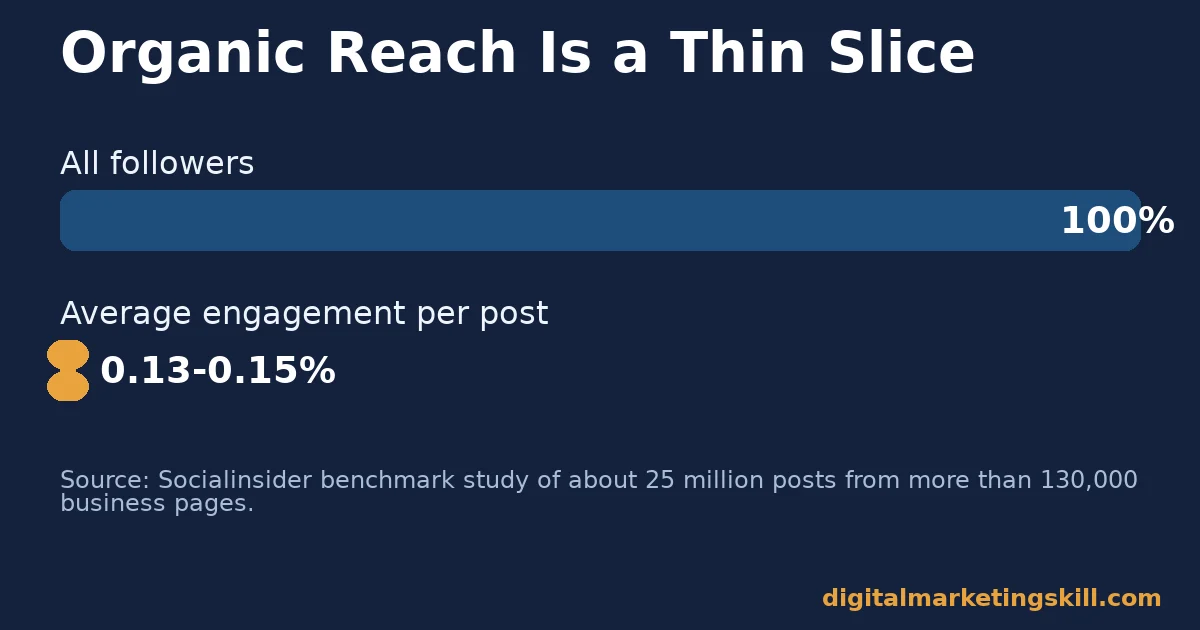
- Organic reach is thin. Socialinsider studied about 25 million posts from more than 130,000 business pages and found an average engagement rate near 0.13 to 0.15%. Most organic posts reach a small slice of followers.
- Ad reach numbers are planning estimates. DataReportal reports Meta’s own ad-planning tool shows a potential reach of about 2.35 billion accounts. That is a targeting ceiling, not people who actually saw an ad.
- Most small businesses are still catching up. In Meta’s Global State of Small Business research with the OECD and World Bank, about 40% of small businesses named a lack of digital marketing knowledge as a top challenge.
- Discovery already happens on social. The same research found 2 in 5 surveyed consumers discovered a small business through a social ad, Page or post. Being absent has a real cost.
In this guide
- What Most Facebook Marketing for Business Advice Gets Wrong
- How Facebook Marketing for Business Actually Works
- Three Tools, Three Different Jobs
- How to Get Results From Each Tool
- How to Measure Whether Facebook Marketing for Business Is Working
- The One Decision Rule: Spend Only Where You Can Measure a Result
- Common Mistakes in Facebook Marketing for Business
- A Real Case: A Small Ad Budget Turned Into a Measurable Return
- Frequently Asked Questions About Facebook Marketing for Business
- Start With One Tool, Track One Number, Then Expand
What Most Facebook Marketing for Business Advice Gets Wrong
Most guides treat Facebook marketing for business as one thing to get right: post more, post better, grow a following. That ignores a basic fact. A Page post, a Group conversation and a paid ad behave completely differently, reach different people, and need different skills to run well.
This guide treats them as three separate tools. It names what each one is actually built on. Then it covers what to do first with each, and how to measure whether any of it is working. Engagement-rate and reach figures below come from named studies of business pages or Meta’s own data; none of them predict your specific results, so treat them as a benchmark, not a promise.
The gap matters because treating all three tools the same way wastes budget fast. A Page post optimized for reach needs a different approach than a Group post optimized for trust. Both differ again from an ad optimized for clicks.
None of this is about picking a single winner. Most small businesses eventually use all three tools together. The point is to know which job each one is doing for you right now. That way, you judge each one by the right number, instead of one borrowed from a different tool.
How Facebook Marketing for Business Actually Works
Every piece of content on Facebook competes for a spot in someone’s feed. According to Meta’s own Transparency Center documentation, an AI system ranks every available post using thousands of signals. Those signals include who a person interacts with and what actions they take on similar content. A business Page post competes against friends, family and other Pages for that same limited space.
The system runs in stages. It first gathers everything a person could see. Then it scores each post for predicted relevance, and blends content from accounts people follow with recommended content from accounts they do not. A Page post has to win that scoring contest against personal content it was never designed to beat.
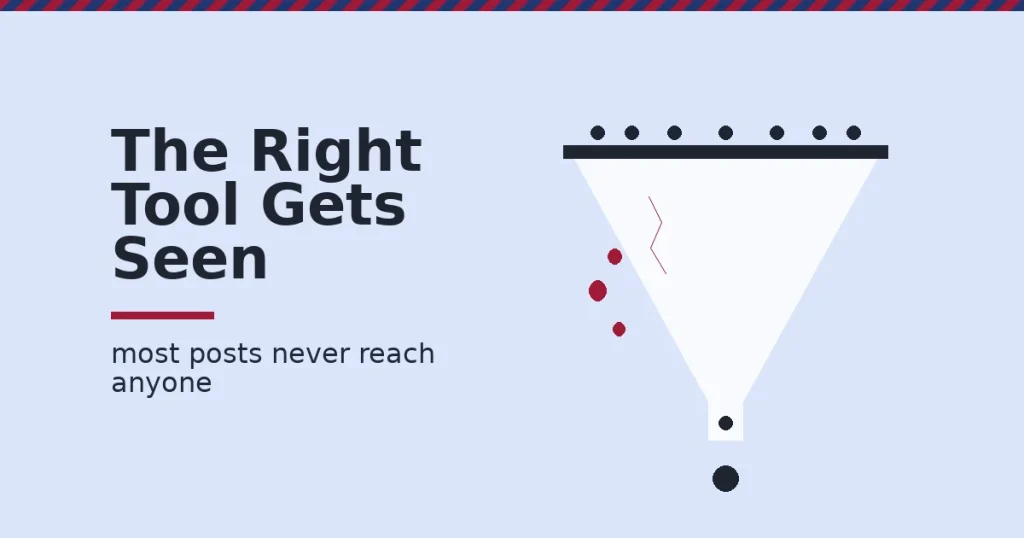
That competition is why organic reach is so thin. Socialinsider’s latest benchmark study puts the average engagement rate at about 0.13 to 0.15%. That study is built from roughly 25 million posts across more than 130,000 business pages. In practice, a Page with 1,000 followers might see only one or two people engage with a typical post.
Paid Reach Is Not Free Reach
Paid ads work differently. Meta’s ad-planning tool reports a potential reach of about 2.35 billion accounts, according to DataReportal. That number describes how many accounts could theoretically see an ad if targeted broadly, not how many will. Treating it as a delivery guarantee is a common and costly mistake.
Meta’s own Business Help Center guidance frames the fix simply. Pick a clear goal for the Page, post on a predictable schedule, and keep promotional content to a minority of what you publish. That advice applies before you spend a single dollar on ads.
Three Tools, Three Different Jobs
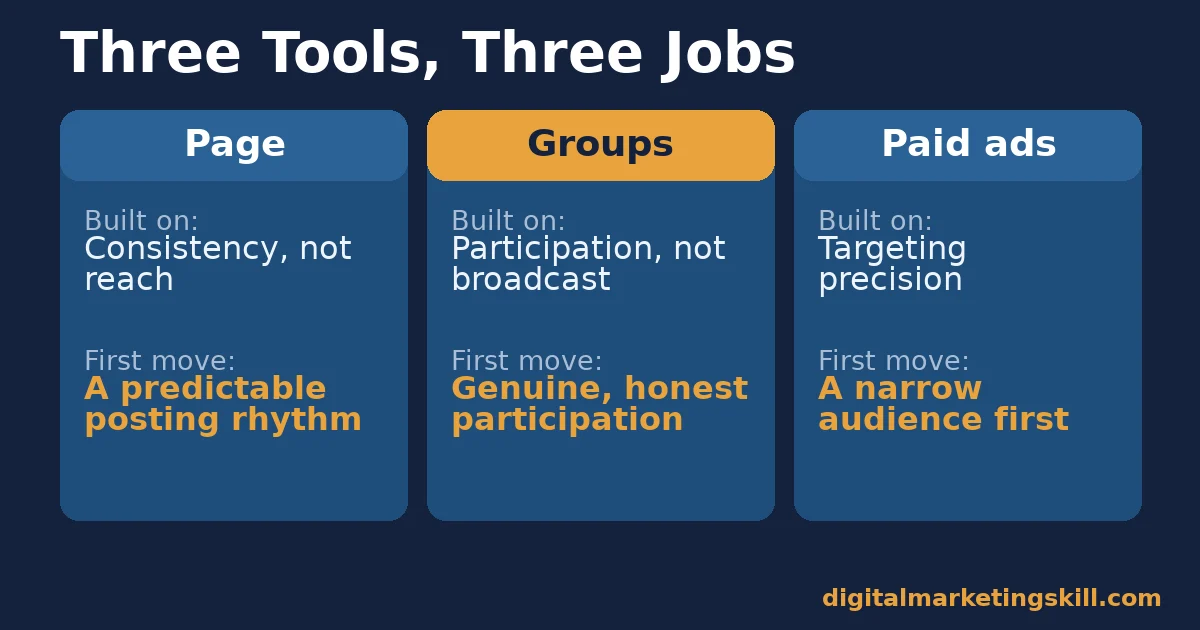
Facebook marketing for business really runs on three tools. Each one is built for a different outcome, and mixing up their jobs wastes effort.
A quick way to choose where to start: if you have no following yet, start with Groups. If you have some following and want to build trust over time, focus on organic Page content. If you need customers now and have a budget, start with paid ads.
Most businesses doing Facebook marketing for business well end up running all three at once. They rarely run all three at the same intensity, though. A seasonal retailer might lean on ads during a launch window and coast on organic content the rest of the time. A service business built on referrals might live mostly in Groups. For them, the Page becomes simple proof of credibility for anyone who checks.
Organic Page Content: Built on Consistency, Not Reach
Organic Page posts are built for relationship, not scale. With engagement rates under 0.2%, a Page post will not reach most of your followers, let alone new people. What it can do is keep your business visible to the smaller group who already chose to follow you.
The advantage is cost. Organic posting is free beyond your time. The limit is patience. Growth from organic content alone is slow, and chasing viral reach usually wastes more time than it earns in customers.
For more on this, the Institute’s guide to social media marketing principles that actually grow a page covers the content habits that make organic posts worth the time they take.
Groups and Community: Built on Participation
Facebook Groups work on a different logic than Pages. People join a Group to get or give help, not to watch a brand talk at them. A business that participates genuinely, answering questions and adding value, earns attention that a Page post rarely gets.
The advantage is trust built faster than a Page alone can build it. The limit is time. Group participation cannot be automated or batched the way Page posts can. It demands real, ongoing attention from a real person.
Group participation can eat more time than a small team has. When that happens, the Institute’s guide to social media outsourcing, in-house versus agency covers how to decide whether to hire that attention out instead of dropping it.
Paid Ads: Built on Targeting Precision
Paid ads are built to put a specific message in front of a specific audience on a schedule you control. Organic reach depends on the feed algorithm’s mood. Ad delivery, by contrast, is something you can budget for and measure directly.
The advantage is speed and control. You decide who sees the ad and how much you spend. The limit is cost. Once the budget stops, the reach stops too, unlike a Group relationship or a loyal Page following.
That trade-off is why ads work best as an accelerant, not a replacement, for the other two tools. An ad can put a new offer in front of strangers quickly, but it cannot build the ongoing trust that keeps a customer coming back without further spend.
How to Get Results From Each Tool
Knowing what each tool is built for is only half the job. Each one needs a specific first move to start producing results.
Organic Content: Lead With a Predictable Posting Rhythm
Pick a posting schedule you can actually sustain, even if it is just twice a week. Stick to it for at least a month before judging results. A predictable rhythm matters more than posting frequency, because it is what the small group of engaged followers come to expect.
Follow Meta’s own 80/20 guidance. Keep roughly 80% of posts genuinely useful or interesting, and limit direct promotion to the rest. A feed full of offers trains your own followers to scroll past you.
Groups and Community: Lead With Genuine Participation
Join or build one Group relevant to your customers. Spend time answering real questions before you mention your business at all. Trust has to come first, because a Group that feels like an ad channel empties out fast.
When you do mention your business, frame it as one option among several, not a pitch. The credibility you build by being genuinely useful is what makes the mention land.
Paid Ads: Lead With a Narrow Audience First
Start with a small, specific audience rather than the broadest one Meta will allow. A narrow audience costs less to test and gives you a cleaner signal about what message actually works, before you spend real money scaling it.
Run one ad with one clear goal, such as a single product or a single offer. Let it run long enough to gather real data. Switching creative or audience too early makes it impossible to tell what was actually working.
Paid ads reward the same underlying skill covered in the Institute’s guide to job-ready digital marketing skills: the ability to read a result and change one variable at a time, rather than changing everything and hoping.
How to Measure Whether Facebook Marketing for Business Is Working
Facebook marketing for business fails most often not because the tools are wrong, but because nobody defined success before spending time or money on them. Four numbers separate real progress from noise. Each one is defined once here, and they mean something different depending on which tool produced them.
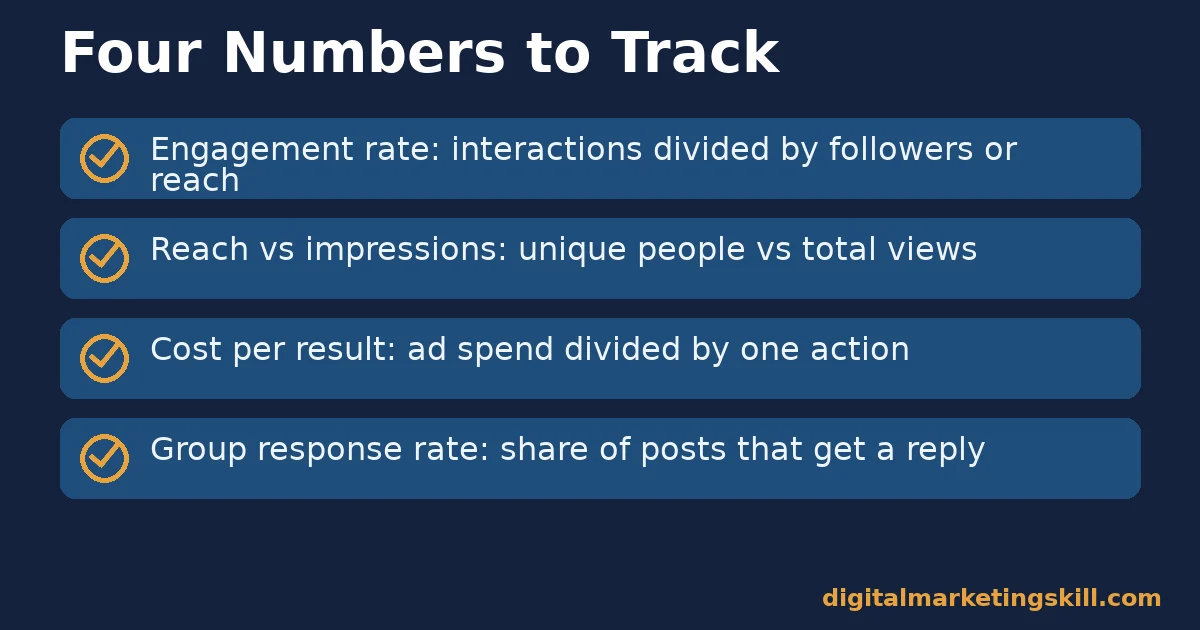
- Engagement rate. This is interactions divided by followers or reach, shown as a percentage. Compare your own Page against Socialinsider’s roughly 0.13 to 0.15% benchmark, not against a friend’s viral post.
- Reach versus impressions. Reach counts unique people who saw a post; impressions count total views, including repeats. A large gap between the two usually means the same small group is seeing your content repeatedly.
- Cost per result. For paid ads, this is total spend divided by the specific action you paid for, such as a click or a purchase. It is the number that tells you whether an ad is actually worth running again.
- Group response rate. This is the share of your posts or comments in a Group that get a reply. A falling response rate is an early sign that your participation has started to feel promotional.
Read reach and engagement together before you read cost per result. A high cost per result with low engagement usually means the message is wrong. A high cost per result with strong engagement usually means the audience or bid is wrong instead.
The One Decision Rule: Spend Only Where You Can Measure a Result
If you take one rule from this guide, make it this one. Do not put budget or time into a Facebook tool until you know exactly which number will tell you if it worked. Vague goals like “get more engagement” lead to vague results.
Illustrative, invented numbers: imagine a small business spending time equally across a Page, a Group and ads, with no tracking on any of them. After a month, they cannot say which tool brought in customers. The same business, tracking cost per result on ads and response rate in the Group, can redirect budget within weeks instead of guessing for months.
The rule holds even when a tool is free. Group participation costs time instead of money, so tracking response rate protects that time the same way cost per result protects an ad budget. A number you never check cannot tell you anything, no matter which tool produced it.
Common Mistakes in Facebook Marketing for Business
Three mistakes account for most of the wasted effort in Facebook marketing for business, and all three are easy to fix once you see them. None of them need a bigger budget to fix. They only need a change in what you measure and when.
The first mistake is judging every post by reach. Group posts are not built for reach, so measuring them the same way as ads hides whether they are actually building trust.
The second mistake is scaling an ad budget before testing the message. A narrow test audience that performs well is a signal to scale. A broad audience that performs poorly from day one is a signal to change the message first, not the budget.
Treating potential reach as a delivery promise is the third mistake. That 2.35 billion account figure describes the outer limit of a targeting tool’s options, not a forecast of your actual results.
A fourth mistake is running all three tools with the same content. A Page caption, a Group comment and an ad headline each need a different tone, because each one meets the reader in a different mood. Copying one into the other three times usually under-performs in all three places.
A Real Case: A Small Ad Budget Turned Into a Measurable Return
Facebook marketing for business does not require a large budget to produce a traceable result. According to a published review on the Digital Marketing Skill Institute’s reviews page, a graduate named Ayooluwa Osemi spent $14 on a Facebook and Instagram ad campaign and generated $878 in sales from it. The campaign matched the paid-ads approach described above: a specific, narrow spend with a clear result to track.
The lesson is in the tracking, not the dollar amount. Osemi could point to an exact spend and an exact return, which is what let the result get verified at all. Without that tracking, the same campaign would have been an unmeasured guess.
Results like this reflect one person’s campaign and market, not a typical outcome, and no outcome is guaranteed; see the Institute’s earnings disclaimer for full context behind any student income figures.
Frequently Asked Questions About Facebook Marketing for Business
Is Facebook marketing for business still worth it?
Yes, but not through organic posts alone. With average engagement rates near 0.13 to 0.15%, a Page by itself rarely reaches new customers. Pairing a Page with Groups or paid ads is what makes the large underlying audience size actually useful to a small business.
How often should a business post on Facebook?
Pick a frequency you can sustain for at least a month, even if that is only twice a week. A predictable rhythm beats an unsustainable burst of posts followed by silence.
Should a small business start with organic content or paid ads?
It depends on your timeline. Organic content and Groups build trust slowly at no direct cost. Paid ads can produce measurable results faster, but the reach stops once the budget does.
What is a good engagement rate on Facebook?
There is no universal good number, because engagement varies heavily by page size and industry. Socialinsider’s benchmark puts the average around 0.13 to 0.15%, so anything meaningfully above that for your page size is a strong result.
Why is my Facebook Page not reaching my followers?
This is normal, not a sign of a broken Page. Organic reach has shrunk industry-wide as feeds prioritize content people already engage with, which is why most businesses now pair organic content with Groups or paid ads.
Does Facebook’s potential reach number mean my ad will reach that many people?
No. Potential reach describes the size of the audience your targeting could include, not how many people will actually see or click the ad. Treat it as a ceiling, not a forecast.
How do I know if my Facebook ad spend is working?
Track cost per result against the specific action you are paying for, such as a click or a purchase. Calculate it before you launch the ad, or you will have no way to judge it afterward.
How is a Facebook Page different from a Facebook Group for business?
A Page broadcasts to followers and competes for feed space the same way a friend’s post does. A Group is a shared space built around a topic, where participation, not broadcasting, earns attention. Treating the two the same way wastes the strength of each, and it is one of the fastest ways to make Facebook marketing for business feel like wasted effort.
Start With One Tool, Track One Number, Then Expand
Facebook marketing for business works best when you stop treating Pages, Groups and ads as one activity. Pick the tool that matches your timeline and budget, define the one number that will tell you if it worked, and give it real time before judging the result.
None of the three tools covered here need to be mastered all at once. Picking one, measuring it honestly, and adding the next tool only once the first is working is enough to start.
The Digital Marketing Skill Institute’s Master Diploma in Digital & AI Marketing covers this in more depth. It pairs courses like AI-Powered Social Media Marketing & Analytics and AI-Powered Google Advertising with unlimited one-on-one coaching and mentoring, plus real project work inside a U.S. partner company.
The diploma is dual US and UK accredited and recognised in more than 100 countries, delivered entirely online, so you can apply what you learn to real campaigns from anywhere in your country.
Explore the program at Digital Marketing Skill Institute, browse more guides on the blog hub, or apply directly whenever you are ready, wherever you live. You can start testing your first tracked campaign today, and the Digital Marketing Skill Institute team is set up to support that process entirely online.
Every figure in this guide was checked against its original source before publication. Figures marked as illustrative are invented examples, not real results.
![9 Amazing Digital Marketing Skills to Make Money Online [With Proof]](https://digitalmarketingskill.com/wp-content/uploads/2019/07/9-Amazing-Digital-Marketing-Skills-to-Make-Money-Online-With-Proof-17.png)