Social media outsourcing means paying a freelancer or agency to run your accounts instead of hiring in-house. The right answer depends on your budget and your posting volume, because those two numbers set the real workload. It does not depend on what a competitor does. Below is a practical way to decide, plus the workload data behind why so many teams get social media outsourcing wrong.
Key Takeaways
- Speed has a price tag now. The Sprout Social Index found three-quarters of consumers expect a brand to respond within 24 hours or sooner, and 73% say they will buy from a competitor if a brand ignores them on social.
- Outsourcing is already the norm at scale. Content Marketing Institute found half of all B2B marketers outsource some content work, and among large companies that share rose from 61% to 75% in a single year.
- Understaffing is the real driver of burnout. Metricool surveyed 927 social media professionals worldwide and found 46% report burnout symptoms, while 75% say they are expected to juggle too many responsibilities at once.
- Most people do this job alone. The same Metricool survey found close to 60% of social media professionals work solo, and even agency and in-house teams describe their staffing as lean relative to what they manage.
- Budget, not preference, decides the model. Low spend favours a freelancer or small agency. Only a larger, steady budget justifies a dedicated in-house hire with benefits and tools included.
In this guide
- What Most Social Media Outsourcing Advice Misses
- Why the In-House vs Agency Decision Matters More Than It Used To
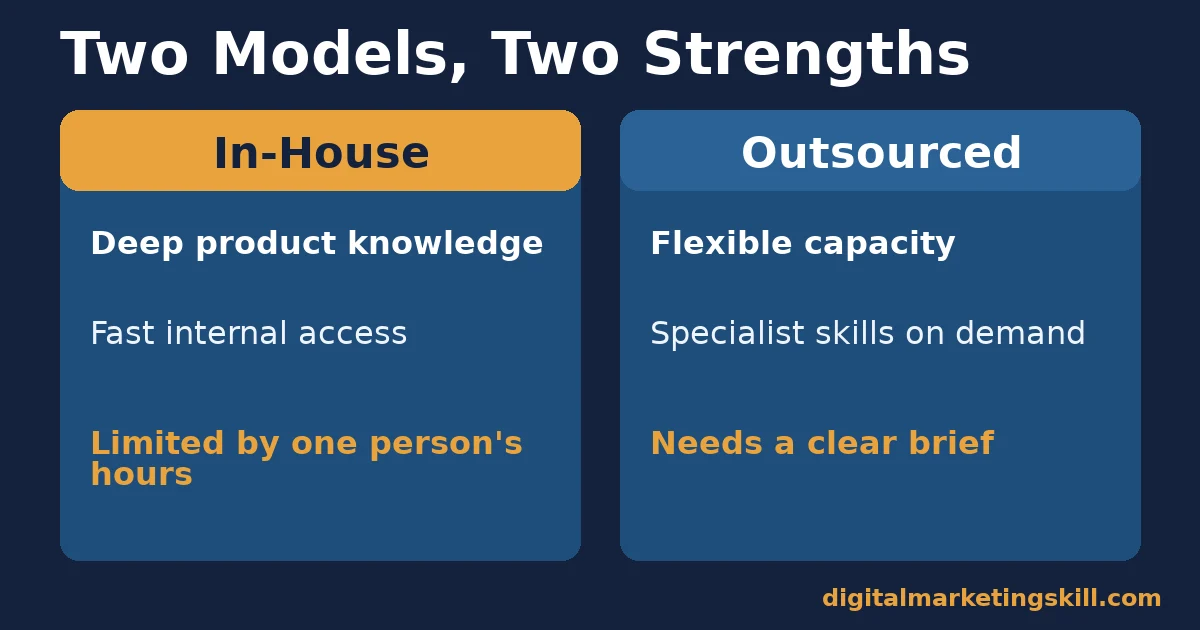
- The Two Real Models: In-House Ownership vs Outsourced Capacity
- How to Choose the Right Model for Each Situation
- Signs You Have Outgrown Your Current Social Media Outsourcing Setup
- Common Mistakes in Both Models
- How to Measure Whether Your Current Model Is Working
- The Most Useful Rule: Size the Model to Your Posting Volume, Not Your Preference
- How Social Media Outsourcing Changes as a Business Grows
- A Real Case: Why Response Speed Became a Measurable Business Risk
- Frequently Asked Questions About Social Media Outsourcing
- Start by Measuring Your Real Workload
What Most Social Media Outsourcing Advice Misses
Most articles present in-house and agency as a culture question. Pick the option that matches your company’s personality, they say. That framing skips the part that actually decides the outcome. How much content do you need? How fast do you need to respond? What can you actually afford to pay for both?
This guide treats social media outsourcing as a capacity problem first and a culture question second. It explains why response speed now carries real commercial weight. It shows how to size the decision against your own posting volume. And it shows how to avoid the burnout pattern that breaks most in-house setups.
A quick ground rule. The response-time and outsourcing figures below come from large surveys of consumers and marketers. They describe averages across many companies, not your specific audience. Treat them as a strong baseline. Check your own data once you have some.
Why the In-House vs Agency Decision Matters More Than It Used To
Social media used to be a nice-to-have marketing channel. It is now a customer service channel with a measurable cost for getting it wrong. According to the Sprout Social Index, three-quarters of consumers expect a response within 24 hours or sooner. Worse for slow brands, 73% of social users say they will buy from a competitor if a brand does not respond to them.
The First-Hour Advantage
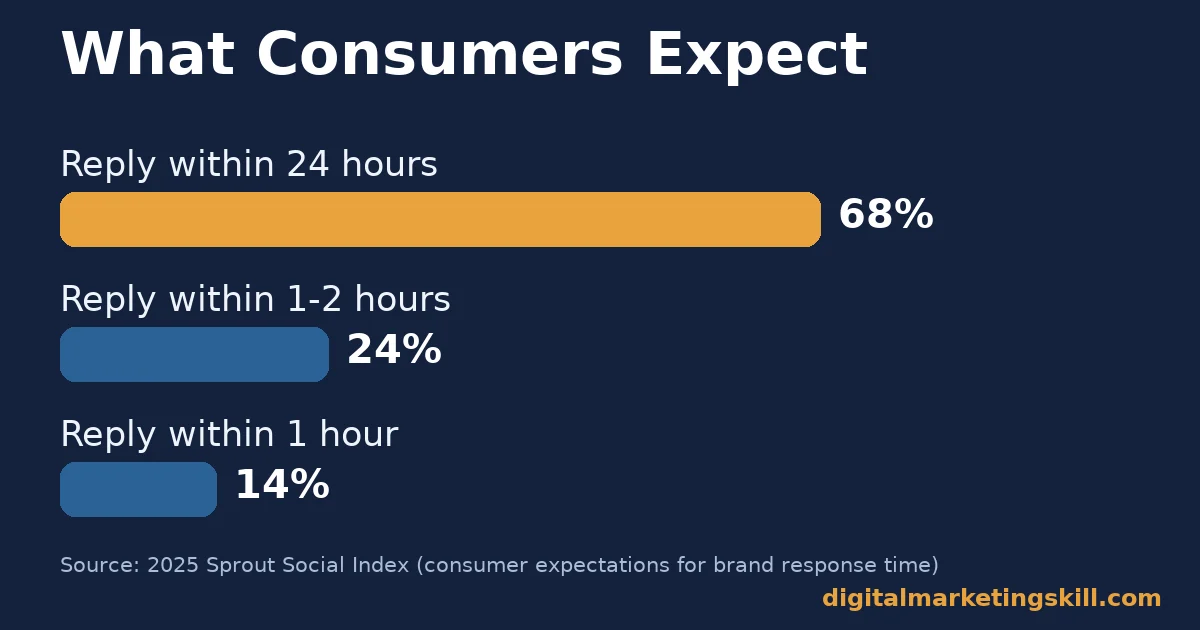
That 24-hour figure is only the baseline, not the ceiling. The same Sprout Social Index breaks the expectation down further. 68% of consumers expect a reply within 24 hours. 24% expect one within one to two hours. 14% expect a reply in under an hour. Whoever runs your accounts, speed is not a nice-to-have anymore. It is table stakes.
That shift changes the stakes of the outsourcing decision. A slow or inconsistent social presence is no longer just a missed opportunity. It is an active reason customers leave. Whoever runs your accounts, in-house or outsourced, needs the capacity to respond fast, not just the ability to schedule posts in advance.
Social Media Is a Capacity Problem Before It Is a Strategy Problem
The Metricool Social Media Well-Being Report surveyed 927 social media professionals worldwide. It found 46% report burnout or near-burnout symptoms. 75% say they are expected to manage too many responsibilities at once: strategy, content creation, analytics, community management and stakeholder communication, often together.
The same report found close to 60% of social media professionals work alone. Even agencies and in-house teams describe their staffing as lean relative to the brands, platforms and content formats they are asked to cover. That gap between workload and headcount is the real reason so many social accounts go quiet or slip in quality. It is rarely a lack of ideas.
The Two Real Models: In-House Ownership vs Outsourced Capacity
Strip away the branding language, and there are really two models. One keeps the work inside the company. The other buys capacity from outside. Each solves a different problem well. Each creates a different failure mode when it is the wrong fit.
In-House: Built for Deep Product Knowledge and Fast Internal Access
An in-house hire learns your product, your customers and your internal approval chain deeply, because that is their only job. They can react to an internal event, a product launch or a customer complaint within minutes. They already sit inside your Slack or email threads.
The tradeoff is cost and ceiling. One person can only produce and respond to so much. Below a certain budget, a single in-house hire is stretched thin across platforms and formats. That is exactly the overload Metricool’s data describes.
Outsourced: Built for Flexible Capacity and Specialist Skills
A freelancer or agency brings capacity that scales up or down with your budget. It also brings specialist skills, such as paid social or video editing, that would be expensive to hire for full time. Content Marketing Institute found half of all B2B marketers already outsource some content work. That share climbs to 75% among large companies.
The tradeoff is context and control. An outside team starts with less product knowledge. It needs a clear brief to stay on brand, and usually works on a response-time service level rather than instant internal access. Social media outsourcing works best when that gap is bridged with a clear brief and a fast approval process.
How to Choose the Right Model for Each Situation
The sections below mirror the two models above. Match your choice to your current posting volume and budget. Do not match it to what looks more professional on paper.
If You Choose In-House: Protect One Person From Doing Five Jobs
Write a job description that names one or two platforms and a realistic weekly post count. Avoid “manage all our social media.” Vague job descriptions are exactly how one hire ends up covering strategy, content, community management and analytics alone. Metricool’s data links that pattern directly to burnout.
Budget for tools and a second pair of hands before you budget for a fancier title. A single in-house hire without scheduling software, design tools or any backup coverage will burn out fast, regardless of how talented they are.
If You Choose Social Media Outsourcing: Brief Like You Mean It
Give any freelancer or agency a real brief. Write down your brand voice. Name three competitor accounts to study. List topics never to post about. A vague brief is the main reason outsourced content misses the brand’s tone, not a lack of skill on the agency’s side.
Set a written response-time expectation in the contract, matched to the 24-hour baseline most consumers expect. Review the first month’s output closely, then step back once the pattern is reliable. Micromanaging every post defeats the purpose of outsourcing capacity in the first place.
Signs You Have Outgrown Your Current Social Media Outsourcing Setup
A model that worked fine a while ago can quietly stop fitting, because volume and expectations both creep up. Watch for these signs, since each one points to a specific fix rather than a full restart.
- Replies are slipping past 24 hours. This usually means the current setup has run out of hours in the day, not that the person or agency has lost skill, so adding capacity fixes it faster than a pep talk.
- The same two platforms get attention, while others go quiet. That is a capacity signal, because a stretched team naturally protects the platforms that feel most urgent.
- Content starts repeating itself. Repetition often shows up when nobody has time left to plan ahead, so the easiest post wins by default. However, readers notice the pattern even when the team does not.
- Nobody can say what last month’s top post was. If reporting has quietly stopped, measurement has likely been cut to make room for output, which is a trade worth reversing.
Any one of these signs is worth a closer look, because each one is cheap to fix early and expensive to ignore. Two or more together usually means the social media outsourcing decision needs revisiting now, not at the next scheduled review. So treat this checklist as a quarterly habit, not a one-time audit.
Common Mistakes in Both Models
Some failures show up regardless of which model you pick. Check your current setup against this list before deciding to switch models. The fix might be simpler than a full restructure.
- No written brand voice guide. Without one, in-house hires drift over time and outsourced writers guess. A simple brand voice guide, built from real examples of your best past posts, fixes both.
- No owner for response time. If nobody is explicitly responsible for replying within 24 hours, replies happen only when someone remembers to check. Therefore, name one owner even if several people help.
- Treating social media outsourcing as a one-off project. A single month of content from an agency with no ongoing relationship rarely builds the consistency platforms reward.
- Switching models during a crisis. Changing from in-house to agency, or back, is disruptive. Plan the switch during a quiet period, not mid-launch.
- No handover documentation. When a hire leaves or a contract ends, undocumented passwords, tone notes and past approvals walk out the door with them.
- No backup for sick days or holidays. A one-person setup with no cover means response times quietly slip the moment that person is away, which is when complaints tend to land hardest. So build a backup plan before you need one, not after.
How to Measure Whether Your Current Model Is Working
Whichever model you run, these metrics show whether it is actually working. They do not just show whether content is going out. Each is defined in one sentence.
Five Metrics That Show the Real Picture
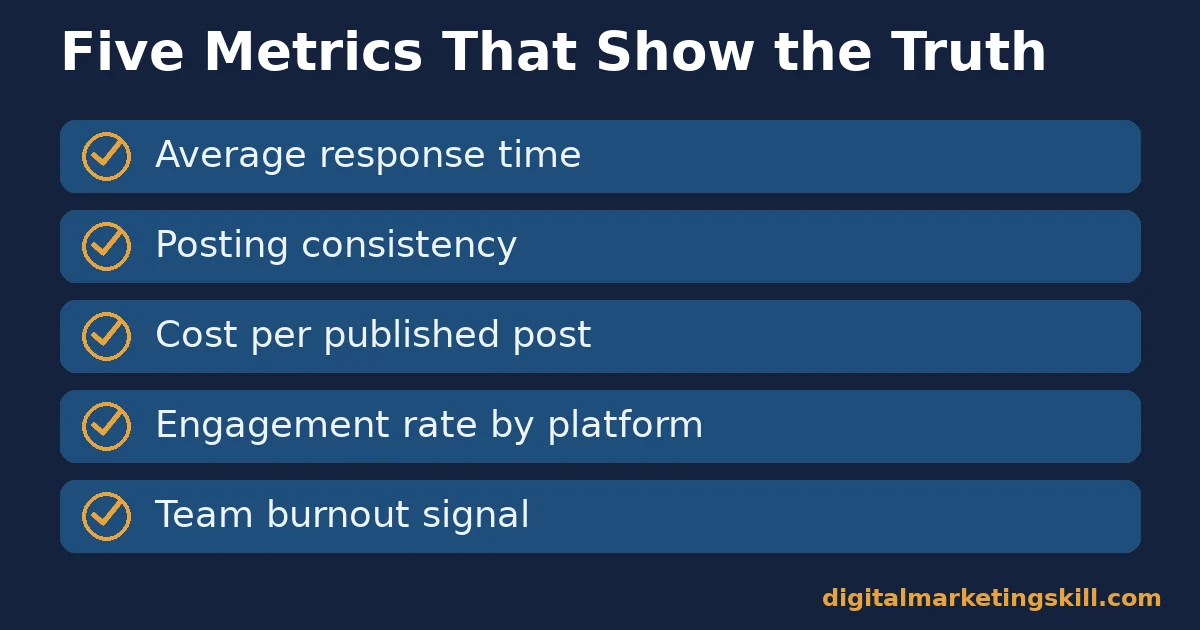
- Average response time. The time between a customer comment or message and your first reply. Compare it against the 24-hour baseline most consumers expect, and aim to beat it.
- Posting consistency. The share of planned posts that actually went out on schedule in a month. A model that cannot hold a schedule is understaffed, whatever the org chart says.
- Cost per published post. Total monthly spend, including salary, tools or retainer, divided by posts published. This makes in-house and outsourced costs directly comparable.
- Engagement rate by platform. Sprout Social defines it as total engagements divided by total reach. Track it per platform, since a drop after switching models is an early warning sign worth investigating.
- Team burnout signal. A simple monthly check-in question: does the current workload feel sustainable? Metricool’s data shows this is not a soft metric. Nearly half of social professionals report burnout symptoms.
Reading the Metrics Together
Read response time and posting consistency first. If both are weak, the model is understaffed, whichever model it is. If response time and consistency look fine but engagement is falling, the problem is probably content quality, not capacity.
Check cost per published post last, against the other four. A cheap model that misses response times and burns out staff is not actually cheap. It is deferring the cost to churn and rehiring.
The Most Useful Rule: Size the Model to Your Posting Volume, Not Your Preference
If you take one decision rule from this guide, make it this. Count your realistic weekly posting volume and response workload first. Then pick the model that can sustainably cover it. Do not pick a model and try to force your output to fit it.
Here is an illustrative example, with invented numbers. A small retailer needs four posts a week on two platforms, plus same-day replies to about 30 comments and messages a week. One in-house hire covers that workload comfortably. A growing retailer needs daily posts across four platforms, video editing and same-day replies to 300 messages a week. That workload needs either several in-house hires or a small outsourced team. Trying to cover it with one in-house generalist is exactly the setup Metricool’s burnout data describes.
How Social Media Outsourcing Changes as a Business Grows
The right model rarely stays fixed, because posting volume and response demand both grow as a business grows. A business that starts with one freelancer handling two platforms often needs a small outsourced team within a year, simply because one person cannot keep pace with daily posting on four platforms plus same-day replies.
Growth can also flip the decision the other way. A company spending heavily on a broad agency retainer sometimes finds that a focused in-house hire, backed by one or two specialist freelancers for design or video, covers the same ground for less and with faster internal access. So the question is never settled permanently. Revisit it on a fixed schedule, such as once a year, rather than only when something breaks.
Whichever direction the business moves, document the reasoning each time. A written record of why you chose in-house, agency or a hybrid makes the next review faster, because you are not starting the analysis from zero.
A Real Case: Why Response Speed Became a Measurable Business Risk
The clearest evidence that social media capacity is now a business risk, not a soft metric, comes from the consumer side of Sprout Social’s own research. Three-quarters of consumers expect a reply within 24 hours or sooner. 73% say a brand’s silence on social media is enough reason to buy from a competitor instead.
That is not a social media metric in isolation. It is a revenue metric wearing a social media costume. A brand that cannot staff fast, consistent responses, whether through an in-house hire or an outsourced team, is quietly losing sales it would otherwise have kept.
Treat this as a floor, not a target. Matching the 24-hour baseline keeps you even with consumer expectations. Businesses that consistently beat it, especially in the first hour or two, tend to see it reflected in loyalty and repeat engagement, even though that gain is harder to isolate in a single public statistic.
Frequently Asked Questions About Social Media Outsourcing
Is social media outsourcing better than hiring in-house?
Neither is universally better. Outsourcing suits lower, variable budgets and specialist skills you would not hire for full time. In-house suits steady, higher budgets where deep product knowledge and instant internal access matter most.
How much does social media outsourcing cost?
Cost varies widely by scope, platform count and content volume, so there is no single reliable figure to quote. Get quotes from two or three providers for your specific posting volume and compare them against the in-house alternative using cost per published post.
Can one person handle social media alone?
Often, but only within a realistic scope. Metricool’s survey found close to 60% of social media professionals already work alone, so it is common. The risk appears when that one person also owns strategy, design, analytics and community management without support.
What should be in a brief for an outsourced social media team?
A written brand voice guide, a list of approved and off-limits topics, a response-time expectation and three competitor accounts to study. The clearer the brief, the less oversight you need later.
How fast should a brand respond on social media?
Within 24 hours at minimum, based on what most consumers now expect. Faster responses, particularly within the first hour or two, tend to be valued even more, though exact gains vary by brand and audience.
What causes burnout in social media roles?
Workload mismatch, not the work itself. Metricool’s research found 75% of social media professionals are expected to manage too many responsibilities simultaneously, with lean staffing relative to what they cover.
Should a small business outsource social media from day one?
Not necessarily. A low, predictable posting volume can often be handled by an owner or a part-time hire. Outsourcing becomes worth considering once volume, platform count or response demands outgrow what one person can sustainably cover.
Can I switch from in-house to outsourced, or the other way round?
Yes, and many businesses do as their budget and volume change. Plan the switch for a quiet period, write down your brand voice and past decisions before the handover, and give the new setup one full month before judging it.
How often should I review my social media outsourcing decision?
Roughly once a year, or whenever posting volume, platform count or budget changes noticeably. A fixed annual review catches a mismatch early, before it turns into the burnout or inconsistency patterns described above.
Start by Measuring Your Real Workload
Social media outsourcing is not a culture decision. It is a capacity decision. Count your realistic weekly posting and response volume this week. Compare it honestly against what your current setup can sustain. Only then decide whether to keep it in-house, outsource it, or split the two.
If you want to build this skill properly, including content strategy, community management and analytics, Digital Marketing Skill Institute teaches it hands-on. The Master Diploma in Digital & AI Marketing covers 10 courses across four AI-powered tracks, including AI-powered social media management and advertising. It comes with unlimited 1-on-1 coaching and mentoring and real project-based work experience with a US partner company from day one. The diploma is dual US and UK accredited and recognised in more than 100 countries.
The program is 100% online, so you can study and apply this anywhere in your country. Related guides, including what social media management actually involves, how to become a social media manager and how to build a content calendar, are on the Digital Marketing Skill Institute blog. When you are ready, apply for the Master Diploma or start from the Digital Marketing Skill Institute homepage.
Every figure in this guide was checked against its original source before publication. Figures marked as illustrative are invented examples, not real results.
![9 Amazing Digital Marketing Skills to Make Money Online [With Proof]](https://digitalmarketingskill.com/wp-content/uploads/2019/07/9-Amazing-Digital-Marketing-Skills-to-Make-Money-Online-With-Proof-17.png)