Target audience segmentation is how you turn “everyone” into a group you can actually reach. Split people by demographic, geographic, psychographic or behavioral traits. Each type answers a different question. So pick the type that matches what you need to decide right now. Validate it with real data, then let your budget decide how deep to go.
Key Takeaways
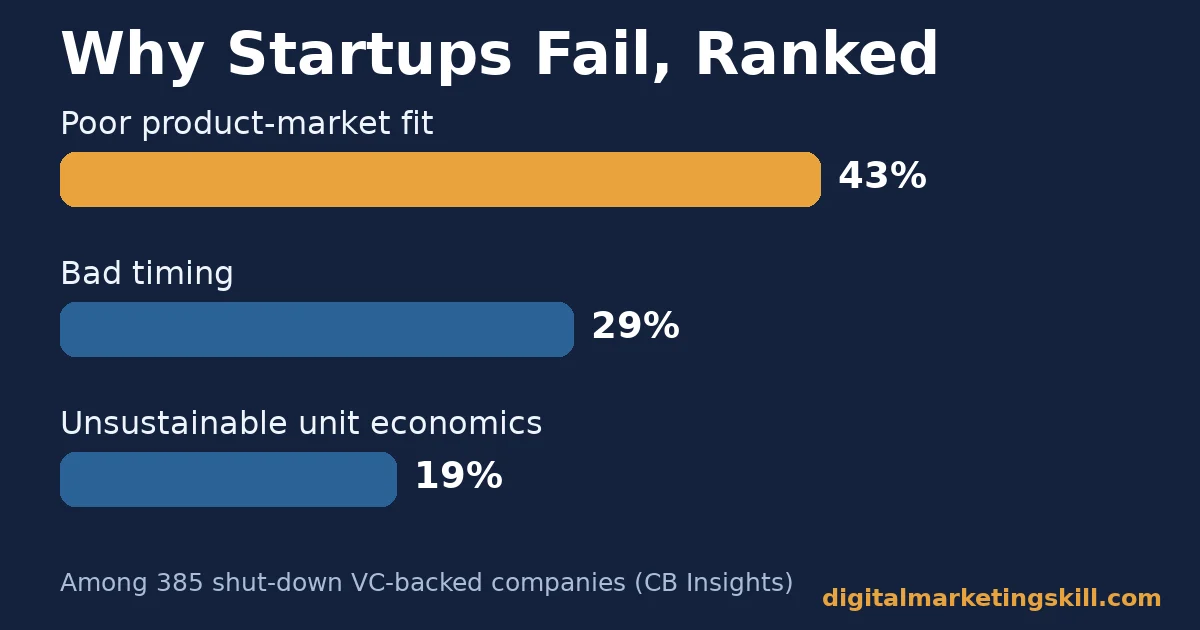
- Vague targeting has a real cost. CB Insights analysed 431 VC-backed companies that shut down. Poor product-market fit was cited in 43% of failures, more than any other reason.
- Most small businesses skip the research. SurveyMonkey asked over 2,000 US small business owners. 62% said they never survey their own customers (US data).
- Few companies execute segmentation well. Research cited from Bain & Company finds 81% of executives call segmentation critical to profit growth, but fewer than 25% believe their company does it well.
- Demographics shift sharply by platform. Pew Research found 80% of US adults aged 18 to 29 use Instagram, versus 19% of adults 65 and older (US data).
- Personas can move real revenue. Thomson Reuters reported a 175% increase in marketing-attributed revenue after building buyer personas, per Demand Gen Report.
In this guide
- What Most Advice on Target Audience Segmentation Gets Wrong
- Why Target Audience Segmentation Changes What You Build
- Four Types of Target Audience Segmentation, and What Each Is For
- Common Mistakes That Undermine Target Audience Segmentation
- How to Research Each Type of Target Audience Segmentation
- How to Measure Target Audience Segmentation
- The One Decision Rule: Start With the Type Your Current Data Can Validate
- A Real Case: Segmentation Realigned a Growth Strategy
- Frequently Asked Questions About Target Audience Segmentation
- Start With One Segment, Then Build the Rest
What Most Advice on Target Audience Segmentation Gets Wrong
Most guides treat target audience segmentation as one step: write a persona, move on. That misses the point. Segmentation is not one thing. It is four different lenses, and each one answers a different question about your buyer.
This guide ranks four types of target audience segmentation by what each is actually good for. It shows how to research each one. It also gives you a rule for choosing where to start, based on your budget and your current customer data.
A few ground rules first. The figures below come from named, dated studies with their own limits. Several are US-only. One company case is a single result, not a guarantee. Treat every number as a snapshot of one study, not a universal law.
One more rule worth stating plainly: more segments is not automatically better. A business with four carefully validated segments usually outperforms one with twelve vague ones. That is because every extra segment needs its own message, its own budget and its own measurement. So depth beats a long list.
Why Target Audience Segmentation Changes What You Build
Without segmentation, every decision defaults to a guess: which channel, which message, which offer. CB Insights studied 431 VC-backed companies that shut down. Poor product-market fit was the top cause, cited in 43% of cases. A clearer target audience does not fix every business problem. But it removes the biggest source of wasted spend: building for people who were never going to buy.
The same logic holds at a smaller scale. A single ad, email or landing page built for an undefined audience has to speak to everyone a little, which usually means it speaks to no one strongly. Target audience segmentation exists to fix that one problem, one group at a time.
The Research Gap Most Businesses Never Close
SurveyMonkey asked more than 2,000 US small business owners about customer research. 62% said they never survey their own customers. That gap is where target audience segmentation usually breaks down. Teams write a persona from assumptions, then never check it against real buyers.
The fix does not need to be expensive. A single short survey to your existing customer list, or ten direct conversations, closes most of that gap. The cost of asking is small. The cost of guessing wrong, repeated across every campaign you run, is not.
Segmentation Pays Off, When Teams Actually Run It
Research cited from Bain & Company, summarised by GreenBook, puts this gap in numbers: 81% of executives call segmentation critical to profit growth. Fewer than 25% believe their own company executes it well. The strategy is not in doubt. The execution is.
Four Types of Target Audience Segmentation, and What Each Is For
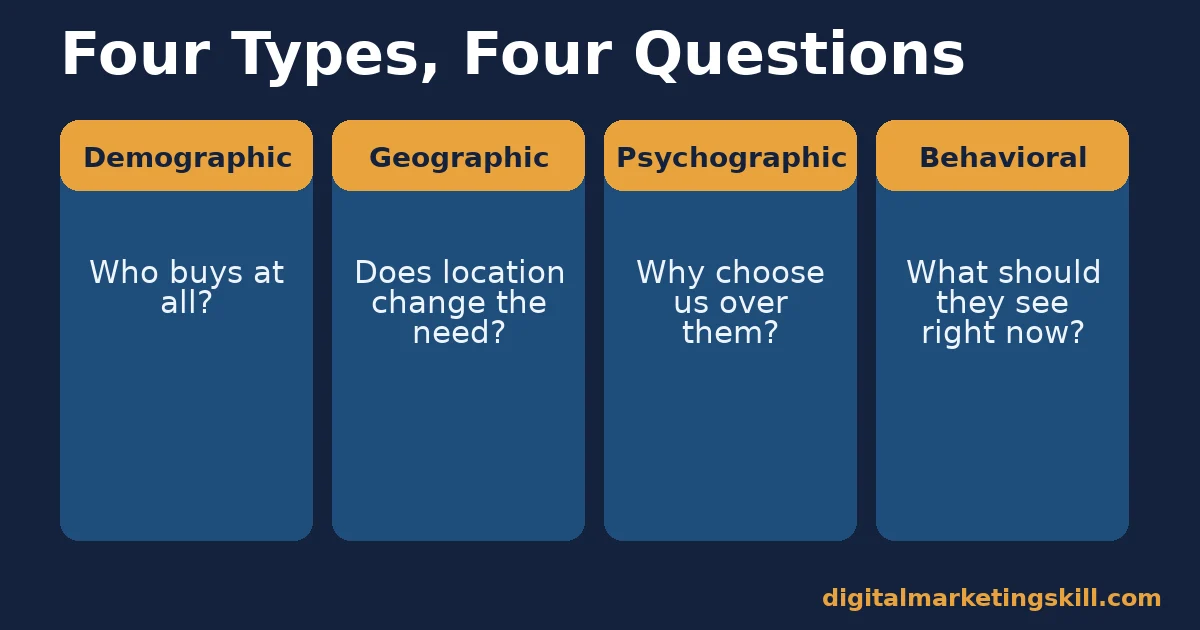
Each type of target audience segmentation answers one specific question. Mixing them up wastes research time on the wrong question for the decision in front of you.
Combining Types Without Losing Focus
Most real audiences are not described by a single type alone. A useful segment often combines two: for example, a demographic group in one geography, or a behavioral trigger inside one psychographic cluster. So the goal is not picking one type forever. It is researching each type well enough that combining them later is based on evidence, not guesswork.
Start narrow anyway. Research one type thoroughly before you layer a second on top. A combined segment built from two shallow research passes is weaker than a single segment built from one deep pass.
Demographic: Built for Broad, Fast Targeting
Demographic segmentation groups people by age, income, gender, education or occupation. It answers a simple question first: roughly who buys this at all? It is the fastest type of target audience segmentation to build. That is because the data is often already sitting in your checkout or sign-up form.
Platforms also make demographic data easy to act on. Google Ads’ own documentation on audience segments explains how ad platforms build these groups directly from account and behavior data, ready for targeting.
Geographic: Built for Local and Regional Relevance
Geographic segmentation groups people by where they live, work or shop. It answers a different question: does location change what this person needs? So for a service with local delivery, store hours or regional pricing, this type of target audience segmentation often matters more than age or income.
It also changes which channel earns attention. A campaign built for one city rarely translates word-for-word into another region, even within the same country.
Psychographic: Built for Message and Positioning
Psychographic segmentation groups people by values, interests, attitudes and lifestyle. It answers the hardest question: why would this specific person choose you over the alternative? According to a compilation citing Demand Gen Report, Thomson Reuters reported a 175% increase in marketing-attributed revenue after building personas around this kind of insight. It also saw a 10% rise in leads sent to sales and a 72% faster lead conversion time.
Treat that case as one company’s result, not a universal multiplier. Psychographic data is harder to collect than demographic data, because it rarely sits in a database already. It usually needs direct conversation, and it should shape your content marketing strategy once you have it. Turning that research into a single customer avatar is often the fastest way to put it to use.
Behavioral: Built for Timing and Personalization
Behavioral segmentation groups people by what they actually do: pages viewed, items purchased, emails opened, features used. It answers a timing question: what should this person see right now? Unlike the other three types, behavioral segmentation shifts in real time as someone’s actions change.
This makes it the most precise type of target audience segmentation and also the most data-hungry. It needs tracking in place before it can tell you anything, and it pairs naturally with marketing automation once a trigger is defined.
Common Mistakes That Undermine Target Audience Segmentation
Most failed target audience segmentation traces back to one of five habits. Check your own research against this list before you trust it.
- Writing a persona from imagination. A persona built entirely from assumptions is a guess wearing a name and a photo, with no survey, interview or sales data behind it. So treat it as a hypothesis to test, not a finished answer.
- Mixing segmentation types in one exercise. Trying to capture age, values and behavior in a single workshop produces a shallow pass at all three. Research one type properly, then move to the next.
- Treating a persona as permanent. Buyers shift as a product, price or market matures. A persona written two years ago and never revisited is quietly guiding decisions for a customer who no longer exists.
- Segmenting too finely to act on. A segment of twelve people is interesting, not actionable. Keep each segment large enough to build a real campaign, offer or message around.
- Skipping the data you already own. Teams often commission new research while ignoring data they already have: checkout history, support tickets, and existing reviews that already describe the real buyer in detail.
How to Research Each Type of Target Audience Segmentation
Knowing what each type is for is only half the job. The other half is collecting real data for it, instead of guessing. None of the methods below need a large budget. Most need an hour and a willingness to ask customers direct questions.
Demographic: Lead With Your Existing Customer Data
Start with people who already bought from you. Pull age, location and any other field you already collect at checkout or sign-up. This is the cheapest target audience segmentation research you can do, because the data already exists.
Add one direct question if you can: a short survey asking who bought, and why. Even a handful of responses beats a guess.
Geographic: Lead With Where Demand Already Exists
Check where your current traffic, orders or enquiries already come from before you guess at a new region. Search and map data usually show real demand before you spend a cent on expansion.
If you serve a local area, your WordPress SEO and local listings carry real weight here. They are often the first local signal a new customer sees.
Psychographic: Lead With Direct Customer Conversations
Interview five to ten real customers before writing a persona from assumptions. Ask what almost stopped them from buying, and what finally convinced them. Those answers reveal values and objections no dashboard shows directly.
Review comments and support tickets are a free, ongoing version of the same research. Read them for language patterns, not just complaints.
Behavioral: Lead With On-Site and Purchase Data
Set up basic event tracking before you try to personalize anything: pages viewed, items added to cart, emails clicked. Behavioral target audience segmentation is only as good as the tracking feeding it.
Start with one clear trigger, such as cart abandonment, before building out a full behavioral program. One well-tested trigger beats five untested ones.
How to Measure Target Audience Segmentation
A segment you cannot measure is just a label. So before you build a campaign around any segment, decide how you will know whether it worked. Each metric below is defined in one sentence.
Five Metrics That Show Whether a Segment Is Working
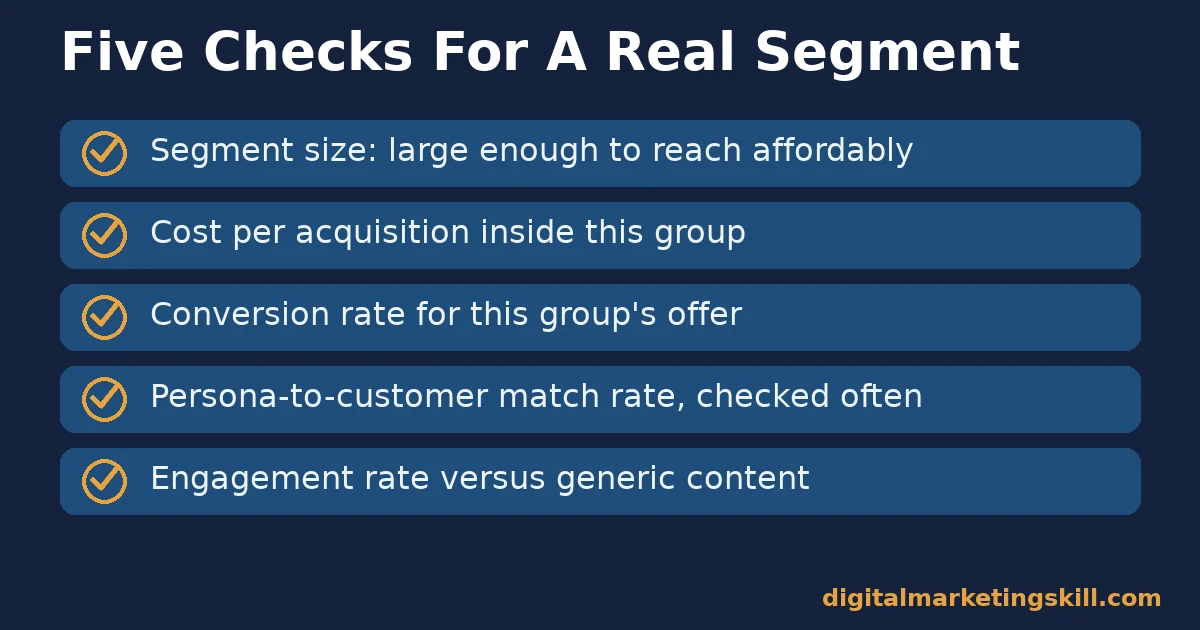
- Segment size. How many real people fit this group. A segment too small to reach affordably is not useful, no matter how precise it feels.
- Cost per acquisition, by segment. What it costs to win one customer inside this specific group. Compare it against the same number for your broader audience.
- Conversion rate, by segment. The share of this group that completes your offer. A segment that converts well is worth deeper research time, and our guide to lead conversion strategies covers how to raise that rate once you know it.
- Persona-to-customer match rate. The share of real buyers who actually match the persona you wrote. Check this quarterly, not once and never again.
- Engagement rate, by segment. How much this group interacts with content built for them, compared with generic content. A gap here shows the segmentation is working.
How to Read These Numbers Together
Start with segment size and cost per acquisition together. A cheap segment that is too small to matter is not a win. Then check conversion and engagement, to see whether the message built for that group is actually landing.
Recheck the persona-to-customer match rate on a schedule. Real buyers drift from the original persona as a product or market matures, and old target audience segmentation research quietly goes stale.
Keep the comparison honest by using the same time window for every segment. Comparing one segment’s results over a full quarter against another’s results over a single week will make the smaller sample look more volatile than it really is.
The One Decision Rule: Start With the Type Your Current Data Can Validate
If you remember one rule from this guide, make it this one. Start your target audience segmentation with the type you can check against real data today, not the type that sounds most sophisticated.
Here is an illustrative example, with invented numbers. A small services business has checkout data for 400 past customers, but no survey responses and no behavioral tracking installed. Demographic segmentation is the only type it can validate immediately, so it starts there: age range, location and typical order size. Within a month, it adds one short customer survey to begin psychographic research. Behavioral tracking comes last, once there is enough traffic to make it worth building.
By month three, the business has three validated segments instead of one guessed persona. It did not need new software or a research budget. It needed to sequence the work in the order its own data could support.
The lesson is sequencing, not purity. Each type of target audience segmentation gets added once there is real data to validate it, not before.
A Real Case: Segmentation Realigned a Growth Strategy
Bain & Company published a client case involving a telecommunications company it calls TelecomCo. The business used tiered customer segmentation to realign its growth strategy around actual demand for networked services, rather than a one-size-fits-all sales approach.
As published by Bain, the result included a 15% increase in the networked services business and a 20% boost to enterprise sales through better account planning. The company also exceeded its year-one growth target by one percentage point. Treat this as one published client result, not a guarantee. Results depend on the market, the segments chosen and how well the sales team acts on them.
The lesson generalises past telecoms. TelecomCo did not add a new product. It regrouped existing customers around actual demand, then matched its sales approach to each group. That is target audience segmentation doing its real job. It changes how a business sells to people it already has access to, not just how it finds new ones.
Frequently Asked Questions About Target Audience Segmentation
What is target audience segmentation?
Target audience segmentation is the practice of splitting your potential customers into groups based on shared traits, such as demographics, location, values or behavior. Each type of segmentation answers a different question about who buys and why.
What are the four main types of target audience segmentation?
The four main types are demographic, geographic, psychographic and behavioral. Demographic and geographic are usually the fastest to research. Psychographic and behavioral take more data and effort, but answer harder questions about motivation and timing.
Which type of target audience segmentation should a small business start with?
Start with whichever type you can validate using data you already have. Most small businesses already have basic demographic data from checkout or sign-up. That makes it the cheapest starting point, even if a different type ends up mattering more later.
How many customers do I need to interview for psychographic research?
Five to ten structured interviews with real customers can reveal real patterns in values and objections. The goal is identifying repeated language and reasons, not reaching statistical significance.
How is behavioral segmentation different from demographic segmentation?
Demographic segmentation is relatively static: age and location rarely change week to week. Behavioral segmentation shifts constantly, based on what someone just did, such as viewing a product or abandoning a cart. So it needs live tracking, not a one-time survey.
How often should I update my target audience segmentation?
Recheck your persona-to-customer match rate at least quarterly. Markets and buyers shift, and segmentation research done once and never revisited slowly drifts away from who is actually buying.
Can target audience segmentation help a business that already has customers?
Yes. Existing customer data is usually the fastest, cheapest segmentation research available, because you do not need to guess. Start by segmenting the customers you already have before trying to find new ones.
How many segments should a small business maintain at once?
Most small businesses get more value from three or four well-researched segments than from a long list of thin ones. Each segment needs its own message and its own tracking, so fewer, deeper segments are usually easier to act on and measure.
Start With One Segment, Then Build the Rest
Target audience segmentation works best built one type at a time, starting with whatever data you can validate today. Pick the type that matches your current decision, research it properly, and measure whether it actually changes conversion before you add the next layer.
If you want guided, hands-on practice building and researching real audience segments, Digital Marketing Skill Institute can help. Its Master Diploma in Digital & AI Marketing is built from four AI-powered tracks across ten execution-first courses. One of them is AI-Powered Lead Generation and Email Automation, and a Full Stack option covers all four tracks. It comes with unlimited 1-on-1 coaching and mentoring, plus a U.S. Project Internship with a verified U.S. Work Reference Letter. The diploma is dual US and UK accredited and recognised in more than 100 countries.
The programme is 100% online, so you can research and apply target audience segmentation from anywhere in your country. Browse more guides on the Digital Marketing Skill Institute blog. Read more outcomes on the reviews page. When you are ready, apply for the Master Diploma or start from the Digital Marketing Skill Institute homepage.
Every figure in this guide was checked against its original source before publication. Figures marked as illustrative are invented examples, not real results.