
Why online businesses fail usually comes down to a short, repeatable list of causes, not bad luck. Roughly half of new US business establishments survive five years, per government tracking data.
Most failures are clearly visible for months before the business actually closes, if you genuinely know where to look. This guide covers how failure actually happens, what differs by cause, and one simple rule for catching it early enough to matter.
Key Takeaways
- Running out of capital is cited in 70% of startup failures, but it is almost always the final symptom, not the root cause, according to CB Insights.
- Poor product-market fit is cited in 43% of failures, more than bad timing or weak unit economics.
- The average online cart abandonment rate is 70.22%, an aggregate of 50 shopping studies. Much of that loss happens quietly, with no complaint at all.
- A one-second delay in mobile page load, from one second to three, raises bounce probability by about 32%, per Google’s own research.
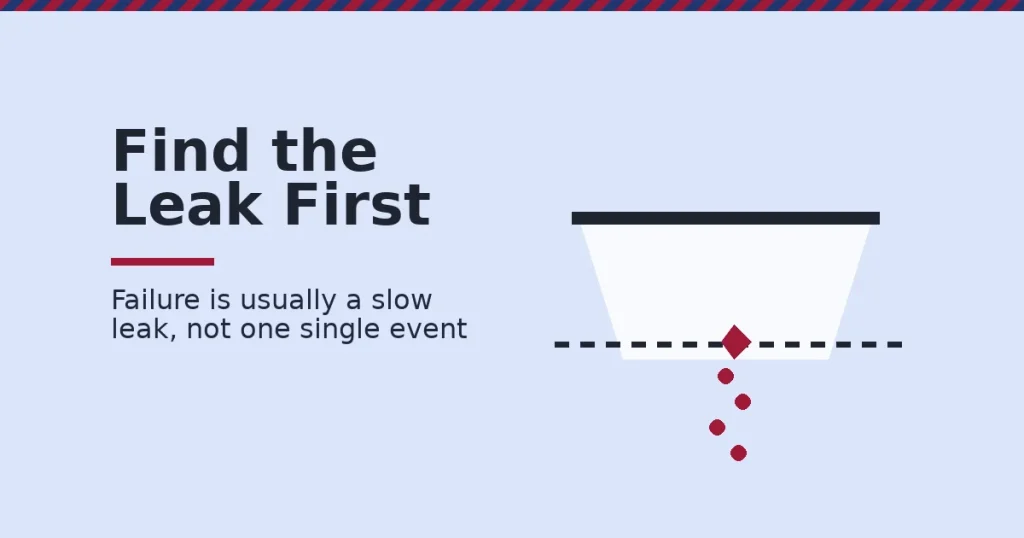
- Failure is rarely one event. It is usually a slow leak across cash, product fit and trust that nobody tracked until it was too late.
In this guide
- Why “Top 10 Reasons” Lists Do Not Prevent Failure
- Why Online Businesses Fail: A Slow Leak, Not a Single Event
- What Differs in Why Online Businesses Fail, by Cause
- How to Catch Each Cause Early
- Measuring Survival: Define Every Number Before You Need It
- The One Decision Rule: Fix the Shortest Runway First
- Common Mistakes That Explain Why Online Businesses Fail Faster
- A Real Case: What Everpix’s Shutdown Actually Teaches
- Frequently Asked Questions About Why Online Businesses Fail
- Build the Skill That Catches These Problems Early
Why “Top 10 Reasons” Lists Do Not Prevent Failure
Search why online businesses fail and you will find the same list everywhere. No plan. No money. Bad marketing. The list is not wrong. It is just not useful. It never says which reason applies to your business right now, or how early the warning signs actually show up. Understanding why online businesses fail, specifically yours, starts with separating the final symptom from the root cause.
Two ground rules. This is a worldwide playbook. Currency and country-specific numbers are labelled as regional. This is an informed method built from the best public failure data available, not a settled formula, because every business fails for its own specific mix of reasons. Use this as a checklist to test against your own numbers, not a guarantee.
Roughly half of new US business establishments survive five years. Bureau of Labor Statistics tracking data puts five-year survival for new employer establishments at around 49% across the cohorts it has measured since the mid-1990s. Individual cohorts range from the high 30s to the mid 50s, depending on the economy at launch.
One-year survival has ranged from about 71% to 85% across regions and years, according to the same BLS Business Employment Dynamics data.
These figures describe US employer establishments specifically, not every solo online seller worldwide. Treat them as a useful benchmark rather than an exact prediction for your own market, since survival rates shift with local conditions, funding access and the type of business.
Why Online Businesses Fail: A Slow Leak, Not a Single Event
Failure rarely looks like failure while it is happening. Revenue still comes in. Customers still buy. The business just slowly loses the ability to cover its own costs, one quiet month at a time, until there is no runway left to fix it.
Running out of capital is cited in roughly 70% of startup failures. But CB Insights’ post-mortem analysis calls it “almost always the final cause of death, not the root problem.”
The same analysis found poor product-market fit cited in 43% of failures, bad timing in 29%, and unsustainable unit economics in 19%. This dataset covers venture-backed companies that shut down recently. Treat the exact percentages as a signal from one segment of startups, not a universal law for every small online business.
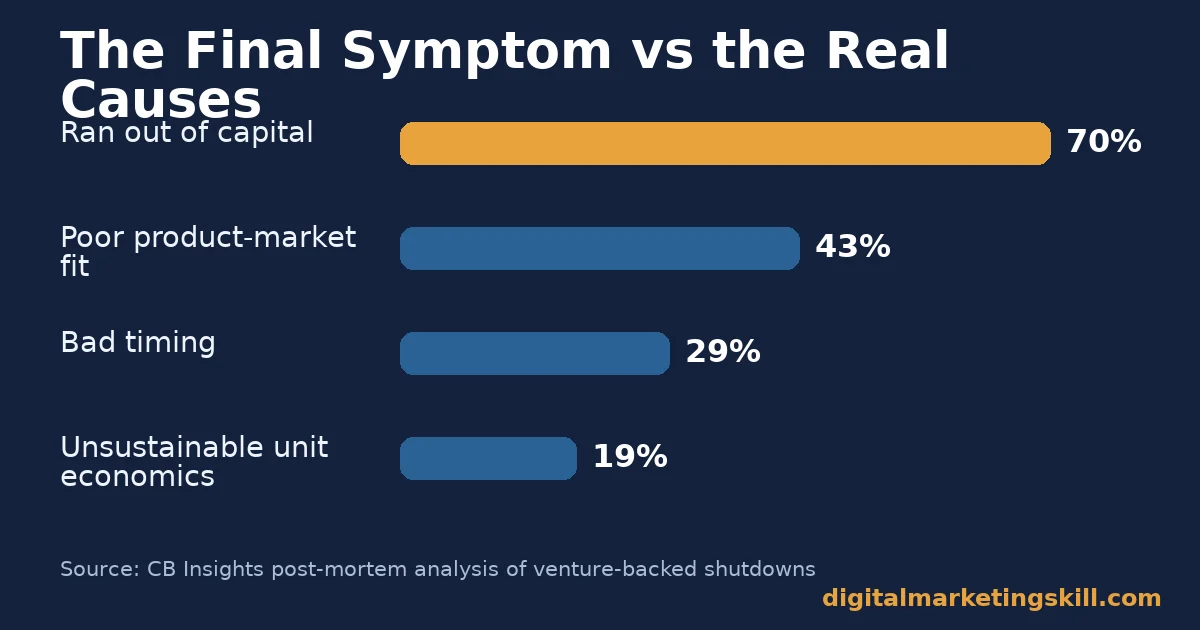
The practical lesson is simple. By the time a business runs out of money, the actual cause has usually been visible for months. A cash shortfall is the symptom. The real cause sits further back, in product fit, pricing, or how much it costs to win a customer.
What Differs in Why Online Businesses Fail, by Cause
Cash Flow Problems: Built for a Slow, Quiet Death
Cash problems rarely announce themselves. A business can be profitable on paper and still run out of cash, because profit and cash are not the same thing. Bills come due on a schedule that does not care when customers actually pay.
A single slow-paying client, a seasonal dip, or an unexpected supplier price increase can each drain a cash position that looked healthy a month earlier. None of these events alone usually ends a business. The danger is that they often arrive stacked. Nobody watches the combined effect until the account balance is already low.
No Real Market Need: Built to Show Up Early, If You Look
A product nobody urgently needs still gets some sales, usually from friends, early adopters, or a short burst of curiosity. The warning sign is what happens after that first wave: flat growth, high churn, or customers who use the product once and never return.
This cause is the easiest to miss, because early sales feel like validation. A founder celebrating the first hundred customers rarely stops to check whether those customers are staying or referring others. Many quietly churn out the back door at the same rate new ones arrive.
Weak Online Trust: Built to Lose Sales Nobody Complains About
A slow page, a confusing checkout, or a site with no reviews does not generate complaints. It just loses the sale silently. A one-second delay in mobile page load, from one second to three seconds, raises bounce probability by about 32%, according to Google’s own research. Nobody emails to say the site was too slow. They just leave.
Checkout itself is its own silent leak. The average online cart abandonment rate is 70.22%, an aggregate of 50 separate studies, according to Baymard Institute. A business can have strong traffic and a product people genuinely want. It can still fail quietly if checkout itself is the weak link nobody tested from a stranger’s point of view.
Founder Overload: Built to Look Like a Marketing Problem
When one person makes every decision, growth eventually outpaces their time. Customer acquisition cost has also risen roughly 60% over the past five years for both B2B and B2C companies, per Paddle’s analysis of subscription businesses. A founder stretched thin is fighting a more expensive market with less attention than before.
This cause often gets diagnosed wrong. Sales slow down, so the founder assumes the marketing is broken and spends more on ads. The real problem is frequently that the founder is the bottleneck on fulfilment, support or product decisions. No amount of extra traffic fixes a business that cannot serve the customers it already has.
How to Catch Each Cause Early
Knowing the cause is step one. Step two is a concrete habit for each one, so the checklist survives a busy quarter instead of staying a good intention.
Cash Flow: Forecast Monthly, Not Annually
Build a rolling 13-week cash forecast and update it every week. An annual budget hides a bad month inside a good year. A weekly forecast shows the dip while there is still time to act on it. Keep the forecast simple: expected income in, committed bills out, and the running balance for each of the next thirteen weeks.
Market Fit: Talk to Ten Real Customers Before Scaling
Before increasing ad spend, call or message ten real customers and ask what almost stopped them from buying. Their answers usually point straight at the gap between what you built and what they actually need.
Repeat this check every few months, since what customers need can shift even after you thought the fit was solid. This single practice addresses one of the most common reasons why online businesses fail after an otherwise promising launch.
Trust: Remove One Friction Point a Month
Pick one barrier each month: a slow page, a confusing form, a missing review section. Our guide to reducing bounce rate walks through the most common fixes in order of impact. Small, steady fixes compound faster than one big redesign, and each one is easy to test before and after.
Founder Load: Document the Decisions Only You Make
Write down every decision that still requires you personally, right now. That list is your real bottleneck. Hand off or simplify one item from it every month, starting with the one that costs you the most hours. A short written process, even an imperfect one, is usually enough to pass a task to someone else safely.
Measuring Survival: Define Every Number Before You Need It
Why online businesses fail is ultimately a measurement problem as much as a strategy one. Every term below matters more during a slow month than a good one, which is exactly when most founders stop tracking them.
- Runway: current cash divided by average monthly burn. Read it as the number of months left at today’s spending pace, not a fixed deadline, since it moves every time revenue or costs change.
- Customer acquisition cost: total sales and marketing spend divided by new customers gained. Compare it against what a customer is actually worth over time, not just against last month’s number.
- Conversion rate: the share of visitors who complete a purchase. A steady drop here, even a small one, is often the earliest readable sign of a trust or pricing problem.
- Monthly burn rate: cash spent minus cash earned in a month. Track it even in profitable months, since one bad month can erase several good ones if nobody is watching.
Review all four together, monthly at minimum. A single metric can look perfectly fine on its own while the other three quietly worsen underneath it.
The One Decision Rule: Fix the Shortest Runway First
Decision rule: whichever resource, cash, customers, or your own time, runs out soonest at the current pace, fix that one before investing anywhere else. A business can survive a weak month in any single area. It rarely survives running out of two at once.
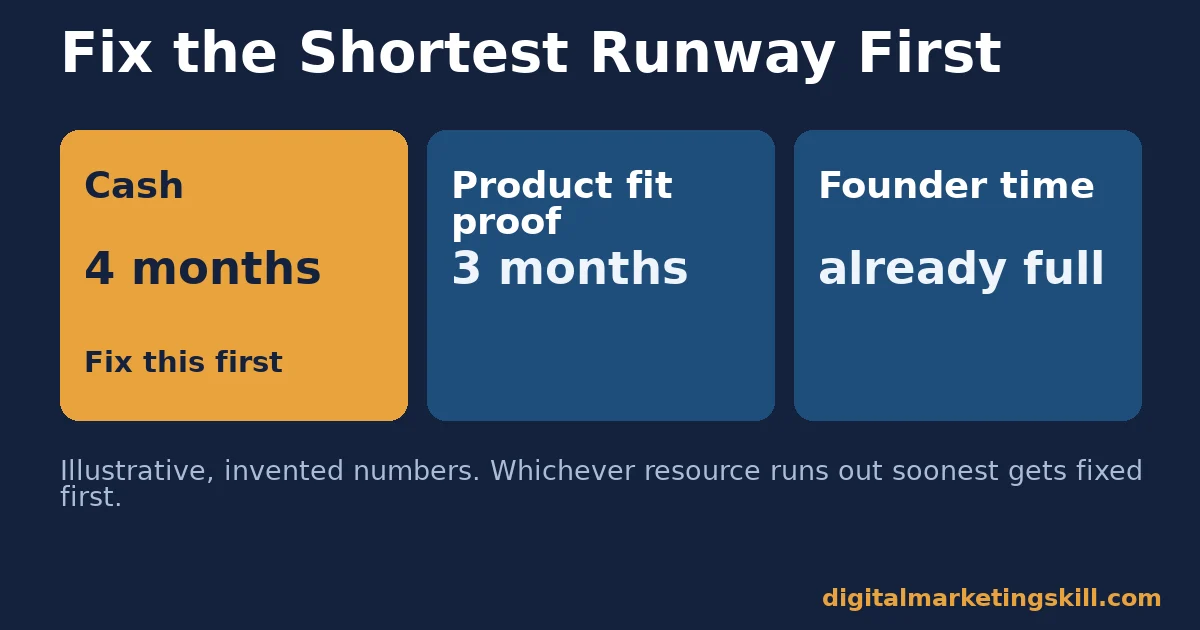
Illustrative, invented numbers to show the rule at work: a founder has four months of cash runway. Their customer base still needs three more months to prove it will stick, and their personal schedule is already fully booked. Under the rule, cash gets fixed first, because it runs out soonest. Product fit gets the next pass once cash buys enough time to test it properly.
This ordering matters because fixing the wrong resource first wastes the time the shortest one was already running out on. A founder who spends a month improving product fit while cash runway quietly drops from four months to three has not gained anything. They have simply spent their scarcest resource on the wrong problem.
Common Mistakes That Explain Why Online Businesses Fail Faster
Four mistakes show up again and again, across industries, business sizes and markets. Checking your own business against this list takes a few minutes and often finds the real cause faster than any new tactic would.
Treating Cash Shortfalls as the Problem, Not the Symptom
Chasing a cash gap with a quick discount or a flash sale can buy a few weeks, but it rarely fixes what actually drained the cash in the first place. Diagnose the root cause before reaching for a short-term patch. This single habit, chasing the symptom instead of the cause, explains a large share of why online businesses fail even after a founder works hard to fix things.
Scaling Before Market Fit Is Proven
Pouring ad spend into a product that has not yet earned repeat purchases just speeds up how fast the underlying problem drains the bank account. Prove the fit on a small scale first, then scale what is already working.
Ignoring Small Friction Because It Feels Minor
A slow checkout step or a confusing return policy rarely generates a single complaint, which makes it easy to dismiss. Multiplied across every visitor, that silent friction is often a bigger drag on revenue than any single marketing decision.
Not Reviewing the Core Numbers Weekly
Monthly or quarterly reviews catch a problem only after it has already compounded for weeks. A short weekly look at cash, conversion rate and acquisition cost catches the same problem while it is still small and cheap to fix. Founders who skip this habit are often surprised, later, to learn that the pattern behind why online businesses fail was visible in their own numbers for months.
A Real Case: What Everpix’s Shutdown Actually Teaches
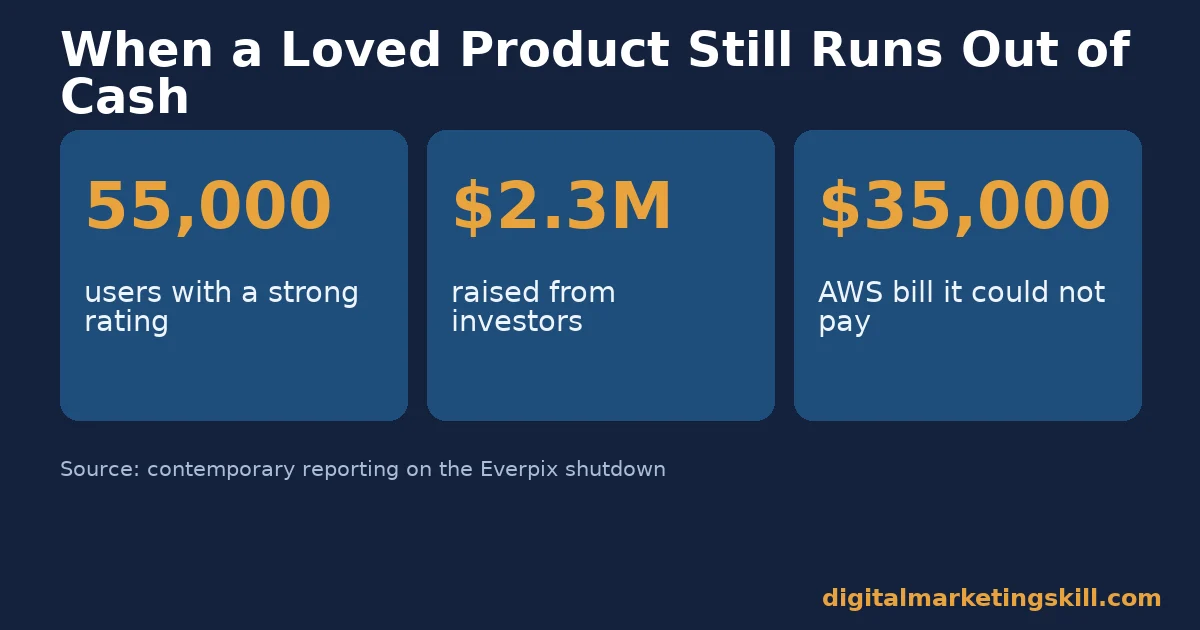
Everpix was a photo storage startup with roughly 55,000 users and a strong product rating. It shut down after it could not pay a $35,000 Amazon Web Services bill, according to reporting at the time. The company had raised $2.3 million. Its freemium pricing never generated enough paying subscribers to cover its running costs.
The limits matter here. This is one well-documented case, not a controlled study. Everpix was a venture-backed startup, not a typical small online business, so the exact numbers will not transfer to a smaller online store or service business. The lesson still generalises: a loved product with no sustainable path from free users to paying ones can run out of cash no matter how good the reviews are.
The mechanism is what makes this case worth remembering. A business can look healthy right up until a single large, predictable bill arrives and there is nothing left to cover it. That bill was never the real cause. It was simply the moment the underlying problem, a monetization model that never matched the cost of running the service, finally became impossible to ignore.
Frequently Asked Questions About Why Online Businesses Fail
What is the single most common reason online businesses fail?
Running out of capital is the most commonly cited final reason why online businesses fail. But it is usually the last stage of a problem that started earlier, such as weak product fit or a customer acquisition cost that was never sustainable. Treating the cash shortage as the actual problem, instead of the symptom, is why the same mistake often repeats in a founder’s next venture.
How long does a typical online business last before it fails?
There is no single number, since it varies heavily by industry and starting conditions. Government survival data for new US businesses puts roughly half still operating at the five-year mark. That is a reasonable worldwide benchmark to plan against. Your own industry and starting capital will shift that number up or down.
Can a business recover after a bad first year?
Yes, often, if the underlying cause gets fixed rather than papered over with more marketing spend. A business that diagnoses whether its real problem is cash, fit, trust, or founder capacity has a real chance to correct course. That chance is best while some runway still remains.
Is running out of money really the main cause, or just the final symptom?
Mostly the final symptom. Research into startup shutdowns consistently finds that capital depletion is the last visible stage of a problem. Poor product-market fit, for example, usually existed well before the money ran out. This is one of the clearest patterns behind why online businesses fail, even when the founders worked hard and the product had genuine fans.
How much cash runway should a new online business keep?
There is no universal number, but tracking runway monthly matters more than hitting a specific target. A rolling 13-week forecast gives enough warning to act before a shortfall becomes a crisis. That habit is often more useful than any single fixed-months rule.
Do online businesses fail for different reasons than physical stores?
The core causes overlap heavily: cash flow, market fit, customer trust and founder capacity all apply to both. Online businesses face some extra, specific friction points, such as page speed and checkout design, that a physical store does not. That is part of why online businesses fail in ways a storefront owner might not immediately recognise.
What is the earliest warning sign that a business is heading toward failure?
A slow, steady decline in conversion rate or repeat purchases, even while total revenue looks stable, is often the earliest readable sign. It usually shows up well before cash flow becomes visibly tight, which is exactly why it gets missed so often.
Build the Skill That Catches These Problems Early
Spotting the real reasons why online businesses fail, early enough to act, is a skill, not luck. It comes from knowing what to track and how to read the warning signs before they become a crisis. That hands-on skill is exactly what the Master Diploma in Digital & AI Marketing at Digital Marketing Skill Institute is built to teach.
What the Program Covers
The program has four AI-powered tracks: social media management and advertising, lead generation and email automation, Google advertising and analytics, and WordPress and SEO. Across all four, it teaches the exact numbers this guide covers, including conversion rate, acquisition cost, and the reporting habits that catch a problem early.
It includes unlimited 1-on-1 coaching and mentoring, plus a U.S. Project Internship with a verified U.S. Work Reference Letter, built in from day one.
Together the four tracks make up a ten-course Master Diploma, with a Full Stack option covering all four. The program is dual US and UK accredited, recognised in more than 100 countries, and runs 100% online. The skill works the same way no matter where you study from.
Where to Go Next
See the full track breakdown on the Master Diploma program page. Read real outcomes on the student reviews page. See how to find and fix the stage of your funnel losing the most sales in our guide to the ecommerce sales funnel. See how to choose channels by cost in our guide to customer acquisition strategy.
When you are ready, apply here, or browse more practical guides on the digital marketing blog. Whatever stage your business is at, you can build this skill from wherever you live. So does Digital Marketing Skill Institute itself, built to work the same way no matter where you study from.
Every figure in this guide was checked against its original source before publication. Figures marked as illustrative are invented examples, not real results.
![9 Amazing Digital Marketing Skills to Make Money Online [With Proof]](https://digitalmarketingskill.com/wp-content/uploads/2019/07/9-Amazing-Digital-Marketing-Skills-to-Make-Money-Online-With-Proof-17.png)






