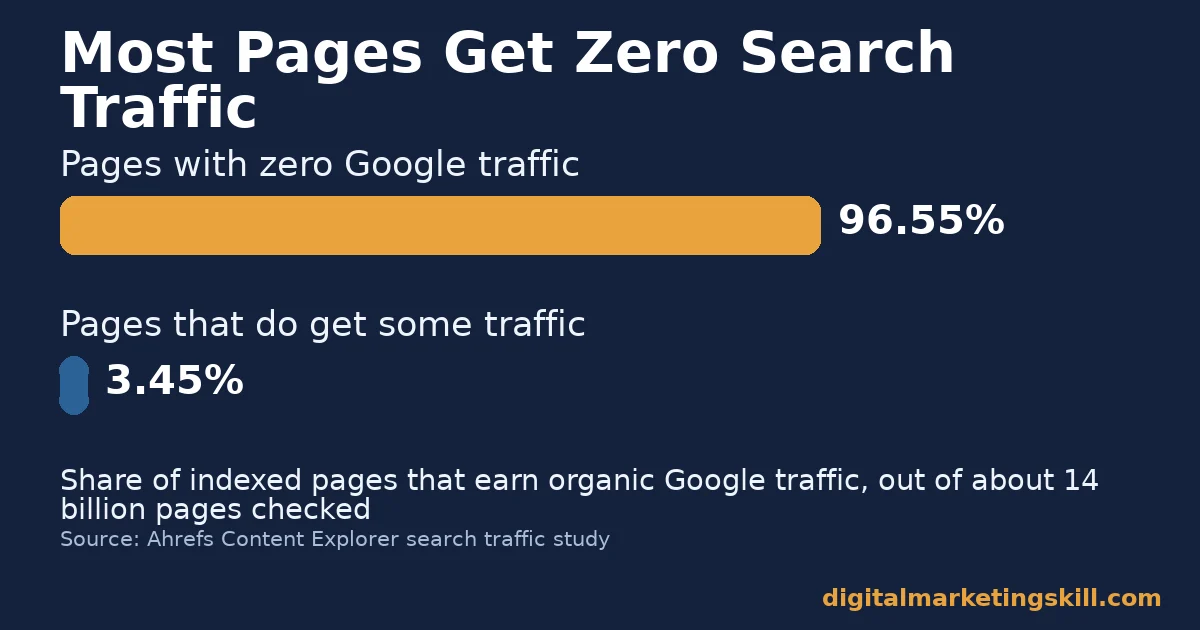
A blog content strategy is the plan behind which topics you write, how you promote each post, and when you update old ones. Most blogs do not fail from weak writing. They fail by skipping two of those three steps. Ahrefs found that 96.55% of indexed pages get zero Google traffic. Orbit Media’s survey of 1,042 content marketers found only 13.9% report strong results.
Key Takeaways
- Most posts are invisible, not bad. Ahrefs found 96.55% of pages get zero Google traffic.
- Effort keeps rising; results do not. Only 13.9% of 1,042 surveyed content marketers report strong results, an all-time low.
- Old posts outperform new ones. HubSpot found refreshed posts gained 106% more organic views; older posts drove 92% of leads.
- Readers scan before they commit. A study of 232 users found an F-shaped scan pattern: top, a lower line, then down the left.
- Promotion is skipped more than it is tried. Influencer collaboration correlates with strong results, yet only 7% of marketers use it now.
In this guide
- What Most Blog Content Strategy Advice Misses
- How a Blog Content Strategy Actually Works
- Three Paths to a Working Blog Content Strategy
- How to Lead With Each Approach
- A Four-Week Plan to Put All Three Paths to Work
- Why the First Screen Decides Whether Any of This Works
- How to Measure Whether Your Blog Content Strategy Is Working
- The Most Useful Rule: Refresh Your Top Fifth Before You Publish More
- A Real Case: Why Upworthy Started Counting Attention Instead of Clicks
- Frequently Asked Questions About Blog Content Strategy
- Common Mistakes That Break a Blog Content Strategy
- Start by Auditing Your Top Five Posts
What Most Blog Content Strategy Advice Misses
Most blogging advice repeats three instructions: write more, write better, share it everywhere. None of that is false. But it treats a blog like a pile of posts, not a system with three connected jobs: choose what to write, get it in front of people, and improve what already exists.
This guide treats those three jobs separately, because each one fails for a different reason. The Ahrefs and Orbit Media figures below come from large datasets and a long-running survey. Read them as strong patterns, not a guarantee for any single blog. The three-part framework here is an informed way to organise the evidence, not a settled formula.
This guide does not claim writing quality is unimportant. Quality alone cannot fix a post nobody searches for. It also cannot fix a strong post nobody sees past its first week. And it makes no promise about timing, since every topic and audience differs. What it does offer is a simple test for any blogging decision: does this choice help someone find the post, help someone promote it, or help an old post earn its traffic back? If the answer is no to all three, the task is probably busywork.
How a Blog Content Strategy Actually Works
A working strategy answers three questions before anyone writes a word. Who is searching for this? How will the right people find the post once it is live? Which existing post deserves improving instead? Skip any one question and the other two go to waste.
Google’s own guidance on helpful, people-first content asks whether a reader would “leave feeling they’ve learned enough” to solve their problem. That test rules out posts written to fill a calendar. For a fuller grounding in the basics, see this step-by-step explainer on content marketing.
Why Most Blogs Skip Two of the Three Jobs
Writing is the visible, satisfying part of blogging, so it absorbs almost all the time. Orbit Media’s annual blogging survey found the average post now takes 3 hours and 20 minutes to write, down from 4 hours 10 minutes a few years earlier, as AI tools took over drafting. That saved time rarely moves to promotion or updates. It just means more new posts, each starting from zero audience and zero backlinks.
The Content Marketing Institute surveyed more than 1,000 B2B marketers. Its top content challenges were prompting readers to act, and measuring whether content works at all, not a shortage of ideas. A strategy that only plans topics never touches either problem. A new post inherits no existing audience to prompt, and no existing data to measure.
Three Paths to a Working Blog Content Strategy
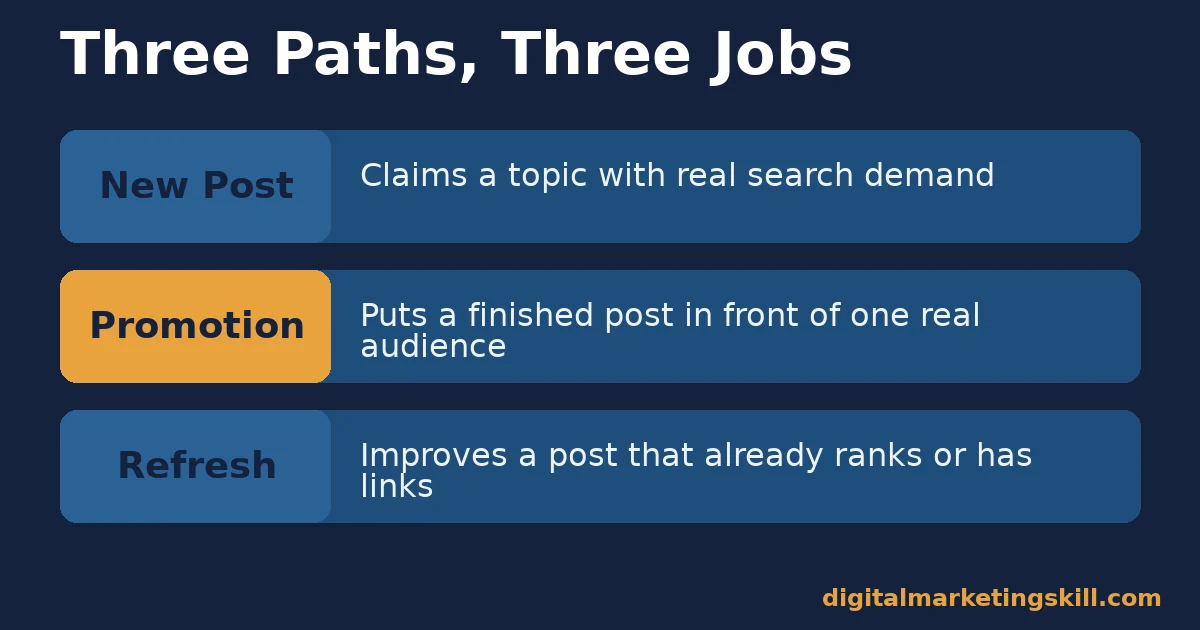
Once a blog has more than a handful of posts, almost every decision falls into one of three paths. Publish something new. Promote something that already exists. Refresh something that is fading. Each path is built for a different result.
New-Post Strategy: Built for Discovery
A new post claims a topic nobody on the blog has covered. It should have real search demand and a realistic chance of ranking. Ahrefs’ search traffic study found a clear pattern: pages with more linking websites tend to get more traffic. Backlinks matter less on low-competition topics with little demand either way.
Promotion Strategy: Built for Reach
A promotion push gets a finished post in front of people who will not find it through search alone. Think email subscribers, a niche community, or a partner’s audience. It borrows attention instead of waiting for Google to grant it.
Refresh Strategy: Built for Compounding Returns
A refresh takes a post that already ranks somewhere, or already has backlinks, and makes it answer the query better than any competitor. HubSpot’s own analysis of historical optimisation found updated posts averaged a 106% gain in organic search views. The post keeps its existing backlinks and ranking history instead of starting over.
How to Lead With Each Approach
Knowing the three paths exist is not the same as using them well. Each one has a first move that makes the rest of the work pay off.
New-Post Strategy: Lead With Search Demand
Before writing, check the exact question has real demand, and that your post can satisfy the intent behind it. A product page will not outrank a comparison article if searchers want a comparison. Ahrefs found that intent mismatch is one of the three main reasons pages get zero traffic, even with backlinks in place. Picking the right target starts with a sound keyword strategy, built on demand rather than guesswork.
Promotion Strategy: Lead With Two Channels, Not Ten
Pick the one or two channels where your actual audience already pays attention. Go deeper there instead of posting everywhere once. Orbit Media’s data shows the paradox clearly. Influencer collaboration correlates strongly with stronger results, yet adoption has fallen as marketers spread thinner across more channels.
Refresh Strategy: Lead With Your Best 20%
Rank your existing posts by traffic or backlinks. Refresh the top fifth first. That is where HubSpot found the largest share of value already sitting: 76% of monthly blog views and 92% of monthly leads came from posts published in previous periods, not the newest ones.
A Quick Self-Check for Any Blog
Ask three short questions about your own blog. Do your newest posts have real search demand behind them? Do your best posts get shared past your own team? Have your top posts been touched recently? A weak answer to any one points straight at the path to fix first.
A Four-Week Plan to Put All Three Paths to Work
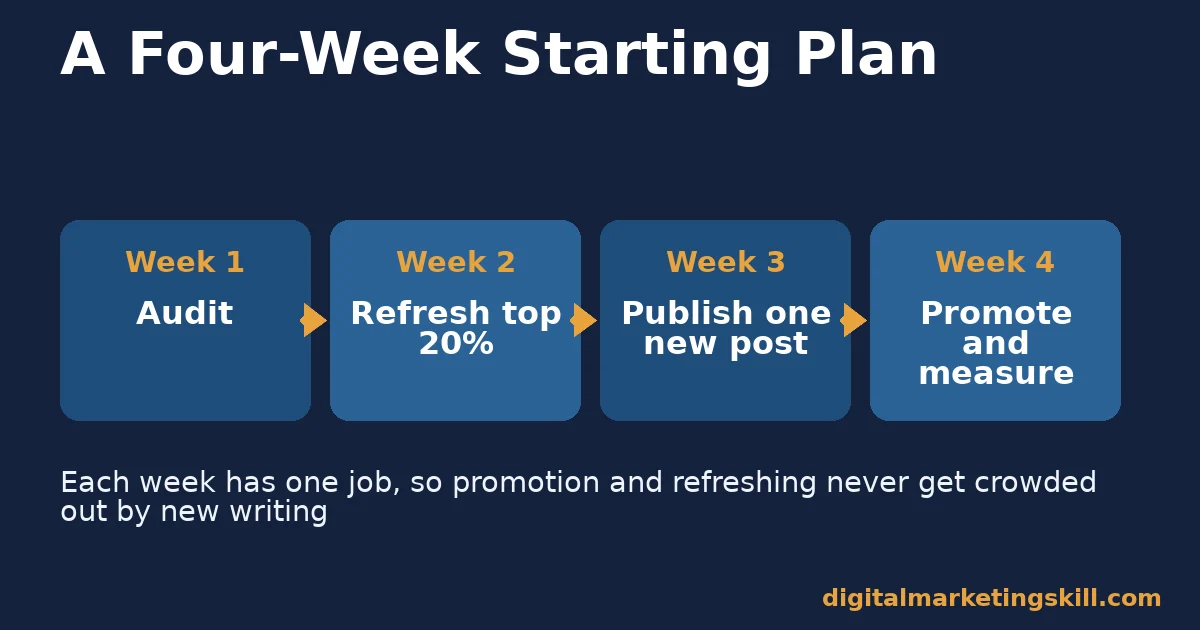
Reading about three paths is not the same as running them. Spreading the work across four weeks stops one path from crowding out the others. That is the exact mistake Orbit Media’s survey keeps finding at scale: writing absorbs the time AI tools save, instead of freeing capacity for promotion or refreshing.
Week One: Audit What Already Exists
List every published post with its organic sessions and referring domains over the last 12 months. Sort from highest to lowest traffic. This spreadsheet usually reveals the shape Ahrefs’ research predicts: a small group of posts carrying most of the traffic, and a long tail getting close to nothing.
Week Two: Refresh the Top Fifth
Take the top 20% of posts from the audit. Rewrite the opening paragraph, update outdated facts, add a missing subheading or example, and strengthen the internal links to and from each one. HubSpot’s data on this exact move showed an average 106% lift in organic search views. This week usually produces the fastest measurable result of the four.
Week Three: Publish One New Post, Built on Demand
Write a single new post, but only after confirming real search demand for the exact question it answers. One well-targeted post beats three written to fill a calendar. Ahrefs found that 96.55% of all indexed pages earn no Google traffic at all, usually because nobody searched for that angle.
Week Four: Promote Through One Channel, Then Measure
Choose the single channel where your audience already spends time: an email list, a niche community, or a partner’s audience. Share both the refreshed posts and the new one there. Close the month by checking the five metrics below against where you started.
Why the First Screen Decides Whether Any of This Works
All three paths can still fail at the same final hurdle: the first screen a reader sees. Nielsen Norman Group’s eye-tracking research tracked 232 users across thousands of pages. It found readers scan in an F-shaped pattern, moving across the top, across a second line further down, then straight down the left side, rather than reading every word.
That means the opening lines and the first subheading carry disproportionate weight. A post can win the search ranking or the promotion click, and still lose the reader in the first ten seconds, if the opening buries the answer under scene-setting. Structure matters as much as research. This guide to SEO writing covers how to build that structure sentence by sentence.
How to Measure Whether Your Blog Content Strategy Is Working
Each of the three paths needs its own measurement. A single blog-wide number hides which lever is actually working.
Five Metrics That Show Which Lever Is Working
- Organic sessions per new post, at 90 days. Shows whether new topics reach searchers at all, separate from older posts still carrying most of the traffic.
- Referring domains per post. A simple backlink count by URL. Ahrefs’ research ties this directly to whether a page can rank for competitive terms.
- Engaged sessions, not raw pageviews. Google Analytics defines an engaged session as one lasting over 10 seconds, including a key event, or including two or more page views. This filters out the F-pattern skimmers who never actually read.
- Traffic lift after a refresh, before versus after. Compare organic sessions for the 90 days before and after an update, to see whether the refresh path is paying off for that post.
- Leads or conversions per post, not per blog. HubSpot’s analysis attributed 92% of blog-generated leads to older posts, a split invisible in a single blog-wide conversion rate.
How to Read These Numbers Together
No single metric proves a strategy is working. A post with rising sessions but no engaged sessions is winning clicks, not readers. A post with strong engagement but no referring domains may be well-liked but invisible to new searchers. A refreshed post with a traffic lift but falling leads may be attracting the wrong audience for the update it received.
Track at least one metric from each path before judging the whole blog. Compare each post against its own history, not a blog-wide average. A handful of top posts can make a flat average look healthier than it is.
Set a simple review rhythm instead of checking numbers only when something feels wrong. A short monthly look at these five metrics, even just five minutes per top post, catches a slipping ranking or a stalled refresh long before it shows up as a drop in overall blog traffic.
The Most Useful Rule: Refresh Your Top Fifth Before You Publish More
If a blog has more than a handful of posts, and strong results are rare, the single highest-leverage move is to refresh the top 20% of existing posts before writing another new one. That is where HubSpot’s data shows the existing value already sitting. It also avoids the trap Orbit Media keeps finding: more new posts, same flat results.
Illustrative, invented numbers: a blog with 40 posts and roughly 3,000 monthly organic sessions typically has 6 to 8 posts carrying most of that traffic. Refreshing those first, before adding post 41, is usually the faster path to a measurable lift. For a wider view of how the pieces fit together, this beginner’s guide to content marketing is a useful companion read.
A Real Case: Why Upworthy Started Counting Attention Instead of Clicks
Upworthy built its early traffic on shareable headlines. It hit the limit of a clicks-only strategy when its own data showed that shares and attention did not move together. Chartbeat’s analysis of about 2 billion visits, reported by its chief executive in TIME, found no relationship between how often a piece was shared and how long readers actually stayed on it.
The lesson for a blog content strategy is the one Upworthy had to learn. A click or a share proves a headline worked, not that the post delivered. Measuring only reach hides that gap. Treat this as one documented case, not a universal law, since every audience and platform behaves differently. The change in measurement, not a change in writing, is what exposed the gap between a popular headline and a post that actually delivered.
The same lesson applies at a smaller scale. A post widely shared on social media, but showing a near-zero engaged session rate in analytics, is behaving like Upworthy’s shared-but-unread headlines. It wins distribution while losing the reader. No amount of extra promotion fixes that if the first screen is the weak link.
Frequently Asked Questions About Blog Content Strategy
How many posts does a blog content strategy need before it starts working?
There is no fixed number. What matters more is whether each post has real search demand behind it, and whether older posts get refreshed, not how many exist in total.
Should a small blog focus on new posts or promotion first?
If a blog has fewer than 20 posts, new posts with real search demand usually matter more. There is little existing content worth promoting or refreshing yet.
How often should an old blog post be refreshed?
There is no universal schedule. A practical trigger is a visible drop in organic sessions or rankings for a post that still has backlinks and relevance. That drop signals competitors have overtaken it.
Does posting more often improve blog content strategy results?
Not by itself. Orbit Media’s survey found publishing frequency has fallen industry-wide, while AI-written volume has risen. Strong results have not risen to match.
What is the fastest way to find which posts to refresh first?
Sort existing posts by organic sessions or referring domains over a recent, consistent period. Start with the top fifth. HubSpot’s data found most of a blog’s existing traffic and leads concentrated there.
Is a content calendar the same as a blog content strategy?
No. A calendar only schedules new topics. A full strategy also covers how each post gets promoted after launch, and when it gets refreshed, which a calendar alone does not plan for.
Do backlinks still matter for a blog content strategy?
Yes, for competitive topics. Ahrefs found a clear correlation between the number of linking websites and a page’s traffic. The link matters less on low-competition topics with little demand either way.
Should every old post be refreshed, or only some?
Only some. Refreshing a post that never had search demand or relevant backlinks rarely changes the outcome. The biggest lift comes from refreshing posts that already have some traffic, links or rankings but have slipped.
Can AI writing tools replace a blog content strategy?
No. Orbit Media found 92.4% of marketers already use AI to help write. Strong results fell to an all-time low of 13.9% over the same period. AI speeds up drafting; it does not fix promotion or measurement on its own.
Common Mistakes That Break a Blog Content Strategy
Most failed attempts at a blog content strategy share a handful of patterns. Spotting them early is easier than fixing a blog after months of effort.
Picking Topics Without Checking Demand First
A topic can feel important internally and still have no real searchers. Because Ahrefs found 96.55% of indexed pages get zero Google traffic, guessing at topics is the single most common way a blog content strategy quietly fails before it starts.
Spreading Promotion Too Thin
Posting once on every available channel feels productive. However, Orbit Media’s data shows the opposite pattern: fewer, deeper channels correlate with stronger results than scattering the same link everywhere once.
Ignoring Posts That Already Rank
It is tempting to treat every new post as the next big opportunity. Still, HubSpot’s data shows that older, already-ranking posts are where most of the blog’s traffic and leads already live. A blog content strategy that ignores them is leaving its biggest lever untouched.
Judging Success by One Metric Alone
Pageviews alone can rise while readers leave within seconds, and shares alone can rise while nobody actually reads the post. So a blog content strategy needs more than one signal before anyone calls it a success or a failure.
Start by Auditing Your Top Five Posts
A blog content strategy becomes manageable once split into three jobs: choose topics with real demand, promote finished posts to the right channel, and refresh what already works. Pick your five highest-traffic posts this week. Check each one against the first-screen test before writing anything new.
The Master Diploma in Digital & AI Marketing at Digital Marketing Skill Institute includes a dedicated content marketing course inside its nine practical courses, alongside SEO, analytics and copywriting. It is built around real project work inside a U.S. company, not theory alone. Every learner gets unlimited 1-on-1 coaching and mentoring. The diploma is dual US and UK accredited, recognised in more than 100 countries, and runs 100% online, so you can build a working content strategy anywhere in your country.
Explore the full digital marketing blog for more practical guides. Browse digitalmarketingskill.com to see the Institute’s full programme, or apply directly whenever you are ready, wherever you live. You can also read real outcomes on the reviews page before you decide, or see the Institute’s homepage for the current programme details.
Every figure in this guide was checked against its original source before publication. Figures marked as illustrative are invented examples, not real results.
![9 Amazing Digital Marketing Skills to Make Money Online [With Proof]](https://digitalmarketingskill.com/wp-content/uploads/2019/07/9-Amazing-Digital-Marketing-Skills-to-Make-Money-Online-With-Proof-17.png)