Social media marketing risks include reputation damage from a viral complaint, slow customer response and an ROI that is hard to prove. None of these risks mean a brand should avoid social media. They mean a brand needs a plan for each one before it posts, not after a crisis starts.
Key Takeaways
- The audience is nearly everyone now, which raises the stakes of every post. DataReportal’s ongoing tracking puts the global social media population at 5.79 billion user identities. That is more than two in three people on Earth. A mistake is not a small, contained event anymore.
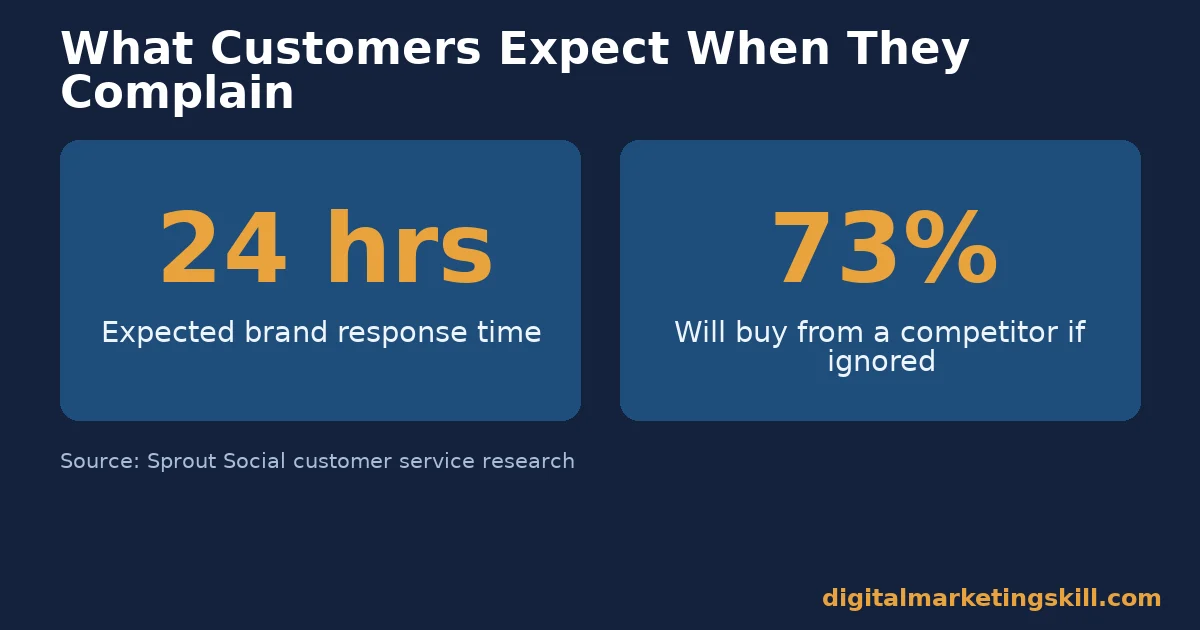
- Customers expect a fast reply, and most brands are not ready for it. Sprout Social’s research found about three-quarters of consumers expect a brand to respond within 24 hours or sooner. A slow response is read as a choice, not an accident.
- Silence has a direct cost. Sprout Social also found 73% of social users say they will buy from a competitor if a brand does not respond on social. Ignoring a comment is not neutral. It actively pushes buyers elsewhere.
- Cost-effectiveness is real, but it hides a different risk. Social platforms are cheap to join. That is exactly why so many under-resourced teams run them without a plan for the social media marketing risks that follow.
- Every risk below has a specific, learnable fix. None of these problems require avoiding social media. They require treating it like any other channel with real exposure: plan first, measure constantly, respond fast.
In this guide
- What Most Social Media Advice Skips
- How Social Media Marketing Risks Actually Play Out in Practice
- Four Social Media Marketing Risks Worth Planning For
- How to Manage Each Social Media Marketing Risk Before It Becomes a Crisis
- How to Measure Whether You Are Managing These Risks Well
- The One Decision Rule: Fix Response Speed Before Anything Else
- A Real Case: What the Numbers Say About Ignoring a Complaint
- Frequently Asked Questions About Social Media Marketing Risks
- Start Managing Social Media Marketing Risks This Week
What Most Social Media Advice Skips
Most social media advice focuses on growth: more followers, more posts, more reach. Growth advice rarely covers what happens when a post goes wrong. It rarely covers a comment thread turning hostile, or a budget review asking for proof the channel is working. Those moments are where social media marketing risks actually show up.
This guide covers four specific risks. They are reach turning into exposure, reputation damage from negative content, a genuinely hard ROI measurement problem, and the time cost of doing it properly. Each has a different shape and a different fix.
None of this is a case against social media marketing. A well-run channel still reaches an audience no other channel can match at the same cost. The risks are real, but so is the upside, and ignoring either one leads to bad decisions.
Risk and upside both scale with reach. So a brand cannot treat social media marketing risks as a side issue once an audience grows past a certain size. Risk management needs to grow alongside the channel itself, not get added later as an afterthought.
How Social Media Marketing Risks Actually Play Out in Practice
A post does not fail quietly on social media. It fails in public, in front of an audience that can reply, screenshot and share within minutes. That visibility is the entire value of the channel. It is also the source of every risk on this list.
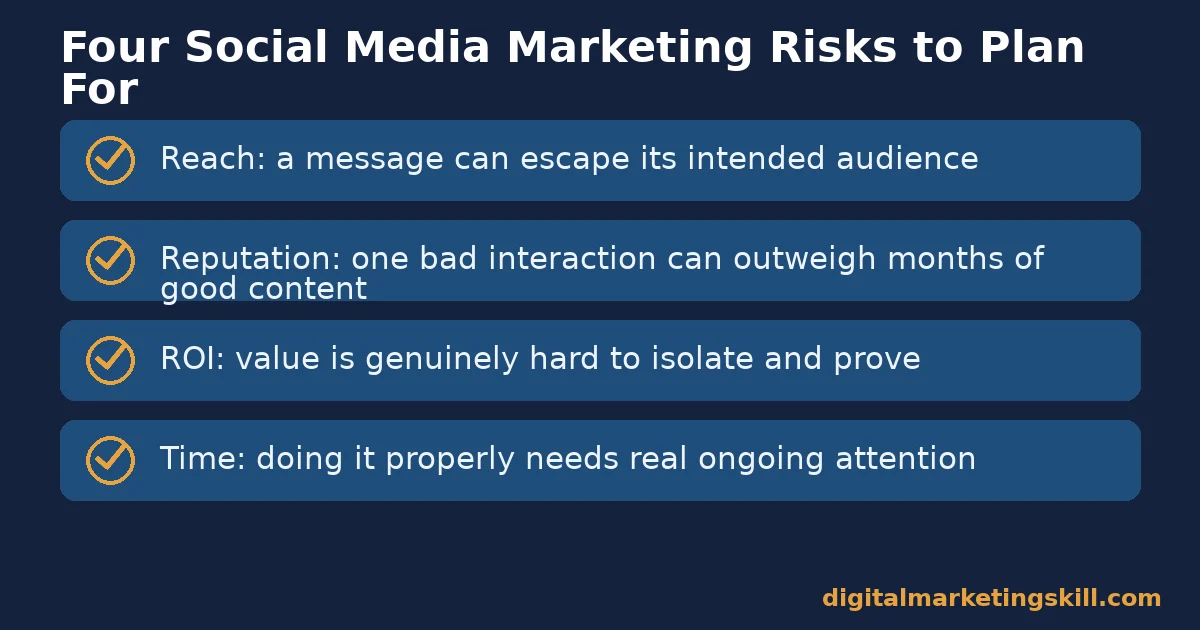
Reach risk comes first. A message meant for existing fans can reach a much wider audience once it is shared outside its original context, and that wider audience is often far less sympathetic. Reputation risk follows close behind. A single bad interaction, handled badly, can outweigh months of good content in a viewer’s memory.
Measurement risk sits underneath both. A channel that is hard to tie to revenue is also hard to defend when a budget gets cut. That stays true no matter how well the channel is actually performing. Time risk is the quiet one. Done properly, social media takes real, ongoing attention, not an occasional scheduled post.
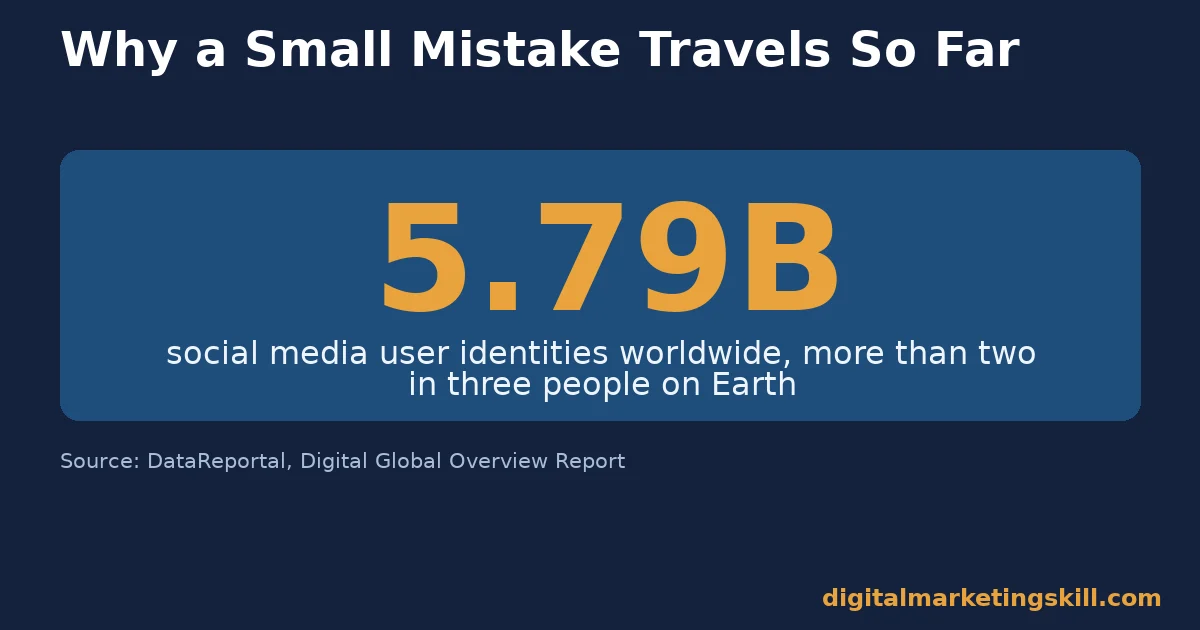
That scale is exactly why small mistakes travel so far. DataReportal’s tracking shows social platforms now reach more than two in three people worldwide. Almost nothing posted publicly stays small for long.
In the United States specifically, Pew Research Center has documented that a meaningful share of social media users report harassment or hostile interactions online. A brand’s comment section inherits that same risk. It arrives the moment the section opens for public replies.
Why Ignoring These Risks Does Not Make Them Go Away
Skipping a plan for these risks does not remove them. It just means the team meets one for the first time during an actual crisis. That meeting happens under pressure, with no process already in place.
Teams that plan for these risks in advance respond faster when something goes wrong. The plan does not prevent every bad moment. However, it shortens how long a bad moment stays bad, which is usually what determines whether a viewer remembers the mistake or the recovery.
Four Social Media Marketing Risks Worth Planning For
Four distinct risks explain most of what goes wrong with an otherwise healthy social media program.
Each one needs its own specific response. Treating them as one general “social media risk” usually means none of them get properly managed.
Reach Risk: Built Into the Same Mechanism That Makes Social Media Work
The same sharing mechanism that spreads a good post spreads a bad one. A message can leave its intended audience and reach people with no context and little goodwill. This is not a flaw in the channel. Instead, it is the channel working exactly as designed, in a direction nobody wanted.
Sharing is frictionless by design. So a single post can outrun a brand’s ability to respond, sometimes within minutes. The same features that make a campaign go well also make a mistake travel just as fast, which is the core trade-off behind every social media marketing risk on this list.
Reputation Risk: Built From a Single Bad Interaction, Not a Pattern
A brand can run a strong social media program for years and still take real reputation damage from one badly handled complaint. Viewers judge a brand by its worst visible moment nearly as much as by its best one. That asymmetry is what makes reputation risk disproportionate to its actual frequency.
Undisclosed paid partnerships add a second, quieter version of this risk. The FTC’s own endorsement guidance requires a clear disclosure whenever a material connection could change how a viewer reads a post. Skipping it can turn a marketing choice into a legal one.
ROI Risk: Built Into How Hard Social Value Is to Isolate
Social media touches awareness, consideration and loyalty all at once. That makes it genuinely difficult to isolate from other marketing activity in a single conversion number. This is a real measurement problem, not a sign the channel does not work.
A deeper look at measuring social media ROI covers this in more detail. For example, a shopper might see a brand on social media weeks before searching for it directly. They might then buy through a completely different channel entirely. A conversion report focused only on last-click social traffic will understate the channel’s real contribution.
Time Risk: Built Into What “Doing It Properly” Actually Requires
Good social media marketing needs ongoing attention: monitoring comments, answering questions, adjusting to what is working. Treating it as a set-and-forget channel is where the other three risks tend to compound. Nobody is watching for them.
A brand that schedules a month of posts and walks away is not actually running a social media program. It is broadcasting into a channel that also happens to accept public replies. Nobody is positioned to manage the social media marketing risks that creates.
How to Manage Each Social Media Marketing Risk Before It Becomes a Crisis
Each fix below targets one specific risk. Running all four together covers the real exposure a brand actually carries on social media.
Reach Risk: Lead With a Pre-Publish Check, Not a Post-Publish Apology
Read every public post before it goes live. Imagine someone with no context and no goodwill toward the brand seeing it first. A second reviewer, even an informal one, catches tone problems a single writer misses.
This single habit catches more of the reach-related social media marketing risks than any policy document ever could, simply because it happens every time, on every post, before anything goes out.
Reputation Risk: Lead With a Response Plan Written Before You Need It
Review a list of common social media marketing mistakes for patterns worth avoiding, then write a simple response plan now, while nothing is wrong. Decide who replies, how fast, and what tone to use for a complaint versus a genuine crisis. A plan written during a crisis is always worse than one written in advance.
Keep the plan short enough that a new team member could read it in five minutes. A long, complicated plan tends to sit unread, which defeats the entire point of managing this particular social media marketing risk in advance.
Review the response plan every few months as part of managing social media marketing risks on an ongoing basis, even when nothing has gone wrong. Platforms change, teams change, and a plan that fit well before can quietly go stale without anyone noticing until it is actually needed.
ROI Risk: Lead With the Metrics You Can Actually Defend
Pick a small number of metrics you can tie back to a business outcome, even loosely. Avoid reporting vanity numbers like raw follower count on their own. A defensible, modest set of numbers survives a budget review better than an impressive but disconnected one.
In addition, pair each number with a short note on what it does and does not show. That honesty matters more during a budget conversation than a bigger, less trustworthy chart ever could.
Time Risk: Lead With a Realistic Weekly Budget, Not an Afterthought
Build this into a full social media marketing strategy rather than a loose habit. Block real, protected time each week for monitoring and response, not just for scheduling new posts. A channel that only gets attention at publishing time will eventually get hit by one of the other three risks.
Even a small, fixed block of time each week beats an unplanned, ad hoc approach to managing social media marketing risks. Consistency matters more here than the total number of hours spent. A team that checks in briefly every day outperforms one that checks in thoroughly once a month.
How to Measure Whether You Are Managing These Risks Well
Four numbers show whether a social media program is actually under control, separate from how good the content itself looks.
Set a Baseline Before Changing Anything
Record your current average response time, complaint volume, and the metrics you report for ROI today. Do this before making any process changes. Without a baseline, a later improvement is hard to prove actually happened, and a skeptical budget reviewer will rightly ask for the comparison.
A baseline also helps a team notice early warning signs of rising social media marketing risk, long before a complaint turns into a visible crisis. Checking it monthly is usually enough to catch a slow drift before it becomes a real problem.
The Four Numbers That Reveal Social Media Marketing Risks Early
None of these four numbers requires expensive software to track. A simple spreadsheet, updated weekly, catches most early warning signs just as well as a dedicated analytics platform would, especially for a smaller team without a large monitoring budget.
- Average response time is how long a comment or message waits before a reply. Sprout Social’s research puts customer expectations at 24 hours or less. Measure this number against that specific bar.
- Unresolved complaint rate is the share of public complaints that never get a visible response. A rising rate here is one of the clearest early signals of a reputation problem building, often weeks before it shows up anywhere else.
- Attributed outcomes is whatever modest, defensible metric ties social activity to a real business result. Tracked referral traffic or a coupon code used only on social both work. It will rarely capture everything social media does, but it should capture something real.
- Weekly monitoring hours is the actual time spent watching and responding, not just scheduling. A number near zero here usually predicts the other three numbers getting worse soon.
Read these four together. A fast response time with a rising complaint rate usually means replies are fast but not actually resolving anything. Meanwhile, falling monitoring hours almost always shows up in the other three numbers within a few months, since nobody catches a small problem before it grows.
The One Decision Rule: Fix Response Speed Before Anything Else
The single most useful rule here is simple. Fix response speed and a basic crisis plan before investing more in content volume or reach. A brand that posts constantly but responds slowly is building exactly the exposure this guide warns about.
A Worked Example of the Cost of a Slow Response
Here is an illustrative, invented example, not a real result. Suppose a brand with 50,000 social followers gets one visible public complaint a week. Sprout Social’s research says 73% of frustrated customers will buy from a competitor after being ignored. A pattern of slow responses could quietly cost several customers a month.
None of those lost customers show up as a single clear event. They show up as a slow decline nobody traces back to response time. That is exactly why this decision rule puts speed first, ahead of every other social media marketing risk covered in this guide.
A Real Case: What the Numbers Say About Ignoring a Complaint
Sprout Social’s own published research is the clearest available case for why response speed sits at the center of social media marketing risk. The finding that 73% of social users say they will buy from a competitor after being ignored is not a minor detail. It means close to three out of every four frustrated customers choose to leave rather than wait.
The same research found most consumers expect a reply within 24 hours or sooner. Brands that treat social media as a broadcast channel, posting without monitoring replies, are operating against both of these findings at once.
The lesson generalises past any one brand. Response speed is not a soft customer service metric. It is a measurable driver of one outcome: whether social media marketing risk turns into lost revenue, or stays a manageable cost of doing business in public.
Frequently Asked Questions About Social Media Marketing Risks
Is social media marketing still worth the risk for a small business?
Usually, yes. The same reach that creates risk also creates access to an audience most small businesses could not otherwise afford. The risks in this guide are manageable with a plan. They are not a reason to avoid the channel entirely.
How fast should a brand actually respond to a public complaint?
Within 24 hours at the outside, based on Sprout Social’s published research on consumer expectations. Faster is better where realistic, since a portion of users expect a reply within just one or two hours. Treat 24 hours as the absolute ceiling, not the target, when weighing this specific social media marketing risk.
What is the single biggest social media marketing risk for most brands?
Slow or missing response to public complaints, not the content itself. Most reputation damage traces back to how a brand handled a complaint, not to the original post that triggered it. A good response, handled the way Sprout Social’s customer service research recommends, can often turn a public complaint into a visible example of good customer service.
Can social media ROI ever be measured cleanly?
Not perfectly. Social media influences awareness and consideration alongside direct conversions. A modest, defensible set of attributed metrics beats either giving up on measurement or reporting vanity numbers that do not survive scrutiny. Treating this measurement gap honestly is itself a way of managing social media marketing risks, rather than pretending the problem does not exist.
Does posting less reduce social media marketing risk?
Not by itself. A brand that posts rarely still gets public comments and complaints. It carries the same response-speed risk as a brand that posts daily. Monitoring matters more than posting frequency.
Who should own crisis response on a small team?
One named person with a clear backup, not an undefined “whoever sees it first” approach. Ambiguity about ownership is one of the most common reasons response time slips during an actual crisis, because everyone assumes someone else already saw the message.
Does a bigger social media budget reduce social media marketing risk?
Not automatically. A larger budget often means more content and more reach, which can raise exposure rather than lower it. Risk comes down through planning and monitoring, not through spending alone.
Start Managing Social Media Marketing Risks This Week
Pick your busiest social account. Time how long the last ten public comments or messages waited for a reply, even if that is the only step you take this month. Compare that number against the 24-hour expectation Sprout Social’s research documents, then build a simple response plan from there.
From there, revisit the other three social media marketing risks one at a time: reach, ROI measurement and the weekly time budget. Tackling them in this order keeps the work manageable instead of attempting a full overhaul in a single week. Progress compounds faster this way than it would from one large, disruptive project.
Small, consistent improvements to response speed and planning reduce social media marketing risk faster than any amount of extra content ever could, and they cost far less to put in place.
Build the Habit, Then Build the Program
Digital Marketing Skill Institute’s Master Diploma in Digital & AI Marketing covers social media strategy and social media marketing as part of its nine practical courses, alongside paid and organic customer acquisition. The program includes unlimited one-on-one coaching and mentoring and real project work inside a US company.
It is dual US and UK accredited and recognised in more than 100 countries, delivered 100% online. You can apply this response framework and manage your own social media marketing risks from a brand anywhere in your country.
See the full program on the Master Diploma page, browse more guides on the digital marketing blog, or go straight to apply when you are ready. Learn more at digitalmarketingskill.com, wherever you live, and see real outcomes on the reviews page. Visit digitalmarketingskill.com to get started.
Every figure in this guide was checked against its original source before publication. Figures marked as illustrative are invented examples, not real results.
![9 Amazing Digital Marketing Skills to Make Money Online [With Proof]](https://digitalmarketingskill.com/wp-content/uploads/2019/07/9-Amazing-Digital-Marketing-Skills-to-Make-Money-Online-With-Proof-17.png)