
Social media marketing tips only help if they fit how people actually use these platforms today. People move fast, judge visually, and quickly size up a brand by how it treats real customers. The highest-leverage moves are short-form video, visible social proof, and fast replies, in that order. This guide covers what to post, how to reply, and how to tell whether any of it is working.
Key Takeaways
- The audience is almost everyone, almost everywhere. About 5.79 billion social media identities are active worldwide, equal to 69.9% of the global population, growing by roughly 800,000 new identities a day (DataReportal).
- Most teams know what matters but cannot act on it fast. 93% of professionals call social intelligence essential for growth, yet only 10% have the operational agility to turn real-time insight into action within hours (Sprout Social).
- Slow reactions cost real opportunities. 86% of professionals believe their organization has missed a real opportunity because social insight arrived too late or stayed siloed (Sprout Social).
- Short-form video now wins on return, not just reach. It delivers the highest ROI of any media format, with 48.6% of more than 1,500 marketers worldwide ranking it in their top three (HubSpot).
- Buyers check other customers before they check the brand. Looking for reviews or ratings is the single most common step shoppers take after they discover a product (Bazaarvoice).
In this guide
- What Most Social Media Marketing Tips Lists Miss
- How Social Media Marketing Tips Actually Work
- Three Content Formats Worth Your Time
- How to Lead With Each Format
- Five Reasons Social Media Marketing Tips Fail in Practice
- How to Measure If Your Social Media Marketing Tips Are Working
- The Most Useful Rule: Reply Before You Post Again
- A 30-Day Plan to Apply These Social Media Marketing Tips
- A Real Case: Turning Ad Skills Into Ongoing Work
- Frequently Asked Questions About Social Media Marketing Tips
- Start With One Platform, Then Expand
What Most Social Media Marketing Tips Lists Miss
Most lists of social media marketing tips read the same way: post consistently, use hashtags, engage your audience. None of that is wrong. But it skips the part that actually moves results: matching the format and the response speed to how people behave on these platforms right now.
This guide treats format and speed as the two levers that matter most. It explains why reach alone is not the bottleneck. It names the three content types that earn attention on their own terms, and shows how to measure whether any of this is actually working for your accounts.
Ground rules first. The reach and format figures below come from DataReportal’s global digital overview and named research firms. Each one surveys a large but specific group, so read every number as a strong signal, not a universal constant for your exact audience. The three-format framework is this guide’s own way of organizing the evidence. It is an informed grouping, not a fixed law of social media. Treat every number as a snapshot that will shift as platforms change.
How Social Media Marketing Tips Actually Work
A social post competes for attention inside a feed built to reward whatever keeps people scrolling. That means the format matters as much as the message. A slow or generic reply, meanwhile, can undo weeks of good content in minutes.
Reach Is Not the Scarce Resource Anymore
Social platforms already reach almost everyone worth reaching. About 5.79 billion active social media identities exist worldwide, equal to 69.9% of the global population (DataReportal). The constraint is no longer whether your audience is on social media. It is whether your specific post earns a share of their limited attention once they are already there, scrolling past dozens of other claims on the same feed.

Knowing What to Do Is Not the Same as Doing It Fast
Most teams already understand what good social media marketing tips look like. 93% of professionals call social intelligence essential for growth. Yet only 10% have the operational agility to turn a real-time insight into action within hours, according to Sprout Social’s Social Intelligence Report. That gap, not a lack of ideas, is why 86% believe their organization has missed a genuine opportunity because the insight arrived too late or stayed stuck in a different team.
Three Content Formats Worth Your Time
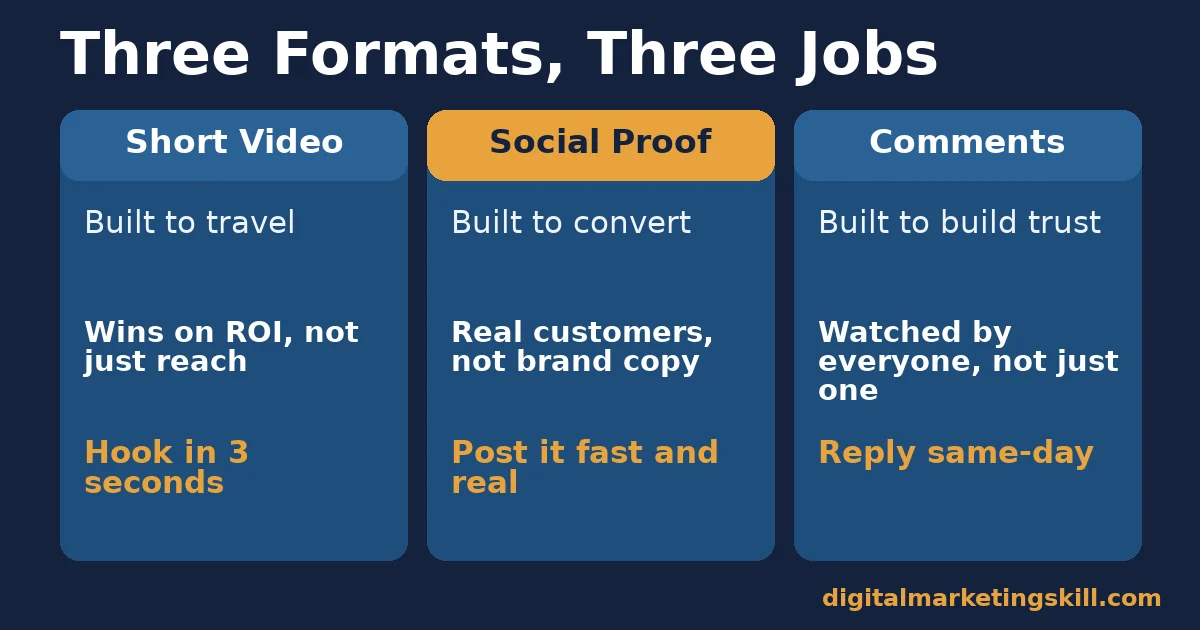
Three formats consistently earn outsized attention for the effort they take to produce. Each works for a different reason. Knowing which lever you are pulling changes how you should plan, shoot, and measure the result.
Short-Form Video: Built to Travel
Short-form video spreads because the format itself is built for distribution. It is fast to watch, easy to share, and favored by the recommendation systems on most major platforms. It now delivers the highest ROI of any media format, with 48.6% of more than 1,500 marketers worldwide ranking it in their top three for performance, according to HubSpot’s State of Marketing report. That is a return figure, not just a reach figure, which is why short-form video belongs at the top of any list of social media marketing tips.
Social Proof: Built to Convert
Social proof, meaning reviews, ratings, and real customer photos, works because it answers one question a brand’s own copy cannot answer convincingly: would a stranger vouch for this? Looking for reviews or ratings is the single most common step shoppers take right after discovering a product, per Bazaarvoice’s Shopper Experience Index. That means social proof often arrives in front of a buyer before your own sales pitch ever does.
Comments and DMs: Built to Build Trust
Comments and direct messages work differently from posts, and most social media marketing tips lists barely mention them at all. They are a live, visible test of whether a brand actually listens. A public reply, or the lack of one, is read by everyone who later visits that thread, not only by the person who wrote the comment. New visitors scroll the comments before they scroll back up to the post itself. That audience-of-everyone-watching effect is what makes response speed a real marketing lever, not just a support metric buried in a help-desk dashboard.
How to Lead With Each Format
Each format above needs a different first move, not a generic “post more” plan. The sections below mirror the three formats, in the same order, so you can jump to the one your accounts need most right now.
Short-Form Video: Lead With the First Three Seconds
Put the payoff, the surprise, or the question in the opening seconds, before any logo, intro, or setup. HubSpot’s own guidance on short-form video puts it plainly: open with a strong hook, such as a question or a surprising fact, and use an eye-catching visual to earn curiosity straight away. Most viewers decide whether to keep watching almost immediately, so a slow build loses the exact audience the format is supposed to win. Script the first line before you script anything else, and treat everything after it as optional.
Social Proof: Lead With Real Customers
Ask every happy customer for a short photo, quote, or video within days of a good result, while the experience is still fresh. Post it close to its original wording rather than polishing it into brand-speak, since the specific, slightly rough version is what reads as credible. One real customer, named and specific, outperforms a dozen vague brand claims.
Comments and DMs: Lead With Speed
Set a target reply window and staff it, even if that window is modest at first. Sprout Social’s own research on response time notes that most consumers want a reply within 24 hours or sooner. A meaningful share expect it within one to two hours. A fast, simple reply beats a slow, perfect one, because the speed itself is part of the message being sent to everyone watching. Treat an unanswered comment on a growing post as a leak, not a minor task for later. The longer it sits, the more new visitors read the silence as a verdict on the whole brand, not just that one exchange. A short, honest reply closes that leak faster than almost anything else you could do with the same five minutes.
Five Reasons Social Media Marketing Tips Fail in Practice
When a social strategy stalls despite following the standard advice, the cause is usually one of five problems. Most generic social media marketing tips never name these directly. Check each one against your last month of posts before you change anything else.
- The format does not match the goal. Using a slow, polished video for a trend that rewards speed, or a quick clip for a message that needs real explanation, wastes the format’s own strengths.
- Replies are too slow to matter. A correct answer given three days late reads as indifference to everyone who saw the original comment sit unanswered.
- There is no real customer in the content. Posts built entirely from brand copy skip the exact proof that makes a stranger trust a claim.
- Insight sits in one team’s dashboard. If only one person sees what is working, the rest of the team keeps repeating what is not.
- Nothing gets measured past likes. Vanity numbers hide whether a post actually moved a real business outcome.
Which Problem to Fix First
Start with whichever problem your own numbers point to. If posts get views but no replies convert into anything, the format or the proof is the issue, not a lack of reach. If engagement is fine but complaints pile up unanswered, speed is the issue, and no amount of extra posting will fix it. Fixing the wrong one first burns a month of effort on a problem that was never the real bottleneck in the first place.
How to Measure If Your Social Media Marketing Tips Are Working
Treat social the way you would treat any channel with a real budget behind it. Define the numbers before you judge the results, not after. Each metric below is defined once, with a note on how to read it.
Six Numbers That Show Real Progress
- Engagement rate. Reactions, comments, shares, and saves divided by reach. A rising rate on similar content shows the format or message is improving, not just the algorithm’s mood.
- Average response time. The typical gap between a comment or DM arriving and a reply going out. Falling response time should track with rising trust signals like repeat comments from the same followers.
- Share of voice from real customers. The share of your posted content that features an actual customer rather than only brand-made material. A rising share tends to track with stronger comment-section trust.
- Video completion rate. The share of viewers who watch a video through to its payoff. A low rate points straight at the opening seconds, not the rest of the edit.
- Click-through to a real action. The share of viewers who go on to visit a site, message, or save contact details, not just watch. This is the number that separates attention from actual interest.
- Issue-to-resolution time. How long a public complaint stays open before a visible resolution. A shrinking number is one of the clearest signs that the speed lever is being pulled correctly.
How to Read These Numbers Together
Read them in sequence. If engagement rate is healthy but click-through is flat, the content is entertaining but not persuasive, so add a clearer next step. Slow response time paired with a long issue-to-resolution time points to trust as the real problem, regardless of how good the content looks. And when real-customer content is rare while engagement stays weak, that absence is very likely the cause, not a coincidence.
Track one change at a time. When you shift a format or a reply target, note the date and compare the next few weeks against the weeks before, so you can tell a real shift from normal week-to-week noise.
The Most Useful Rule: Reply Before You Post Again
If this guide leaves you with one decision rule, make it this one. Before you publish a new piece of content, clear every open comment and message on the last one. A brand that replies fast earns the right to be heard on its next post; a brand with a pile of unanswered comments is publishing into a room that has already stopped listening.
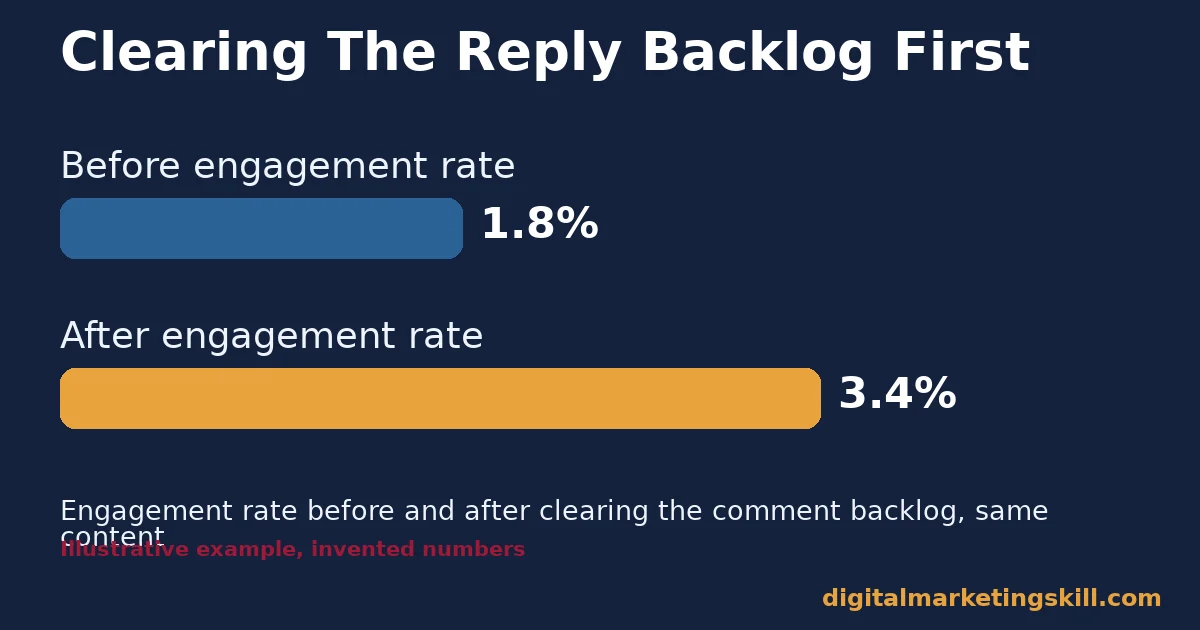
Here is an illustrative example, with invented numbers. A small shop posts daily but takes about 48 hours to answer comments, and its engagement rate sits at 1.8%. The owner pauses new posts for a week, clears the backlog, and sets a same-day reply target going forward. Engagement rises to 3.4% over the next month, on the same posting frequency and the same content style.
The lesson is about sequence, not extra effort. Fixing the response gap first means every post published afterward lands with an audience that already trusts the brand to show up, instead of one that has learned to expect silence. The content itself did not need to change at all for the numbers to move.
A 30-Day Plan to Apply These Social Media Marketing Tips
This plan turns the social media marketing tips above into four concrete weeks of work. It fits around a normal week, uses tools you already have, and does not require a new budget to start. The point is to sequence the fixes rather than attempt all of them at once.
- Week one: audit your last ten posts. Note the format, the response time on comments, and whether a real customer appeared in the content.
- Week two: fix the reply gap. Set a same-day reply target and clear any existing backlog of comments and messages before posting anything new.
- Week three: shoot one short-form video. Script only the first three seconds in advance, then let the rest follow naturally from there.
- Week four: feature one real customer. Ask for a short, specific quote, photo, or clip, and post it close to how they actually said it.
At the end of the month, compare engagement rate, response time, and click-through against the numbers from your audit in week one, using the same ten posts as the baseline so the comparison stays fair. Keep whatever moved the numbers. Repeat the cycle with the next batch of content.
A Real Case: Turning Ad Skills Into Ongoing Work
Ibrahim Damilare’s story is published on Digital Marketing Skill Institute’s reviews page. He describes running paid social advertising, in his own words: “I run Advert for my business and others.” Those same campaign skills were tested first on his own small business. Once the approach worked there, he turned that proof into paid work managing campaigns for other businesses too, without needing a large portfolio to get started.
The pattern mirrors the sequence in this guide. Master one lever well enough to show a real result, then let that result open the next piece of work. Treat this as one documented example, not a guaranteed outcome; results vary by niche, effort, and market, and DMSI’s earnings disclaimer sets out those limits in full. The lever he leaned on was speed and proof, not a large advertising budget, which is why the same sequence works at a much smaller scale too.
Frequently Asked Questions About Social Media Marketing Tips
Which social media marketing tips actually move the needle?
Matching format to goal, replying fast, and featuring real customers consistently outperform generic posting advice. Each one is measurable, so you can confirm it is working rather than guessing.
How often should a business post on social media?
Consistency matters more than a specific number. A realistic schedule you can sustain, paired with fast replies, beats a packed calendar that collapses after a few weeks.
Is short-form video worth the effort for a small business?
Yes, because it delivers the highest return of any format among surveyed marketers, and it does not require expensive production to work well.
How fast should a brand reply to comments and messages?
As fast as realistically possible, with same-day as a practical target for most small teams. The visible gap between a comment and a reply is read by everyone who later sees that thread.
Do likes and followers matter for social media marketing?
They matter less than engagement rate, response time, and click-through to a real action. A large following with weak engagement rarely converts into real business results.
What is the biggest social media marketing mistake small businesses make?
Treating a comment section as optional. An unanswered backlog quietly undoes the value of good content faster than almost any other mistake on this list.
Do these social media marketing tips work the same on every platform?
The underlying levers, format, proof, and speed, apply everywhere, but the exact mechanics shift by platform. Test each tip on your main platform first, then adapt it rather than copying it exactly onto a second one.
Can a very small team realistically apply all of these social media marketing tips at once?
No, and trying to is usually the problem. Pick the single weakest number from your own audit, fix that one lever for a month, and only then move on to the next.
Start With One Platform, Then Expand
Social media marketing tips work best applied narrowly first. Pick one platform, fix your reply speed, add one short-form video and one real customer feature, then measure the result before adding a second platform. That sequence builds a habit you can sustain, instead of a calendar you abandon in a month.
None of this requires a large team or a large budget, just a willingness to fix the response gap before adding more content. If you want structured, hands-on practice rather than building this alone, Digital Marketing Skill Institute teaches these skills through real client-style work. The Master Diploma in Digital & AI Marketing is built around four AI-powered tracks, including AI-Powered Social Media Management and Advertising. A Full Stack option covers all four tracks across ten courses. It includes unlimited 1-on-1 coaching and mentoring and a U.S. Project Internship with a verified U.S. Work Reference Letter, and the diploma is dual US and UK accredited and recognised in more than 100 countries.
The programme runs 100% online, so you can build these skills from anywhere in your country. Browse more guides on the Digital Marketing Skill Institute blog, and when you are ready, apply for the Master Diploma or start from the Digital Marketing Skill Institute homepage.
Every figure in this guide was checked against its original source before publication. Figures marked as illustrative are invented examples, not real results.
![9 Amazing Digital Marketing Skills to Make Money Online [With Proof]](https://digitalmarketingskill.com/wp-content/uploads/2019/07/9-Amazing-Digital-Marketing-Skills-to-Make-Money-Online-With-Proof-17.png)






