Website SEO optimization means making a site easy for Google to crawl, fast enough to keep visitors, and useful enough that people actually want the answer on the page. Most guides stop at keywords. The data below shows why technical health and genuinely helpful content matter more. It also gives a simple rule for deciding what to fix first.
Key Takeaways
- Ahrefs’ analysis of roughly 14 billion pages found that 96.55% get zero traffic from Google. The main reasons are no search demand, no backlinks or a mismatch between the page and what searchers actually want.
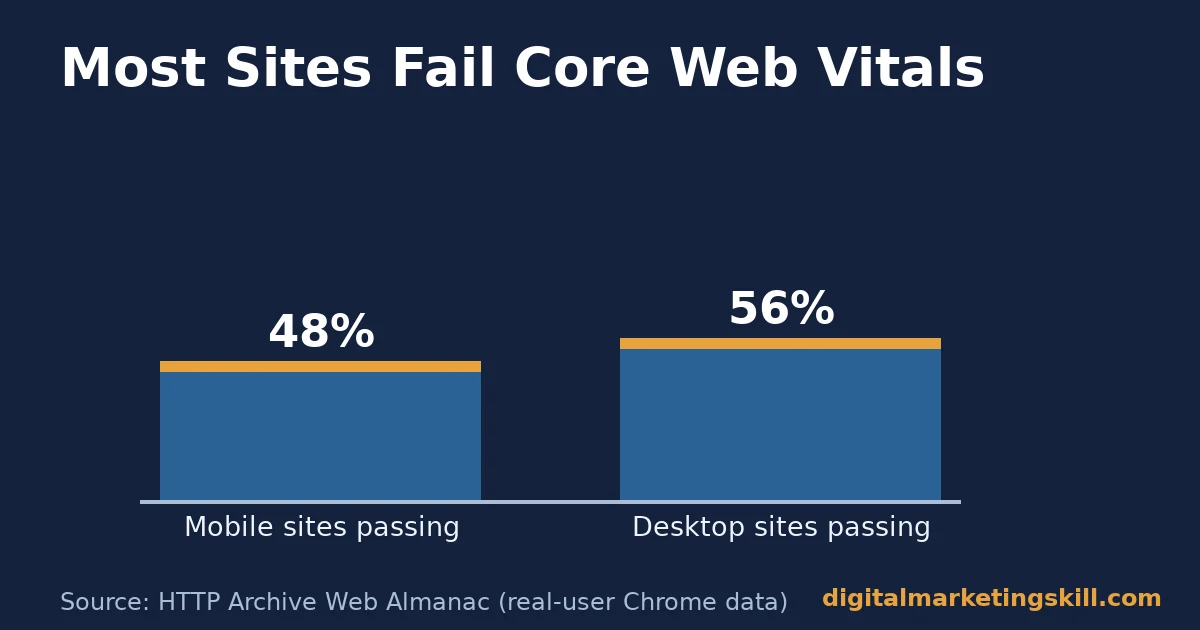
- The HTTP Archive’s Web Almanac found only 48% of mobile websites pass all three Core Web Vitals thresholds, against 56% on desktop. Most sites still fail Google’s own speed and stability bar.
- Google’s own case studies show real revenue tied to website SEO optimization. Vodafone Italy cut its largest page-load metric by 31% and saw 8% more sales. Nykaa improved the same metric by 40% and gained 28% more organic traffic.
- Nielsen Norman Group reports that bounce probability rises 32% as mobile load time goes from one second to three. Speed problems quietly cost visitors before content even loads.
- Website SEO optimization rewards depth over tricks. Ahrefs found the average page ranking first for one keyword also ranks in the top 10 for nearly 1,000 other related terms. One thorough page beats many thin ones.
In this guide
- Website SEO Optimization: What Most Checklists Get Wrong
- How Website SEO Optimization Actually Works
- What Differs by Discipline: Technical, Content or Links
- How to Lead With Each Discipline
- Titles and Meta Descriptions Still Decide the Click
- Does Website SEO Optimization Work the Same Everywhere?
- Measuring Whether Website SEO Optimization Is Working
- What AI Search Changes About Website SEO Optimization
- The One Decision Rule
- What Website SEO Optimization Looks Like in Practice
- Frequently Asked Questions About Website SEO Optimization
- Your Next Step With Website SEO Optimization
Website SEO Optimization: What Most Checklists Get Wrong
Most website SEO optimization advice is a list: add keywords, write meta descriptions, build backlinks. That list is not wrong, but it skips the order of operations. A fast, crawlable site with thin content still fails. A brilliant article buried behind a slow, broken site never gets read.
The checklist format also hides which fixes matter most right now. A site with failing Core Web Vitals gains little from more backlinks, because the pages those links point to may barely load. Sequencing the work correctly is what separates sites that rank from sites that stay busy without moving.
What follows is an informed read of current search data, not a fixed formula. Google changes its ranking systems constantly, and your site’s starting point changes what to fix first. The arc below covers how ranking actually works, what differs between technical, content and link work, how to lead with each one, how to measure progress, one decision rule, a real case, and a direct FAQ.
How Website SEO Optimization Actually Works
Search engines do three things before a page can rank: crawl it, index it, then rank it against every other page competing for the same query. A page can fail at any stage. A blocked page never gets crawled, while a thin or duplicate page may get crawled but not indexed. Even an indexed page still needs to beat competitors on relevance and trust to rank.
Google’s own developer documentation confirms that Core Web Vitals are used by its ranking systems. It also says Google “always seeks to show the most relevant content, even if the page experience is sub-par.” In other words, speed and stability help, but they do not override weak content.
The HTTP Archive’s Web Almanac is built from real-user Chrome data across millions of sites. It found that only 48% of mobile pages and 56% of desktop pages pass all three Core Web Vitals thresholds. Loading speed is the weakest of the three on mobile, with only 62% of sites scoring well, against 77% for interaction responsiveness and 81% for visual stability.
Desktop sites fare noticeably better across all three metrics. This points to mobile networks and device variety as the harder environment to optimize for.
Because most search traffic now happens on mobile, treat the mobile experience as the baseline, not an afterthought tested after the desktop version ships. A slow, hard-to-read page also hurts blog readership directly, since visitors who bounce never get far enough to judge the content at all.
What Differs by Discipline: Technical, Content or Links
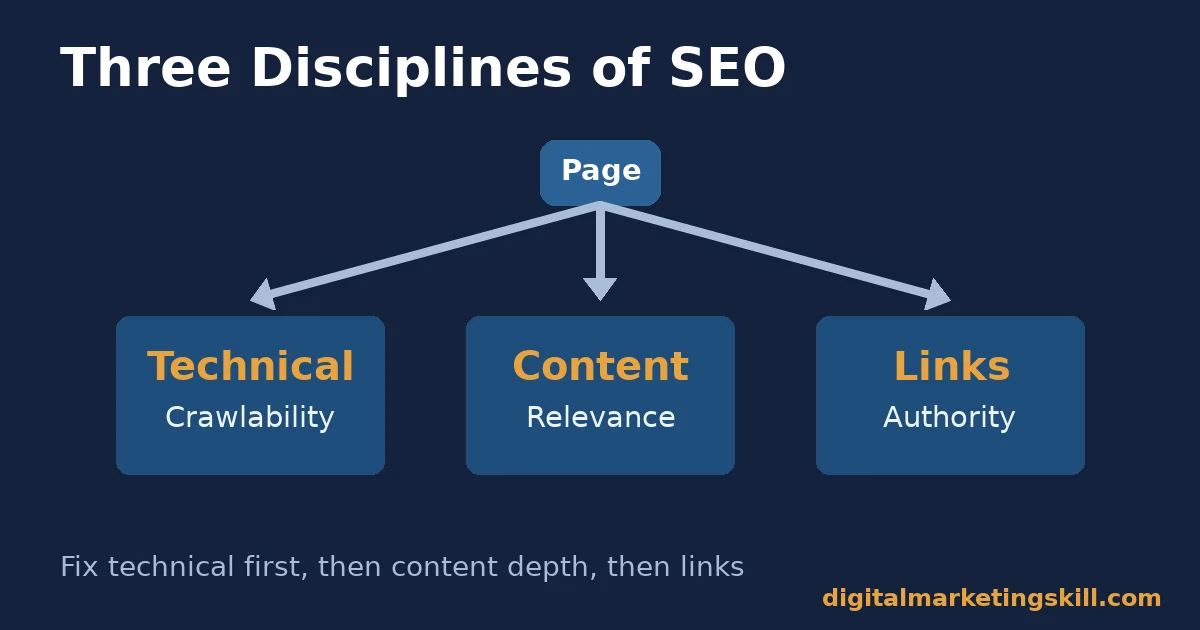
Website SEO optimization splits into three disciplines, and each one fails in a different way.
Technical SEO: Built for Crawlability
Technical work makes sure Google can reach and understand a page at all: clean URLs, a working sitemap, fast load times, no broken redirect chains. None of it makes a page more useful to a reader. But without it, nothing else matters, because the page may never be indexed.
Google’s SEO starter guide confirms some common myths do not apply here. The keywords meta tag is not used for ranking. Keywords in a domain or URL path have “hardly any effect.” Content length alone does not matter either. Technical SEO is about access and clarity, not about stuffing signals Google has already said it ignores.
Content SEO: Built for Relevance
Content work answers the actual question behind a search. Google’s own guidance on creating helpful, reliable, people-first content frames the test simply: would someone “leave feeling they’ve learned enough about a topic to help achieve their goal?” It also warns that content spread thin across many unrelated topics is a warning sign of low quality, especially when built mostly through automation to attract visits.
Our guide to blog content strategy covers why so many posts get written and then ignored.
Link Building: Built for Authority
Links signal that other sites trust a page enough to reference it. Ahrefs’ search traffic study found that pages with zero backlinks are far less likely to rank. It separately found that roughly 1 in 6,671 pages without any backlinks still reaches 1,000 monthly visits. Ahrefs treats that as a correlation worth noting, not proof that links alone decide rankings.
How to Lead With Each Discipline
Knowing the three disciplines is only half the job. Here is what to lead with inside each one.
Technical SEO: Lead With Core Web Vitals
Fix loading speed first, since it is the weakest metric for most mobile sites. Google defines a good result as a largest content element loading within 2.5 seconds, a response to interaction within 200 milliseconds, and visual shifting under 0.1. Each is measured at the 75th percentile of real visits.
Content SEO: Lead With One Thorough Page per Topic
Write one page that fully answers a topic instead of several thin ones that each cover a sliver of it. Ahrefs’ study of ranking pages found the typical page in the top spot for one keyword also ranks in the top 10 for hundreds of related terms. Depth on one topic compounds across many searches at once.
This matters even more given how much long-tail demand exists. Ahrefs’ keyword database shows that terms searched fewer than 10 times a month make up almost 93% of roughly 2.3 billion tracked keywords. A single thorough page naturally picks up dozens of these low-volume variations without ever targeting them directly. That is a large, quiet source of traffic most checklists ignore.
Link Building: Lead With Content Worth Citing
Earn links by publishing something other sites want to reference: original data, a genuinely useful tool, or a clear explanation nobody else has written as well. Chasing link volume without a reason for anyone to link back rarely holds up. The sites most likely to link are the ones that already trust the content.
Watch for the trap of buying or trading links purely for volume. A page stuffed with low-quality inbound links but no reason to cite it tends to plateau. A smaller number of relevant, earned links from sites that cover the same topic carries more weight over time.
Titles and Meta Descriptions Still Decide the Click
Ranking well is only half of website SEO optimization. The other half is persuading someone to click once they see the result. Google’s own blog on title generation found that it now uses a site’s actual <title> element around 87% of the time, up from roughly 80% a few years earlier. It only replaces a title when the element is missing, outdated, inaccurate or filled with boilerplate text.
Meta descriptions get rewritten far more often. Ahrefs’ study of 20,000 keywords found Google rewrites 62.78% of meta descriptions it is given. The rate is even higher for long-tail queries, at 65.62%, than for high-competition “fat head” queries at 59.65%. A quarter of top-ranking pages had no meta description at all, and description length made little measurable difference to whether Google kept it.
The practical takeaway is to write a clear, accurate title and description for a human reader. Do not try to game the snippet, because Google is already willing to substitute its own version when yours is vague.
Does Website SEO Optimization Work the Same Everywhere?
The mechanics of crawling, indexing and ranking are global. Google uses the same Core Web Vitals thresholds and the same helpful-content guidance everywhere, so the advice above does not change by country.
What changes is the platform your site runs on and how much competition exists for a given query. W3Techs’ tracking shows WordPress now powers 40.1% of all websites and 58.6% of sites with a known content management system. Most of the fixes above have a plugin or built-in setting to handle them, whichever country or market the site serves.
Website SEO optimization also travels well because the underlying behaviour it is built around is global. SparkToro’s clickstream analysis found a similar zero-click pattern in Europe, at 59.7% of searches, close to the 58.5% rate in the US. The pressure to earn a click, not just a ranking, is not a single-market problem.
Measuring Whether Website SEO Optimization Is Working
Four numbers tell you whether the work is paying off, and each one is defined differently.
- Core Web Vitals pass rate: the share of real visits where your largest content element, interaction response and visual stability all meet Google’s thresholds. Google Search Console reports this by URL group.
- Average position: where your page typically appears in search results for a given query, shown in Search Console. A page can gain clicks by moving from position 8 to position 4 with no content change, just technical or authority improvements.
- Click-through rate: clicks divided by impressions for a query. A low rate at a good position usually means the title or meta description is not persuasive, not that the ranking is wrong.
- Zero-click share: SparkToro’s clickstream analysis found 58.5% of US Google searches end without any click at all. Tracking this expectation keeps teams from blaming content when a query itself rarely sends traffic anywhere.
Review these four numbers monthly inside Search Console, alongside the same small business marketing apps you likely already use for analytics. Compare them against whatever business metric the page is meant to support, such as signups or sales. A ranking gain that does not move clicks usually points to a weak title or snippet, not a wasted optimization effort.
Keep a simple log: page, month, average position, click-through rate and the one change made. Six months of this habit shows which type of change moves the numbers fastest on your specific site. That matters more than any general industry average.
What AI Search Changes About Website SEO Optimization
AI search tools send far less traffic than traditional results, so far. Ahrefs’ study of 3,000 websites found AI referrals made up only 0.17% of visitors on average. Smaller sites saw a higher share, up to 0.56% of visitors on sites with fewer than 1,000 monthly visits. ChatGPT accounted for about half of that AI traffic, with Perplexity and Gemini making up most of the rest.
The traffic that does arrive can convert well. Ahrefs reported that on its own site, AI search sent just 0.5% of total traffic but produced 12.1% of sign-ups over a recent 30-day period. That means AI visitors converted about 23 times better than typical organic search visitors.
This is a single company’s own data, not a general benchmark. It suggests AI referrals are small in volume and worth watching rather than chasing.
Pages do not need separate optimization to appear in AI-generated answers. Ahrefs’ analysis of AI Overview citations, covering 863,000 keyword searches, found 38% of cited pages were already ranking in the regular top 10 results. Most of the rest ranked somewhere on the first page of normal search. Website SEO optimization that already works for traditional search is the same work that earns AI citations.
The One Decision Rule
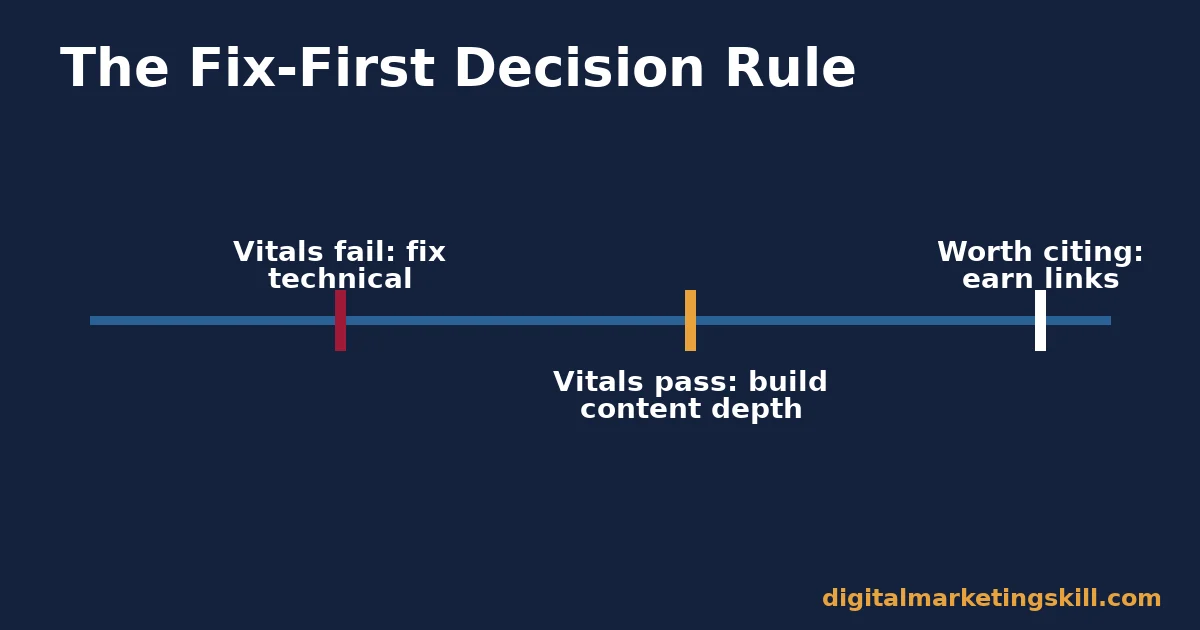
Here is the rule that cuts through most website SEO optimization debates: fix technical problems first if Core Web Vitals fail. No amount of content work rescues a page Google struggles to load or index. Once Core Web Vitals pass, shift effort to content depth, and only chase links once the page is genuinely worth citing.
Illustrative, invented numbers: imagine a page with a 4.2 second loading time and thin, 300-word content. Fixing the loading time to 2.1 seconds alone might lift rankings modestly. But rewriting the page to 1,500 words that fully answer the query, on top of that speed fix, is what typically moves it from page two to page one. Speed removes the barrier. Content earns the position.
Apply the same rule in reverse when a page already loads fast but still underperforms. If Core Web Vitals already pass, do not spend another month tuning milliseconds nobody will notice. Move straight to content depth, then to earning links once the page is genuinely worth citing.
What Website SEO Optimization Looks Like in Practice
Google’s own published case studies document real, measurable gains from fixing Core Web Vitals. Vodafone Italy cut its largest loading metric by 31% and recorded 8% more sales. Nykaa improved the same metric by 40% and gained 28% more organic traffic. Cdiscount improved all three Core Web Vitals together and saw a 6% revenue uplift.
These are single-company, vendor-published figures, not independently audited studies. Treat the percentages as a direction, not a guarantee for any other site.
Esther Elueme, a Master Diploma in Digital & AI Marketing graduate of Digital Marketing Skill Institute, describes a similar pattern on a smaller scale. Her testimonial on the Institute’s reviews page says that within a month of training she had built a website, added her business niche to Google, and optimized her pages for keyword search.
The lesson in both cases is the same: website SEO optimization pays off when technical fixes and genuinely relevant content happen together, not as separate projects.
Neither case promises a specific outcome for every site. Page speed, content depth and competition all vary. Treat these figures as evidence the approach works, not as a guaranteed percentage for your own results.
Keyword research for SEO draws on the same data; see our keyword planner guide for how to read search-volume and competition figures.
Frequently Asked Questions About Website SEO Optimization
What is the fastest way to start website SEO optimization?
Check Core Web Vitals in Google Search Console first. If a page fails loading speed, interaction response or visual stability, fix that before investing in new content. A slow or unstable page undercuts everything written on it.
Does website SEO optimization still need backlinks?
Yes, but volume matters less than relevance. Ahrefs’ research found that most pages without any backlinks get little to no traffic. A small share rank anyway, usually because the topic has very specific, low-competition demand.
How long does website SEO optimization take to show results?
Technical fixes such as Core Web Vitals improvements can show up in Search Console data within weeks. Content and link-driven ranking gains typically take longer, often a few months, because Google needs to recrawl, reassess and compare the page against competitors.
Does website SEO optimization still matter with AI search growing?
Yes. Google’s own documentation says there are “no additional requirements to appear in AI Overviews or AI Mode.” Pages still need to be indexed and performing well in regular search first. Ahrefs found 38% of AI Overview citations already rank in the top 10 organically, so strong traditional SEO remains the foundation.
Is keyword stuffing still part of website SEO optimization?
No. Google’s own SEO starter guide states plainly that repeating words is tiring for readers, and that keyword stuffing violates its spam policies. Natural language that covers a topic thoroughly outperforms forced repetition.
What is the single biggest website SEO optimization mistake?
Publishing many thin pages instead of fewer thorough ones. Ahrefs found that top-ranking pages typically rank for hundreds of related terms at once. One complete page usually outperforms five shallow ones targeting slices of the same topic.
Does website SEO optimization require a specific platform?
No. Core Web Vitals and helpful-content guidance apply to any platform. W3Techs tracking shows WordPress alone powers over 40% of all websites, but the same principles apply on any system.
Should every page target a different keyword for website SEO optimization?
Not necessarily. Ahrefs’ research shows a single well-ranked page usually already ranks for hundreds of related terms. Splitting one topic into several thin pages often competes against your own content instead of adding reach.
Your Next Step With Website SEO Optimization
Website SEO optimization works best as one coordinated effort: fix what blocks Google first, then build content worth ranking, then earn the links that follow naturally. Start with a free Core Web Vitals check in Search Console this week. Then move to the page that gets the most traffic but converts the least.
The Master Diploma in Digital & AI Marketing at Digital Marketing Skill Institute includes a full AI-powered Search Engine Optimisation & Content Marketing course alongside AI-powered WordPress Website & eCommerce Development. It comes with unlimited one-on-one coaching and mentoring, plus real project-based work experience inside a US partner company from day one.
The diploma carries dual US and UK accreditation and is recognised in more than 100 countries. It runs 100% online, so you can build and optimize real sites from anywhere in your country.
Visit Digital Marketing Skill Institute to read more graduate stories, browse the blog for more guides, and when you are ready, apply here.
Every figure in this guide was checked against its original source before publication. Figures marked as illustrative are invented examples, not real results.
![9 Amazing Digital Marketing Skills to Make Money Online [With Proof]](https://digitalmarketingskill.com/wp-content/uploads/2019/07/9-Amazing-Digital-Marketing-Skills-to-Make-Money-Online-With-Proof-17.png)