
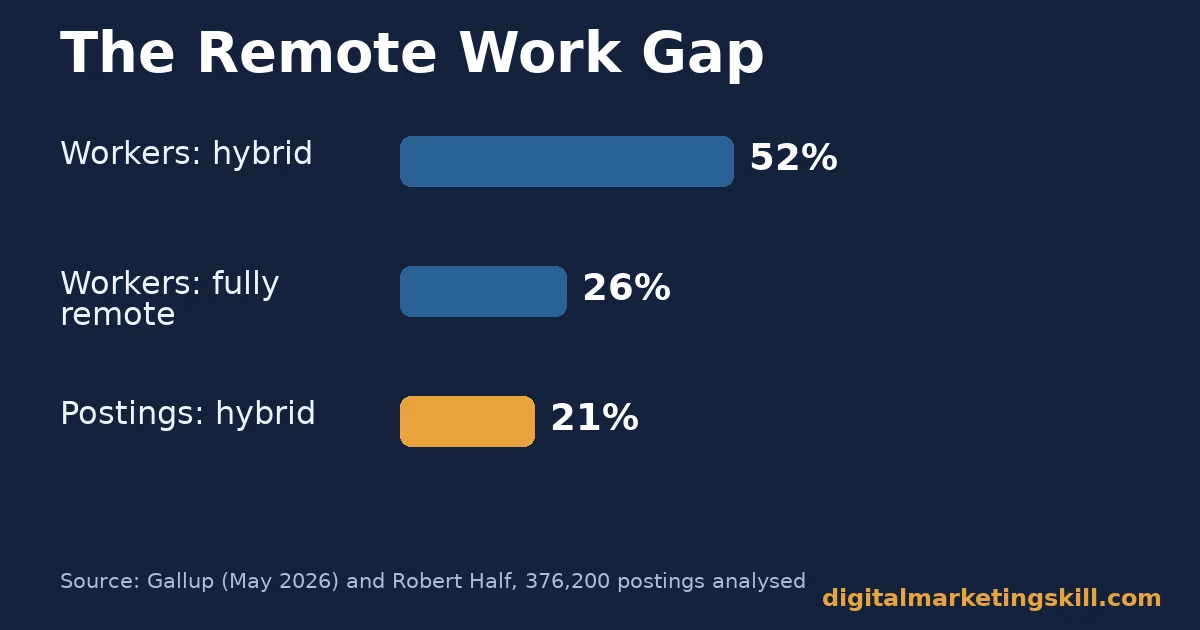
Remote digital marketing jobs exist in real numbers. Employer job postings do not match what workers say they want, though. Only 21% of marketing and creative roles get advertised as hybrid. Most remote-capable employees want flexibility. Closing that gap takes one visible, provable skill, not a long list of certificates.
Key Takeaways
- 52% of US remote-capable employees now work hybrid, 26% work fully remote, and 22% work fully on-site (Gallup, May 2026 survey).
- Only 21% of marketing and creative job postings are advertised as hybrid. That figure comes from an analysis of 376,200 marketing and creative postings, including 64,900 digital marketing postings (Robert Half).
- Search marketing strategist roles carry a median wage of $78,760 a year in the US, with growth rated “much faster than average” (O*NET, US Department of Labor).
- Kofi B., a Digital Marketing Skill Institute graduate, says AI marketing knowledge won him a remote role in Canada. He adds he “could do the work of a 3-person team.”
- One clearly demonstrated skill, shown through real work, outperforms a long list of certificates when you apply for remote digital marketing jobs.
In this guide
- Why Remote Digital Marketing Jobs Feel Harder to Find Than Workers Expect
- How Remote Digital Marketing Hiring Actually Works
- What Differs by Role Type
- How to Win Each Role Type
- Build Proof Before You Search for Remote Digital Marketing Jobs
- Mistakes That Quietly Block Remote Digital Marketing Applications
- Measure Your Readiness for Remote Digital Marketing Jobs
- The One Rule for Landing a Remote Digital Marketing Job
- Where Remote Digital Marketing Jobs Actually Come From
- A Real Case Worth Studying
- Build the Routine That Makes Remote Work Stick
- Frequently Asked Questions About Remote Digital Marketing Jobs
- Start Your Path to Remote Digital Marketing Work
Why Remote Digital Marketing Jobs Feel Harder to Find Than Workers Expect
Workers want flexibility. Gallup’s latest data shows 52% of US remote-capable employees already work hybrid. Another 26% work fully remote. That is nearly eight in ten workers spending at least part of their week outside an office.
Employers have not matched that appetite, at least not in marketing. Robert Half’s analysis of 376,200 marketing and creative job postings found only 21% advertised as hybrid. The gap between what workers want and what gets posted is real. It explains why remote digital marketing jobs can feel scarce even while remote work overall grows.
For a closer look at the tradeoffs involved, see our full comparison of remote versus in-office work. This guide treats both numbers as a snapshot from one survey period, not a permanent ranking. Postings shift by quarter and by employer. The pattern they reveal, though, is durable: demand from workers exceeds visible supply from employers, so a generic application rarely wins a crowded, remote-friendly listing.
How Remote Digital Marketing Hiring Actually Works
A remote hiring decision usually comes down to one question: can this person do the work without supervision in the room? Employers cannot watch a remote hire’s daily habits. So they lean harder on proof. A portfolio, a published result or a verifiable case carries more weight remotely than it does for an in-office hire, where day-to-day presence can substitute for proof.
That shift favors specific, demonstrable skills over broad resumes. A beginner who can show one real campaign, one real client result or one real piece of measurable work beats a beginner who lists ten tools they have only studied. If you are still deciding which digital marketing skills to focus on first, pick the one you can prove fastest, not the one that sounds most impressive.
What Differs by Role Type
Not every digital marketing role gets offered remotely at the same rate. Not every role needs the same proof either.
Specialist Roles Get Remote Offers First
Narrow, measurable specialties such as paid media, SEO or email automation get remote offers more easily than generalist roles. A specialist’s output is easy to verify from a distance. Rankings move or they do not; campaigns convert or they do not. That verifiability is exactly what remote hiring rewards.
Generalist Roles Compete Harder for Remote Slots
A broad “does a bit of everything” marketing role is harder to verify remotely. The work spans many small tasks that are harder to point to as one clear result. Generalists typically need a stronger portfolio, because no single metric proves their value the way a ranking or a conversion rate does for a specialist.
Freelance Roles Skip the Remote Debate Entirely
Freelance and contract digital marketing work is remote by default. The hybrid-versus-remote posting gap barely applies here. The tradeoff moves elsewhere: freelancers carry the full weight of proving reliability and results themselves, client by client, without an employer brand to lean on. Choosing the right freelance platform for your stage matters too, since beginner-friendly and established-freelancer platforms reward different things.
How to Win Each Role Type
Each role type rewards a different kind of proof. Build the proof before you apply, not during the interview.
Specialist Roles: Lead With One Measurable Result
Pick one campaign, one client or even one practice project. Show the number it moved: traffic, rankings, conversion rate or revenue. One specific, verifiable result outperforms a list of tools you have used but never measured.
Generalist Roles: Lead With a Structured Portfolio
Organize a portfolio by channel or by project, not as a flat list of tasks. A hiring manager scanning quickly should see which channels you have handled within seconds, and what each one produced, even at a small scale. Google’s own guidance on helpful content asks whether a reader leaves “feeling they’ve learned enough,” a useful test to apply to your own portfolio write-ups too.
Freelance Roles: Lead With a Narrow, Reliable Niche
Pick one service and one client type, and deliver it consistently before expanding. A freelancer known for one thing done well wins repeat and referred work faster than a freelancer offering everything to everyone. Once you land a first client, the process for how to get digital marketing clients consistently gets much easier, because referrals start doing some of the work for you.
Build Proof Before You Search for Remote Digital Marketing Jobs
Most job seekers search first and build proof later, if at all. That order wastes effort, because a hiring manager scanning a remote application decides fast. A missing portfolio link or a vague bullet point often ends the review before your actual skill ever gets considered.
Flip the order instead. Ahrefs’ study of roughly 14 billion pages found 96.55% get no search traffic from Google at all, a reminder that even a published project needs real demand behind it to count as proof. Spend one to two weeks building a single, real piece of proof before you send a single application. That could be a volunteer campaign, a practice project on your own site, or paid work for one small client. The specific channel matters less than the fact that it produced a real, checkable number.
This also changes how you search. Once you have proof, you can target listings that match it directly, rather than applying broadly and hoping a generic resume lands somewhere. A narrower, better-matched search usually beats a wider, unfocused one.
Mistakes That Quietly Block Remote Digital Marketing Applications
These habits show up constantly in applications for remote digital marketing jobs. Each one is fixable before you apply again.
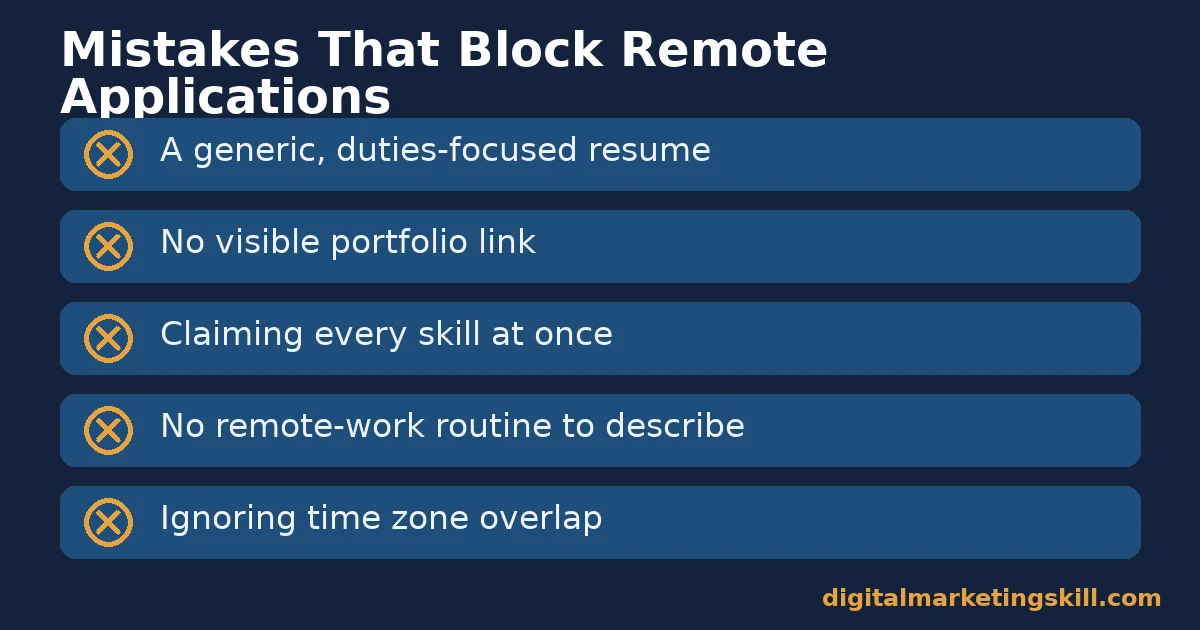
- Applying with a generic resume. A resume built for in-office hiring often lists duties, not results. Remote hiring managers skim for proof, not job descriptions.
- No visible portfolio link. If a hiring manager has to ask for examples, most will move to the next applicant instead. Put the link where it cannot be missed.
- Claiming every skill at once. Listing ten specialties with no depth reads as unverifiable. One well-proven specialty beats ten unproven ones.
- No remote-work routine to describe. Employers ask how you structure an unsupervised day. An applicant with no answer signals risk, regardless of skill level. The right remote work tools can make this answer concrete instead of vague.
- Ignoring time zone overlap. A remote role still usually needs some live overlap with a team or client. Applicants who address this upfront remove an easy objection.
- Waiting for the perfect project before starting. A small, finished practice project beats a large, unfinished one. Momentum matters more than scale at the start.
- Treating every application the same way. A copy-pasted cover letter rarely mentions the employer’s actual product or audience. A short, specific reference to the role takes minutes and changes how the application reads.
Measure Your Readiness for Remote Digital Marketing Jobs
Three checks tell you whether you are ready to apply, before a hiring manager tells you no.
- Proof count: the number of results you can point to with a real number attached (traffic, rankings, conversions, revenue). Zero means you are not ready yet. Even one, honestly documented, changes your odds.
- Portfolio load time: how long it takes a stranger to find your best proof. If it takes more than two clicks, most hiring managers will not find it either.
- Response rate: applications sent versus replies received. A consistently near-zero rate after ten or more applications usually means the proof, not the search, needs fixing first.
Track all three before changing your approach. A low response rate with strong proof points at targeting. A low response rate with weak proof points at the portfolio itself. Review the numbers every two weeks while you search, not once at the end, so you can adjust early instead of repeating the same mistake for a month.
The One Rule for Landing a Remote Digital Marketing Job
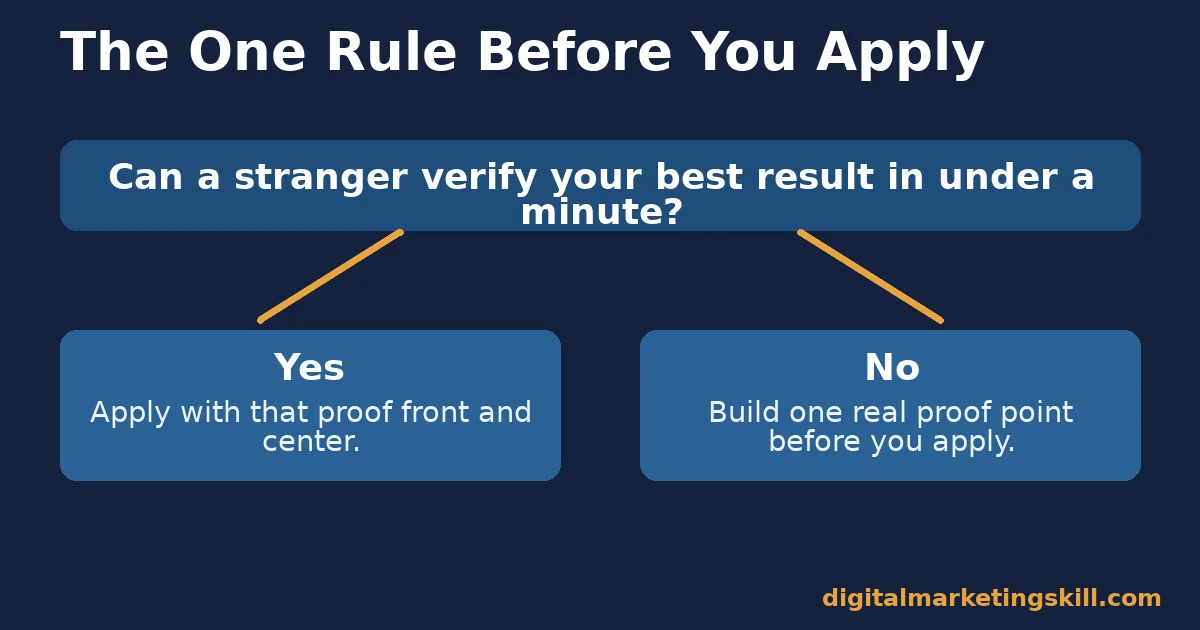
Before you send another application, answer one question in writing: what specific result can you prove, and where can a stranger verify it in under a minute? If you cannot answer that clearly, fix the proof before you fix the application.
Illustrative, invented example: an applicant sends 40 generic applications with a bullet-point resume and gets zero replies. They stop. They build one documented case study showing a 30% lift in email click-through rate for a volunteer project, and link it at the top of their resume. Then they send 10 targeted applications. Three reply. The skill did not change; the proof did.
Where Remote Digital Marketing Jobs Actually Come From
Three channels produce most remote digital marketing jobs, and each one rewards a slightly different approach.
Agencies hire remote specialists constantly. Agency work is already project-based and spread across clients in different places. An agency cares less about a long resume. It cares more about whether you can produce results on one channel right away.
In-house teams hire remote marketers less often. The roles tend to be more stable once offered, though. A company hiring one in-house remote marketer usually wants broader ownership of a channel or a function. A structured portfolio matters more here than for an agency role.
Direct clients are the least predictable channel. You find them through referrals, cold outreach or a freelance platform. They are often the fastest to convert for someone with almost no track record yet. A single small client, done well, frequently becomes the first real proof point. That proof point then unlocks agency or in-house roles later.
A Real Case Worth Studying
Kofi B., a Digital Marketing Skill Institute graduate, says on the Institute’s reviews page that AI marketing knowledge won him a remote role in Canada. In his words, he “could do the work of a 3-person team.” The mechanism matches the hiring pattern above: a specific, demonstrable capability, not a broad resume, made the difference from a distance.
This is one published graduate result, not a guarantee. Outcomes depend on the role, the market and the applicant’s own proof of work, consistent with the Institute’s earnings disclaimer.
Build the Routine That Makes Remote Work Stick
Getting hired is only the first step. Many new remote hires struggle in the first month, not because of skill, but because nobody taught them how to structure an unsupervised day.
Set fixed working hours, even if the role allows flexible ones. A loose schedule tends to drift into long, unfocused days that produce less than a shorter, structured one. Block specific hours for deep work, like writing or analysis, separate from hours for calls and messages, since switching between the two constantly slows both down.
Over-communicate early. A new remote hire who sends short, regular updates builds trust faster than one who goes quiet and delivers a big result at the end. Trust, once built, gives you more freedom later; it has to be earned first, though, especially on a distributed team that cannot see your day directly.
Frequently Asked Questions About Remote Digital Marketing Jobs
Are remote digital marketing jobs actually common?
They exist, but employer postings undercount worker demand. Only 21% of marketing and creative job postings are advertised as hybrid, even though most remote-capable employees want flexible or fully remote work.
Which digital marketing roles get offered remotely most often?
Specialist roles with measurable output, such as SEO, paid media and email marketing, get remote offers more easily than generalist roles. Results are easier to verify from a distance.
Do I need years of experience to get a remote digital marketing job?
No, but you need provable results. One well-documented campaign or project, even a small one, carries more weight remotely than years of unverified experience on a resume.
Is freelancing a realistic path into remote digital marketing work?
Yes. Freelance work is remote by default, which removes the hybrid-versus-remote posting gap entirely. The tradeoff is that freelancers must prove reliability and results themselves, client by client.
What is the biggest mistake applicants make applying for remote digital marketing jobs?
Submitting a generic, duties-focused resume with no visible proof of results. Remote hiring managers skim for evidence, not job titles, so an application without a portfolio link rarely gets a second look.
How many applications should I expect to send before landing a remote role?
There is no fixed number, but response rate is the signal to track. If strong, specific proof still produces near-zero replies after ten or more applications, the issue is usually targeting, not skill.
Does location still matter for remote digital marketing jobs?
Sometimes, mostly because of time zone overlap and legal hiring restrictions in some countries. Beyond that, most employers care far more about proof of results than about where the applicant lives.
Should I specialize before applying for remote digital marketing jobs, or stay broad?
Specialize first if you are early in your search. A narrow, proven specialty is easier to market and easier for a hiring manager to verify than a broad set of half-practiced skills.
Start Your Path to Remote Digital Marketing Work
Remote digital marketing jobs reward proof over promises. One specific, verifiable result beats a long list of unproven skills. Pick one specialty. Document one real result. Put it where a stranger can find it in under a minute. Then apply with intent instead of volume.
The Digital Marketing Skill Institute’s Master Diploma in Digital & AI Marketing is built around real client and project work from day one, across four AI-powered tracks (ten courses total, with a Full Stack option covering all four). It includes a U.S. Project Internship with a verified U.S. Work Reference Letter and unlimited 1-on-1 coaching and mentoring, the kind of documented proof remote hiring managers look for. The program is dual US and UK accredited, recognised in more than 100 countries, and 100% online, so you can build toward remote digital marketing work from anywhere in your country. Explore the Master Diploma program, read more graduate outcomes on the reviews page, browse the digital marketing blog for related guides, or go straight to the application page to get started at digitalmarketingskill.com.
Every figure in this guide was checked against its original source before publication. Figures marked as illustrative are invented examples, not real results.
![9 Amazing Digital Marketing Skills to Make Money Online [With Proof]](https://digitalmarketingskill.com/wp-content/uploads/2019/07/9-Amazing-Digital-Marketing-Skills-to-Make-Money-Online-With-Proof-17.png)






