Instagram marketing mistakes rarely look dramatic. A blurry product shot, a private toggle left on by habit, or a comment left unanswered for three days. Each one looks small on its own. Together, they cap how far a post travels and how many followers turn into buyers. This guide names the Instagram marketing mistakes that still matter today, sorted by account stage, with a fix for each one.
Key Takeaways
- Resolution still breaks posts. Instagram only keeps a photo at full quality if you upload it at least 1080 pixels wide, with an aspect ratio between 1.91:1 and 3:4. Outside that range, the photo gets resized and can look soft.
- Hashtag advice has changed. Instagram’s current guidance is 3-5 focused hashtags per post. That is a sharp change from the 20-30 tag strategy that older studies rewarded.
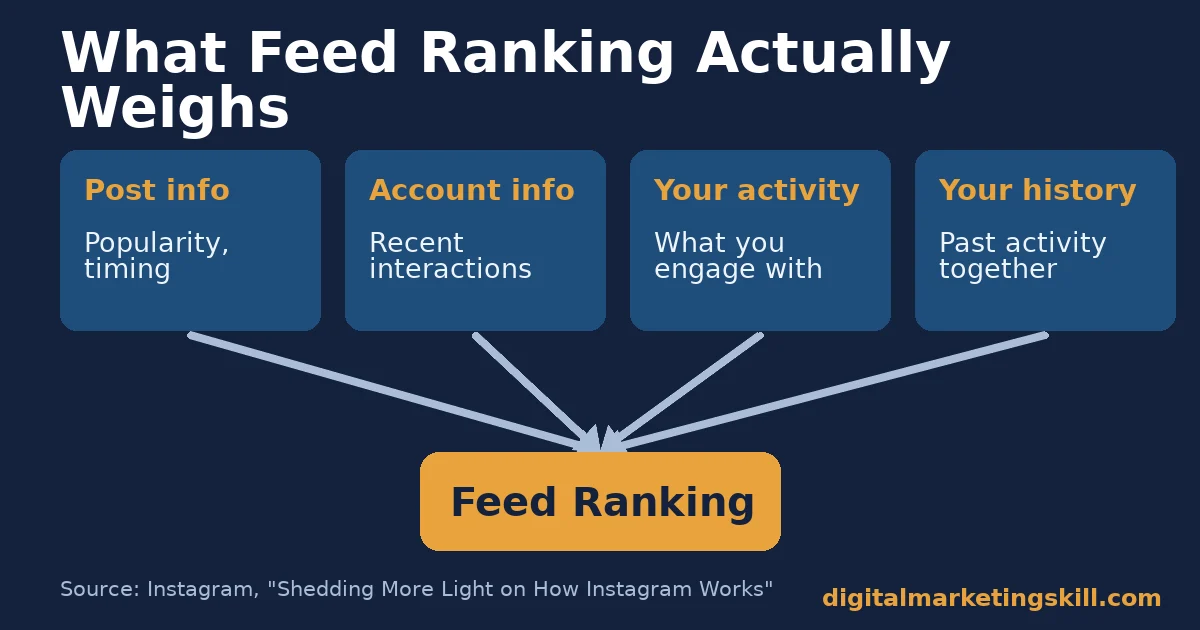
- Ranking rewards relationship, not volume. Instagram’s own engineering blog says Feed ranking weighs how often people already interact with your account, and how recently you posted. Sporadic posting fades quietly.
- Response speed is a real metric now. Instagram is one of the top channels, cited at 44%, that people turn to first with a question. Most expect a reply within 24 hours or sooner.
- The private-account mistake changed shape. Instagram’s own help pages confirm a professional business account cannot be set to private at all. The real risk today is an incomplete profile, not a locked one.
In this guide
- What Most Instagram Marketing Mistakes Advice Misses
- How Instagram Actually Decides What to Show
- Instagram Marketing Mistakes That Differ By Account Stage
- How To Fix Each Stage’s Instagram Marketing Mistakes
- How To Measure Whether You Are Still Making These Mistakes
- The One Rule: Fix Discoverability Before You Fix Volume
- A Worked Example: Correcting a Grid Built On Random Posts
- Frequently Asked Questions About Instagram Marketing Mistakes
- Where To Go From Here
What Most Instagram Marketing Mistakes Advice Misses
Most lists of Instagram marketing mistakes read the same way. Post good photos. Use hashtags. Stay consistent. None of that is wrong. But it treats every business account the same, and a brand-new account is not fighting the same battle as an established one.
This guide treats Instagram marketing mistakes as stage-specific. The data below comes from Instagram’s own help pages and engineering blog, plus published research from Sprout Social and Later. Read every figure as a snapshot from the source named, not a settled number for every account. Instagram does not publish its full ranking weights, so treat any claim about exact algorithm behaviour as an informed inference, never a confirmed fact.
One more ground rule: a mistake that mattered in an older version of Instagram can quietly stop mattering, or flip entirely, as the platform changes. The hashtag advice in this guide is one clear example, and the private-account advice is another. Treat any marketing checklist that has not been reviewed recently with some suspicion, and check its claims against Instagram’s own current help pages before you act on it.
This also means a list of Instagram marketing mistakes is never truly finished. A habit that is harmless today can become costly after the next ranking change, so the stage-based approach below is meant to be revisited, not applied once and filed away.
How Instagram Actually Decides What to Show
Instagram’s own blog post, “Shedding More Light on How Instagram Works,” names what Feed and Stories ranking actually weighs. First, it checks information about the post, including how popular it is and when you posted it. Next, it checks information about your account, based on how often people have interacted with it lately. Then it checks the viewer’s own activity. Finally, it checks that viewer’s history with your specific account.
Explore works differently. There, popularity signals carry more weight, such as how fast people like, comment on, share and save a post. Explore is built for discovery, not for showing content from accounts you already follow.
Reels rank differently again. Instagram’s own blog post says Reels ranking leans on the viewer’s recent video activity, the viewer’s history with the account that posted, information about the reel itself (including audio and visual analysis), and how quickly a reel is already spreading.
In practice, a short video can reach people who have never followed the account, in a way a static photo rarely does. This is one reason a mix of formats tends to outperform a single-format feed.
Two things follow directly. First, a post from an account nobody interacts with starts at a disadvantage in Feed, no matter how good the photo looks. Second, random, irregular posting makes that disadvantage worse, because there is no recent interaction to measure. Every mistake below either breaks one of these two mechanics, or wastes the reach it does earn.
Instagram Marketing Mistakes That Differ By Account Stage
The mistakes that hold back a brand-new account are not the ones that hold back an account with ten thousand followers. Three stages, three different failure patterns, and three distinct sets of Instagram marketing mistakes worth separating before you try to fix anything.
New Accounts: Built On Random Posting
A new account has no interaction history for Instagram to reward. So every post gets judged almost entirely on its own, and on who happens to see it. For example, posting whatever is on hand (a vacation photo one day, a product shot the next, a meme after that) gives Instagram no consistent topic to learn.
It also gives a first-time visitor no reason to believe the account is about anything in particular. This is one of the most common Instagram marketing mistakes on brand-new accounts, because it feels harmless in the moment.
The result is a grid that looks personal, not professional. A visitor deciding whether to follow is really asking one question: what will I get if I follow this account? A random grid cannot answer that. The same discipline that keeps a Facebook page consistent, covered in this guide to social media marketing principles, applies here too.
Growing Accounts: Built On Vanity Metrics
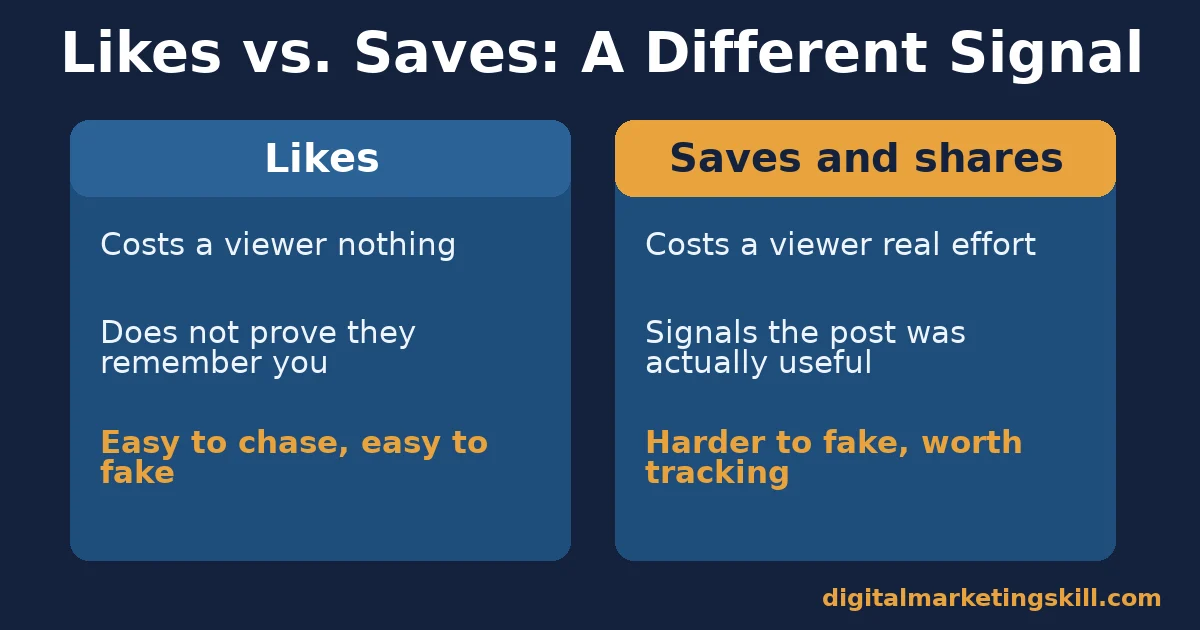
Once an account passes a few thousand followers, the common mistake shifts. Teams start judging every post by likes alone, because likes are the easiest number to see. But a like is the lightest possible signal. It costs a viewer nothing. It does not mean they remember the brand, trust it, or will ever buy from it.
Chasing likes also pushes teams toward whatever gets a quick thumbs-up: memes, giveaways, trending audio. That crowds out content that actually supports the business. Saves and shares cost a viewer more effort, so they are a better sign a post was useful. Growing accounts rarely track either one. Pairing engagement data with the view covered in this breakdown of Instagram brand awareness gives a fuller picture than likes alone.
Established Accounts: Built On Autopilot
Established accounts have the opposite problem. They coast. The grid looks professional. The captions are polished. But nobody is reading the comments. Questions sit unanswered for days. Direct messages queue up. The account quietly becomes a one-way broadcast.
This matters more than it used to. Instagram is now one of the main channels, cited at 44% by Sprout Social, that people turn to first with a question or complaint, trailing only TikTok and Facebook. An account that broadcasts but does not listen is losing a real customer-service channel. The same broadcast-only trap shows up on the other major platform too, in this list of Facebook marketing mistakes.
How To Fix Each Stage’s Instagram Marketing Mistakes
The fix for each stage mirrors its mistake directly. None of these need a bigger budget. They need a different habit.
New Accounts: Lead With One Content Pillar
Pick three to five content pillars before posting anything else. A pillar is simply a repeating category, such as “how we make it,” “customer questions answered,” or “behind the scenes.” Every post should map to one pillar, visibly, so a new visitor can tell what the account is for within four or five posts.
Post resolution matters here too. Instagram’s own help page confirms it only keeps a photo at full quality within a width of 320 to 1080 pixels, at an aspect ratio between 1.91:1 and 3:4. Outside that range, the platform resizes it, and a low-resolution source can come out visibly soft.
So export at the full recommended size every time. For a new account, every post is still doing the work of a first impression.
Growing Accounts: Lead With Saves and Shares, Not Just Likes
Track save rate and share rate alongside likes. Treat a high-save, lower-like post as a win, not a disappointment. Content that explains, lists or compares something tends to earn saves, because people bookmark it to return to later. Content that is purely decorative tends to earn likes, and little else.
A simple way to start is a monthly review: pull the five highest-save posts and the five highest-like posts from the last month, and compare their formats side by side. Most teams find the two lists barely overlap, which is the clearest proof that likes and saves are measuring different things, not the same thing at different intensities.
Hashtags matter here too, but differently than most teams expect. Instagram’s current guidance, cited in Later’s analysis of more than 18 million Instagram feed posts, is 3-5 focused, relevant hashtags. That replaces the old 20-30 tag strategy that older studies used to reward. Pick tags that actually describe the post’s topic and its audience, not the broadest net you can cast.
Established Accounts: Lead With Response Speed
Established accounts usually already have the content habit in place, so the fastest remaining win is almost always process, not creative work. A shared reply log, a short list of saved answers to common questions, and a named person responsible for the inbox each day can turn a multi-day response gap into a same-day one without adding headcount.
Set an internal target for comment and direct-message replies, and track it like any other metric. Sprout Social’s research on brand response time found that most people want a reply within 24 hours or sooner. It also found that most people would rather message a brand privately than complain in public. A quiet inbox is often a warning sign, not proof of a quiet account.
Also revisit the account’s basic setup. A business or creator profile cannot be switched to private on Instagram at all. Instagram’s own help pages confirm the platform blocks the change, or converts the account back to personal first.
So if an old “make sure it’s public” checklist item still sits in your team’s process, swap it for a check on the profile category, contact button and bio link instead. Those are the fields that actually affect discovery today, and fixing them avoids one of the more outdated Instagram marketing mistakes still floating around in old guides.
How To Measure Whether You Are Still Making These Mistakes
Five numbers catch most Instagram marketing mistakes before they cost real reach.
- Engagement rate (likes, comments, saves and shares, divided by reach or followers) shows whether content is landing at all. Sprout Social’s research, citing RivalIQ, puts the median Instagram engagement rate across industries at about 0.36%. Treat that as a baseline, not a target to copy exactly.
- Save rate (saves divided by reach) shows whether people found a post useful enough to keep. A rising save rate next to a flat like count usually means the content got more useful, not less popular.
- Response time (the gap between a comment or DM arriving and your reply) shows whether the account is actually listening. Track the median, not the average. One slow weekend can hide a generally fast team.
- Hashtag reach share (the percentage of reach that came through hashtags, visible in Instagram’s own post insights) shows whether a smaller, sharper hashtag set still pulls its weight after you trim it down.
- Follower-to-engagement ratio (engagement rate against follower count, tracked over time) flags when a growing follower count stops converting into real interaction. It is often the clearest sign of a vanity-metrics problem.
Read these five together. Pair them with the channel-level view in this guide to Google Analytics traffic sources, so Instagram’s numbers sit next to every other channel. A rising follower count next to a flat engagement rate is the clearest warning sign here.
The One Rule: Fix Discoverability Before You Fix Volume
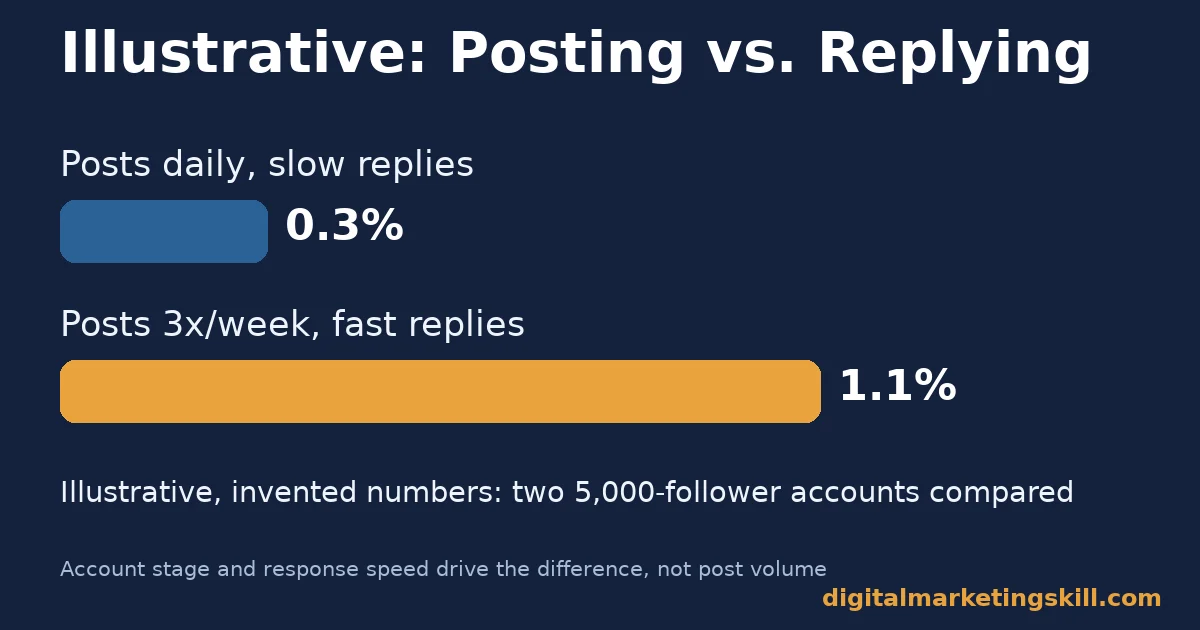
If an account is not showing up in the Feed of people who already follow it, posting more will not fix that. Posting more consistently, and replying faster, will. Instagram’s own explanation ties Feed visibility to recent interaction and posting recency, not raw post count. A brand posting daily to an account nobody engages with is working harder for the same result, or worse.
Illustrative, invented numbers: picture two accounts, each with 5,000 followers. Account A posts daily but rarely replies to comments, so its engagement rate sits near 0.3%. Account B posts three times a week, but replies to every comment within a few hours, so its engagement rate sits near 1.1%.
So on the signals Instagram has actually described, Account B’s steady interaction history gives it the stronger long-term position, even with fewer posts.
A Worked Example: Correcting a Grid Built On Random Posts
Illustrative, invented numbers: a small retail account posts whatever photo is easiest that week. A product one day, a staff birthday the next, a customer repost after that. There is no repeating theme and no hashtag plan. Engagement sits near the account’s usual average, and follower growth is flat.
Before changing anything, the team lists the specific Instagram marketing mistakes they can see in the grid: inconsistent themes, photos exported at low resolution, a hashtag set copied from a competitor years ago, and comment replies that lag by two or three days. Naming each mistake separately, rather than treating “the account isn’t working” as one vague problem, makes the fix list concrete and easier to assign.
The team then defines three content pillars: new arrivals, how-to styling, and customer questions answered. Next, they switch every export to the full 1080-pixel recommended width, and trim hashtags down to five relevant tags. Finally, they reply to comments within the same business day.
Over the following weeks, engagement rate and save rate both rise, in line with the mechanics above: more relevant content, clearer resolution, tighter hashtag targeting, and a stronger interaction history.
However, the limit on this example is that it is illustrative, not a documented case. So expect real results to vary by industry, audience size and starting engagement rate, which is exactly what Sprout Social’s own benchmark data shows across categories.
Frequently Asked Questions About Instagram Marketing Mistakes
How many hashtags should a business account use on Instagram?
Instagram’s current guidance is 3-5 focused, relevant hashtags per post. Older studies that favoured 20-30 tags reflected an earlier version of the platform. A smaller, more relevant set still helps a post reach the right audience today, without looking like spam.
What image size avoids blurry Instagram photos?
Upload at a width of at least 1080 pixels, with an aspect ratio between 1.91:1 and 3:4. Instagram’s own help documentation confirms photos inside that range keep their original resolution. Anything outside it gets resized, which is often what makes a photo look soft after upload.
Can a business Instagram account be set to private?
No. Instagram’s help pages confirm a professional business or creator account cannot be switched to private. The platform either blocks the change, or converts the account back to a personal profile first. This is one of the Instagram marketing mistakes from older advice that no longer applies to business profiles the same way.
Do likes matter for Instagram marketing?
Likes are a real signal, but a light one. Saves and shares generally cost a viewer more effort, so they track usefulness better. Growing accounts get a clearer picture by watching save rate and share rate alongside likes, not likes alone.
How fast should a business reply to Instagram comments and DMs?
Sprout Social’s research found that most people expect a reply within 24 hours or sooner. Instagram is now one of the channels people turn to first with a question. Treating response time as a tracked metric, not an afterthought, is one of the simpler fixes on this list.
Does posting every day help an Instagram account grow?
Not by itself. Instagram’s own description of Feed ranking weighs recent interaction history and timing more than raw post count. An account posting daily to disengaged followers can underperform one posting a few times a week, with faster replies and more relevant content.
What is the average Instagram engagement rate for a business account?
Sprout Social, citing RivalIQ’s tracking, puts the median across industries at about 0.36%. Treat it as a rough baseline for your own account’s trend over time, not a universal target. The figure varies by industry, format and audience size.
Should a business account post Reels as well as photos?
It is worth testing. Instagram’s own description of Reels ranking leans on recent video activity and how quickly a reel is already spreading, which can expose an account to people who have never followed it before. A photo-only account skips that discovery path entirely, so mixing formats is one of the simpler Instagram marketing mistakes to fix once resolution, hashtags and response time are already in order.
Where To Go From Here
Fixing Instagram marketing mistakes is rarely about one viral post. Instead, it is about removing the habits that quietly cap reach, one account stage at a time. Digital Marketing Skill Institute’s Master Diploma in Digital & AI Marketing builds this skill alongside paid search, SEO, email and analytics.
It covers nine practical courses, unlimited one-on-one coaching and mentoring, and real project work inside a U.S. company. The program is dual US and UK accredited, recognised in more than 100 countries, and delivered 100% online, so you can study anywhere in your country.
Browse more guides like this one on the digital marketing blog, or read outcomes from past students on the reviews page. Go straight to the application page to start. Wherever you live, the program runs entirely online, and Digital Marketing Skill Institute is built for marketers who want proof, not just a certificate. Explore more free resources at digitalmarketingskill.com while you decide.
Every figure in this guide was checked against its original source before publication. Figures marked as illustrative are invented examples, not real results.
![9 Amazing Digital Marketing Skills to Make Money Online [With Proof]](https://digitalmarketingskill.com/wp-content/uploads/2019/07/9-Amazing-Digital-Marketing-Skills-to-Make-Money-Online-With-Proof-17.png)