A social media manager plans content, runs the posting schedule, and ties engagement back to real business results. Employers care less about a title. Instead, they care about proof you can do the job. This guide covers what a social media manager actually does, what job postings really ask for, and how to build proof before you apply.
Key Takeaways
- The category is growing faster than average. The US Bureau of Labor Statistics projects 7% growth for market research analysts and marketing specialists, the category covering social media work. About 82,000 openings are projected each year.
- Median pay sits well above the general average. Indeed, the same Bureau of Labor Statistics data puts the median annual wage for this category at $78,760.
- One skill dominates job postings by far. Huntr’s analysis of 1,958 social media manager job postings found content creation required or preferred in 67.6% of them. No other single skill came close.
- Analytics and video are close behind. The same analysis found analytics in 23.1% of postings and video editing in 23.0%. Both, in fact, outrank any single design or platform tool.
- Salary scales clearly with proven experience. Robert Half’s own salary guide places social media manager pay from $62,500 for people new to the role, up to $95,500 for people with extensive, proven experience.
In this guide
- What Most Advice for a Social Media Manager Skips
- What a Social Media Manager Actually Does Day to Day
- What Differs Between Entry Paths
- How to Make Each Path Work
- How to Prove You’re Ready, Not Just Interested
- The One Rule: Build Proof Before You Apply
- A Real Example: What Job Postings Actually Ask For
- How the Role Differs by Company Type
- Tools Worth Learning First
- Common Mistakes Early Social Media Managers Make
- A Simple 90-Day Starter Plan
- Frequently Asked Questions About Becoming a Social Media Manager
- Build Real Proof, Not Just a List of Skills
What Most Advice for a Social Media Manager Skips
Most advice lists generic skills: “be creative,” “know social media,” “communicate well.” None of that is wrong. It just skips how employers actually filter candidates, which is against a specific list of required skills on a real job posting.
Treat every figure here as a snapshot of current hiring, not a lifetime guarantee. After all, government projection data describes an occupational category, not any single company’s plans. Likewise, job-posting analyses describe what employers wrote down, not necessarily everything that makes someone good at the job.
What a Social Media Manager Actually Does Day to Day
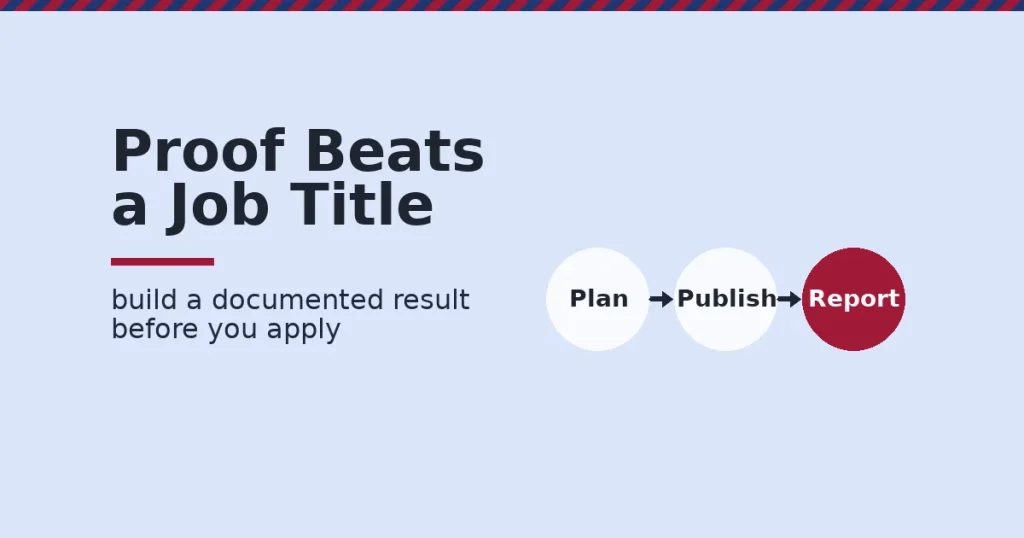
The job splits into three repeating cycles. First comes planning content. Then publishing and engaging. Then reporting on what happened. Each cycle feeds the next, so a weak link anywhere slows the whole process down.
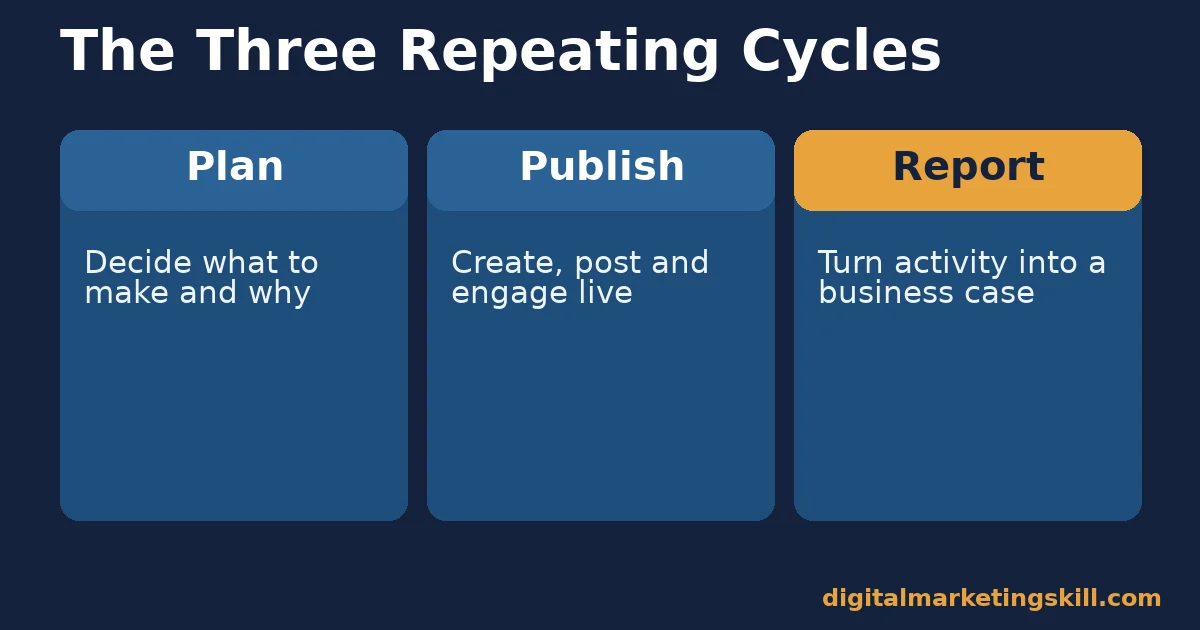
Planning: Deciding What Gets Made
Planning means building a content calendar tied to real goals, not just filling empty slots. First, a social media manager decides what to post and on which platform. More importantly, they can explain why that post serves a business outcome, not just activity for its own sake.
Publishing and Engaging: Where the Work Becomes Visible
This is the part most people picture. It means writing captions, directing or editing short video, and responding to comments. It also means watching a post’s first few hours closely, since that is when most engagement happens. A reliable social media management tool makes scheduling easier, though it never replaces judgment about what to post.
Community management, the direct back-and-forth with an audience, showed up in close to one in five job postings analysed by Huntr. So this is not a minor side task. It’s a named, frequently required skill.
Reporting: Turning Activity Into a Business Case
The final step is reporting results in terms a manager outside marketing can understand. Likes and shares still matter. But Robert Half’s own guidance is blunt about what employers actually want: proof that activity turned into website visits and new business, not just engagement for its own sake.
This reporting step is also winning more respect at the leadership level. Sprout Social’s own research found that 56% of marketing leaders now say social media drives real revenue for their companies, not just brand awareness. That shift raises the bar for what a social media manager is expected to prove with numbers, not just show with screenshots.
What Differs Between Entry Paths
Most people become a social media manager through one of two routes. First, a portfolio-first path builds proof through real work, often unpaid or freelance at first. A structured-training path builds the same proof through a guided course with real project work built in.
Portfolio-First: Built on Visible, Checkable Work
This path means running real accounts, even small ones, and keeping records of what you did and what changed. So a portfolio-first candidate can point to a specific campaign, a specific number, and a specific decision they made. That specificity, in short, is what separates a real portfolio from a vague list of claims.
Structured Training: Built on Guided Practice and Feedback
This path trades some trial and error for guided feedback and a structured sequence of real project work. It suits people who want a faster, more predictable route to the same portfolio a self-taught path eventually builds anyway.
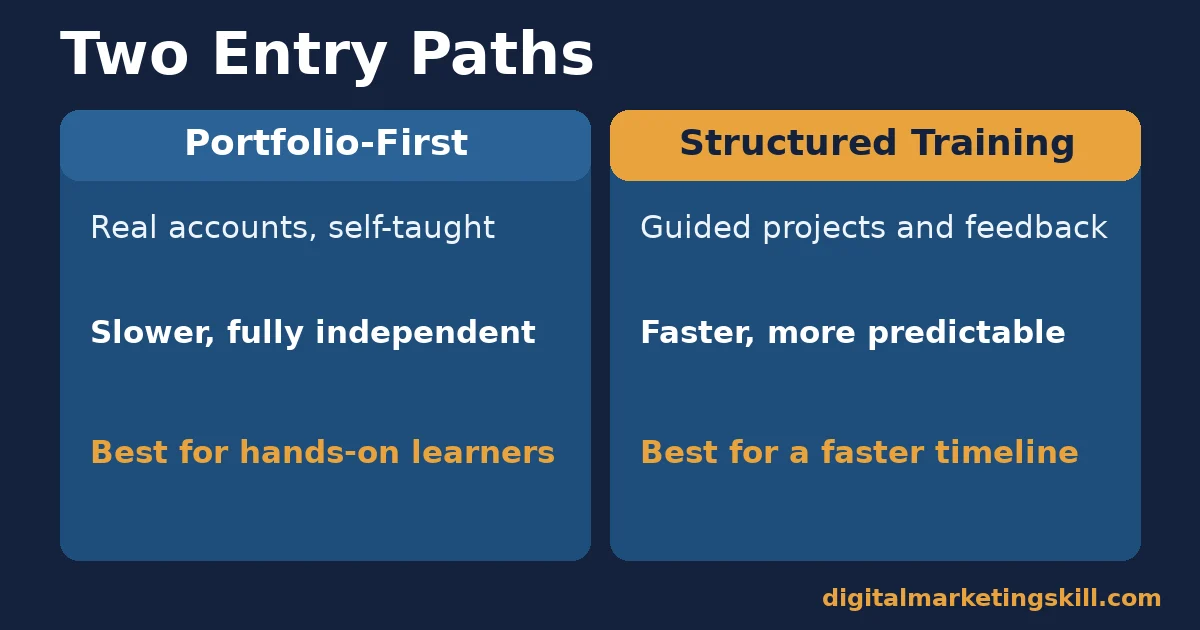
Neither path is inherently better. The real trade-off is speed versus independence. Structured training compresses the timeline. A self-built portfolio costs more time, but no tuition.
How to Make Each Path Work
Portfolio-First: Document Everything From Day One
Fix a portfolio-first path by tracking results from your very first post, not once you feel “ready.” Screenshot analytics regularly. Platforms don’t keep old data visible forever, and you’ll want real numbers later, not a vague memory of doing well.
Pick one or two platforms to go deep on, rather than spreading thin across every network. A focused, well-documented presence on two platforms beats a shallow presence on six.
Structured Training: Choose a Program With Real Output, Not Just Lessons
Fix a structured-training path by checking what you’ll actually have at the end. Look for a real campaign you ran and real analytics you can show, not only a certificate. A certificate alone rarely satisfies an employer who wants to see applied work.
Ask specifically whether the program includes real client or project work, mentoring from someone with hiring experience, and a result you can describe in an interview with actual numbers attached. Building a varied content creation habit alongside any program also strengthens your eventual portfolio.
How to Prove You’re Ready, Not Just Interested
Five Things a Hiring Manager Actually Checks
Each of these answers a different question an employer is quietly asking. Cover as many as you can before you apply.
- A content sample. Something you made, not just shared, drawn from a mix of social media content formats. This proves you can produce, not just curate.
- A number you can explain. Growth, engagement or traffic you can describe in plain terms, including why it changed. A number without context convinces no one.
- Platform fluency, not just presence. Knowing why a format works on one platform and fails on another, not just having an account everywhere.
- Basic analytics comfort. Reading a dashboard and explaining what it shows. This skill alone appeared in close to a quarter of the job postings Huntr analysed.
- A clear “why” for each post. The ability to explain the business reason behind a piece of content, not just its creative idea.
The One Rule: Build Proof Before You Apply
If you remember one rule from this guide, make it this one: build at least one real, documented result before you apply, not after.
Here is an illustrative, invented example to show why this matters. Picture two candidates for the same role. One lists “managed social media” with no numbers attached. The other names a small account’s starting and ending engagement rate, and explains the single change that caused it. The second candidate is far easier to trust, even with a shorter resume overall.
Apply the same rule to interviews. A specific, numbered story beats a general claim about being “passionate about social media” almost every time.
A Real Example: What Job Postings Actually Ask For
Huntr analysed 1,958 live social media manager job postings and counted exactly which skills employers listed, and how often. The clear limit: this describes what employers wrote in a posting, not necessarily everything the job requires once you’re hired.
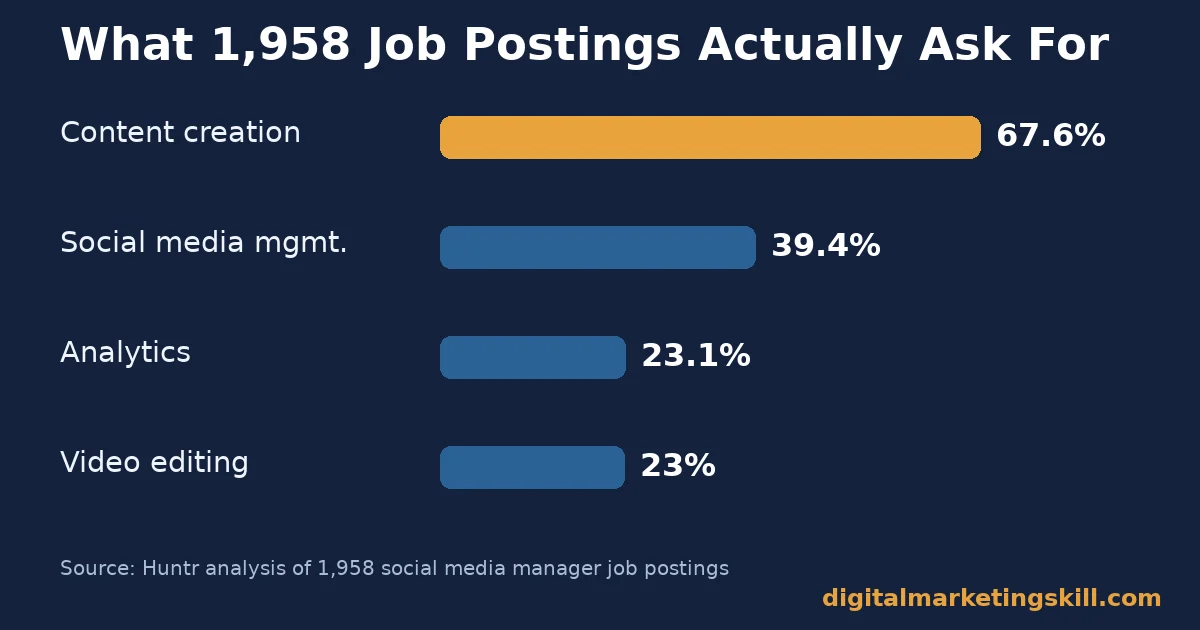
Content creation led by a wide margin, appearing in 67.6% of postings. Social media management as a general skill followed at 39.4%. Strategy came next at 23.5%, then analytics at 23.1%, then video editing at 23.0%. Specific tools appeared further down the list: Canva in 15.5% of postings, TikTok in 15.1%, and Instagram in 14.5%.
The lesson generalises beyond this one analysis. Specific platform or software skills matter less than the ability to actually create content and read what happened after you posted it. Build those two abilities first. Specific tools become easy to pick up afterward.
How the Role Differs by Company Type
A social media manager’s day looks different depending on who signs the paycheck. The core skills stay the same. The pace, the approval process and the scale of reporting change a lot.
Agency Roles: Fast Pace, Many Clients at Once
At an agency, you typically manage several client accounts in parallel. Each client has its own voice, goals and reporting format, so context-switching is a daily skill, not an occasional one. Agencies often move faster, with shorter approval chains and tighter deadlines.
In-House Roles: One Brand, Deeper Context
An in-house social media manager works for a single company, which allows for deeper product and audience knowledge over time. Approval processes can be slower, since more internal stakeholders usually review content before it goes live. The trade-off is depth over breadth.
Freelance and Solo Work: Full Ownership, Full Responsibility
Freelancers own every part of the cycle: planning, publishing, reporting and client communication, often for several small clients at once. This path builds a wide skill set quickly, though it also means handling the business side, like invoicing and client acquisition, without a team around you.
Startup Roles: One Person Doing a Team’s Job
At an early-stage startup, a social media manager often absorbs tasks that would belong to several specialists at a larger company, from light design work to customer service replies. This builds breadth fast, but it also means less time to go deep on any single skill. It suits people who enjoy variety over specialisation.
Tools Worth Learning First
You don’t need every tool on the market. You need a small set that covers the full cycle: planning, creating, and reporting.
A Simple Scheduling and Planning Tool
Start with one tool that lets you plan posts ahead of time and see your calendar at a glance. This alone fixes the most common early mistake, which is posting reactively with no plan at all.
One Design Tool You Actually Know Well
Canva appeared in 15.5% of the job postings Huntr analysed, more often than any other named design tool. You don’t need to master every feature. You need to know it well enough to produce clean, on-brand visuals quickly.
A Way to Track Numbers Outside the Platform Itself
Native platform analytics disappear or reset over time, so keep your own simple record, even a basic spreadsheet, of key numbers each month. This habit alone makes your eventual portfolio far easier to build, since the numbers already exist when you need them.
Common Mistakes Early Social Media Managers Make
Reporting Only Vanity Metrics
Likes and followers are easy to screenshot, but they rarely convince a hiring manager or a client on their own. Pair every vanity metric with a business outcome, even a small one, so the number means something beyond itself.
Spreading Across Too Many Platforms at Once
Trying to maintain a strong presence everywhere usually produces a weak presence everywhere. A focused, well-documented effort on one or two platforms builds a far stronger portfolio than a thin presence spread across six.
Not Tracking Results From the Start
Many beginners wait until they feel “ready” before they start measuring anything. By then, the early results that would have made a great portfolio story are already gone. Track from the first post, even if the numbers are small at first.
Ignoring Direct Feedback From an Audience
Comments and direct messages are a free, constant source of information about what an audience actually wants next. Some early social media managers treat replying as a chore instead of research, and miss patterns that would have shaped a stronger content plan. A short weekly scan of comments, looking specifically for repeated questions or requests, often surfaces a content idea no analytics dashboard would show.
A Simple 90-Day Starter Plan
If you’re starting from nothing, a loose 90-day structure beats waiting for the perfect plan. This is a rough guide, not a rigid schedule.
First Month: Pick a Lane and Start Publishing
Choose one or two platforms. Choose a narrow topic or audience you actually understand. Publish consistently, even if early posts feel rough. The goal this month is volume and a working habit, not perfection.
Second Month: Start Measuring and Adjusting
Begin tracking basic numbers: reach, engagement rate, and any traffic sent elsewhere. Compare week to week, not post to post, since single posts swing too much to mean much on their own. Adjust your content mix based on what the numbers actually show, not just what felt good to make.
Third Month: Package the Results Into a Portfolio Story
Take your strongest, most documented result and turn it into a short, specific story: what you tried, what changed, and why. This becomes the centrepiece of your applications and interviews, the kind of specific, numbered proof this guide keeps coming back to.
Keep the story short enough to say out loud in under a minute. A hiring manager remembers one clear, specific story far better than a long list of everything you touched over three months.
Frequently Asked Questions About Becoming a Social Media Manager
Do I need a degree to become a social media manager?
No single degree is required by most employers. A documented portfolio and a clear ability to explain results usually matter more than the specific credential on your resume.
Which platform should I focus on first?
Whichever platform your target employer’s audience actually uses. A strong, documented presence on one relevant platform beats a thin presence spread across every network that exists.
What does a social media manager actually earn?
Robert Half’s own salary guide places the range from $62,500 for people new to the role, through $78,750 for moderate experience, up to $95,500 for extensive, proven experience. Actual pay varies by location, company size and industry.
How long does it take to become job-ready?
It depends on how fast you build a documented portfolio with real numbers attached, not on a fixed amount of time. A focused few months of real, tracked work can outweigh a year of unfocused posting with nothing measured.
Do I need to learn every social media tool before applying?
No. Job postings name specific tools less often than core skills like content creation and analytics. Learn the fundamentals first. Pick up specific tools as a role actually requires them.
Should I freelance first, or aim for a full-time role right away?
Either can work. Many people use freelance or small-account work specifically to build the documented proof a full-time application needs. Treat early freelance work as portfolio-building, not just income.
Is an agency or an in-house role better to start with?
Neither is objectively better. An agency role exposes you to more brands and formats quickly. An in-house role builds deeper expertise in one brand. Pick based on whether you want breadth or depth first.
How many examples do I need in a portfolio?
A handful of well-documented, specific results beats a long list of vague ones. Three or four real examples, each with numbers and context attached, usually say more than a dozen screenshots with no explanation.
Do certifications actually help?
They can help a resume pass an initial screen, but they rarely replace proof of real, applied work in an interview. Treat a certification as a supplement to a documented portfolio, not a substitute for one.
Is a startup role a good place to start a career?
It can be, especially if you want broad exposure fast. A startup role often means doing several jobs at once, which builds range quickly, though it can also mean less structured mentoring than an agency or in-house team provides.
Build Real Proof, Not Just a List of Skills
Becoming a social media manager is one practical path inside a much wider AI and digital marketing skill set. It’s exactly the kind of applied, results-first training taught across the Digital Marketing Skill Institute’s Master Diploma in Digital & AI Marketing.
The program is built from four AI-powered tracks totalling ten courses: AI-Powered Social Media Management and Advertising, AI-Powered Lead Generation and Email Automation, AI-Powered Google Specialist, and AI-Powered WordPress and SEO Specialist. A Full Stack option covers all four.
Every track includes unlimited 1-on-1 coaching and mentoring, plus a U.S. Project Internship with a verified U.S. Work Reference Letter, exactly the kind of documented, real-world proof this guide recommends building. The program carries dual US and UK accreditation, recognised in more than 100 countries.
It’s 100% online, so you can study and apply it anywhere in your country. Everything starts from the DMSI homepage. See the full curriculum on the Master Diploma program page, browse more practical guides on the digital marketing blog, read real outcomes on the reviews page, and when you’re ready, apply here to start, wherever you live.
Every figure in this guide was checked against its original source before publication. Figures marked as illustrative are invented examples, not real results.