

Instagram SEO is the practice of optimising your profile and posts so they surface in Instagram’s own search results, not just Google’s. Instagram ranks search results on text match first, then your activity, then popularity. Getting the text right in the places Instagram actually reads is most of the work. It costs nothing but time.
Key Takeaways
- Text match wins first, not engagement. Instagram’s own blog states that the words you enter in the search bar are “by far the most important signal for Search.” That beats activity or popularity every time.
- Instagram’s reach is still huge. DataReportal’s analysis of Meta’s advertising tools put Instagram’s potential ad reach at 1.74 billion users worldwide. The audience for Instagram SEO is not shrinking.
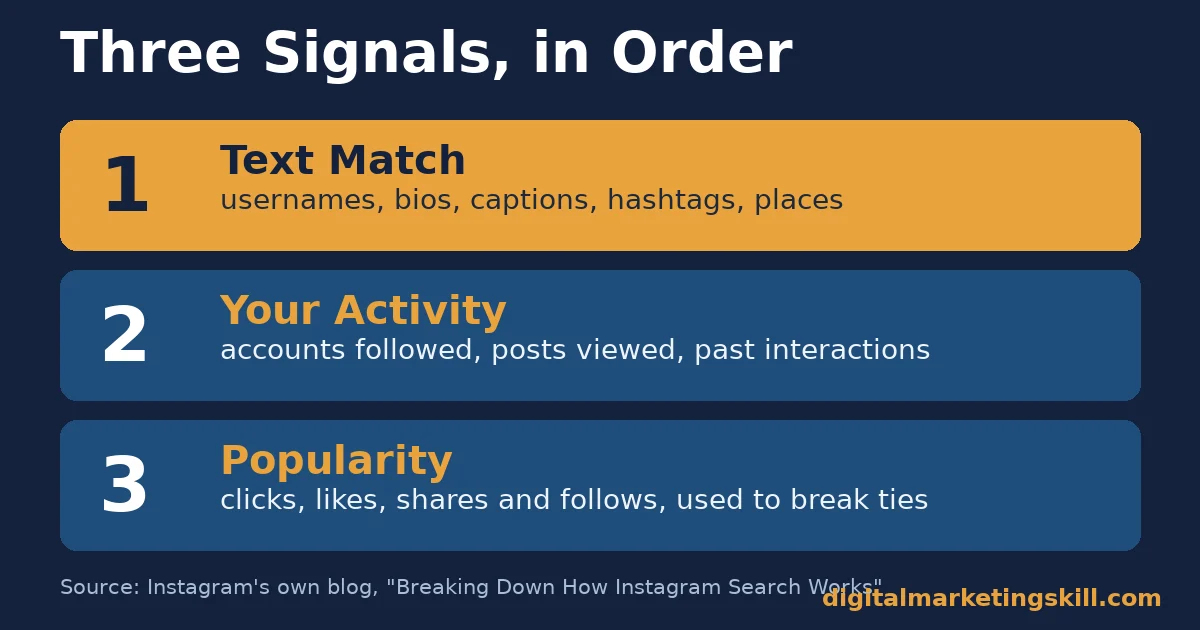
- Search ranks on three signals, in order. Text match comes first. Past activity with accounts and hashtags comes second. Popularity signals like clicks, likes, shares and follows come third, according to Instagram’s own explanation.
- Alt text gets read, but it is not a keyword-stuffing field. Instagram indexes alt text for search. Descriptive, accurate text still performs better than a packed list of keywords.
- Most Instagram SEO advice skips the mechanism. Knowing which three signals Instagram actually ranks on changes where you spend your time. That is the decision rule this guide builds toward.
In this guide
- What Most Instagram SEO Advice Skips
- How Instagram Search Actually Ranks a Result
- What Differs by Surface: Search, Explore and Google
- How to Lead With Each Surface
- How to Measure Instagram SEO
- The Most Useful Rule: Fix Text Match Before Chasing Engagement Tactics
- Common Mistakes With Instagram SEO
- A Real Case: Paid Reach Shows What Instagram’s Audience Is Worth
- Frequently Asked Questions About Instagram SEO
- Start With Your Bio, Then Expand
What Most Instagram SEO Advice Skips
Most Instagram SEO guides list the same tactics: put keywords in your bio, use hashtags, write good captions. Those tactics are not wrong. What they skip is the mechanism behind them, which is how Instagram’s own search actually ranks a result.
This guide applies to anyone who wants to be found inside Instagram’s own search bar, not just whoever lands on a post from a link or a follow. That includes a personal brand, a local service, an online store or a creator. The three ranking signals below work the same way regardless of what the account sells.
Here are the ground rules for this guide. The ranking signals below come directly from Instagram’s own blog post explaining how search works. They are not guesswork repeated across marketing sites. Reach and demographic figures come from DataReportal’s analysis of Meta’s advertising tools. That source itself notes the figures reflect ad reach, not exact active-user counts.
Instagram’s interface and specific ranking details change over time. Treat the mechanism in this guide as the stable part, and the tactics as the part worth re-checking occasionally. The three ranking signals themselves have held steady since Instagram first published them, even as individual features around them have changed.
How Instagram Search Actually Ranks a Result
Instagram’s own blog breaks its search ranking into three signals, used in order. The first and most important is text match. Instagram compares the words you type against usernames, display names, bios, captions, hashtags and places. A close text match beats a popular but unrelated account almost every time.
The second signal is your own activity. Instagram looks at the accounts you follow, the posts you have viewed, and how you have interacted with accounts before. Results connected to your existing activity rank higher than ones you have never engaged with. This signal explains why two people searching the identical term can see a different order of results.
The third signal is popularity, used mainly to break ties among otherwise similar results. Instagram factors in the number of clicks, likes, shares and follows a given account, hashtag or place has received. A more popular account using similar keywords can still outrank a well-optimised one with little engagement, which is why popularity sits third rather than first.
The practical takeaway is ordering. Instagram SEO work should start with text match, because it carries the most weight. That signal is also entirely within your control, unlike the two that depend on other people’s behaviour.
What Differs by Surface: Search, Explore and Google
Instagram SEO is not one single ranking system. The three surfaces below behave differently, and each rewards a different kind of optimisation.
Confusing the three is the single most common reason Instagram SEO effort goes to waste. A creator who polishes captions for search while posting content nobody watches is optimising the wrong surface for their actual goal. Know which surface you are chasing before you touch a single caption, because the fix for one rarely helps the other.
In-App Search: Built on Text Match First
Instagram’s own search bar is the clearest Instagram SEO surface, because its ranking signals are published directly by the platform. Text match dominates here. A username, bio or caption that closely matches what people actually type outperforms a vague but popular one. This surface rewards clear, specific words over clever branding every time.
Explore and Reels: Built on Engagement Signals, Not Search Terms
Think of Explore as a recommendation engine rather than a search box. Nobody typed anything to arrive there, so there is no query for text to match against in the first place.
Explore and Reels are discovery surfaces, not search surfaces. They show content to people who never typed a query, based mainly on what similar users have engaged with. Keywords in a caption still help here, because Instagram uses that text to understand the topic. Engagement behaviour, though, carries far more weight than it does in search.
The limitation is control. The signal Explore weighs most is how people already behave once they see your content, so text alone cannot force a placement there.
Public Profiles on Google: Built on Standard Web SEO
Public Instagram profiles and some posts can be indexed by Google. That index follows ordinary web SEO rules rather than Instagram’s internal ones. A bio and caption written with a real keyword in mind can rank in Google results for that term. That ranking stays entirely separate from how the same post performs inside Instagram’s own search.
Our guide on on-page SEO checklist covers how Google evaluates a page, which applies loosely to how it evaluates an indexed public profile too. Google’s own guidance on helpful, people-first content is a useful check for a bio or linked landing page as much as for a blog post.
How to Lead With Each Surface
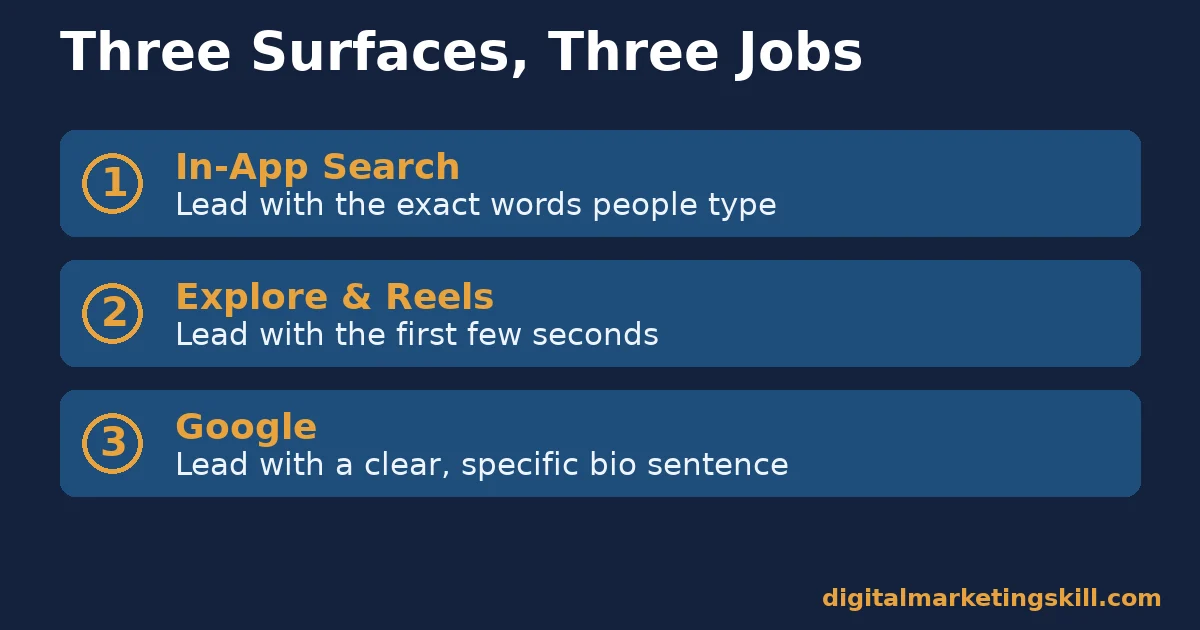
Understanding a surface is not the same as optimising for it. The sections below mirror the three surfaces above and turn each into a specific starting move. Work through them in order, since fixing text match first makes every later step easier to measure.
In-App Search: Lead With the Exact Words People Type
Rewrite your username, display name and bio around the specific words your audience searches, not a clever brand name alone. Then write captions that repeat your core topic in plain language, because Instagram’s text match reads captions too, not only the profile fields.
Explore and Reels: Lead With the First Few Seconds
Explore ranks on engagement rather than text. So your first job is earning a watch, a like or a save within the first few seconds of a Reel, or the first glance at a photo. A keyword-perfect caption on a post nobody engages with still loses to a weaker caption on content people actually watch.
Public Profile: Lead With a Clear, Specific Bio Sentence
Write one plain sentence in your bio that states exactly what you do and for whom, using the words a stranger would Google. That single sentence does double duty: it helps Instagram’s own text match and gives Google a clear snippet to index.
Keep that sentence specific rather than clever. “Help busy parents plan easy family dinners” matches far more searches, inside Instagram and on Google, than a vague tagline that reads well but names nothing a stranger would actually type.
Our guide on social media campaign strategies for small businesses covers how to keep that positioning consistent once you take it beyond the bio.
How to Measure Instagram SEO
Each metric below is defined in one sentence, with a note on how to read it.
- Search-originated profile visits. Instagram’s own account insights break down how visitors found your profile, including search. A rising share from search means your text match is working.
- Reach from non-followers. The share of accounts reached who did not already follow you. This separates genuine discovery from your existing audience simply seeing another post. A rising share here points to Explore and Reels working, not search.
- Saves per post. A strong save rate signals real usefulness, and it is one of the popularity signals Instagram’s own blog names as a ranking input.
- Keyword-to-bio match rate. An informal check: does your bio contain the exact phrase your target customer would type into Instagram’s search bar? A missing or vague match limits text-match ranking before anything else matters.
- Google impressions for your profile URL. Available in Google Search Console if your profile is indexed. This tracks the separate, standard-web-SEO side of Instagram SEO.
Reading the Numbers Together
Start with search-originated visits and keyword-to-bio match together. If the match is weak and search visits are low, fix the text first, because that is the cheapest and most controllable lever. If the bio already matches well but reach from non-followers stays flat, the problem has shifted to engagement on Explore and Reels, which text alone cannot fix.
Here is a worked example, with invented numbers for illustration. An account checks its insights and finds 5% of profile visits come from search, with a bio that never mentions its actual niche. After rewriting the bio and username around the exact service it offers, search-originated visits climb to 18% of total visits within a month, while posting frequency and content style stay exactly the same.
The owner tracks nothing else differently that month, which is the point of the example. A single, controllable text change moved a measurable number, before any new content, any paid spend or any change to posting schedule. That order of operations is exactly what the decision rule in this guide recommends.
The Most Useful Rule: Fix Text Match Before Chasing Engagement Tactics
If you take one decision rule from this guide, make it this one. Fix your username, bio and caption text match before investing time in Reels trends, posting schedules or engagement pods. Text match is the signal Instagram ranks first, and it is entirely within your control, while engagement-based ranking depends on how an audience behaves once it already sees your content.
This rule holds regardless of account size. A brand-new account and an established one both start from the same first question: does the text actually match what people type? Everything downstream of that answer depends on getting it right first.
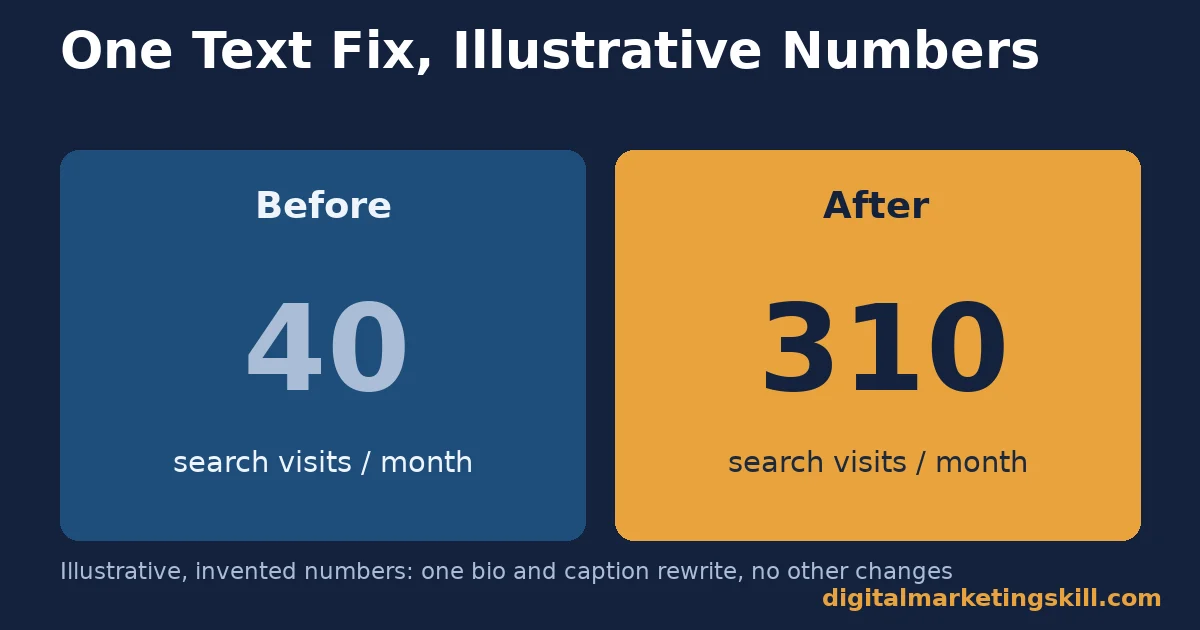
Here is an illustrative example, with invented numbers. A plant-care account with a vague bio gets 40 search-originated profile visits a month. After rewriting the bio and first few captions around the exact phrases customers search, like “indoor plant care tips,” search visits rise to 310 a month within a few weeks, with no change to posting frequency or content style.
Common Mistakes With Instagram SEO
Three mistakes repeat across accounts trying Instagram SEO for the first time. Each one wastes effort that could have gone toward text match, the signal that actually ranks first.
- Stuffing hashtags instead of fixing the bio. A long hashtag list cannot make up for a username and bio that say nothing specific. Instagram SEO starts with the fields people actually read, not the ones that feel easiest to pad.
- Treating Explore like search. Explore and Reels rank mostly on engagement behaviour, not keyword text, so optimising a caption’s keywords alone will not force a Reel into Explore. The two surfaces need different work.
- Writing alt text for the algorithm instead of the image. Instagram’s own accessibility blog post describes alt text as a way to describe a photo for people using screen readers. Keyword-packed alt text performs worse than a plain, accurate description, because Instagram penalises text that reads as spam rather than a real description.
Avoiding even one of these mistakes usually moves search-originated visits more than another round of hashtag research. Review your profile against this list every few months, since a bio written for an old offer rarely matches what today’s audience actually types. A quick quarterly check costs minutes. It catches drift before it compounds into months of weak search-originated visits.
A Real Case: Paid Reach Shows What Instagram’s Audience Is Worth
Ayooluwa Osemi, a Digital Marketing Skill Institute graduate, published a result that shows how much reach Instagram’s audience can return on a small budget. According to the student’s review on the institute’s reviews page, a $14 spend on Facebook and Instagram ads produced $878 in sales.
That case is paid reach, not organic Instagram SEO, so treat it as evidence of audience value rather than a search-ranking result. It is one published figure from one campaign, not a guaranteed return, and spend-to-sales ratios vary by product and audience. See the institute’s earnings disclaimer for the full context.
The connection to Instagram SEO is still useful: paid reach and organic search ranking draw on the same underlying audience. A platform large enough to return $878 from a $14 test is also large enough to make fixing your text match worth the time it takes. Organic ranking will never show a return that fast, but it keeps paying long after the ad budget has run out and the campaign has ended.
Frequently Asked Questions About Instagram SEO
What is Instagram SEO?
Instagram SEO is the practice of optimising your username, bio, captions, alt text and hashtags so your content ranks in Instagram’s own search results. It is separate from, though related to, getting an Instagram profile indexed on Google.
Does Instagram SEO actually affect the algorithm?
It affects Instagram’s search ranking specifically, which runs on text match, activity and popularity signals, according to Instagram’s own blog. Explore and Reels discovery rely far more on engagement behaviour than on keyword text, so the two systems need separate work even though people often lump them together as “the algorithm.”
Where should I put keywords for Instagram SEO?
Put your clearest, most specific keyword in your username or display name if possible, then repeat the core topic in your bio and in captions using natural language. Alt text is indexed too, but it should describe the image accurately rather than list keywords.
Do hashtags still matter for Instagram SEO?
Hashtags are one of the fields Instagram’s search matches text against, so relevant ones still help. They carry less weight than they once did relative to captions and bios, which is why text match across your whole profile matters more than hashtag volume alone.
How many keywords should I use in my Instagram bio?
Fewer than it feels like you need. One or two specific phrases that match real searches beat a bio crammed with every term you can think of, because Instagram’s text match rewards relevance, and a cluttered bio reads worse to an actual visitor.
How is Instagram SEO different from Google SEO?
Google SEO ranks a page across the open web using its own crawling and ranking system. Instagram SEO ranks content inside Instagram’s own search bar using the platform’s three signals. A public profile can appear in both systems at once, each judged separately.
How long does Instagram SEO take to show results?
Text-match changes, like a rewritten bio, can affect in-app search ranking within days, since that signal does not depend on accumulating new engagement. Explore and Reels reach take longer, because that ranking depends on real audience behaviour building up over time.
Can a private Instagram account benefit from Instagram SEO?
Only partially. Instagram’s in-app search can still match a private account’s username and name, but captions and bios behind a private account cannot be indexed by Google, and non-followers cannot see content to engage with it on Explore.
Should a business Instagram account ever go private?
Rarely, if discoverability matters at all. A private account loses the Google-indexing path and the Explore path entirely. That closes off two of the three Instagram SEO surfaces this guide covers, leaving only in-app search among existing followers’ networks.
Does changing my username hurt Instagram SEO?
A username change can briefly affect existing search rankings and any external links pointing to the old handle. Once Instagram re-indexes the account, though, a username that better matches what people actually search for usually outperforms the old one.
Start With Your Bio, Then Expand
Instagram SEO works fastest when you fix the signal you control first. Rewrite your username, display name and bio around the exact words your audience searches. Check search-originated visits after a few weeks, and only then turn to Explore and Reels engagement tactics.
Revisit the mechanism, not just the tactics, every so often. Instagram SEO keeps working the same way even as individual trends and features change, because the three ranking signals behind it have stayed consistent since Instagram first explained them.
If you want structured, hands-on practice, the Digital Marketing Skill Institute teaches these exact skills inside its Master Diploma in Digital & AI Marketing. The programme is built around four AI-powered tracks, including AI-Powered Social Media Management and Advertising and AI-Powered WordPress and SEO Specialist, across ten courses total, with a Full Stack option for completing all four. It comes with unlimited 1-on-1 coaching and mentoring, plus a U.S. Project Internship that leads to a verified U.S. Work Reference Letter. The diploma is dual US and UK accredited and recognised in more than 100 countries.
The programme is fully online, so you can study from anywhere in your country. Browse more guides on the Digital Marketing Skill Institute blog, check real outcomes on the reviews page, and when you are ready, apply for the Master Diploma or start from the Digital Marketing Skill Institute homepage.
Every figure in this guide was checked against its original source before publication. Figures marked as illustrative are invented examples, not real results.
![9 Amazing Digital Marketing Skills to Make Money Online [With Proof]](https://digitalmarketingskill.com/wp-content/uploads/2019/07/9-Amazing-Digital-Marketing-Skills-to-Make-Money-Online-With-Proof-17.png)






