Does AI replace digital marketers at every level of the job, or just parts of it? The short answer: AI takes over specific tasks, not the whole role, and Anthropic’s own task-exposure analysis puts marketing specialists at 65% exposure even though most senior marketers expect their jobs to survive.
That gap between high exposure and low actual replacement is the real story, and it is one this guide works through task by task. This guide shows exactly which tasks are at risk, and how to move your work toward the parts AI cannot do.
Key Takeaways
- Exposure is high. Replacement is not. Anthropic’s AI usage analysis rates marketing specialists and market research analysts at 65% task exposure. So that places the role fifth among the occupations studied.
- Most marketers already use AI daily. CoSchedule surveyed 1,005 marketing professionals. 85% use AI tools for content creation. 85.84% plan to use AI even more over the next two to three years.
- Budgets are outpacing readiness. Gartner surveyed 402 marketing leaders for its CMO Spend Survey. CMOs now put 15.3% of their marketing budget into AI. Yet 70% admit their processes are not mature enough to use it well.
- Content and copy carry the most risk. When marketing leaders were asked which function AI threatens most, content and copywriting ranked first. Design and creative work ranked second.
- Human judgement is rising in value, not falling. The World Economic Forum’s Future of Jobs Report lists creative thinking as one of the fastest-growing skills employers want. Even so, 39% of workers’ core skills are expected to change within the next few years.
For the tools behind these tasks, see our breakdown of AI marketing tools.
In this guide
- What the “AI Replace Digital Marketers” Debate Misses
- How AI Actually Performs Marketing Work
- AI Replace Digital Marketers: Where Exposure Differs By Task
- AI Replace Digital Marketers: How To Make Your Role Harder To Automate
- How To Measure Whether AI Is Replacing Or Assisting Your Work
- The One Rule: Automate The Task, Never The Judgement
- A Real Case: What Duolingo’s AI-First Shift Shows And Does Not Show
- Frequently Asked Questions: Does AI Replace Digital Marketers
- Build The Judgement Skills AI Cannot Replace
What the “AI Replace Digital Marketers” Debate Misses
Most answers to “does AI replace digital marketers” land on one of two extremes. Either AI takes every marketing job, or AI is just a tool and nothing changes. Neither extreme matches the data.
The real question is not whether AI replace digital marketers as a whole category, but which tasks move first. It is which tasks inside the job move to AI first, which stay human, and how fast that line is shifting. This guide works at that level.
A few ground rules first. Exposure figures show which tasks AI can speed up. But they do not predict how many jobs vanish. A highly exposed task can still need a human to direct it. Most figures below are US-focused or self-reported by marketers and executives, so treat them as informed snapshots, not global certainties. The task breakdown ahead is an informed inference from this evidence, not a settled fact.
Treat this guide as a snapshot of where things stand, not a permanent ranking. Exposure percentages change as tools improve and as companies change how they use them. A task that looks safe from automation can look different once a new tool handles it well, and a task that looks exposed can still need a careful human hand when the stakes are high, such as a sensitive client announcement or a public apology.
The goal is not to memorise the numbers above, but to learn the method for sorting any new AI tool into one of the three operations above, so you can judge its real impact on your own role as it appears.
How AI Actually Performs Marketing Work
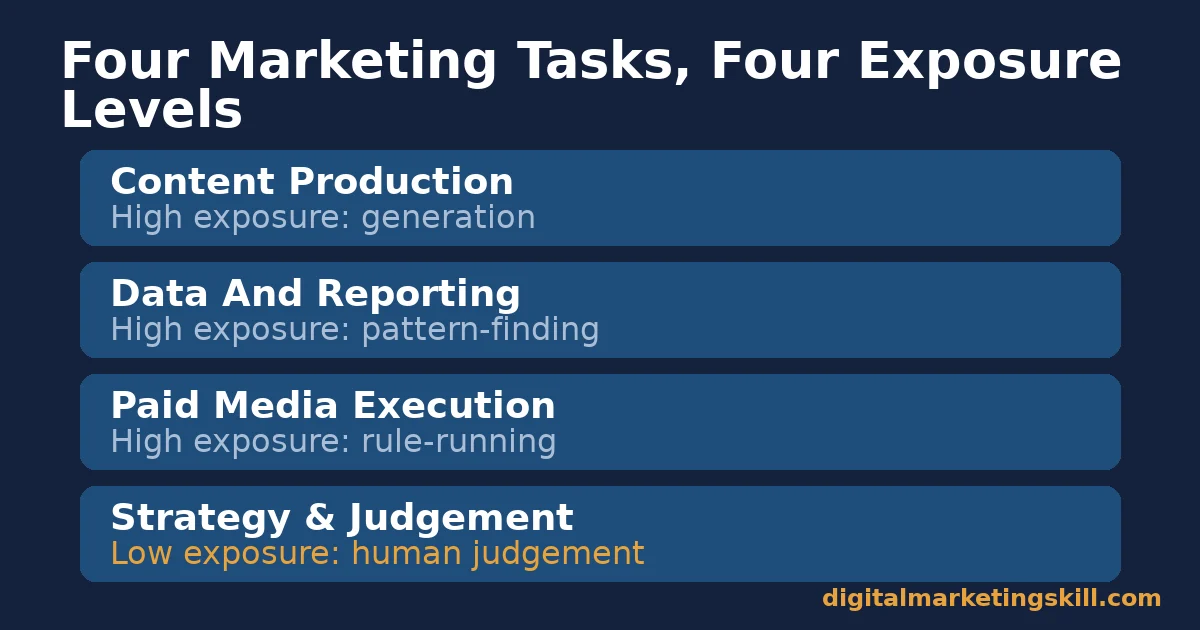
AI tools are good at three things. They generate text or images from a pattern. They find structure in large datasets fast. They run one decision rule across thousands of instances at once. Almost every AI marketing feature is one of these three operations wearing a different name.
Generation covers drafting ad copy, writing a blog outline, resizing a creative for ten ad formats, or producing a product description from a spec sheet. Pattern-finding covers clustering customer segments or spotting which subject lines get opened. Rule-running covers bidding on thousands of keywords or pausing a weak ad automatically.
Still, none of the three includes judging whether a message is true. None of them judges whether a campaign fits a brand’s values, or whether a client needs a hard conversation instead of a report.
A model can generate a confident-sounding claim about a product with no way to verify it is accurate; a person has to check that before it goes out. That gap is where the next section’s differences come from, and it is also the clearest answer to why AI replace digital marketers remains the wrong framing for the job as a whole.
AI Replace Digital Marketers: Where Exposure Differs By Task
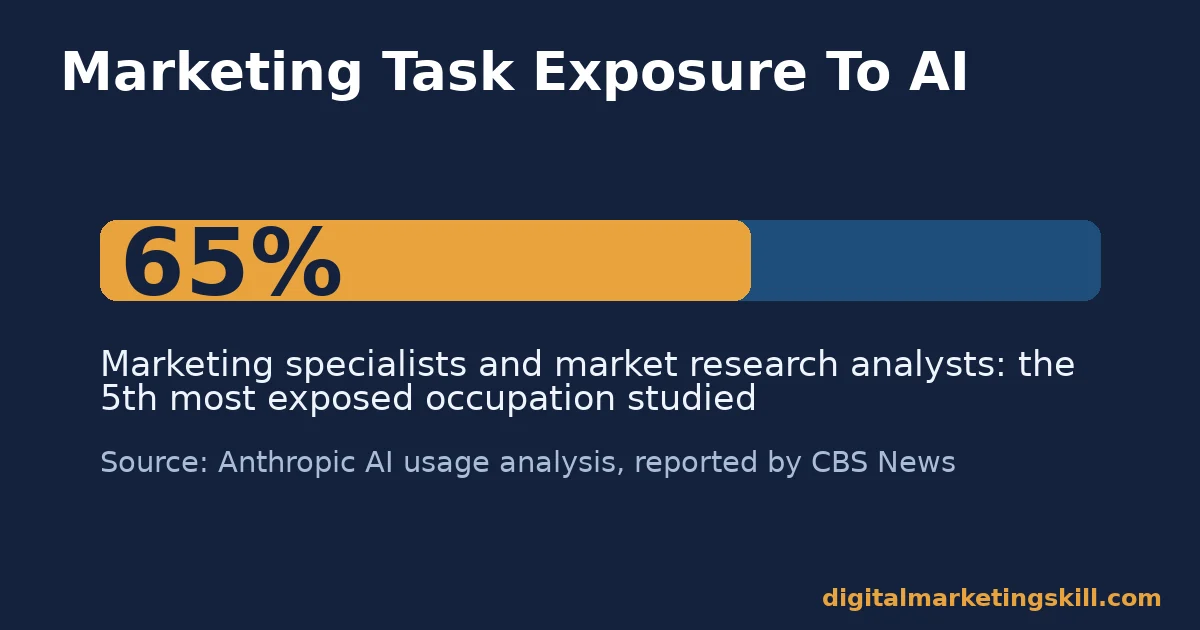
Marketing is not one job. It is a bundle of tasks with very different exposure levels. Anthropic’s analysis of real AI usage, reported by CBS News, already puts marketing specialists at 65% exposure, among the highest of any occupation studied. That average hides a wide spread between the tasks inside the role.
Content Production: Built For Speed
Drafting blog posts, social captions, ad variations and product copy is the task AI performs closest to a skilled human. It is pure generation from a pattern. CoSchedule’s State of AI in Marketing survey found 85% of marketers already use AI for content creation. A separate Forbes report on marketing leaders found content and copywriting ranked first when leaders named the function AI threatens most.
This is also the most visible part of the job to clients and managers. That visibility is why it dominates headlines about AI “replacing” marketers. Speed is real here. Quality control over that speed is where humans still matter, covered next.
Data And Reporting: Built For Scale
Pulling campaign numbers and building dashboards is pattern-finding at scale. AI tools now do most of this assembly work in minutes. Gartner’s CMO Spend Survey found marketing leaders now put 15.3% of their budget, on average, into this kind of AI tooling.
Exposure is high for assembly. But the same survey found 70% of CMOs say their processes are not mature enough to turn that assembled data into a confident decision. So the gap between a dashboard and a decision has not closed.
Paid Media Execution: Built For Iteration
Bidding, budget pacing and creative testing are rule-running tasks. Ad platforms have automated large parts of this for years, independent of generative AI. A marketer who once adjusted bids by hand now mostly sets the goal and the guardrails.
This is the task where people say AI replace digital marketers is most literally true, since the manual work is already gone. It is also where marketers who only knew the manual steps feel most exposed, because the platform absorbed a skill they used to be paid for.
Strategy And Judgement: Built For Ambiguity
Deciding what a brand should stand for, which market to enter, or how to read a client’s unstated concern in a meeting is not generation, pattern-finding or rule-running. These calls require weighing values and consequences that are not written down anywhere for a model to learn from.
This matches the World Economic Forum’s Future of Jobs Report, which lists creative thinking among the fastest-growing skills employers want, even while 39% of workers’ core skills are expected to change within the next few years. The skills changing are mostly tool-based. By contrast, the judgement-based ones are becoming more valuable, not less.
AI Replace Digital Marketers: How To Make Your Role Harder To Automate
The fix for each exposure level above is not to avoid AI. It is to move your own effort toward the part of the task AI cannot do. The sections below mirror the four task categories above, in the same order.
Content Production: Lead With Judgement AI Can’t Supply
Let AI produce the first draft, the variations and the resizes. Spend your own time on what the draft gets wrong: a fact that needs checking, a tone that misses this audience, or a claim that could embarrass the brand. Treat every AI draft like a junior writer’s first attempt, not a finished asset.
Also own the brief AI drafts from. A vague prompt produces generic copy. A brief built from real customer language and one clear goal produces copy worth publishing. Writing that brief well is a skill in itself, and it is the part of content work least likely to be automated soon.
Data And Reporting: Lead With The Decision, Not The Dashboard
Do not compete with AI on assembling the dashboard. It usually wins on speed. Compete on deciding what the dashboard means for next week’s plan. Most teams, per Gartner’s finding above, have not built that step from data to decision, so building it is a real advantage.
Before you present a report, ask what would change if the main number moved by a fifth, and bring that answer with you. A report with a recommendation attached is worth far more than a report alone. So only one of those is easy for AI to produce unsupervised.
Paid Media Execution: Lead With The Hypothesis
Automated bidding tools need a hypothesis to test. They do not generate good ones alone. Your value shifts from setting bids by hand to deciding which audience or offer is worth testing first, and to spotting when a result is a fluke rather than a real signal.
This also means reading automated systems critically, not trusting them by default. A platform that optimises toward its own reported metric is not the same as one that optimises toward your actual business goal. Catching that gap is still a human job.
Strategy And Judgement: Lead With Context AI Doesn’t Have
Bring context no model can access: how a specific client reacted last quarter, what internal politics will slow an approval, or which competitor move actually worries your leadership. This context turns a generic strategic option into the right call for this situation.
Write that context down somewhere AI tools can draw on later, such as a shared brief or a client history. This habit also makes you more useful when you lean on AI for the digital marketing tools and analysis that sit underneath your strategy.
How To Measure Whether AI Is Replacing Or Assisting Your Work
Vague worry about being “replaced” is hard to act on. These four measures turn the question into something you can track, month over month.
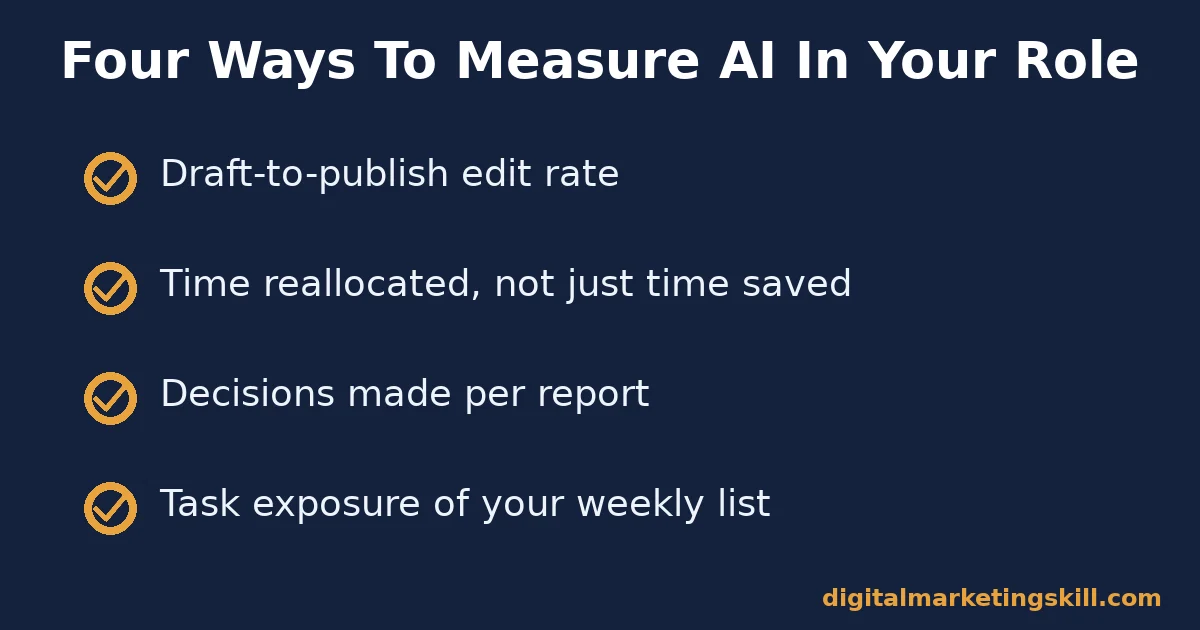
- Draft-to-publish edit rate: the share of an AI draft you rewrite before it ships. A falling rate on routine tasks is fine. A falling rate on judgement-heavy tasks is a warning sign.
- Time reallocated, not just time saved: track what you did with the hours AI freed up. Time that disappears into more low-value tasks does not build career safety. Time moved to strategy or new skills does.
- Decisions made per report: count how many reports end with a clear recommendation, not just numbers. This is a rough proxy for how much judgement you add beyond automatable assembly.
- Task exposure of your weekly list: once a quarter, mark each task as generation, pattern-finding, rule-running or judgement. A rising share of judgement tasks over time is the clearest sign your role is moving the right way.
Read these together, not alone. A high edit rate paired with a rising share of judgement tasks is healthy. A low edit rate paired with a falling share of judgement tasks is the pattern worth fixing early.
The One Rule: Automate The Task, Never The Judgement
If there is one decision rule for using AI safely in a marketing career, it is this: hand AI the task, keep the judgement for yourself.
Illustrative, invented example: a marketer asks an AI tool for ten subject lines for a product launch email. She does not ship the top-ranked line automatically. Instead, she checks each line against three questions AI cannot answer for her.
Does it match a promise the product can keep? Does it match this audience’s past reactions? Would she be comfortable if a journalist quoted it back at the company? Only a line that passes all three gets scheduled. The AI did the generation. She did the judgement. That split is the rule in practice.
A Real Case: What Duolingo’s AI-First Shift Shows And Does Not Show
Duolingo cut about 10% of its contractor workforce early in its AI shift, as it moved more course and content work to AI tools, then made further cuts. Leadership later said it would keep phasing out contractor work AI could handle, and used AI to help launch roughly 148 new language courses at once, a scale that manual creation alone could not have matched as quickly.
The case shows real exposure in content production, matching the task breakdown above. Course and translation drafting is close to pure generation, and that is exactly the part of the work that moved to AI first.
The case also shows the limits. Users publicly complained about a drop in translation and course quality, and the backlash was visible enough to hurt public sentiment toward the brand. That is a real cost of removing human judgement from a generation-heavy task too completely.
It matches the earlier point: AI needs a human checking its output against audience expectations, not just producing it faster. One company’s choices are not a universal verdict on AI versus marketers, but they are a concrete, checkable example of both the upside and the cost.
Frequently Asked Questions: Does AI Replace Digital Marketers
Will AI replace entry-level marketing jobs first?
Entry-level roles built from generation and assembly tasks, such as drafting routine copy, are more exposed than senior roles. Instead, senior roles lean more on judgement and client relationships. This does not mean entry-level roles disappear; it means the tasks that survive will be the ones that already involve judgement.
New marketers benefit from seeking those tasks out early. A junior marketer who asks to sit in on client calls, rather than only producing drafts, is deliberately moving toward the part of the job least exposed when people ask does AI replace digital marketers at the entry level.
Which digital marketing skills are safest from AI right now?
Skills built on context AI cannot access are safest: reading a client’s unstated concerns, making brand and values calls, and deciding which strategic bets are worth the risk. Skills that are pure execution, such as setting ad bids by hand, are the least safe, because platforms already automate most of that work.
Should a digital marketer resist using AI tools to protect their job?
No. The idea that AI replace digital marketers wholesale does not match how CoSchedule’s 1,005 respondents behave: 85.84% plan to use AI even more. Avoiding it mostly means falling behind peers who use it to clear routine work faster. The safer path is using AI for generation and pattern-finding while deliberately building the judgement skills in this guide.
Will AI replace SEO specialists specifically?
SEO work splits the same way the rest of marketing does. Generating draft content and pulling keyword data with free SEO tools is increasingly automated. Deciding what a business should rank for, and how to prioritise a short list of fixes, stays a judgement call. As long as people search for answers and expect trustworthy results, that judgement layer stays valuable.
How quickly is marketing AI exposure changing?
So far, it is moving fast on the generation and assembly side. AI tool adoption among marketers has gone from a minority to a clear majority within a few years. It is moving slower on the judgement side, where the limit is not the technology but the lack of full context and accountability a human still provides. Expect exposure on routine tasks to keep rising while strategic tasks stay far lower.
What should a digital marketer actually do this month about AI?
Pick one recurring task from your week, the kind people worry about when they ask does AI replace digital marketers. Classify it using the four categories in this guide. If it is mostly generation or pattern-finding, hand the first draft to an AI tool and spend the time you save on judgement work instead. Repeat with a second task next month. Small, specific shifts compound faster than a vague resolution to “use AI more.”
Build The Judgement Skills AI Cannot Replace
AI will keep absorbing the generation, pattern-finding and rule-running parts of digital marketing. So the judgement, brief-writing, client context and strategic calls in this guide are the parts worth strengthening deliberately, wherever you live. You can learn digital marketing at digitalmarketingskill.com with that exact split in mind.
The Digital Marketing Skill Institute’s Master Diploma in Digital & AI Marketing is built around that split. It runs on four AI-powered tracks, totalling ten execution-first courses, so you learn to direct AI tools rather than compete with them: AI-Powered Social Media Management and Advertising, AI-Powered Lead Generation and Email Automation, AI-Powered Google Specialist, and AI-Powered WordPress and SEO Specialist, with a Full Stack option for completing all four.
Every track includes unlimited one-on-one coaching and mentoring, plus a U.S. Project Internship with a verified U.S. Work Reference Letter. The diploma carries dual US and UK accreditation, recognised in more than 100 countries, delivered 100% online, so you can build these skills anywhere in your country.
Start with the Master Diploma in Digital & AI Marketing page to see the current tracks, read real outcomes on the reviews page, or go straight to the application page to start your own shift toward judgement-led marketing work. Explore more guides on the Digital Marketing Skill Institute blog, wherever in your country you happen to be based, or learn more at digitalmarketingskill.com.
Every figure in this guide was checked against its original source before publication. Figures marked as illustrative are invented examples, not real results.