
Digital marketing career opportunities keep growing because most companies now sell online. Few of them know how to do it well. That gap creates real openings, in roles from strategy to hands-on execution. This guide splits those openings into two tracks. It shows what each one actually pays and demands. Then it gives one rule for picking your first move.
Key Takeaways
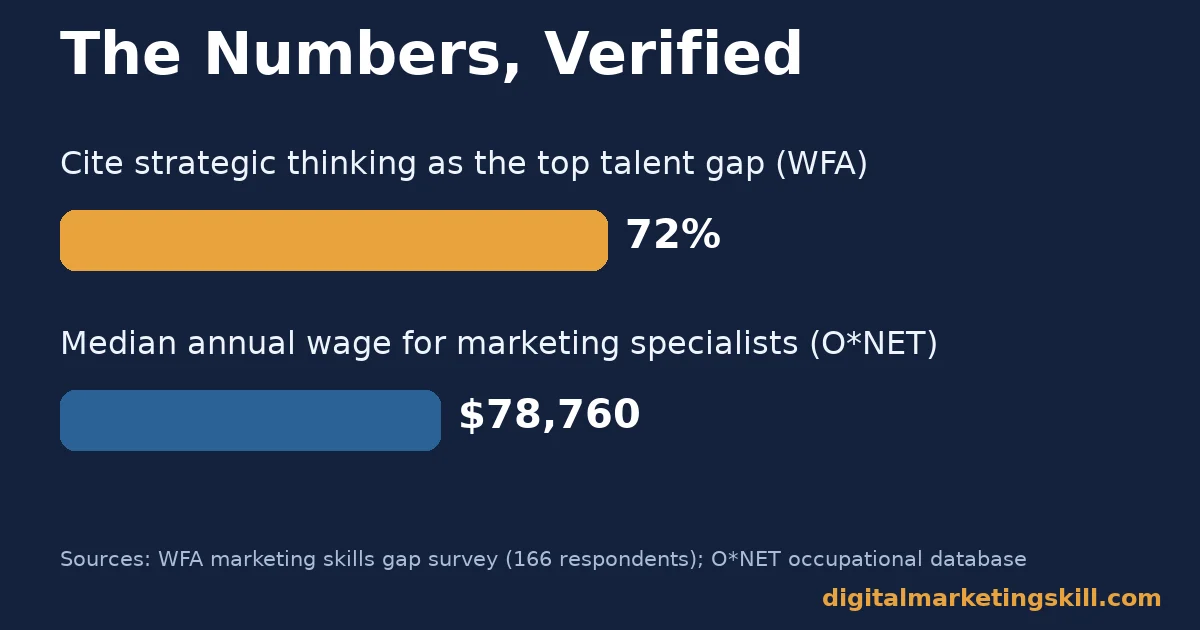
- Strategic thinking is the top shortage, not technical skill. A WFA survey asked 166 marketing professionals at brands spending $80 billion a year. So 72% named strategic thinking as their single biggest talent gap.
- Pay is solid and the outlook is strong. O*NET reports a median wage of $78,760 a year for marketing specialist roles. Growth is rated “much faster than average,” with about 82,000 projected openings over the next decade.
- AI fluency is now a named gap, not a bonus skill. The same WFA survey found 56% of respondents rate AI fluency as underdeveloped on their teams, alongside 55% for data-driven decision-making.
- Upskilling is now the main plan, not just hiring. 52% of the surveyed leaders ranked “failing to upskill existing talent fast enough” among their top two talent risks for the next three years.
- Real transitions happen without a marketing degree. One Digital Marketing Skill Institute student moved from a pharmacy background into email marketing work. They report scaling client work to $5,000 a month, per their own published review.
In this guide
- What Most “Career Opportunities” Lists Get Wrong
- Why Digital Marketing Career Opportunities Keep Growing
- Digital Marketing Career Opportunities Split Into Two Tracks
- How to Move Into Each Track
- Three Mistakes That Slow Down a Digital Marketing Job Search
- Where to Find These Roles
- How to Measure Whether a Role Is a Real Opportunity
- The One Decision Rule: Match the Track to Your Current Proof
- A Real Case: From Pharmacy Background to $5,000-a-Month Email Work
- Frequently Asked Questions About Digital Marketing Career Opportunities
- Build Your Proof With Structured, Hands-On Training
What Most “Career Opportunities” Lists Get Wrong
Search “digital marketing career opportunities” and you get a list of ten job titles. Few lists explain why those roles exist. Fewer still say which ones are growing fastest right now. Almost none tell you what separates a role you can break into quickly from one that takes years to reach.
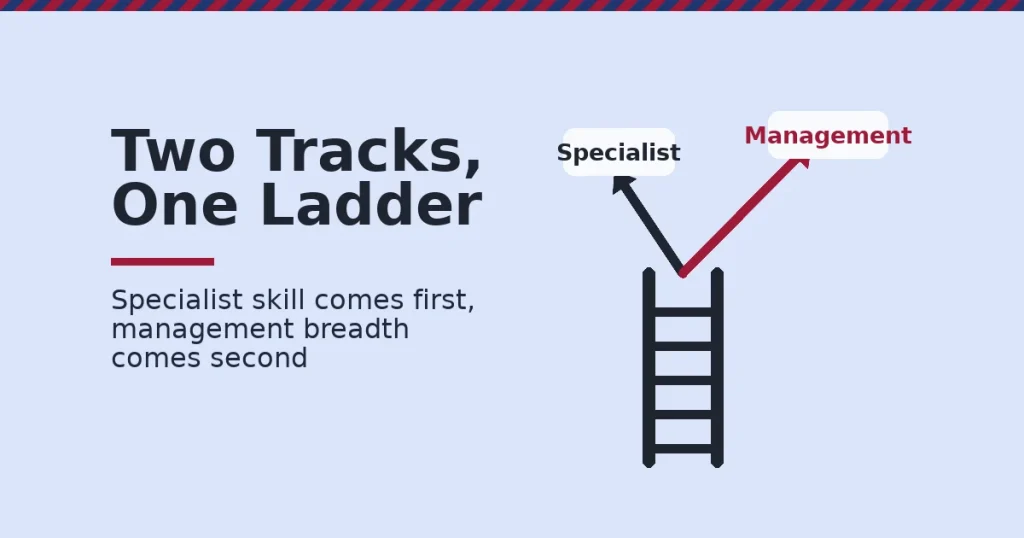
This guide fixes that gap. Instead of listing every title, it splits digital marketing career opportunities into two real tracks. Specialist roles are built around one skill done deeply. Management roles are built around breadth across several skills. Each track has a different entry point and a different ceiling.
A few ground rules first. Salary figures below come from O*NET, the US Department of Labor’s own occupational database. So treat them as a US snapshot, not a worldwide number. The WFA survey is self-reported by a modest sample of 166 professionals. So read its percentages as directional, not exact. Every case in this guide is named and sourced; nothing here is invented.
Why Digital Marketing Career Opportunities Keep Growing
Three forces drive the current wave of digital marketing career opportunities. Knowing them helps you judge which roles will still matter in a few years.
Spend keeps shifting online. More buying decisions start on a search engine, a social feed or a marketplace. So every company needs someone managing that presence. This is not a trend. It is where the budget already sits.
The skills gap is real and reported, not just a hiring cliché. The WFA’s survey found strategic thinking, data strategy and insight development as the three biggest shortages. They were named by 72%, 46% and 36% of respondents. So companies are not short on marketing budget. They are short on people who can use it well.
AI changed what “skilled” means. Tools now handle execution that used to take a full team. So 59% of the same WFA respondents say judgement matters more, not less. Prioritisation skills matter more too, even as AI takes over routine tasks. That shift favors people who can direct a tool, not just operate one.
Together, these forces explain why digital marketing career opportunities are not shrinking as automation grows. Instead, they are shifting toward judgement, strategy and the ability to read what a campaign’s numbers actually mean.
Digital Marketing Career Opportunities Split Into Two Tracks
Almost every digital marketing role fits one of two tracks. Picking the right one first saves months of applying to roles that do not fit your actual strengths.
Specialist Roles: Built for Deep Skill
Specialist roles focus on one channel or skill, done well. SEO specialist, email marketer, copywriter, paid media buyer and content creator all fall here. You are judged on the quality and results of one specific craft. You are not judged on managing other people.
These roles are usually the fastest digital marketing career opportunities to break into. That is because you can build a visible portfolio before anyone hires you. A specialist can show finished work: ranked pages, written campaigns, ad results. That proof carries more weight early on than a resume line. Our guide on social media marketing skills covers one popular specialist starting point in more depth.
Management Roles: Built for Breadth
Management roles, like digital marketing manager or content marketing manager, sit across several channels at once. You plan campaigns and read performance data. Then you coordinate specialists rather than producing every asset yourself.
These digital marketing career opportunities usually come after some specialist experience. That is because judging a team’s work well requires having done a version of it yourself. O*NET’s “Bright Outlook” rating for marketing specialist and management occupations reflects this entire category, not one single job title.
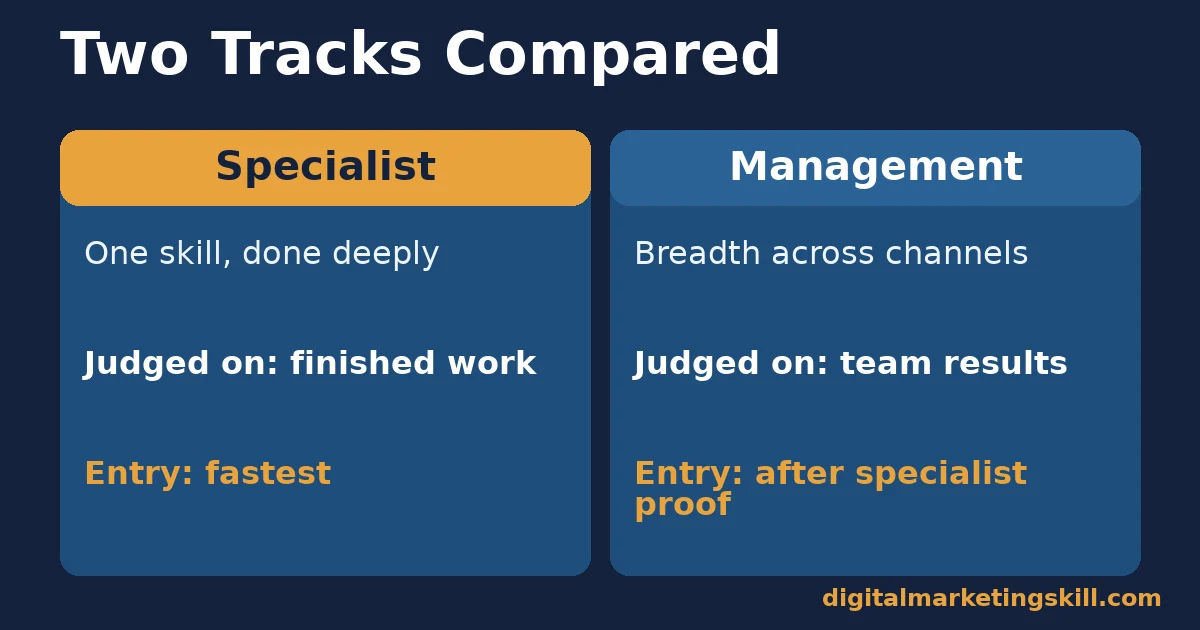
Neither track is “better.” A specialist role gets you earning and building proof faster. A management role pays more once you reach it, but it takes longer to reach convincingly. Most people who build a long career move from one track into the other. Few people move straight into management.
How to Move Into Each Track
Knowing the two tracks exist is not the same as moving into one. The sections below mirror the tracks above, with the first real step for each.
Specialist Track: Build Proof Before You Apply
Pick one skill, not three. Trying to show SEO, email and paid media all at once rarely works. None of them end up looking strong enough to hire for. Build two or three finished examples in that one skill. Even unpaid ones for a real business count, before you start applying for paid roles.
Then apply to roles that name that exact skill in the title. A focused application beats a generic one. Hiring managers can see the proof lines up with the job. A structured digital marketing internship is one reliable way to gather that proof before your first paid role.
Management Track: Earn It Through a Specialist Track First
Spend real time as a specialist before aiming for management. The strongest digital marketing managers can still read a campaign’s raw numbers. That is because they once ran campaigns themselves. Skipping that step usually shows up later, when a manager cannot judge if a specialist’s work is actually good.
Once you have that base, ask for cross-channel projects inside your current role. Coordinating one small project across two channels is the real test for management-track digital marketing career opportunities. It matters more than any title change alone.
Three Mistakes That Slow Down a Digital Marketing Job Search
Most people who struggle to find digital marketing career opportunities make one of three mistakes. Fixing even one usually speeds up the search.
Applying too broadly. Sending the same generic resume to SEO, social media and email roles all at once looks unfocused. A hiring manager notices that fast. It also means your portfolio never gets deep enough in any one area to stand out. Pick one lane first, even if you branch out later.
Listing tools instead of results. A resume line that says “experienced with Google Analytics” tells a hiring manager nothing. A line that says “used Google Analytics to cut bounce rate by 18% on a client landing page” tells them everything. Always pair the tool with the outcome it produced.
Waiting for a perfect portfolio. Many candidates delay applying until they feel fully ready. In practice, two or three solid, finished examples are enough to start applying for digital marketing career opportunities. A portfolio built over years, instead of weeks, usually means months of lost income for no real benefit.
Each of these mistakes shares one root cause. They all trade a fast, visible result for a slower, invisible one. Fixing them usually means doing less, not more: one skill, one clear result, one application at a time.
Where to Find These Roles
Once you know your track, the search itself matters too. A handful of platforms carry most real postings for digital marketing career opportunities, and each works a little differently.
LinkedIn works best for roles that value network and visible work history, since recruiters often check a profile’s activity before reaching out. Indeed aggregates listings from many smaller company career pages, so it tends to surface roles at businesses too small to recruit actively on LinkedIn. Company career pages themselves are worth checking directly too, since some roles never get posted anywhere else. Glassdoor is also worth a look before an interview, since it often shows salary ranges and interview questions reported by past applicants for the same role.
Whichever platform you use, search by the specific skill from your specialist track, not the word “marketing” alone. A search for “email marketing specialist” or “SEO specialist” returns far more relevant digital marketing career opportunities than a generic search ever will.
Set up saved searches and alerts on two platforms, not five. Checking five job boards every day rarely finds more roles than checking two well, and it eats time you could spend finishing a portfolio piece instead. Consistency beats coverage here.
How to Measure Whether a Role Is a Real Opportunity
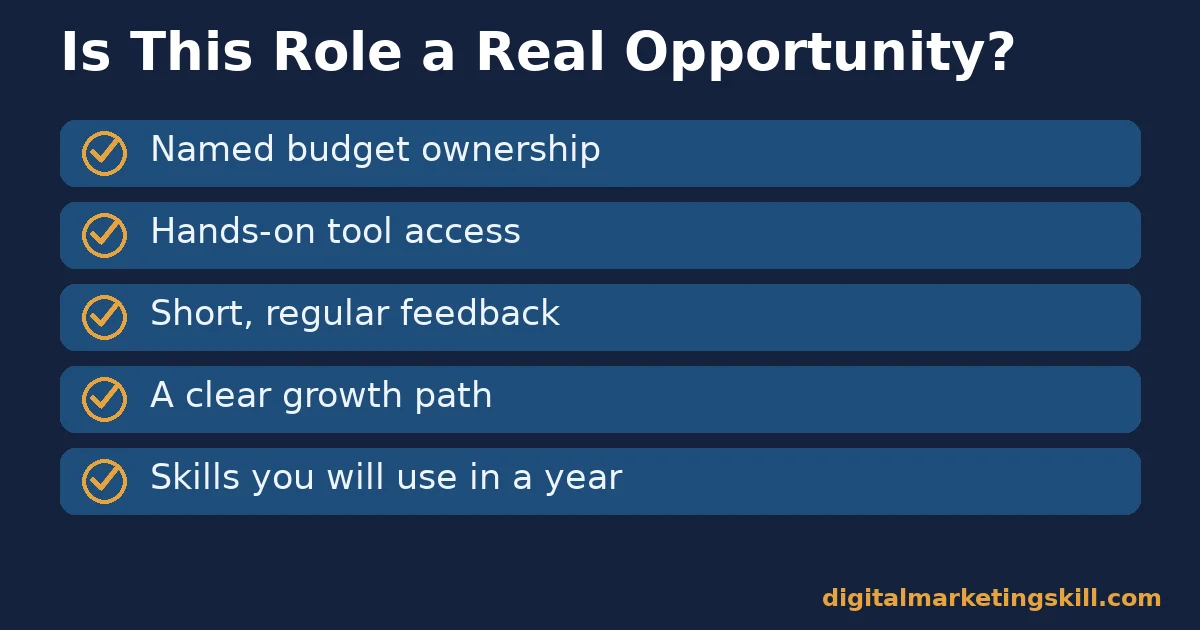
Not every open job is a genuine opportunity. Check a role against these signals before you commit months to pursuing it.
- Named budget ownership. Does the role control or directly influence real ad or content spend? Roles with budget ownership usually have clearer success metrics, which makes your results easier to prove later.
- Tool access. Will you get hands-on access to the platforms themselves, such as ad managers, analytics and a CRM? Hands-on access is what builds the specialist proof described above, not a dashboard someone else controls.
- Reporting line. Who reviews your work, and how often? A short, regular feedback loop usually means faster skill growth than a role where your manager rarely looks at the details.
- Growth path. Ask directly what the next role up looks like. A team that cannot answer this question usually has not planned any track for you.
- Skills you will use in a year. Compare the role’s day-to-day tasks against the WFA’s named gaps: strategy, data and AI fluency. A role that only builds routine execution skills teaches less than one that touches judgement and data.
Score a role on these five points before accepting it. A role with only one or two strong signals is still worth taking as a first job. Treat it as a stepping stone, though, not a destination.
Write the score down somewhere, even a simple note. Reviewing it again in six months shows you whether the role is still a stepping stone or has quietly become a dead end. Many people stay too long in a role simply because they never checked it twice.
The One Decision Rule: Match the Track to Your Current Proof
If you remember one decision rule from this guide, make it this one. Apply for specialist digital marketing career opportunities until you have real, visible proof in one skill. Only then start aiming at management roles.
Here is an illustrative example, with invented numbers. Someone with zero marketing experience spends three months on this. They build five SEO case studies on their own site, plus two volunteer projects. They apply only to SEO specialist roles, not marketing manager roles, and land one within six weeks. Eighteen months later, with a track record of ranked pages behind them, a marketing manager role becomes a realistic, winnable application.
The lesson is about sequencing, not talent. Skipping straight to a management application without specialist proof usually means competing against candidates who have both the proof and the breadth already.
This rule also works in reverse. If you already have years of specialist work behind you but keep getting passed over for management roles, the fix is rarely more specialist work. It is usually proof of breadth: a cross-channel project, a small team you led, or a budget you managed, even briefly.
A Real Case: From Pharmacy Background to $5,000-a-Month Email Work
Olajire Jacob’s story is published on Digital Marketing Skill Institute’s own reviews page. It is a documented case of a specialist-track entry with no prior marketing background. By their own account, they began by charging around $500 to set up email marketing flows for clients in the US, UK and Canada.
From that single specialist skill, email flow setup, they report scaling their digital marketing services to $5,000 a month. The case shows the specialist-first path in practice. One visible skill, applied for real clients, gets built into a broader service over time. For a wider look at what makes a role worth pursuing, see our guide on what makes a good digital marketing career.
The limit here matters. This is one person’s self-reported result, not an audited outcome. Results like this are not typical or guaranteed for every student. See the earnings disclaimer for the full context behind any student income figure.
What makes the case useful is not the dollar figure. It is the sequence. One narrow, visible skill came first. Client work came second. A broader service only came after both were already proven. That order matches the decision rule above, not the other way around.
Frequently Asked Questions About Digital Marketing Career Opportunities
What are the best digital marketing career opportunities for beginners?
Specialist roles are the easiest entry point: SEO specialist, email marketer, copywriter, content creator and paid media assistant. Each lets you build visible proof of one skill before you have any job title to show for it.
Do digital marketing career opportunities require a degree?
No specific degree is required for most roles. O*NET lists marketing specialist occupations as reachable through varied education paths. Many employers weigh a portfolio and relevant certification as heavily as a formal degree.
Which digital marketing career opportunities pay the most?
Management roles generally pay more than entry-level specialist roles, because they carry responsibility across a wider budget. O*NET reports a median of $78,760 a year across marketing specialist and management occupations in the US. Actual pay varies widely by seniority and employer.
How long does it take to find a digital marketing job after training?
It depends on how much visible proof you have, not just how much you have studied. Building two or three finished examples in one specialist skill before applying tends to shorten the search. Hiring managers can judge real work rather than a resume alone.
Are digital marketing career opportunities being reduced by AI?
The evidence points the other way for skilled roles. The WFA survey found 59% of respondents expect judgement and prioritisation skills to matter more, not less, as AI takes over routine execution tasks.
What skills matter most for digital marketing career opportunities right now?
Strategic thinking, data-driven decision-making and AI fluency are the three gaps the WFA survey names most often, at 72%, 55% and 56% respectively. Building even basic strength in these areas sets a candidate apart from one who only knows platform mechanics.
Can you find digital marketing career opportunities without a portfolio?
It is possible, but much harder. Most hiring managers now expect at least a small portfolio, even unpaid or volunteer work. Building two or three finished examples before applying is one of the fastest ways to shorten a search for digital marketing career opportunities.
Should you specialize or stay a generalist early in your career?
Specialize first. A narrow, provable skill gets you hired faster than broad but shallow knowledge across many channels. You can widen into a generalist or management role later, once you already have one strong skill as proof. Trying to do both at once usually slows down both goals.
Build Your Proof With Structured, Hands-On Training
Finding real digital marketing career opportunities starts with proof, not just knowledge. Structured training that puts you in front of a real budget speeds up the specialist-first path described in this guide.
The Master Diploma in Digital & AI Marketing at Digital Marketing Skill Institute is built from ten execution-first courses across four AI-powered tracks: AI-Powered Social Media Management and Advertising, AI-Powered Lead Generation and Email Automation, AI-Powered Google Specialist, and AI-Powered WordPress and SEO Specialist, with a Full Stack option for completing all four. Every track includes unlimited 1-on-1 coaching and mentoring.
Students also complete a U.S. Project Internship with a verified U.S. Work Reference Letter. They work with real budgets the way the specialist-first path in this guide recommends. The program is dual US and UK accredited, recognised in more than 100 countries, and 100% online, so you can train for digital marketing career opportunities from anywhere in your country. Browse more guides on the Digital Marketing Skill Institute blog, read student reviews, and when you are ready, apply for the Master Diploma or start from the Digital Marketing Skill Institute homepage.
Every figure in this guide was checked against its original source before publication. Figures marked as illustrative are invented examples, not real results.
![9 Amazing Digital Marketing Skills to Make Money Online [With Proof]](https://digitalmarketingskill.com/wp-content/uploads/2019/07/9-Amazing-Digital-Marketing-Skills-to-Make-Money-Online-With-Proof-17.png)






