
What makes a good digital marketing career? For most people who enjoy testing ideas and reading data, the field delivers one. Entry costs are low. Pay climbs fast once you can prove results. It suits stability-seekers far less, because budgets and tools shift every year. The sections below give you the numbers, so you can judge it for yourself.
Key Takeaways
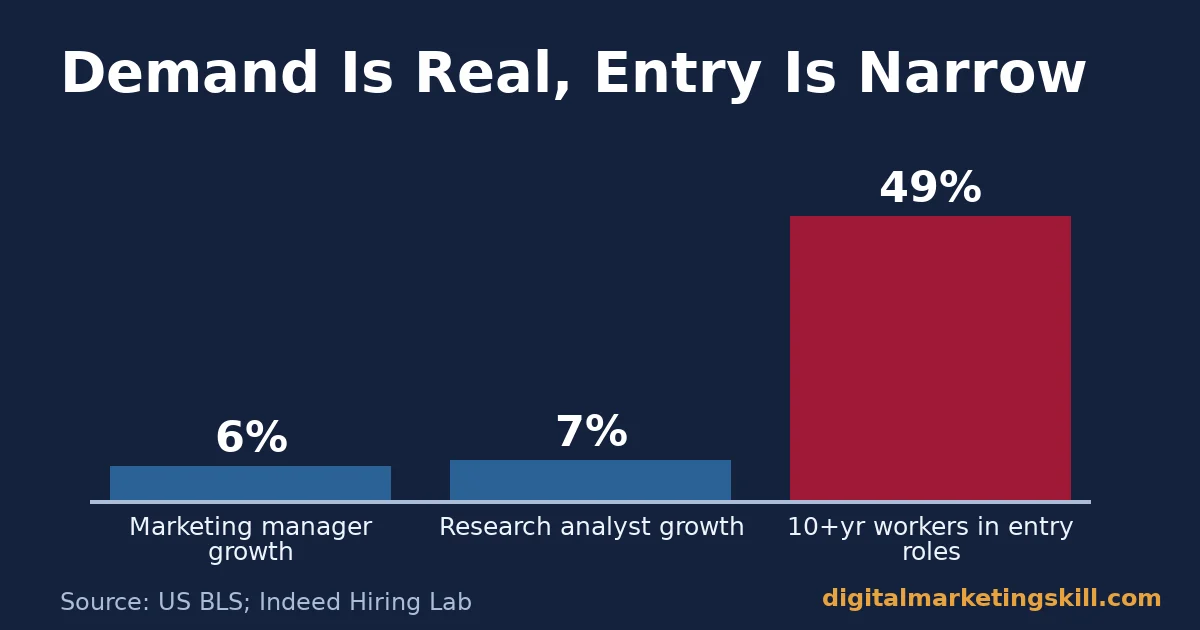
- The US Bureau of Labor Statistics projects 6% growth for advertising and marketing managers and 7% for market research analysts over the next decade. Both rates beat the average occupation, with roughly 36,300 marketing-manager openings a year.
- Entry level is crowded. Indeed Hiring Lab found that 49% of applications from workers with 10 or more years of experience went to entry-level roles. Beginners compete with veterans, not just each other.
- Pay climbs steeply once you have proof. Talent Scout’s analysis of US postings shows a median advertised salary of $62,814 for junior marketing roles, $87,500 for mid-level and $135,000 for senior. That is a jump of about 39% from junior to mid-level alone.
- AI is now the baseline tool, not a threat to avoid. HubSpot reports 86.4% of marketing teams already use it, while most employers plan to hold headcount flat. That rewards one person who can do the work of two.
- A good digital marketing career rewards a narrow, provable skill over a broad job title. NACE data shows internship-to-full-time conversion running above 63%, the best rate in five years, when the work itself is real.
In this guide
- Good Digital Marketing Career: What the Debate Usually Misses
- How a Good Digital Marketing Career Actually Works
- What Differs by Path: Employed, Freelance or Specialist
- How to Lead With Each Path
- The Skills That Actually Get You Paid
- The Trade-Off Nobody Lists on the Job Posting
- Does This Hold Up Outside the United States?
- Measuring Whether a Good Digital Marketing Career Is Working for You
- The One Decision Rule
- What a Good Digital Marketing Career Looks Like in Practice
- Frequently Asked Questions About a Good Digital Marketing Career
- Your Next Step Toward a Good Digital Marketing Career
Good Digital Marketing Career: What the Debate Usually Misses
Most articles on this question give a flat yes or no. That misses the point. A good digital marketing career is not one job. It covers at least three roles: people who run channels like social media and email, people who buy ads and read performance data, and people who build websites and automations.
Each group faces a different hiring market, a different pay curve and a different risk of burnout.
What follows is an informed read of the latest hiring and pay data, not a settled verdict. Job markets move, and your local market may differ from the US figures cited here. The arc is simple: how the career actually works, what differs across the three paths, how to lead with each one, how to measure your own progress, one decision rule, a real case, and a direct FAQ.
How a Good Digital Marketing Career Actually Works
A digital marketing career runs on a short, repeating loop. Pick a channel. Publish or run a test. Read what happened. Then do more of what worked. Over months, this loop builds a portfolio of visible results. That portfolio is what gets you hired again, more than any single certificate.
The loop also rewards specificity. “I write and test subject lines for small retail brands” tells a hiring manager what you can deliver tomorrow. “I do digital marketing” tells them nothing. It competes against thousands of equally vague applications.
The US Bureau of Labor Statistics projects employment of advertising, promotions and marketing managers to grow 6% over the next decade. It counts 454,800 of those roles and about 36,300 average annual openings, both faster than the average occupation. For market research analysts the projected growth is 7%, with roughly 82,000 annual openings.
These are US figures for experienced roles. The growth is real, but the entry-level door is narrower than the headline number suggests.
Skills gaps help explain why the door stays open even when headcount is flat. Robert Half’s research into marketing and creative hiring found that skills shortages delayed marketing analytics projects at 44% of organisations, customer experience and personalisation work at 38%, marketing automation at 37% and AI integration at 37%. The work exists. Employers often cannot find people who can do it.
That is good news if you build the missing skill on purpose instead of waiting to be taught it.
That gap also shows up in how companies hire. SHRM’s survey of 1,688 HR professionals found 56% of employers now use pre-employment skills assessments. 79% of HR professionals say the assessment score matters as much as or more than a candidate’s resume history. A good digital marketing career, then, is built less on where you studied and more on whether you can demonstrate the skill under test conditions.
What Differs by Path: Employed, Freelance or Specialist
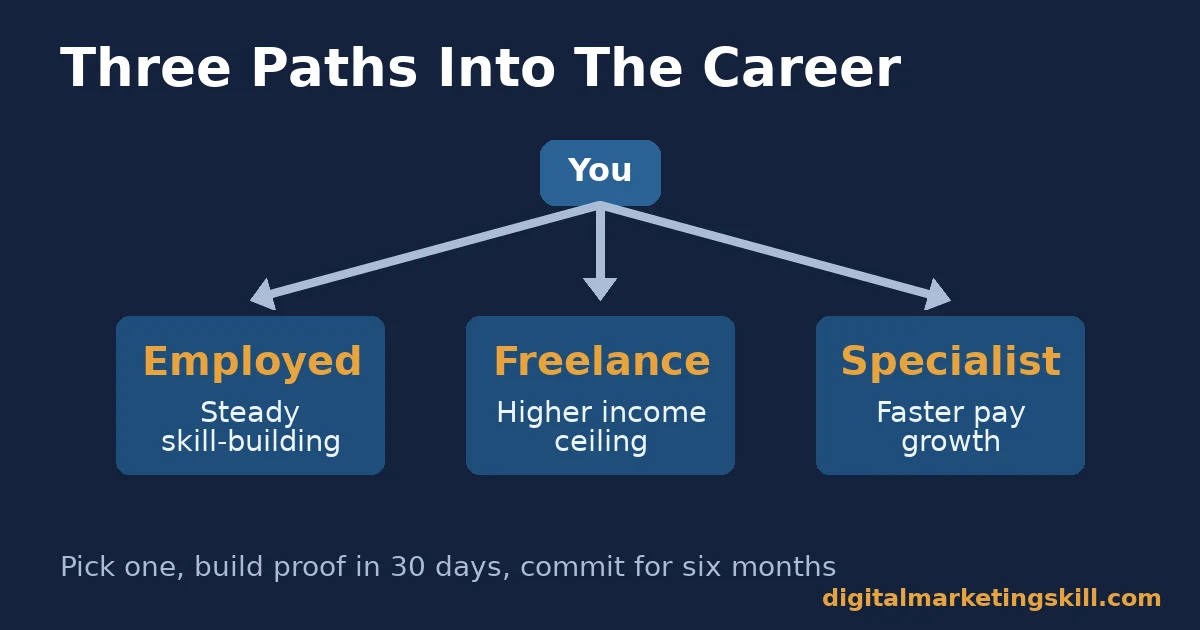
Three paths lead into a good digital marketing career. Each one trades speed for risk differently.
Employment: Built for Steady Skill-Building
An in-house or agency job gives you a manager who reviews your work, a steadier paycheck and faster feedback on mistakes. Talent Scout’s analysis of 6,731 US postings across 16 marketing roles found that 28.9% stayed open for more than 30 days. For social media manager roles the figure reached 42.2%.
That gap exists because companies want the work done but are not always willing to pay full price for it. It keeps junior roles available if you can show proof fast.
Freelancing: Built for a Higher Income Ceiling
Freelancing removes the ceiling a single employer sets on your pay, because you can serve several clients once you have a system. It also removes the safety net. You carry your own sales pipeline, your taxes and the gaps between contracts. A clear niche shortens that gap, because a prospective client can picture exactly what you do before you ever speak.
Specialising: Built for Faster Pay Growth
Choosing one skill, such as paid search, lifecycle email or technical SEO, and going deep tends to raise pay faster than staying a generalist. Talent Scout’s data shows senior growth-marketing manager postings at a median of $156,500, well above the general senior median of $135,000. Specialists at the top of a narrow skill tend to out-earn broad generalists at a similar level.
How to Lead With Each Path
Knowing the trade-offs is only half the job. Here is what to lead with once you have picked a lane.
Employment: Lead With Proof Inside One Company
Ask your manager for one metric you own. Report on it weekly, in your own words, not just a dashboard screenshot. That habit turns a job description into a story you can tell in an interview a year later. It is also how you build the case for a raise or a promotion.
Freelancing: Lead With a Named Niche
Pick one business type and one problem, for example “email flows for independent skincare brands,” and say it on every profile and pitch. A named niche travels faster by referral than a general title, because the person referring you can describe exactly who you help.
Specialising: Lead With One Measurable Skill
Pick the one skill that HubSpot’s State of Marketing research ranks as most valuable right now: automation and AI prompting, cross-team communication, or data and analytics. Build one finished example that proves it, such as a workflow you automated end to end. Lead every conversation with that example instead of a list of tools you have touched.
The Skills That Actually Get You Paid
Whichever path you choose, the same short list of skills keeps showing up in hiring data. LinkedIn’s Skills on the Rise analysis ranks performance analysis and AI literacy among the fastest-growing marketing skills. It is based on actual hiring outcomes, not self-reported claims.
HubSpot’s survey of more than 1,500 marketers backs this up. It names “finding candidates with the right skill set” as hiring managers’ top challenge. It ranks automation and AI prompting, cross-team communication, and data and analytics as the three most valuable skills a marketer can bring.
Credentials still help, but less than they once did. NACE’s Job Outlook survey of 216 employer respondents found about half now have at least some roles flexible on degree requirements. Most treat relevant experience as a one-to-one substitute for a missing degree, concentrated in operations, customer service and administrative roles.
Even so, few employers hire a no-degree candidate more than a quarter of the time, even where the flexible policy exists on paper.
A free, no-degree option such as Google’s Digital Marketing and E-commerce certificate will not replace a degree by itself. Coursera lists it at more than 190 hours of instruction over six months.
But Coursera’s own graduate survey of Google certificate completers reports that 75% of certificate completers see a positive career outcome, meaning a new job, a promotion or a raise, within six months. That is a self-reported US figure, not an independent audit. It still lines up with the broader pattern: structured practice plus one finished project moves people forward faster than credentials alone.
The Trade-Off Nobody Lists on the Job Posting
A fair answer has to weigh the downside most postings never mention: workload and burnout, especially on channel-operator teams. The Link in Bio Social Media Salary and Career Survey covered 2,500 respondents across more than 40 countries. It found 77% reporting active or recent burnout, 67.2% feeling they do the work of more than one job, and only 10.3% describing their workload as reasonable.
Note the scope: this survey covers social media roles specifically, not every corner of digital marketing, and it is self-reported.
The same survey has a more hopeful number next to the bad one. 51% of respondents got a raise in the past 12 months. Almost 75% of those who asked for more money in a negotiation received it, and successful negotiators earned about 15% more than people who accepted the first offer. So workload risk is real, but so is your ability to push back on pay once you have results.
Protect yourself early. Write down your deliverables, agree working hours in advance, and treat negotiation as a normal step, not a confrontation.
Does This Hold Up Outside the United States?
Every pay and growth figure above comes from US data, because that is where the best-documented postings and salary studies sit. The underlying demand is not US-only, though. The World Bank reports that small and medium enterprises make up roughly 90% of all businesses worldwide and employ more than half of the global workforce. Almost all of them need someone to run their digital presence.
A good digital marketing career travels well, wherever you live, as long as you adjust three local details. Check pay benchmarks on job boards local to you, rather than assuming the US numbers above travel directly. Watch currency and payment fees if you serve clients abroad. Plan around time zones and reliable internet access if your work is fully remote.
Measuring Whether a Good Digital Marketing Career Is Working for You
Three numbers tell you whether your own path is actually moving, regardless of which one you picked.
- Response rate: the share of applications or pitches that get a reply. A rate under 5% usually means your portfolio or niche is too vague, not that the market has no room.
- Rate of pay growth: how your hourly or salary rate moves every six months. Talent Scout’s data shows roughly a 39% jump from junior to mid-level pay. Flat pay for a year is a signal to add a new, provable skill.
- Time-to-result: how long it takes you to show a test result to a client or manager. Shortening this builds trust faster than any certificate, because it proves you can work without constant supervision.
Track these three numbers every month, next to the metrics your job or clients already care about, such as clicks or conversions. If response rate and pay growth both stall for two straight quarters, treat that as a signal to change your niche or add a skill. It is not a reason to quit the field outright.
Keep the tracking simple. A single spreadsheet row per month, updated in five minutes, beats an elaborate dashboard nobody checks. The goal is a habit you will actually keep for a year. A good digital marketing career is built on a dozen small, honest check-ins, far more than on any single dramatic pivot.
The One Decision Rule
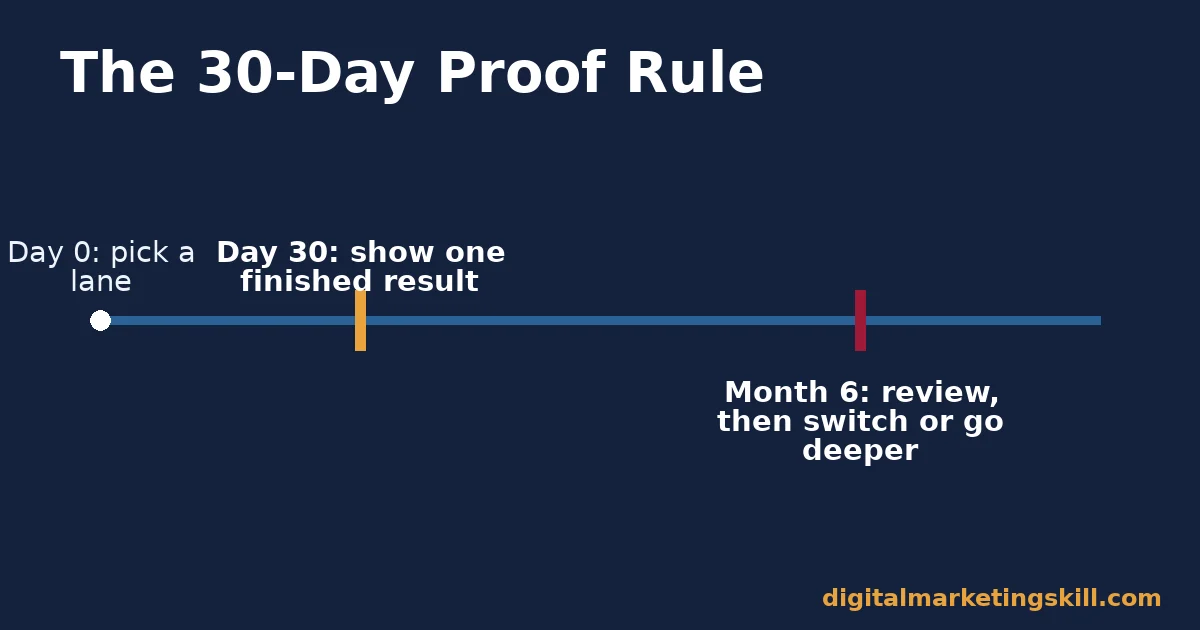
Here is the single rule that cuts through most of the debate: choose the path that lets you show a finished, numbered result within 30 days. Then commit to it for six months before switching.
Illustrative, invented numbers: say a career changer spends two weeks learning paid social basics, then runs a $50 test campaign for a friend’s small shop. She reports a 3.2% click-through rate against a 1.8% platform average.
That one number, delivered on time, usually outweighs a half-finished certificate when a hiring manager compares two similar resumes. The rule works because it forces a decision inside a month, instead of letting research replace action for a whole year.
What a Good Digital Marketing Career Looks Like in Practice
Zainab A., a Master Diploma in Digital & AI Marketing graduate of Digital Marketing Skill Institute, now manages three clients in the US and Canada alongside her day job. She earns enough to overpay her UK mortgage, according to her testimonial on the Institute’s reviews page. Another graduate, Kofi B., says the skill that won him a remote role in Canada was specifically his AI marketing knowledge, not a general job title.
Our guide to job-ready digital marketing skills breaks down what that kind of proof looks like in practice.
Limits worth stating plainly: these are self-reported outcomes published by the Institute, not an independently audited study. Individual results vary with effort, market and starting skill. Past income or job outcomes are never a guarantee of future results; see the Institute’s earnings disclaimer for the full context.
Still, both cases follow the pattern from the decision rule above: one named, measurable skill, proven to a real client, inside a short window. Our guide on how to break into digital marketing covers that same pattern in more detail.
Frequently Asked Questions About a Good Digital Marketing Career
Is a good digital marketing career realistic without a college degree?
Often, yes. LinkedIn’s analysis of its own paid job postings found the share without a degree requirement grew by roughly a third between two recent hiring cohorts. Actual no-degree hires grew more slowly than the postings did. A finished portfolio project still carries more weight than a missing degree line for most entry roles.
How long does it take to build a good digital marketing career?
Expect a few weeks to learn one channel’s basics, and a few months to build a portfolio strong enough for a first paid role or client. Pay then tends to rise quickly once you have real results. Talent Scout’s data shows about a 39% jump from junior to mid-level median pay.
Will AI replace a good digital marketing career?
AI is changing which tasks matter, not whether the career exists. HubSpot found 86.4% of marketing teams already use AI, mostly for first drafts and routine graphics. Those specific tasks no longer set a candidate apart. Judgment, strategy and client relationships remain harder to automate.
Which skill should you learn first for a good digital marketing career?
Start with whichever channel work keeps your attention during a two-week trial. Try writing and testing content, running paid ads and reading the data, or building the pages and automations behind both. HubSpot ranks automation and AI prompting, cross-team communication and data and analytics as the three most valuable skills right now.
Is a good digital marketing career possible while working a full-time job?
Yes, many people start this way. Zainab A.’s case above shows a graduate running client work alongside a full-time job. That approach limits risk while a portfolio and client list build up on the side.
Does a good digital marketing career pay well compared with other fields?
It depends on the role and your location. The BLS lists a median pay of $165,780 a year for advertising, promotions and marketing managers, and $78,760 for market research analysts in the US, both experienced roles. Entry pay is lower everywhere, and salaries vary widely by country, so check your own local job market before comparing.
What is the biggest mistake beginners make chasing a good digital marketing career?
Spreading effort across too many channels at once. NACE’s Internship and Co-op Survey, covering 284 employer organisations, found a 63.1% intern-to-full-time conversion rate, the highest in five years, when the internship work itself was concrete and measurable. The same logic applies outside internships: one finished, well-documented project beats five half-started ones.
Can you start building a good digital marketing career later in life?
Yes. Employers and clients generally care about results and reliability more than age. A career change brings transferable skills in customer handling, project management and deadlines that a 22-year-old graduate has not had time to build yet. Treat your previous field as a niche advantage, not a disadvantage to hide.
Your Next Step Toward a Good Digital Marketing Career
A good digital marketing career rewards one proven skill over a long list of tools. Pick a lane, build one finished result in the next 30 days, and measure it honestly against the numbers above.
The Master Diploma in Digital & AI Marketing at Digital Marketing Skill Institute builds that proof directly into the course. It includes nine practical courses: AI-powered SEO and content marketing, AI-powered Google Advertising, and AI-powered Social Media Marketing & Analytics are among them. You also get unlimited one-on-one coaching and mentoring, plus real project-based work experience inside a US partner company from day one.
The diploma carries dual US and UK accreditation and is recognised in more than 100 countries. It runs 100% online, so you can build your portfolio from anywhere in your country.
Visit Digital Marketing Skill Institute to read more graduate stories, browse the blog for guides such as our breakdown of a digital marketing career path built on proof rather than credentials, and when you are ready, apply here.
Every figure in this guide was checked against its original source before publication. Figures marked as illustrative are invented examples, not real results.
![9 Amazing Digital Marketing Skills to Make Money Online [With Proof]](https://digitalmarketingskill.com/wp-content/uploads/2019/07/9-Amazing-Digital-Marketing-Skills-to-Make-Money-Online-With-Proof-17.png)