Marketing automation tools replace repetitive manual marketing tasks with rules that fire on their own. A welcome email, a cart reminder, a lead score update: all of these can run without a person at the keyboard. The right category depends on what is actually eating your time, not which tool ranks first on a list. This guide covers the mechanism, what differs by category, how to measure results and one decision rule for choosing well.
Key Takeaways
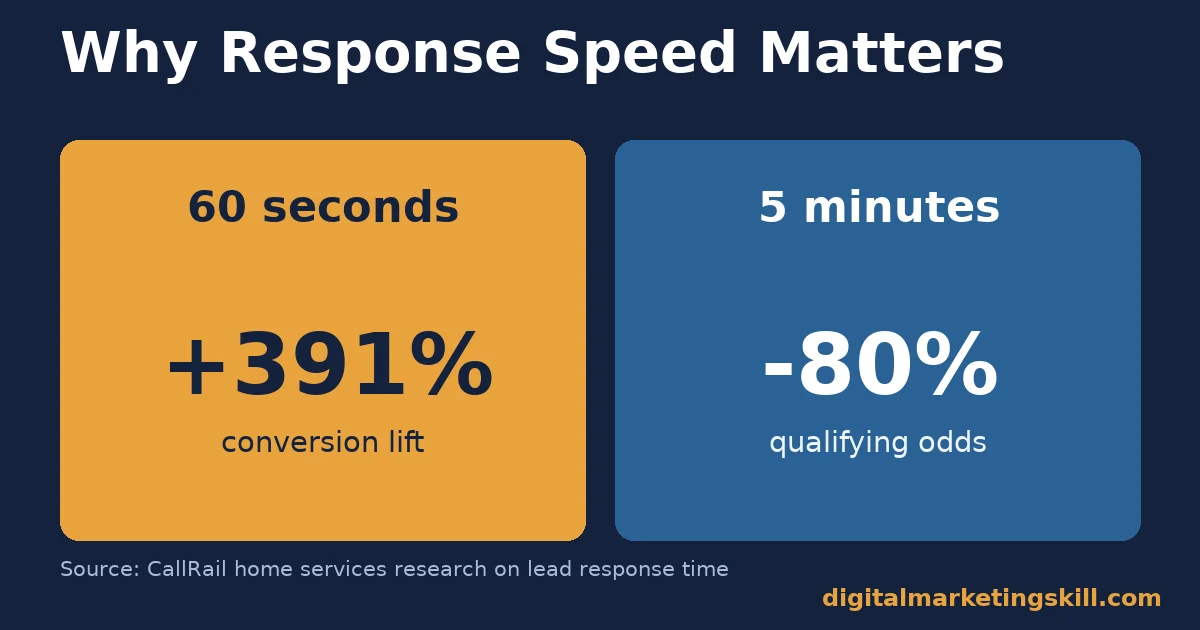
- Speed decides more leads than content does. CallRail’s home services research found that responding to a web lead within 60 seconds lifted conversion by 391%. A five-minute wait cut qualifying odds by 80%.
- Abandoned carts are the clearest automation win for ecommerce. Barilliance’s analysis of online shopping carts found an average abandonment rate around 77%. Recovery emails converted at roughly 18.64% of the time.
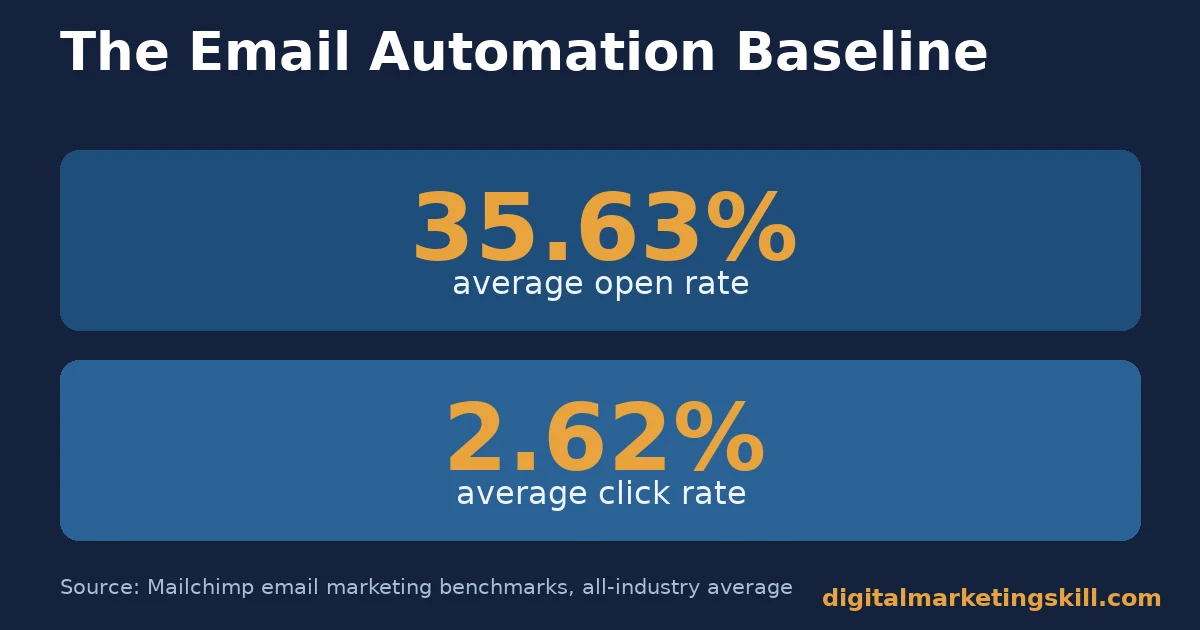
- Email automation still has a reliable baseline. Mailchimp’s benchmark data puts the all-industry average open rate at 35.63% and click rate at 2.62%. That is a useful floor for judging an automated sequence.
- AI-assisted automation is now common, not rare. Salesforce’s State of Marketing survey covered 4,450 marketing professionals across 26 countries. It found 75% use at least one form of AI in their marketing work.
- Most tool choices fail from mismatch, not missing features. A tool built for ecommerce flows rarely fits a service business’s lead-nurture problem, and the reverse is just as true. That mismatch is the decision rule this guide builds toward.
In this guide
- What Most “Best Tools” Lists Get Wrong
- What Marketing Automation Tools Actually Do
- What Differs by Category of Marketing Automation Tool
- How to Choose the Right Category First
- How to Measure Marketing Automation Tools
- The Most Useful Rule: Automate the Bottleneck You Can Prove, Not the One You Assume
- Common Mistakes When Choosing Marketing Automation Tools
- A Real Case: Automation Tied to a Measured Sales Lift
- Frequently Asked Questions About Marketing Automation Tools
- Start With the Bottleneck, Not the Tool
What Most “Best Tools” Lists Get Wrong
Most marketing automation tools lists rank software by features and price. That is useful once you already know what you need. It is not useful before that point, because the real question is not which tool has the most features. It is which category of automation fixes the actual bottleneck in your business.
Here are the ground rules for this guide. Every figure below names its source, its scope and, where relevant, its sample size. A vendor-reported figure about that vendor’s own product is stated as such. Tool prices and feature lists change constantly, so this guide focuses on categories and decision criteria instead of ranking specific products, which go stale within months.
That focus matters because a tool that tops a ranking today may not fit your specific bottleneck at all. Picking by category first, then shopping inside that category, avoids most of the wasted subscriptions this mistake creates.
This guide applies whether you run a service business, an online store or a mix of both. The category differences below hold regardless of company size. They come from what each tool watches and triggers, not from how big the business happens to be. A one-person shop and a fifty-person team face the same four questions when choosing among marketing automation tools, just at different scale.
What Marketing Automation Tools Actually Do
A marketing automation tool watches for a trigger, then performs an action without a person doing it manually. The trigger could be a form submission, a cart abandonment, a date, or a lead score crossing a threshold. From there, the action might be an email, a task for a salesperson, a tag update or a text message.
The value is not the automation itself; it is consistency. Following up on every lead within 60 seconds, every single day, is unrealistic for a person. A rule that does it automatically is not. That gap between what a person can sustain and what a rule can sustain is where marketing automation tools earn their budget.
This also explains why the wrong tool disappoints a buyer. A tool built for one trigger-action pattern, like cart recovery, cannot be forced to handle a different pattern. Multi-step lead scoring, for example, needs heavy workarounds to fake inside the wrong tool. So matching the category to the problem matters more than any single feature on a comparison chart.
What Differs by Category of Marketing Automation Tool
The four categories below solve different problems. Each section names what the category is actually built for.
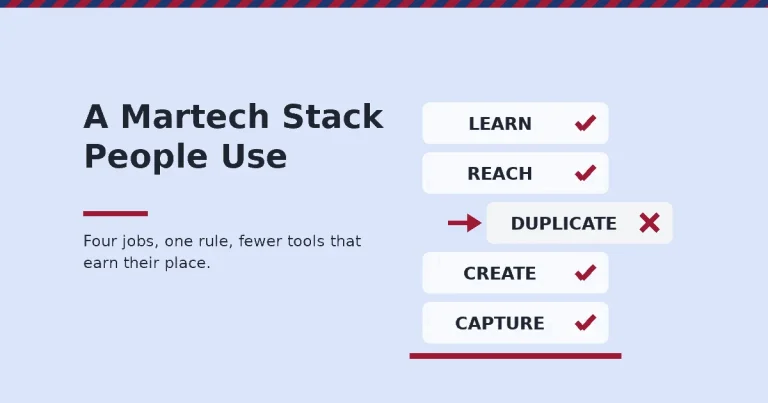
Most businesses eventually use more than one category. Rarely do they need all four at once from the start. Treat this as a menu to choose from in order of proven need, not a checklist to complete in a single quarter.
Email and Lead-Nurture Tools: Built for a Sequence Over Time
These tools send a planned series of messages triggered by a signup, a purchase or inactivity. They are built for relationships that develop over days or weeks, not an instant reply. Mailchimp’s benchmark data puts the all-industry average open rate at 35.63% and click rate at 2.62%, a reasonable floor to judge your own sequence against.
The limitation is speed. A nurture sequence is not built to catch a hot lead in the first minute, because that is a different job entirely, covered by the next category.
Lead-Response Tools: Built for the First 60 Seconds
This category routes a new lead to a person or an automated reply the moment it arrives. That can happen by text, call routing or an instant chat response. CallRail’s home services research found that responding within 60 seconds lifted conversion by 391%, while a five-minute delay cut qualifying odds by 80%. Speed, not content quality, is the entire job of this category.
The limitation is depth. A fast first response does not replace the longer nurture sequence a lead may still need afterward. Our guide on email marketing ROI and why segmentation changes it covers what to send once that first reply has landed.
Ecommerce Flow Tools: Built for Cart and Browse Behaviour
This category watches shopping behaviour, specifically an abandoned cart or a browsed-but-not-bought product, and triggers a recovery sequence. Barilliance’s analysis found an average cart abandonment rate around 77%, with recovery emails converting at roughly 18.64% of the time. For a store with real traffic, that single automated flow often outperforms broader campaigns.
The limitation is scope. These tools are built around a purchase event. That makes them a poor fit for a service business with no shopping cart to watch.
CRM-Based Tools: Built to Score and Route Leads Over the Whole Funnel
These tools track every touch a lead makes, score it, and move it between stages automatically. They suit a longer sales process with multiple decision-makers, where a single email sequence cannot track where a lead actually stands.
The limitation is setup cost. A CRM-based tool takes real time to configure correctly. A half-set-up CRM often creates less visibility than a simple spreadsheet, which is worse than not using one at all.
How to Choose the Right Category First
Understanding a category is not the same as picking the right one. The sections below mirror the four categories above and turn each into a specific starting question.
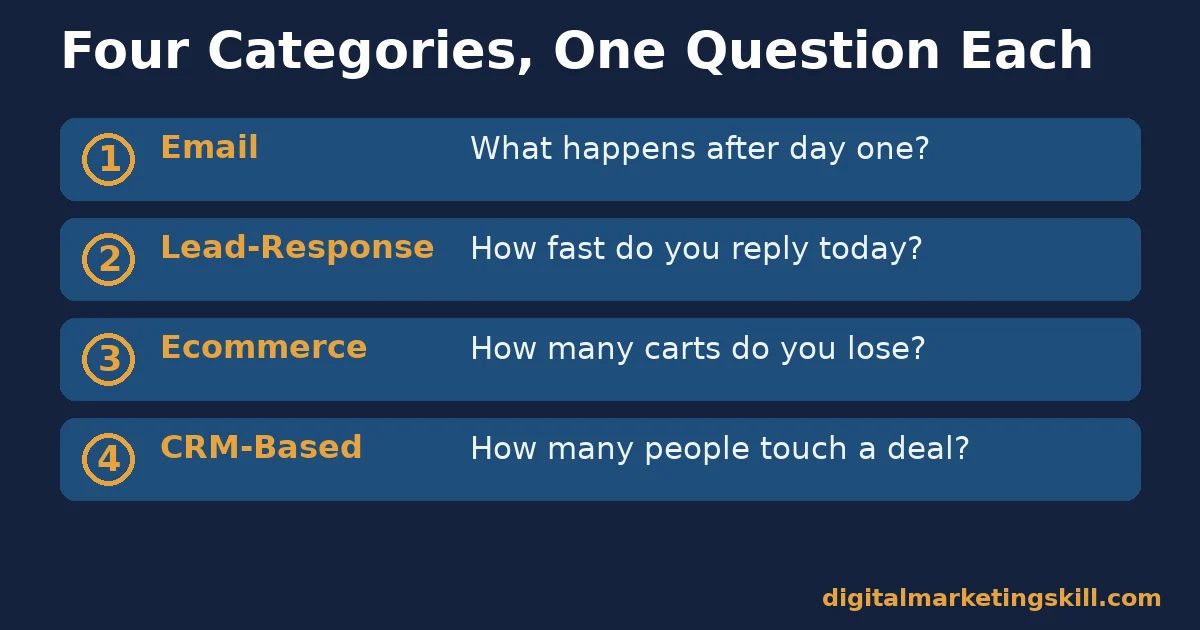
Email and Lead-Nurture: Ask What Happens After Day One
If a new contact gets one email and then silence, start here. Map the three or four messages a genuinely interested lead should receive over their first two weeks. Then automate just that sequence before adding anything more complex.
Lead-Response: Ask How Fast Your Team Replies Today
Time your own current response to a fresh lead, honestly, for a week. If it regularly exceeds a few minutes, this category pays for itself fastest, because the CallRail data shows how steeply conversion falls with delay.
Ecommerce Flows: Ask How Many Carts You Lose Today
Check your store’s own abandonment rate against Barilliance’s roughly 77% benchmark. If you have no recovery sequence running at all, this is usually the single highest-return automation project available to an online store.
CRM-Based: Ask How Many People Touch a Deal Before It Closes
A CRM-based tool earns its setup time when your sales process involves more than one person or more than a couple of weeks. When a single person closes most deals in one conversation, this category is likely overkill for now.
Our guide on persuasive email marketing copy that converts covers what to write once your CRM flags a lead as ready. Pairing the right message with the right trigger is what turns a CRM from a database into a working part of marketing automation tools.
How to Measure Marketing Automation Tools
Each metric below is defined in one sentence, with a note on how to read it.
- Sequence completion rate. The share of contacts who go through an entire automated sequence without unsubscribing or going cold. A low rate means the sequence itself needs editing, not more volume.
- Response time to new leads. The time between a lead arriving and a person or automated reply reaching them. Compare this against CallRail’s 60-second benchmark as a rough target, not a guarantee.
- Cart recovery rate. The share of abandoned carts that convert after a recovery email or message. Compare your own rate against Barilliance’s roughly 18.64% average as a sense check.
- Automated vs manual conversion gap. The difference in conversion rate between leads that went through an automated flow and those that did not. A small or negative gap means the automation is not adding real value yet.
- Time reclaimed per week. An estimate of hours no longer spent on the task the automation replaced. Zapier’s survey of 1,500 knowledge workers at small and mid-sized US businesses found marketers who use automation report saving the most time of any role, a self-reported figure worth treating as a ceiling rather than a typical result.
Reading the Numbers Together
Start with the automated vs manual conversion gap. If that gap is healthy, the category you chose is working, so refine it rather than replacing it. If the gap is flat, the trigger or message is wrong for your audience, and no amount of extra automation volume will fix that on its own.
Check time reclaimed last, not first. A tool can save hours and still fail on conversion, which means the hours saved are not worth much until the conversion gap improves too.
Here is a worked example, with invented numbers for illustration. A service business tracks response time for two weeks and finds an average of eleven minutes, well past CallRail’s benchmark window. After automating the first reply, average response time drops to under a minute, and the conversion rate on new leads rises from 9% to 14%. The owner reads that gap and decides the lead-response category earned its budget, before even testing the other three categories.
The Most Useful Rule: Automate the Bottleneck You Can Prove, Not the One You Assume
If you take one decision rule from this guide, make it this one. Before buying any marketing automation tool, measure your current numbers for two weeks across response time, cart abandonment and nurture-sequence completion. Automate whichever bottleneck the numbers actually show, not the one that feels most urgent.
Here is an illustrative example, with invented numbers. A small online store assumes its email nurture sequence is the weak point and spends a month upgrading it, with conversion barely moving. A two-week check instead shows a 79% cart abandonment rate with no recovery flow running at all.
Building that one missing flow lifts monthly revenue more in two weeks than the nurture-sequence project did in a month. The budget finally matched the actual bottleneck, instead of the one that seemed most obvious.
The same pattern shows up across categories. A business often assumes it needs a full CRM. Once it actually measures response time, the simpler lead-response category would have closed the gap at a fraction of the setup cost. Measuring first protects the budget from an expensive guess.
Common Mistakes When Choosing Marketing Automation Tools
Three mistakes repeat across businesses buying marketing automation tools for the first time. Each one wastes a subscription that could have funded the category that actually mattered.
- Buying the all-in-one platform first. A broad platform looks efficient on paper, but a business that has never automated anything usually gets more value proving one category works before paying for five.
- Copying a competitor’s tool choice. A competitor’s marketing automation tools were picked for their bottleneck, not yours. Matching their stack without matching their problem rarely produces the same result.
- Setting up a sequence once and never revisiting it. An automated flow still needs the same edits a manual campaign would get. Marketing automation tools remove the sending work, not the job of improving the message.
Avoiding even one of these mistakes usually pays for the subscription within the first few months. Review your own setup against this list once a quarter, because a tool that fit your bottleneck a year ago may not fit the bottleneck you have today.
A Real Case: Automation Tied to a Measured Sales Lift
Olajire Jacob, a Digital Marketing Skill Institute graduate, built automated email flows as a service for other businesses. According to the student’s review on the institute’s reviews page, the work scaled from an average of $500 per client setup to $5,000 a month in service revenue.
That growth came from applying the category-first approach this guide describes: fixing one client’s actual automation gap at a time, not installing every available feature at once.
Keep the limits of this case in mind. It is one published result from one person’s service business, not a guaranteed outcome for installing automation tools yourself, and results vary by market, pricing and client type. See the institute’s earnings disclaimer for the full context.
The underlying lesson still generalises: marketing automation tools pay off fastest when they are sold, or bought, against one proven gap at a time, not as a bundle of features nobody asked for.
Frequently Asked Questions About Marketing Automation Tools
What are marketing automation tools used for?
They replace repetitive manual marketing tasks, like sending a welcome email or following up on an abandoned cart, with rules that fire automatically. The goal is consistency a person cannot sustain alone, not replacing judgment entirely.
Which marketing automation tool category should I start with?
Start with whichever bottleneck your own numbers prove, not the category that sounds most advanced. Time your lead response for a week, check your cart abandonment rate, and see whether new contacts get more than one email before you decide.
Do small businesses really need marketing automation tools?
Only once a real, measurable bottleneck exists. A business with very few leads or sales may get more value from fixing the offer or the traffic first, since there is little volume yet for automation to multiply.
What is the difference between marketing automation and email marketing?
Email marketing is one channel a marketing automation tool can use, not the whole category. Automation adds the trigger and the logic, such as sending a different message depending on what a contact clicked, while plain email marketing usually sends the same message to everyone on a list.
Does marketing automation replace the need for a marketing team?
No. It replaces the repetitive execution a team would otherwise do by hand, which frees people for the parts automation cannot do, such as strategy, creative work and judgment calls about what to test next.
How fast should a business respond to a new lead?
As close to immediately as possible. CallRail’s research found that responding within 60 seconds lifted conversion by 391% compared with slower replies, while a five-minute delay cut qualifying odds by 80%.
Is email automation still worth it with so many channels available?
Yes. Mailchimp’s benchmark data shows a reliable all-industry average open rate of 35.63% and click rate of 2.62%, and email remains a channel a business owns rather than rents from a platform’s algorithm.
How do I know if my marketing automation tool is actually working?
Compare conversion for contacts who went through the automated flow against those who did not. A meaningful gap means it is working, while a flat or negative gap means the trigger or message needs fixing, not more automation volume.
Can one marketing automation tool cover every category?
Some all-in-one platforms try, but a tool that stretches across every category often does each one shallowly. Starting with the single category that matches your proven bottleneck usually beats an all-in-one platform you only half configure.
How long should I test a marketing automation tool before switching?
Give a new sequence or flow at least a full sales cycle before judging it, since a shorter window can be skewed by a single unusually good or bad week. Compare the automated vs manual conversion gap across that whole period, not just the first few days.
Start With the Bottleneck, Not the Tool
Marketing automation tools work best when the category matches a bottleneck you have actually measured. Track your response time, cart abandonment and nurture completion for two weeks. Then pick the category that addresses the biggest gap, and automate that one thing properly before adding a second.
Revisit this process every few months. The category that solves today’s bottleneck in marketing automation tools may not be the one that matters most once that gap closes and a new one takes its place.
If you want structured, hands-on practice, the Digital Marketing Skill Institute teaches these exact skills inside its Master Diploma in Digital & AI Marketing. The programme is built around four AI-powered tracks, including AI-Powered Lead Generation and Email Automation and AI-Powered Social Media Management and Advertising, across ten courses total, with a Full Stack option for completing all four. It comes with unlimited 1-on-1 coaching and mentoring, plus a U.S. Project Internship that leads to a verified U.S. Work Reference Letter. The diploma is dual US and UK accredited and recognised in more than 100 countries.
The programme is fully online, so you can study from anywhere in your country. Browse more guides on the Digital Marketing Skill Institute blog, check real outcomes on the reviews page, and when you are ready, apply for the Master Diploma or start from the Digital Marketing Skill Institute homepage.
Every figure in this guide was checked against its original source before publication. Figures marked as illustrative are invented examples, not real results.