Marketing vs advertising comes down to scope. Marketing is the whole process of researching a market, shaping an offer, and building long-term demand for it. Advertising is one paid tool inside that process: a message you pay to place in front of an audience. Advertising supports marketing. It does not replace it.
Key Takeaways
- Marketing is the wider system. The American Marketing Association defines marketing as the activities and processes for creating, communicating, delivering and exchanging offerings of value (American Marketing Association).
- Advertising is one paid channel inside it. Global ad spend is forecast to reach $1.34 trillion, growing 11.9%, with social media the fastest-growing channel at $394.6 billion (WARC).
- Budgets split unevenly. Marketing budgets average 9.6% of company budget, and within that, paid media alone takes 31.4% of the marketing budget, a five-year high (Deloitte-Duke CMO Survey; Gartner via Chief Marketer).
- Proving advertising’s return is still the top struggle. Measuring ROI is marketers’ single biggest challenge, cited by 33.0% of respondents (HubSpot State of Marketing).
- The two work on different timelines. A long-running analysis of 996 effectiveness-award campaigns found brand-building marketing drives slower, more durable growth, while short-term advertising activation drives a sharper, faster but shorter-lived lift (IPA Databank, Binet and Field).
In this guide
- What Most Marketing vs Advertising Advice Gets Wrong
- How Marketing and Advertising Actually Relate
- What Differs Between Marketing and Advertising
- How to Lead With Each Side of Marketing vs Advertising
- Common Mistakes That Blur Marketing vs Advertising Decisions
- Who Owns What: Marketing vs Advertising Roles on a Team
- How to Measure Marketing and Advertising Separately
- When Marketing and Advertising Numbers Disagree
- The One Decision Rule for Marketing vs Advertising Budgets
- A Real Case: What Decades of Campaign Data Show About the Split
- Frequently Asked Questions About Marketing vs Advertising
- Build Both Skills, Not Just One
What Most Marketing vs Advertising Advice Gets Wrong
Most explainers treat marketing vs advertising as a vocabulary problem. They define each word and stop there. That misses the real question. Most people asking about marketing vs advertising actually want to know where their next budget dollar or hour should go.
This guide treats marketing vs advertising as a resourcing question, not only a definitions question. It covers what each discipline is built to do and how to lead with each one. Then it shows how to measure them separately, and gives one clear rule for splitting your effort between them.
A few ground rules first. The budget-split figures below come from self-reported surveys of marketing leaders. Read them as industry benchmarks, not a guarantee for your business. The IPA research covers mostly larger brand campaigns submitted for awards, so small-business results may differ.
None of this means marketing vs advertising has one universal correct split. Category, business stage, and how quickly you need measurable results all shift the right answer. Treat every number here as a current snapshot, not a permanent rule, and recheck it against your own results before committing a full budget cycle to it.
How Marketing and Advertising Actually Relate
Marketing starts earlier and runs longer than advertising. It covers market research, product and pricing decisions, positioning, distribution and customer relationships. The American Marketing Association defines marketing as the activities, institutions and processes for creating, communicating, delivering and exchanging offerings that have value for customers and society.
Advertising sits inside that process as one paid, planned tool. Its job is to get a specific message to a specific audience. It is funded, scheduled and placed, usually with a clear sponsor named.
When advertising works well, it executes a decision marketing already made: who to reach, with what offer, and why it matters to them. Our deeper guide to brand advertising covers the awareness-building side of that paid layer in detail.
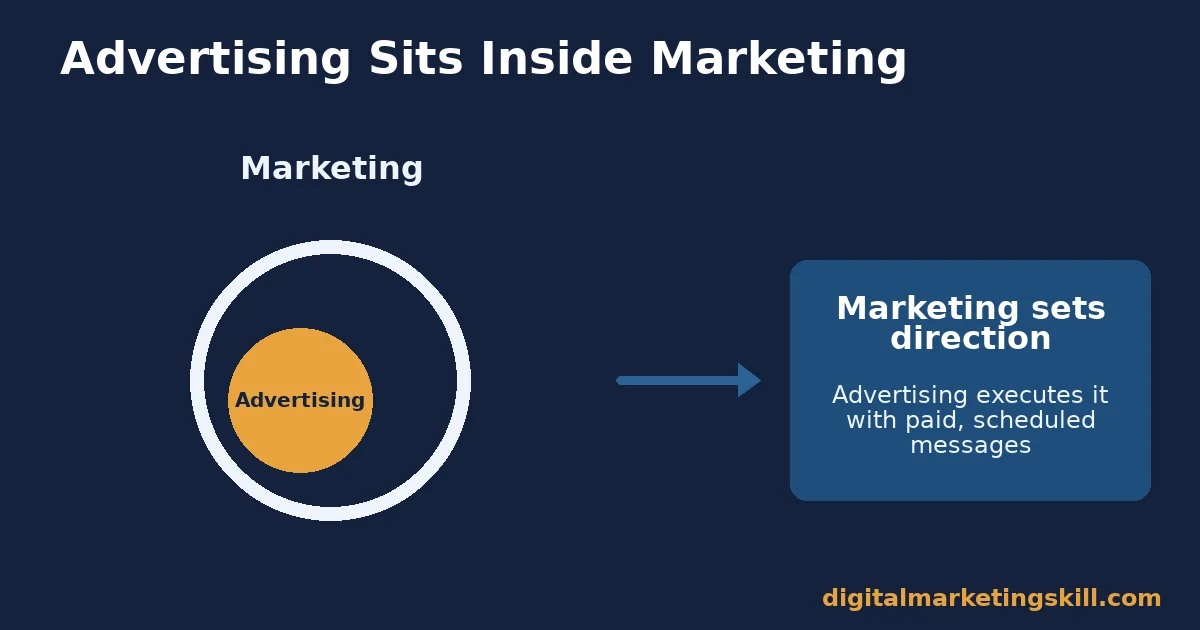
This relationship explains a common mistake. Teams often judge their whole marketing programme by advertising numbers alone, such as clicks or cost per lead. That only measures the paid layer. It says nothing about whether the product, pricing or positioning underneath it is actually right.
The Money Behind Marketing vs Advertising Is Enormous
Global advertising spend is forecast to grow 11.9% to $1.34 trillion, according to WARC’s global ad spend forecast. Social media leads that growth, rising to $394.6 billion. Search follows close behind at $295.7 billion. Together, social, search and retail media take about two-thirds of all ad spending.
That figure covers advertising alone. The wider marketing budget that funds it, research, content, email, events and the advertising itself, runs separately. It is usually reported as a share of company budget or revenue, not as a media total. Our guide to setting a content marketing budget breaks down how to size that wider pool before advertising gets its share.
Scale alone does not settle marketing vs advertising, though. A business can spend heavily on ads and still lose, if the marketing decisions behind those ads are wrong. Spend is a measure of activity, not of whether that activity is pointed at the right audience with the right offer.
What Differs Between Marketing and Advertising
Marketing and advertising differ on four practical points: timeline, audience, cost structure and the question each one answers. The two sections below mirror each other, so you can compare marketing vs advertising side by side.
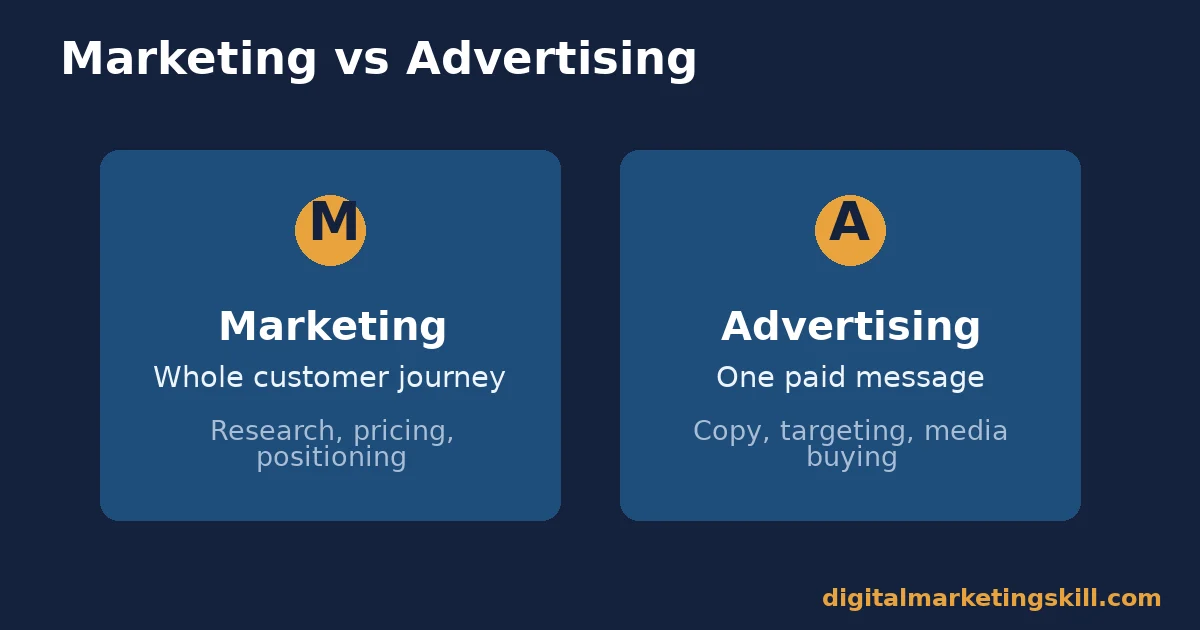
Marketing: Built for the Whole Customer Journey
Marketing starts before a product exists and continues after a sale closes. It answers questions like: who needs this, what should we charge, where should we sell it, and how do we keep customers once we have them. Its tools include research, product decisions, pricing, distribution and relationship-building.
Because marketing covers the whole journey, its budget is harder to isolate. A marketing team’s work shows up in brand recall, repeat purchase rates and customer lifetime value. Those numbers build up over months, not days.
Advertising: Built for One Paid Message, One Audience
Advertising answers a narrower question: how do we get this specific message in front of this specific audience, right now. Its tools are copywriting, visual design, media buying and targeting. A campaign has a start date, an end date and a media budget attached to it.
Because advertising is a discrete, paid activity, it is also the easiest part of marketing to measure directly. Every impression, click and conversion can usually be tied back to a specific ad, budget and date. That precision is exactly why marketing vs advertising debates so often default to advertising’s numbers, even when the real problem sits upstream in marketing.
How to Lead With Each Side of Marketing vs Advertising
The sections below mirror the two roles above. Use marketing to decide what to say and to whom. Use advertising to say it loudly, on schedule, to a paid audience.
Marketing: Lead With Research and Positioning
Start every campaign with the marketing questions first: who is the audience, what do they actually need, and why should they pick you over the alternative. Skipping this step is the single biggest reason advertising underperforms. A well-placed ad for the wrong offer still fails.
Build your positioning before you write a single ad. A one-sentence statement of who you serve and why you are different should guide every later advertising decision, from the headline to the audience you target.
Advertising: Lead With the Offer and the Channel
Once positioning is set, advertising’s job is execution. Match the offer to the channel. A direct-response offer suits search and paid social. A brand-awareness message suits video and display. Our guide to PPC campaign optimisation covers how to keep the paid side efficient once it is live.
Keep creative and targeting tightly matched to the positioning marketing already set. Advertising that drifts from a brand’s actual positioning may still get clicks. It still attracts the wrong customers, though, which shows up later as poor retention.
Common Mistakes That Blur Marketing vs Advertising Decisions
A few recurring mistakes explain most marketing vs advertising confusion inside real teams.
- Funding advertising before positioning exists. Teams launch ads to hit a deadline, then discover the message does not match what the audience actually wants.
- Judging all of marketing by advertising metrics. Click-through rate and cost per click say nothing about brand trust, retention or lifetime value.
- Cutting brand-building the moment budgets tighten. Short-term activation is easier to defend in a budget review, even when long-term brand work is what sustains growth.
- Treating the split as fixed. The right marketing vs advertising ratio depends on category, business stage and how measurable your results need to be.
Which Mistake to Check in Your Own Team
Start by checking whether your team has written positioning at all. Many teams skip straight to advertising because positioning feels slower and harder to show progress on. If positioning exists but nobody references it when briefing ads, that gap is usually the real problem.
A Quick Checklist Before You Brief an Ad
- Write down, in one sentence, who the ad is for.
- Confirm that sentence matches your team’s actual positioning document.
- State the one action you want the viewer to take.
- Pick the channel that matches that action, not the channel that is easiest to buy.
- Decide in advance which metric, CTR, CAC or LTV, will judge success.
Who Owns What: Marketing vs Advertising Roles on a Team
Confusion over marketing vs advertising often starts with job titles, not just budgets. Clarifying who owns which decision prevents the same mistake twice: positioning drifting because nobody is actually responsible for it.
Roles That Sit Inside Marketing
Marketing roles typically include research, brand strategy, product marketing, content and customer lifecycle work. These roles ask broad questions: what does the market need, and how does our offer answer that need better than the alternative.
Roles That Sit Inside Advertising
Advertising roles typically include media buying, paid search and social specialists, and creative production for paid campaigns. These roles ask narrower, more operational questions: which audience, which channel, which budget, and which creative wins the test.
Small teams often merge both sets of roles into one person. That is workable, as long as that person still treats the two questions separately, instead of letting whichever task is due soonest quietly take over the budget.
Agencies usually split the same way internally, even when a client hires just one agency for everything. A brand strategist or account planner handles the marketing side, researching the audience and shaping the positioning brief. A media buyer and a creative team then handle advertising, turning that brief into a running campaign.
Knowing this split helps you ask an agency the right question. Do not only ask how the campaign is performing. Ask who owns the positioning behind it, and how that work was actually done.
How to Measure Marketing and Advertising Separately
Marketing vs advertising needs two different scorecards. They answer different questions, so mixing their metrics hides which side actually needs attention.
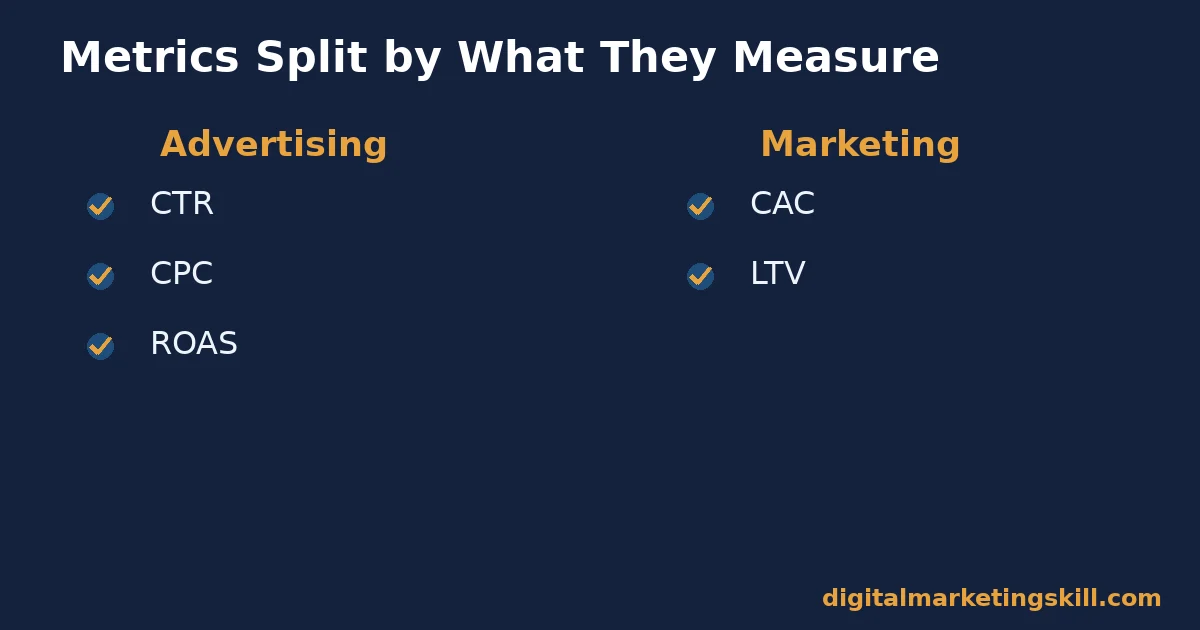
Five Metrics, Split by What They Actually Measure
- Click-through rate (advertising). The share of people who saw an ad and clicked it. It tells you whether creative and targeting are working, not whether the offer behind it converts.
- Cost per click or cost per lead (advertising). What you pay per interaction. Rising costs can signal more competition in the auction, not necessarily a weaker ad.
- Return on ad spend, or ROAS (advertising). Revenue generated per dollar of ad spend. It is the clearest direct measure of one campaign’s payback.
- Customer acquisition cost, or CAC (marketing). The full cost, across every channel, of acquiring one customer. Unlike ROAS, it should include content, email and research spend, not only paid media.
- Customer lifetime value, or LTV (marketing). The total revenue a customer generates over the relationship. Comparing LTV to CAC shows whether the whole marketing system, not just one campaign, is sustainable.
Measuring ROI is still the top reported struggle for marketers, cited by 33.0% of respondents in HubSpot’s State of Marketing survey. Splitting metrics this way makes that problem easier to solve: advertising numbers judge campaigns, and marketing numbers judge the whole system.
When Marketing and Advertising Numbers Disagree
Sometimes advertising numbers look strong while marketing numbers look weak, or the other way round. That gap is useful information, not a contradiction to ignore.
If click-through rate and ROAS look healthy but customer lifetime value is falling, the advertising is working, but it may be attracting the wrong customers. Because those customers churn faster, the marketing system still loses, even though the campaign report looks good.
If lifetime value is strong but ROAS is weak, the product and positioning are probably sound. The paid execution, however, needs work: targeting, creative, or the channel mix may be off. Reading both scorecards together, instead of just one, usually points straight at which side of marketing vs advertising needs attention first.
The One Decision Rule for Marketing vs Advertising Budgets
When a limited budget needs splitting, follow this order. First, confirm the marketing fundamentals: audience, offer and positioning. Second, size your advertising budget to match how directly measurable you need the return to be. Third, review both every quarter, since advertising performance can shift faster than positioning does.
Illustrative, invented numbers. Picture two businesses with the same $10,000 monthly budget. One spends all of it on paid social ads with no positioning work behind them. Clicks look good, but conversion stays low because the offer is unclear.
The other spends $3,000 refining its positioning and messaging, then $7,000 on ads built from that work. The second business typically sees a higher conversion rate. Its advertising is now saying something the audience actually wants to hear.
A Real Case: What Decades of Campaign Data Show About the Split
Clear documented evidence on marketing vs advertising balance comes from the IPA’s effectiveness databank research by Les Binet and Peter Field. It analysed 996 campaigns submitted for the Institute of Practitioners in Advertising’s effectiveness awards.
Brand-building marketing and short-term advertising activation work on different timelines, the research found. Activation produces a sharp but short-lived uplift. Brand-building produces a slower, more durable, compounding effect instead.
A starting split from that research puts about 60% of budget toward brand-building and 40% toward activation. Later work shows this varies widely by category, from roughly 80:20 in financial services to closer to balanced in B2B categories.
Treat this as a well-documented pattern from mostly larger, award-submitted campaigns, not a universal rule for every business size. Still, it is strong evidence on marketing vs advertising: the data shows both working together, on different clocks, rather than competing for the same job.
A smaller business without that kind of award-campaign data can still apply the underlying lesson. Protect some budget for brand-building marketing work, even while advertising carries most of the near-term pressure to perform. That balance, more than any single ratio, is what the research actually recommends.
Frequently Asked Questions About Marketing vs Advertising
Is advertising a type of marketing?
Yes. Advertising is one paid tool used inside the broader marketing process. Marketing also includes research, product decisions, pricing, distribution and customer relationships that advertising does not cover on its own.
Can a business do marketing without advertising?
Yes. Marketing activities like research, content, email and referrals can run without any paid advertising. Most businesses eventually add advertising because it is the fastest way to reach a precise audience with a paid, scheduled message.
Which costs more, marketing or advertising?
Marketing usually costs more in total. It includes advertising plus research, content, tools and staff time across the whole customer journey. Advertising is typically reported separately, as a media line item within the larger marketing budget.
What is the main difference between marketing and advertising goals?
Marketing aims to understand and serve customer needs over time, building awareness, trust and repeat business. Advertising aims to prompt a specific, often immediate action, such as a click, a visit or a purchase, from a defined audience.
Do marketing and advertising use different metrics?
Yes. Advertising metrics like click-through rate, cost per click and ROAS measure a single paid campaign. Marketing metrics like customer acquisition cost and lifetime value measure the whole system across every channel, paid and unpaid.
How much of a marketing budget should go to advertising?
There is no fixed number. Gartner’s CMO Spend Survey data puts paid media at roughly 31.4% of the typical marketing budget, a five-year high. Effectiveness research from the IPA suggests weighting spend toward brand-building over short-term activation in most categories, though the best ratio varies by industry.
Does the marketing vs advertising split change by business size?
Yes, generally. Smaller businesses often lean more heavily on advertising because it produces faster, more measurable results on a tight budget. Larger, established brands can afford to weight spending more toward brand-building marketing, since they already have steadier demand to defend.
What happens if advertising spend grows faster than marketing strategy?
Results usually plateau or decline. More ad spend without clearer positioning tends to raise costs per click as targeting gets stretched thinner, while conversion rates stay flat because the underlying offer has not improved. Growing the budget rarely fixes a problem that sits in the marketing layer.
Build Both Skills, Not Just One
Marketing vs advertising is not a competition between two disciplines. It is a division of labour. Marketing sets the direction with research, positioning and pricing. Advertising executes with paid, scheduled messages to a defined audience. Strong results need both, measured separately and funded in the right order.
The Digital Marketing Skill Institute’s Master Diploma in Digital & AI Marketing builds both sides of this skill set. It runs on four AI-powered tracks totalling ten courses, including AI-Powered Social Media Management and Advertising and AI-Powered Lead Generation and Email Automation, with a Full Stack option for completing all four.
Every track includes unlimited one-on-one coaching and mentoring, a U.S. Project Internship with a verified U.S. Work Reference Letter, and dual US and UK accreditation recognised in more than 100 countries, wherever you live in your country. The program runs 100% online, so you can apply both the marketing and advertising sides of this guide to real campaigns as you learn.
See the full program on the Master Diploma page, read real outcomes on student reviews, browse more guides on the digital marketing blog, or go straight to the application page to start anywhere in your country. Learn more about the Institute at digitalmarketingskill.com, or visit digitalmarketingskill.com directly for details on every track.
Every figure in this guide was checked against its original source before publication. Figures marked as illustrative are invented examples, not real results.