
Small business influencer marketing works when you match the creator’s size to your budget and your goal. It fails when you chase the biggest following you can afford. A single-location shop gets more from five small creators than from one big account. Trust and fit beat raw reach at a small scale. This guide shows which creator tier to use, how to brief it, and how to check if it worked.
Key Takeaways
- The category has scaled fast. The global influencer marketing market reached roughly $33 billion. It has grown several times over in just a few years, according to Statista’s market-size tracking. Small business influencer marketing is no longer a side bet for big brands only.
- Smaller creators are winning budget share. In the Influencer Marketing Hub’s benchmark survey of over 600 marketers, 52.83% plan to grow nano-tier spending. 51.43% plan to grow micro-tier spending. Only about 20% plan to grow macro-tier spending.
- Rising cost is the top complaint. The same survey found 35.4% of marketers name rising creator costs as their main challenge. That is why small business influencer marketing needs a clear tier plan before you spend.
- Disclosure is not optional. The US Federal Trade Commission requires a clear “ad” or “sponsored” label on any post a creator was paid or gifted for. Most other major markets enforce a similar rule.
- Payback can be fast with a tight brief. 65.9% of marketers in the same benchmark survey expect payback within one month. But only when goals and creative direction are set before the first post goes live.
In this guide
- What Most Small Business Influencer Marketing Advice Gets Wrong
- How Small Business Influencer Marketing Actually Works
- The Four Creator Tiers in Small Business Influencer Marketing
- How to Lead With Each Tier in Small Business Influencer Marketing
- A Six-Step Process for Your First Small Business Influencer Marketing Campaign
- How to Measure a Small Business Influencer Marketing Campaign
- The One Decision Rule for Small Business Influencer Marketing
- A Real Case: What Disciplined Small-Budget Testing Looks Like
- Frequently Asked Questions About Small Business Influencer Marketing
- Start Your Small Business Influencer Marketing With One Tier, Then Expand
What Most Small Business Influencer Marketing Advice Gets Wrong
Most guides treat influencer marketing as one channel with one price. It is not. A nano creator with 3,000 followers and a macro creator with 300,000 followers solve different problems. They also cost very different amounts. A small budget spent on the wrong tier buys reach the business cannot convert.
This is an informed inference from benchmark surveys and market trackers, not a settled fact. The exact numbers move every few months. So treat every figure here as a snapshot of current industry behaviour, not a permanent ranking.
The real gap in most small business influencer marketing advice is simple: nobody connects tier, cost and measurement. Articles list influencer “types” and campaign “tips.” They rarely connect a specific tier to a specific budget, or to a specific way to check if it worked. They also rarely show how it fits inside the rest of a small business marketing budget. That gap is what this guide closes. For the basics of the wider channel, see our guide to how influencer marketing works and what it costs.
How Small Business Influencer Marketing Actually Works
Small business influencer marketing works because an audience already trusts the creator more than it trusts a cold ad. When a creator talks about a product, some of that trust transfers to the product. It works the same way a friend’s recommendation carries more weight than a billboard. More than two in three people worldwide now use social media, according to DataReportal’s tracking of social media identities. The audience a small business needs is almost certainly already following someone in its niche.
The mechanism has three moving parts: fit, disclosure and distribution. Fit means the creator’s audience already cares about your category. The product does not need an introduction from zero. Disclosure means the post carries a clear, visible paid or gifted label. In the United States, the FTC’s disclosure guidance requires the word “ad,” “advertisement,” or “sponsored” placed with the content itself. It cannot sit buried in a bio or behind a “more” link. Comparable sponsorship-labelling rules apply in most other major markets too.
Who Is Responsible for Disclosure
The FTC’s own guidance makes one more point clear: responsibility sits with both the influencer and the business paying them, not with the platform. A small business cannot hand that legal risk to the creator alone. A US-only survey of over 3,700 consumers from BBB National Programs’ Influencer Trust Index found that the label itself barely changes trust; what erodes trust is a creator who hides the deal, since 70% of respondents said they felt deceived after discovering an undisclosed partnership.
Distribution is the third part. A platform’s own algorithm decides how far even a sponsored post travels. A creator with a smaller, more engaged audience can outperform a bigger one whose followers rarely interact.
The Four Creator Tiers in Small Business Influencer Marketing
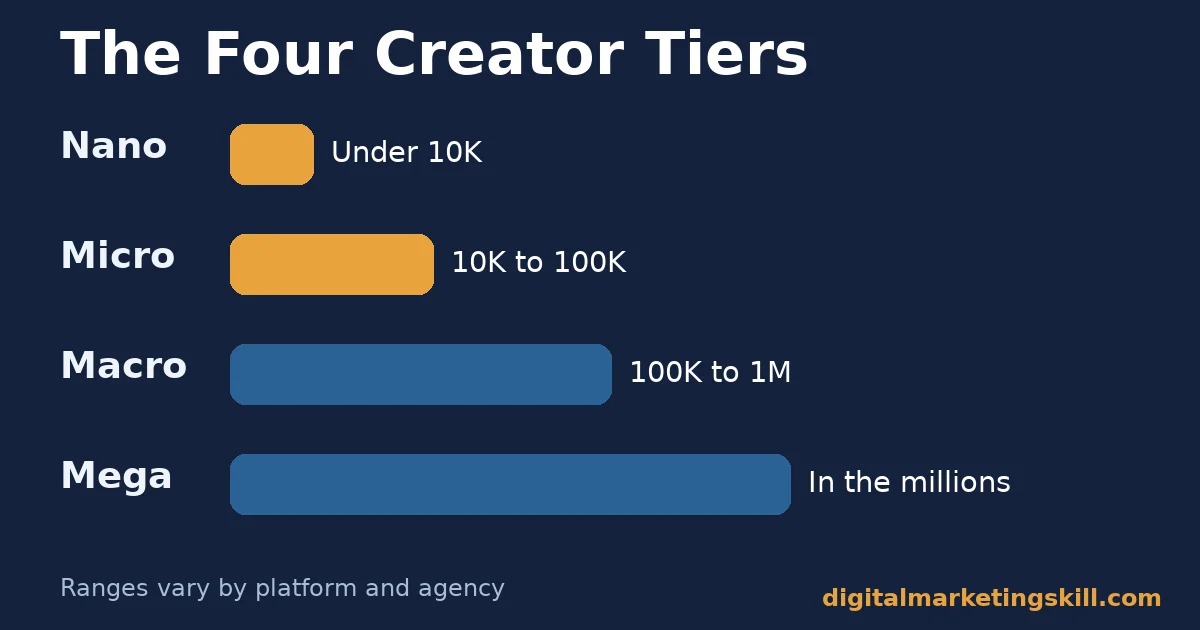
Industry trackers generally split creators into four follower-count bands. The exact cut-offs vary by platform and agency. So treat these as working ranges, not fixed law, and adjust them once you see what a tier actually costs in your own niche.
Nano Creators: Built For Trust in Tight Communities
Nano creators typically have under 10,000 followers. Their audience is often a real community: former classmates, neighbours, people who share a hobby. A nano creator’s post reads like a tip from someone the follower actually knows. That is exactly why it converts well for a local or niche small business, especially when the creator and the customer live in the same neighbourhood or share the same hobby.
Micro Creators: Built For Engaged, Niche Reach
Micro creators generally sit between 10,000 and 100,000 followers. They have grown past the “friend group” stage. But most still answer their own comments, and their audience is self-selected around one topic, such as home baking or budget travel. That focus is why 52.83% of marketers in the Influencer Marketing Hub survey plan to grow micro-tier spending.
Macro Creators: Built For Fast Scale
Macro creators commonly range from 100,000 to 1 million followers. They behave more like a media outlet than a peer. A team often handles their scheduling and deals. They are built to put a message in front of many people fast. That suits a product launch or a short sale window more than a slow trust-building campaign.
Mega Creators: Built For Broad Awareness
Mega and celebrity creators have followings in the millions. They are built for brand awareness at a scale most small businesses cannot afford to buy directly. Their fees put them out of reach for most independent businesses. They matter here mainly as the ceiling that shows why the other three tiers exist.
How to Lead With Each Tier in Small Business Influencer Marketing
Knowing what a tier is built for is only half the job. A small business also needs to know what to do differently once it picks one.
Nano Creators: Lead With Local Trust and Usage Rights
Pay nano creators with product, a flat fee, or both. Ask for simple usage rights so you can reuse the content in your own posts or ads as a form of user-generated content. Brief them loosely: give the key message and one required disclosure line. Then let their own voice carry it. An overly scripted post breaks the exact trust you are paying for.
Micro Creators: Lead With Niche Fit and Longer Deals
Search for micro creators by topic first, follower count second. A 40,000-follower account that already talks about your exact niche will outperform a 90,000-follower generalist. Offer a three-post deal instead of one single post. Repetition inside one trusted feed builds familiarity faster than three different creators each posting once.
Macro Creators: Lead With a Tight Brief and Clear Usage Rights
Treat a macro creator like a media buy. Agree the exact deliverable, the posting window, and whether you can run the content as a paid ad afterward, in writing, before you pay the fee. Rising creator costs are the top challenge for 35.4% of marketers. So get a fixed quote and a cancellation clause before you commit a big share of a small budget to one macro post.
Mega Creators: Lead With Awareness Goals, Not Direct Response
A mega creator rarely fits a small-business budget. If one ever does, through a platform’s creator marketplace or a bundled campaign, judge it on reach and brand lift, not direct sales. The fee per follower is far higher than at the micro or nano tier. A single post from a huge account rarely converts at the rate a niche micro creator does.
Many fast-growing mega and macro accounts post mostly short-form video. If that is where your budget lands, pair the campaign with the basics in our guide to using TikTok for your business.
A Six-Step Process for Your First Small Business Influencer Marketing Campaign
Once you know your tier, run the campaign through the same six steps every time. This keeps every test comparable, so you can tell what actually worked.
Step 1: Set One Goal and One Number
Pick one goal: awareness, trackable clicks, or sales. Attach one target number to it before you contact a single creator. A vague goal makes every result look like a win, because without a number you can always claim success after the fact.
Step 2: Fix the Test Budget First
Decide the total you can spend before you pick creators, not after. A fixed budget forces you to choose a tier that fits it, instead of stretching toward a tier you cannot really afford. So if your test budget is under $1,000, stay at the nano or micro tier until it proves itself.
Step 3: Shortlist by Niche Fit, Then Check Engagement
Build a shortlist of creators who already talk about your category. Then check how often their own audience actually comments and replies, not just the follower count. Scroll through their last ten posts and count genuine replies, not just like counts, because likes are the easiest metric to inflate and the least useful one to trust.
Step 4: Write a One-Page Brief
Put the goal, the key message, the required disclosure line, and the deadline on one page. Skip anything that tries to script every word; a scripted post reads as an ad, not a recommendation. So leave the exact wording to the creator, and only lock down the facts that must appear.
Step 5: Give Every Creator a Unique Link or Code
Without a unique link, code, or UTM tag per creator, you cannot tell which post drove which result. This single step is the one most small businesses skip, and the one that makes measurement possible at all. Because without it, every later KPI in this guide becomes a guess instead of a fact.
Step 6: Review, Then Decide What to Repeat
After the posts run, compare cost per engagement and attributed sales across every creator. Repeat the deals that worked. Drop the ones that did not, and reinvest in one bigger test at the next tier up. Keep a simple spreadsheet with one row per creator, so the next campaign starts from evidence instead of memory.
How to Measure a Small Business Influencer Marketing Campaign
A small business cannot afford to guess whether a campaign worked. These five numbers answer that question without an enterprise analytics stack.
Five KPIs That Separate Signal From Noise
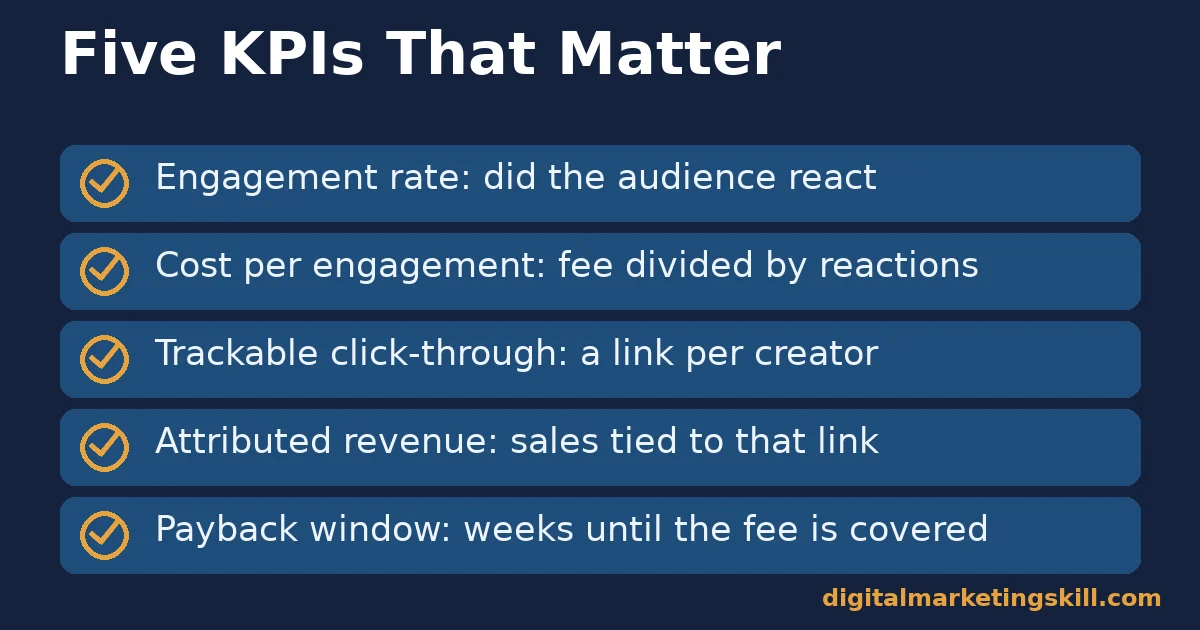
- Engagement rate is the share of a creator’s followers who liked, commented or shared the sponsored post. It shows whether the audience paid attention, not just whether they saw it.
- Cost per engagement is the total fee divided by the number of engagements. It lets you compare a $200 nano post against a $5,000 macro post on equal terms.
- Trackable click-through is the share of viewers who used a unique link, code or UTM tag tied to that one creator. Without it, you cannot tell which post drove traffic.
- Attributed conversions or revenue is sales tied to that same unique link or code. It turns “people liked it” into “people bought it.”
- Payback window is how long attributed revenue takes to cover the creator fee. In the Influencer Marketing Hub benchmark, 65.9% of marketers expect this within one month. A campaign that still has not paid back after two months is worth a second look.
How to Read These Numbers Together
No single KPI tells the full story. High engagement with no trackable clicks usually means a missing or unclear call to action. Low engagement with strong attributed revenue can still be a win. That pattern is common with nano creators in a tight local niche, where the audience is small but highly qualified.
Read cost per engagement and payback window together. A cheap post with a long payback is not actually cheap, once you count the weeks it ties up your testing budget. So when you compare two creators, do not stop at the cheaper fee; check which one actually pays itself back faster.
The One Decision Rule for Small Business Influencer Marketing
Here is the single most useful rule: prove a tier before you scale a tier. Spend your first test budget at the nano or micro level. Confirm a positive cost per engagement and a reasonable payback window. Only then move a larger budget toward macro reach. This order protects you from the one mistake that sinks most first-time campaigns: paying for broad reach before you confirm the audience actually buys.
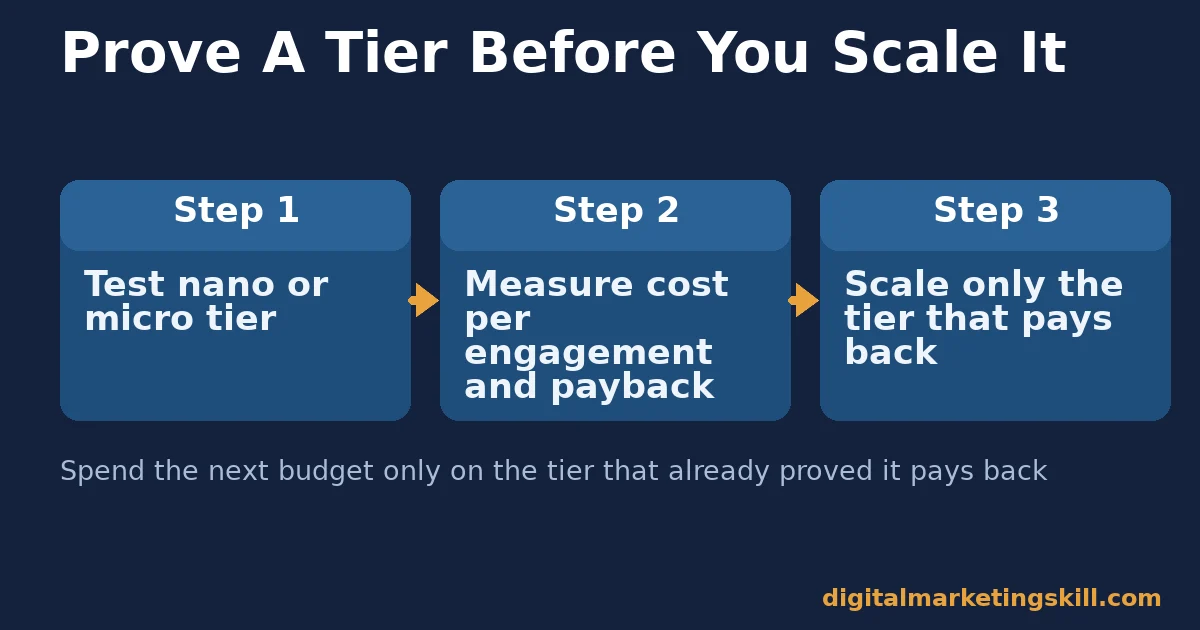
Here is an illustrative, invented example of the rule in action. A small skincare brand has a $600 monthly test budget. It splits that across six nano creators at $100 each. Three posts generate strong engagement and trackable sales. Three generate little. The brand drops the three weak partners.
It doubles the budget on the three strong ones for a second month. Only after two profitable months does it test a single $1,500 micro-creator post. The numbers are invented for illustration. The sequence, test small, measure, then scale, is the real decision rule.
A Real Case: What Disciplined Small-Budget Testing Looks Like
Real influencer-specific case data is hard to verify on its own. Most published “case studies” come from agencies selling the service. A more useful real case comes from a related discipline. A Digital Marketing Skill Institute graduate, Olajire Jacob, described a scoped service built into a freelance income stream in a published review: “Fresh from the course, I was charging an average of $500 to set up email marketing flows for clients in the US, UK & Ca… I was able to expand my digital marketing services and scale to $5K/mo.”
That case is about email marketing, not an influencer partnership. Treat it as a parallel lesson, not direct proof of influencer ROI. A tightly scoped, priced service, tested with a small number of clients before it scales, builds a track record faster than a broad, unscoped offer.
The same discipline applies to small business influencer marketing: a scoped test, run at one tier, beats an unscoped campaign spread across every tier at once. Because a scoped test gives you a clean result you can act on, while a scattered campaign only gives you a mix of numbers you cannot compare. Income results like this vary by person and are not guaranteed. See the Institute’s earnings disclaimer for the limits on any student income example.
Frequently Asked Questions About Small Business Influencer Marketing
How much should a small business budget for its first influencer campaign?
Start with an amount you could afford to lose completely. That is often a few hundred dollars split across three to six nano creators. The test is about proving the tactic, not funding one big bet. So resist the urge to put most of that budget into a single creator, no matter how good their feed looks.
Can a local business really use influencer marketing without a national audience?
Yes. Nano and micro creators in your own city or niche often reach more relevant followers than a national macro account. Your product only needs to reach the people who can actually buy it, which for most local businesses is a few thousand people, not a few million.
How many followers does a creator need before it is worth paying them?
Follower count matters less than engagement and niche fit. Because a creator with 5,000 highly engaged, topic-relevant followers can beat one with 50,000 passive followers on both engagement rate and cost per engagement.
Do small businesses have to follow the same disclosure rules as big brands?
Yes. Disclosure rules apply to the creator’s post no matter the advertiser’s size. A small business must still require the “ad” or “sponsored” label on anything it pays for, or gifts a product toward.
Should a small business use product gifting instead of paying a fee?
Gifting can work with nano creators who genuinely use the product. It is still legally a form of payment that requires disclosure. It rarely scales once you need set posting dates or exclusivity, so treat it as a starting point rather than a long-term substitute for a fee.
What is the single biggest mistake small businesses make with influencer marketing?
They buy reach before they confirm conversion. Paying for a bigger-tier creator before a smaller, cheaper test proves the audience buys wastes the budget that should have funded three or four smaller tests instead. Because once that budget is gone, there is nothing left to run the test that would have shown what actually works.
Start Your Small Business Influencer Marketing With One Tier, Then Expand
Small business influencer marketing rewards discipline over budget size. Pick one tier that fits your test budget. Brief it clearly. Measure engagement and attributed revenue. Scale up only once the numbers prove it.
If you want a structured way to build these skills, the Digital Marketing Skill Institute’s Master Diploma in Digital & AI Marketing includes the AI-Powered Social Media Management and Advertising track. It is one of four AI-powered tracks totalling ten courses, with a Full Stack option for completing all four, unlimited one-on-one coaching and mentoring, and a U.S. Project Internship with a verified U.S. Work Reference Letter. The program is dual US and UK accredited and recognised in more than 100 countries, delivered 100% online, so you can study and apply it anywhere in your country.
Explore the Master Diploma program, browse real outcomes on the reviews page, read more on the blog, and when you are ready, apply here. Wherever you live, you can start small, test one tier, and build small business influencer marketing from there. Learn more at Digital Marketing Skill Institute, or begin directly at digitalmarketingskill.com.
Every figure in this guide was checked against its original source before publication. Figures marked as illustrative are invented examples, not real results.
![9 Amazing Digital Marketing Skills to Make Money Online [With Proof]](https://digitalmarketingskill.com/wp-content/uploads/2019/07/9-Amazing-Digital-Marketing-Skills-to-Make-Money-Online-With-Proof-17.png)






