
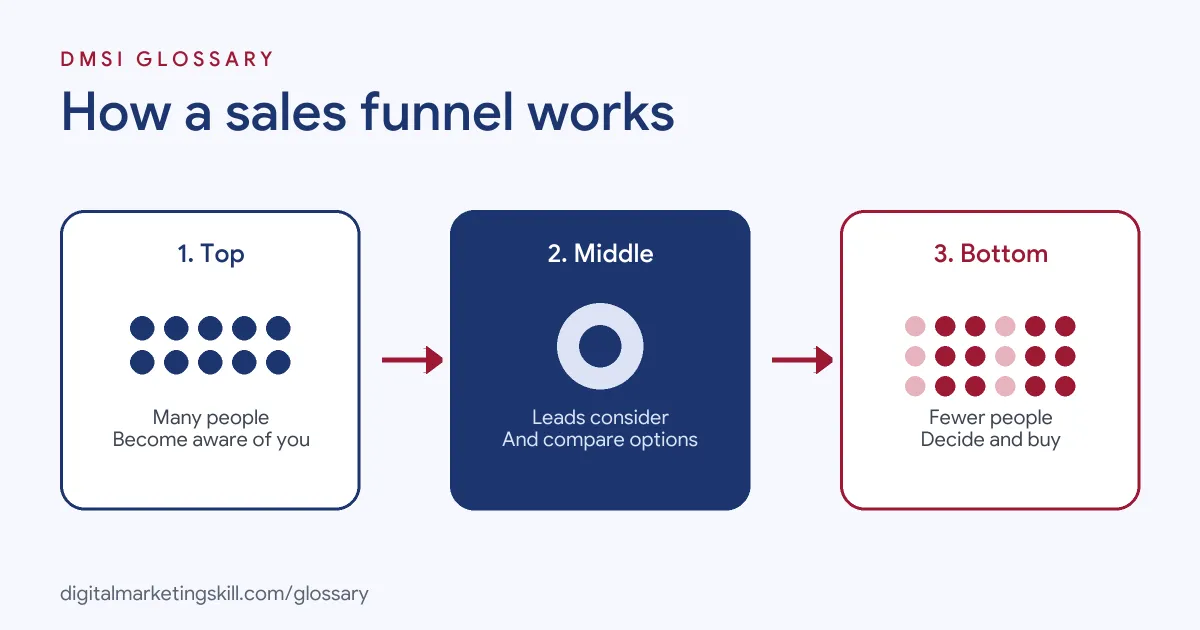
A sales funnel is a model of the steps people go through on the way from first hearing about a business to buying from it. It is wide at the top, where many people become aware of you, and narrow at the bottom, where fewer people decide to buy. It matters because it shows where potential customers drop out, so you know which stage to fix first.
Key Takeaways
- The funnel tracks the buyer’s journey, from awareness to purchase.
- Most models have three broad parts: top, middle and bottom.
- Real buyers don’t always move in a straight line. Some skip stages or go back.
- A sales pipeline looks at the same journey from the seller’s side.
- Measuring how many people move from one stage to the next shows you where to improve.
What Is a Sales Funnel?
Salesforce defines it as “the journey a prospect takes from awareness of a product or service to purchase.” HubSpot describes it in a similar way: it “mirrors the path your prospects take to become a customer.”
Think of a yoga studio. Thousands of people see its Instagram posts. A few hundred visit its website. Then 80 sign up for a free class, 30 attend and 10 buy a monthly pass. Each step has fewer people than the one before. That shape is the funnel.
So the model helps you see the whole path at once. In other words, it turns a messy customer journey into stages you can measure and improve.
How a Sales Funnel Works
HubSpot explains that the funnel starts with a large number of potential buyers at the top. Next, certain criteria reduce that pool to a smaller number of prospects. Then, towards the bottom, only a handful of opportunities remain. Finally, each deal ends as won or lost.
Top of the Funnel
At the top, people first discover you. They might see a social post, find a blog article or click an ad. Your job here is to attract the right people, not everyone. That’s why Salesforce advises focusing your marketing on your buyer persona.
Middle of the Funnel
In the middle, people know about you and start to compare options. Typically, they become leads by sharing an email in exchange for something useful, such as a guide. You then nurture them with helpful emails, case studies and demos. HubSpot also suggests lead scoring, which means giving each lead points based on their traits, behaviour and engagement.
Bottom of the Funnel
At the bottom, people are ready to decide. As a result, clear offers, reviews, free trials and quick answers to objections matter most here. According to HubSpot, the further a deal moves down the funnel, the higher its chance of closing.
Moving Between Stages
People rarely move down on their own. Instead, something has to nudge them to the next step. At the top, that might be a useful post that earns a click. In the middle, it could be a free guide followed by a short email series. At the bottom, a clear offer or a quick call often does the job. Salesforce adds that sellers should step in to “remove blockers and address needs,” so buyers can move ahead smoothly.
Sales Funnel Examples
Here are three common versions:
- Online store: Instagram ads bring visitors to product pages. Some add items to their basket, and a reminder email brings back people who left. Then a share of them complete the checkout.
- B2B software: A blog post attracts readers, who download a free template. Next, a short email series leads some of them to book a demo. After that, the sales team closes a few deals.
- Online course: A free webinar draws sign-ups. Afterwards, a follow-up email offers a short consultation, and some people then enrol.
In each case, every stage has one job: to move people to the next step.
Sales Funnel vs Sales Pipeline vs Marketing Funnel
These terms overlap, so here is how Salesforce separates them:
| Term | Point of view | What it covers |
|---|---|---|
| Marketing funnel | The buyer | From first contact with ads, social posts or emails to becoming a lead |
| Sales funnel | The buyer | The journey from interest through to final purchase |
| Sales pipeline | The seller | How sales reps track, analyse and guide each deal through stages |
Salesforce sums up the key difference as perspective. A pipeline shows what the sales team does, while the funnel shows what the buyer experiences.
HubSpot also offers an alternative model, the flywheel. It focuses on the momentum you gain when happy customers buy again and refer others. In short, the funnel ends at the sale, while the flywheel treats customers as the force that brings in more customers.
How to Build a Sales Funnel
HubSpot’s process for creating one follows these steps. Before you start, map the journey your customers take today, even if it is messy.
- Define the problem you solve. Understand your audience’s pain points and needs.
- Set your goals. For example, more leads, demos, sign-ups or purchases.
- Create an offer that generates leads. A free guide, trial or webinar works well.
- Qualify your leads. Check which ones fit your ideal customer.
- Nurture qualified leads. Send helpful emails and content over time.
- Close the deal. Make the offer clear and remove last-minute doubts.
- Track and analyse results. After that, improve the weakest stage first.
To measure the flow, you can use a funnel report in Google Analytics. Google says its funnel exploration lets you see the steps users take to complete a task and “how well they are succeeding or failing at each step.”
Best Practices for a Sales Funnel
- Treat it as a guide, not a rule. Salesforce notes that prospects may bounce between stages or jump straight to purchase.
- Measure each step. Track the conversion rate from one stage to the next.
- Fix leaks before adding traffic. Above all, more visitors won’t help if most drop out later.
- Match content to the stage. Use guides at the top, comparisons in the middle and offers at the bottom.
- Keep marketing and sales aligned. Agree on what counts as a qualified lead.
Common Mistakes to Avoid
Many businesses focus only on the top, so they buy more traffic while the real problem sits further down. Others push for a sale too early, before people trust them. Some never follow up with leads, which wastes the effort it took to get them. Finally, many teams don’t track each stage, so they can’t see where people leave. HubSpot also points out that the buyer’s journey “no longer follows a straight highway” from awareness to purchase. So build in ways for people to come back, such as email and retargeting.
Where You’ll Use a Sales Funnel at Work
Funnels sit at the heart of lead generation, email and sales roles. For example, recent remote job listings ask candidates to:
- “Optimize the sales funnel from lead generation through closed deals” (Sales Manager).
- Follow up on leads “to move them through the sales funnel” (Sales Representative).
- Show a “Basic understanding of sales funnels and appointment setting” (Cold Caller).
So if you want to work as an Email Marketing Specialist, Marketing Automation Specialist or Lead Generation Specialist, you will build, measure and improve funnels. In fact, many marketing reports are simply a funnel with numbers at each stage.
On a typical day, you might check how many new leads came in, which emails people opened and where deals stalled. Then you suggest one change, such as a clearer offer or a faster follow-up, and test whether it helps.
Learn It in the Lead Generation Track
You can learn to design and improve a sales funnel in the AI-Powered Lead Generation and Email Automation track. It covers AI fundamentals, lead generation, and email marketing and automation. Your portfolio project is to build a lead magnet and an automated email sequence that converts. You also join a U.S. Project Internship from day one, with unlimited 1-on-1 mentoring.
To go further, read our practical guide to sales funnel stages and our tips on fixing an ecommerce sales funnel. You can also read our glossary entry on lead generation.
Frequently Asked Questions
What is a sales funnel in simple terms?
It is the path people take from first hearing about your business to buying from you, shown as stages that get narrower towards the sale.
What are the main stages?
Most models use three broad stages: top (awareness), middle (consideration) and bottom (decision and purchase). Some split these into more detailed steps.
What is the difference between a sales funnel and a pipeline?
A funnel shows the journey from the buyer’s point of view. A pipeline shows how the sales team tracks and manages each deal.
How do I measure my funnel?
Count how many people reach each stage, then work out the conversion rate between stages. Tools such as Google Analytics funnel reports can help.
Is the funnel model still useful?
Yes, as a guide. However, real buyers often skip or repeat stages, so use it to spot problems rather than as a fixed path.
Sources: Salesforce: What is a sales funnel?; HubSpot: The sales funnel; Google Analytics Help: Funnel exploration; remote job listings on Himalayas.