
A marketing qualified lead (MQL) is a lead that your marketing team judges ready to pass to sales, because it fits your ideal customer and has shown real interest. It sits between a new lead and a sales conversation. It matters because it stops sales teams wasting time on people who aren’t ready, and it shows marketing which campaigns bring in useful leads.
Key Takeaways
- An MQL has engaged with your marketing and meets criteria your team agreed in advance.
- Most teams decide who counts with lead scoring, which adds points for fit and for actions.
- In HubSpot, MQL is a lifecycle stage that comes after lead and before sales qualified lead.
- Marketing and sales must agree on the definition, or the handoff breaks down.
- Salesforce cites a Gartner figure that just 21% of MQLs convert to SQLs, so the bar matters.
What Is a Marketing Qualified Lead?
HubSpot defines an MQL as “a contact or company that your marketing team has qualified as ready for the sales team.” Adobe puts it more simply. It calls an MQL someone “that has engaged with your marketing efforts” but is not yet ready to buy.
So an MQL is warmer than a brand-new lead, but colder than a buyer. For example, someone who downloads a free guide is a lead. However, if that person works at a company your business targets, opens your emails and then visits your pricing page, they may become an MQL.
The exact rules differ from one business to the next. That’s why every team needs a written definition that both marketing and sales accept.
How a Marketing Qualified Lead Works
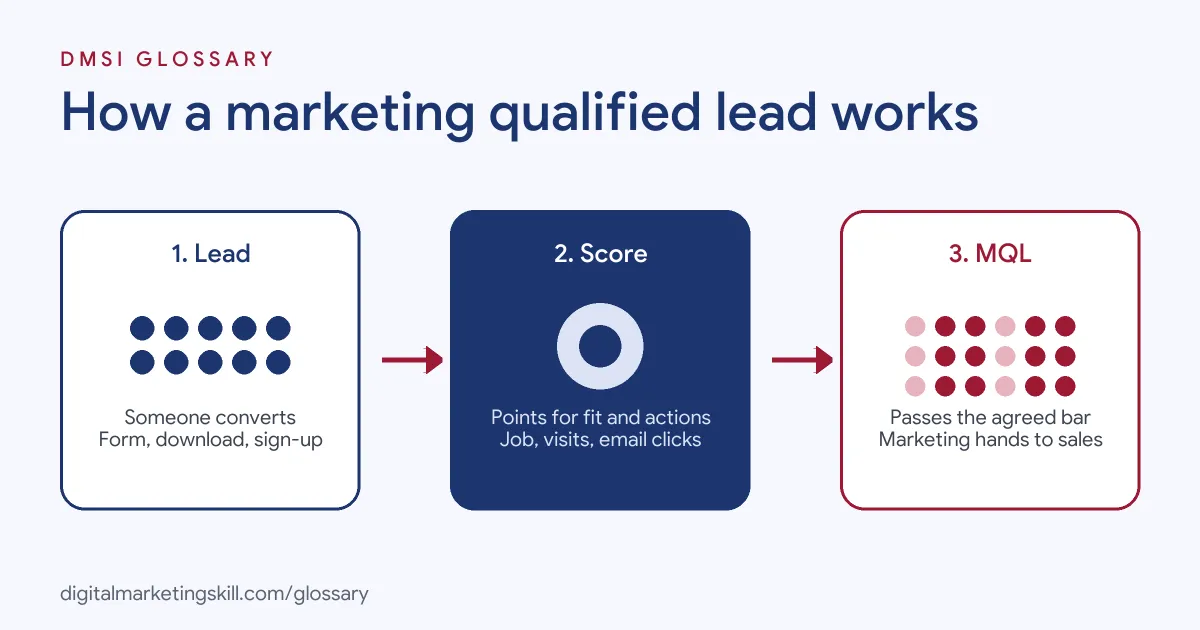
An MQL moves through three stages. First, someone becomes a lead by converting on your site. Next, they earn points as you learn more about them. Finally, once they pass your agreed score, marketing hands them to sales.
Lifecycle Stages
Many CRMs track this journey as lifecycle stages. HubSpot’s default order runs subscriber, lead, marketing qualified lead, sales qualified lead, opportunity, customer and evangelist. By default, its automatic updates only move a contact forward, not back. As a result, you can report on how many people reach each stage and how long they stay there.
Lead Scoring
Lead scoring is how most teams decide when someone qualifies. Salesforce describes it as assigning “numerical values or points to leads based on their interactions with your brand.” HubSpot splits scores into two kinds:
- Fit scores use details such as job title, company size or annual revenue.
- Engagement scores use actions such as website visits or email opens.
HubSpot also lets you add score decay. In that case, points from an old action shrink over time, so a lead who went quiet long ago drops back down.
The Handoff to Sales
When a lead reaches the target score, Adobe notes that CRM automation can send it to sales “via an email notification or task.” Then a salesperson follows up. If the lead is a good fit, sales marks it as a sales qualified lead. If not, it goes back to marketing for more nurturing.
Marketing Qualified Lead Examples
Here are three examples of how different businesses might set the bar:
- Software company: A lead works at a firm with over 50 staff, has a manager job title and has visited the pricing page twice. Together, those signals push it over the MQL score.
- Training provider: A lead downloads a course guide, opens three emails in a row and books a call. Because booking a call shows strong intent, it earns the most points.
- Agency: A lead fills in a contact form and gives a company website and a monthly ad budget. The form answers alone are enough to qualify.
In each case, the business decides which signals predict a sale. Then it gives those signals the most weight.
Lead vs MQL vs SQL
These three labels describe how close someone is to buying:
| Stage | What it means | Who owns it |
|---|---|---|
| Lead | Someone who has converted on your site, such as by filling in a form | Marketing |
| Marketing qualified lead | A lead that fits and has engaged enough to meet the agreed bar | Marketing, then handed to sales |
| Sales qualified lead | A lead that sales has checked and accepted as a potential customer | Sales |
In short, marketing qualifies on fit and interest, while sales qualifies on readiness to buy. Salesforce, for example, points sales teams to the BANT checks: budget, authority, need and timeline.
How to Define a Marketing Qualified Lead
A clear definition takes a few steps. Do them with sales in the room, not alone:
- Study past customers. List the job titles, company sizes and industries that bought most often.
- List buying signals. Note the actions those customers took before they bought, such as pricing page visits or demo requests.
- Give each signal points. Strong signals, such as a call booking, earn more than weak ones, such as a single email open.
- Set a threshold. Agree the score at which a lead becomes an MQL.
- Automate the handoff. Set your CRM to alert sales or create a task when a lead passes the bar.
- Review the results. Every month or quarter, check how many MQLs turned into SQLs and customers. Then adjust the points.
How to Measure MQL Performance
Counting MQLs is only the start. To see whether your definition works, track a few numbers side by side:
- MQL volume: how many leads pass the bar each week or month, and from which campaigns.
- MQL to SQL rate: the share that sales accepts. For example, 30 SQLs from 120 MQLs is a 25% rate.
- Time in stage: how long leads sit as MQLs before sales acts. HubSpot records the date each record enters and leaves a stage, so you can report on this.
- MQL to customer rate: the share that ends up buying, which shows the true value of each campaign.
If volume is high but the SQL rate is low, your bar is probably too low. On the other hand, if sales wants more leads and accepts almost all of them, you may be able to lower it.
Best Practices for Marketing Qualified Leads
- Write it down. A shared, written definition prevents arguments about lead quality.
- Mix fit and interest. A keen student with no budget and a perfect buyer who never engages are both poor MQLs.
- Weight high-intent actions. Adobe notes that actions such as visiting a pricing page can trigger the move to MQL.
- Use decay. Old activity shouldn’t keep a lead qualified forever.
- Track the conversion rate. The share of MQLs that become SQLs tells you if your bar is right.
Common Mistakes to Avoid
Teams often go wrong in similar ways. First, they set the bar too low to hit a lead target, so sales ignores the leads. Second, they score only on actions, such as email clicks, and forget fit. Third, they never review the scoring model after launch. Finally, they treat MQL counts as the goal, when sales and revenue are what matter. A smaller number of good leads beats a large pile of weak ones.
Where You’ll Use Marketing Qualified Leads at Work
MQLs come up often in lead generation and marketing operations roles. For example, remote job listings ask candidates to:
- “define MQL scoring and lead lifecycle logic” (Sr. Marketing Operations Manager).
- “Maintain lead scoring, lifecycle stages, and MQL handoff logic, and QA them on a regular cadence” (Marketing Operations Manager).
- “define, defend and improve MQL criteria, scoring, routing, handoffs, SLAs and pipeline commitments” (B2B Demand Generation Leader).
So in roles such as Lead Generation Specialist or Marketing Automation Specialist, you will build scoring rules, report on MQL numbers and work closely with sales.
Learn It in the Lead Generation Track
You can learn how a marketing qualified lead is won in the AI-Powered Lead Generation and Email Automation track. There, you build a lead magnet and an automated email sequence that converts, which is how most MQLs start. You also work on a U.S. Project Internship from day one, with unlimited 1-on-1 mentoring.
Want to turn more of those leads into customers? Read our guide to lead conversion strategies, or start with the basics of lead generation.
Frequently Asked Questions
What is a marketing qualified lead in simple terms?
It is a lead that marketing thinks is ready to talk to sales. It fits your target customer and has shown enough interest, such as visiting your pricing page.
What is the difference between an MQL and an SQL?
Marketing decides who is an MQL, based on fit and engagement. Sales then checks the lead and, if it is ready to buy, marks it as an SQL.
How do you score an MQL?
Give points for fit, such as job title or company size, and for actions, such as visits or email clicks. A lead becomes an MQL when it passes your agreed score.
What is a good MQL to SQL conversion rate?
It varies by business. Salesforce cites a Gartner figure that just 21% of MQLs become SQLs, so use your own history as the benchmark and aim to improve it.
Who decides what counts as an MQL?
Marketing usually sets the rules, but sales should agree to them. Otherwise, sales may reject the leads marketing sends over.
Sources: HubSpot Knowledge Base: Use lifecycle stages; HubSpot Knowledge Base: Lead scoring tool; Adobe: MQL vs SQL; Salesforce: MQL vs SQL; remote job listings on Himalayas.